

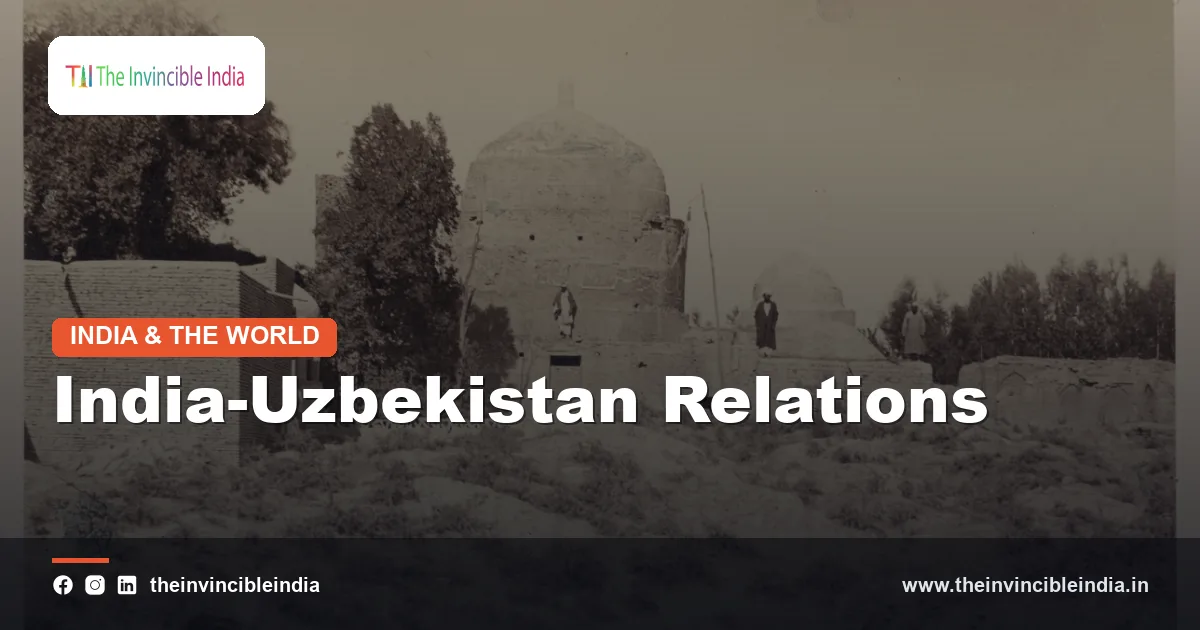
India-Uzbekistan relations are the diplomatic, economic, cultural and strategic ties between the Republic of India and the Republic of Uzbekistan, a doubly landlocked country at the centre of Central Asia, and they rest on centuries of shared history along the Silk Road. The relationship was formalised after Uzbekistan became independent from the Soviet Union in 1991 and was raised to the level of a strategic partnership in 2011.
Today India-Uzbekistan relations cover political dialogue, defence exercises, pharmaceuticals, information technology, textiles, education, energy and connectivity projects. This guide explains how the partnership developed, what each country seeks from it, and which challenges still limit its growth. It was last reviewed on 16 October 2026.
| Attribute | Details |
|---|---|
| Countries | Republic of India and Republic of Uzbekistan |
| Diplomatic relations established | 1992, following Uzbekistan’s independence in 1991 |
| Level of partnership | Strategic partnership, announced in 2011 |
| Capitals | New Delhi and Tashkent |
| Historical link | Babur, founder of the Mughal Empire, was born in Andijan in the Fergana Valley in 1483 |
| Main multilateral platforms | Shanghai Cooperation Organisation (SCO), India-Central Asia Dialogue, India-Central Asia Summit |
| Defence cooperation | Joint army exercise “Dustlik” and regular defence consultations |
| Key sectors | Pharmaceuticals, information technology, textiles, education, health, energy, connectivity |
| Connectivity routes discussed | Chabahar port in Iran and the International North-South Transport Corridor (INSTC) |
Key Takeaways
- India-Uzbekistan relations formally began in 1992, after Uzbekistan emerged as an independent state following the dissolution of the Soviet Union in 1991.
- India and Uzbekistan upgraded their relationship to a strategic partnership in 2011, and both governments have since expanded dialogue on security, trade and technology.
- Babur, the founder of the Mughal Empire in India in 1526, was born in Andijan in present-day Uzbekistan, which gives the two countries a shared historical heritage.
- Uzbekistan has no coastline and no direct land border with India, so Indian trade with Uzbekistan depends on corridors through Iran, Afghanistan or other transit countries.
- Chabahar port in Iran and the International North-South Transport Corridor are the main connectivity projects that India and Uzbekistan have discussed for reaching each other’s markets.
- Cooperation between India and Uzbekistan is strongest in pharmaceuticals, information technology, medical education, textiles and capacity building, and total trade remains modest compared with its potential.
What is the historical background of India-Uzbekistan relations?
The historical background of India-Uzbekistan relations lies in the Silk Road, the network of land routes through which merchants, scholars, soldiers and pilgrims moved between the Indian subcontinent and Central Asia for more than two thousand years. Cities such as Samarkand, Bukhara, Tashkent and Termez were important stops on these routes, and Indian textiles, spices and ideas travelled north while horses, fruit and craftsmen came south.
Buddhism is part of this story. The region around Termez in southern Uzbekistan was a notable centre of Buddhist learning and art in the early centuries of the common era, and archaeological remains there reflect links with Gandhara and the wider Kushan world. The conquests of Timur (Tamerlane) from Samarkand in the late fourteenth century also reached northern India, and the court culture of the Timurid dynasty shaped what later became Mughal culture.
Indian merchants and moneylenders were also present in Central Asian trading towns for centuries. Their presence in Bukhara and neighbouring cities was recorded by travellers, and the Persian language, architecture and cuisine of the Mughal courts show how closely the two regions were interwoven.
Why is Babur important to India-Uzbekistan relations?
Babur is important to India-Uzbekistan relations because the founder of the Mughal Empire was born in 1483 in Andijan, a city in the Fergana Valley of present-day Uzbekistan, and his story links Indian and Uzbek history directly. Babur was a descendant of Timur on his father’s side and of Genghis Khan through his mother, and he spent his early years trying to hold and recapture Samarkand.
After losing the contest for Samarkand to rival rulers, Babur moved to Kabul and then, in 1526, defeated the Delhi Sultanate ruler Ibrahim Lodi at the First Battle of Panipat. That victory started the Mughal rule in India, which lasted in various forms until the nineteenth century. Babur wrote his memoir, the Baburnama, in Chagatai Turkic, and it is regarded as an important primary source for the geography, plants, animals and people of Central Asia and northern India.
Uzbekistan honours Babur as a cultural figure, and Indian leaders visiting the country have often referred to him as a bridge between the peoples. Heritage, tourism and academic exchanges linked to Babur and the Timurid era remain a regular theme of cultural diplomacy between the two states.
When did India and Uzbekistan establish diplomatic relations?
India and Uzbekistan established diplomatic relations in 1992, soon after Uzbekistan declared independence on 1 September 1991 following the breakup of the Soviet Union. India had a long history of dealing with Tashkent when it was part of the Soviet Union, and the Indian Embassy in Tashkent became active in the early 1990s.
One historical episode connects India and Tashkent in a lasting way. In January 1966, Indian Prime Minister Lal Bahadur Shastri and Pakistani President Ayub Khan signed the Tashkent Declaration in the city under Soviet mediation to end the 1965 conflict, and Shastri died there soon after. A memorial and statue in Tashkent are associated with him, and the episode is often recalled in bilateral speeches.
Following independence, Uzbek President Islam Karimov visited India in the 1990s, and political contacts grew steadily. The two countries signed agreements on trade, culture, double taxation and science, and the Indian Technical and Economic Cooperation (ITEC) programme began training Uzbek officials and professionals.
How did the 2011 strategic partnership change India-Uzbekistan relations?
The 2011 strategic partnership gave India-Uzbekistan relations a formal framework for regular consultations on politics, security, trade and technology. It was announced during a visit by Uzbek President Islam Karimov to New Delhi in 2011, and it recognised that the two countries share interest in a stable, secure and prosperous Central Asia and Afghanistan.
The framework led to several institutional mechanisms, including a joint commission on trade and economic cooperation, foreign office consultations and a joint working group on counter-terrorism. After Shavkat Mirziyoyev became President of Uzbekistan in 2016, the relationship gained fresh momentum. Prime Minister Narendra Modi visited Uzbekistan in 2015 during a tour of Central Asian states, and President Mirziyoyev visited India in 2018 and attended the Vibrant Gujarat summit in January 2019.
Both sides have also met at the Shanghai Cooperation Organisation, which Uzbekistan hosted in Tashkent in 2016 and in Samarkand in 2022. India became a full SCO member in 2017, which made it a regular partner of Uzbekistan in a multilateral forum as well as a bilateral one.
What role does the India-Central Asia framework play?
The India-Central Asia framework gives India a structured dialogue with Uzbekistan, Kazakhstan, Kyrgyzstan, Tajikistan and Turkmenistan together, and Uzbekistan is one of its most active participants. India’s “Connect Central Asia” policy, announced in 2012, set the broad aim of strengthening political, economic, cultural and security links with the region.
The India-Central Asia Dialogue at the level of foreign ministers first met in Samarkand in January 2019. The first India-Central Asia Summit was held virtually in January 2022, bringing the heads of state of all five Central Asian republics and the Indian Prime Minister into one meeting. A second format of in-person summitry and ministerial meetings has been discussed since then, along with a business council and a secretariat to follow up decisions.
Within this multilateral structure, Uzbekistan acts as one of the largest and most economically diverse Central Asian states. As the most populous country in Central Asia, it offers India a large market, a skilled workforce and a central geographic position in the region.
How does connectivity through Chabahar and the INSTC affect India-Uzbekistan relations?
Connectivity through Chabahar port and the International North-South Transport Corridor (INSTC) affects India-Uzbekistan relations because Uzbekistan is doubly landlocked and India has no direct land route to it, so both countries need transit corridors to trade at scale. Chabahar is a port on Iran’s Makran coast outside the Persian Gulf, and India has developed a terminal there as an alternative route to Afghanistan and Central Asia.
The INSTC is a multi-modal network of ship, rail and road routes, agreed in 2000 by India, Iran and Russia, that is designed to link the Indian Ocean and the Persian Gulf with the Caspian Sea, Russia and northern Europe. Central Asian countries, including Uzbekistan, have explored joining or using these routes, and Uzbekistan has taken part in discussions about the Ashgabat Agreement, a transit and transport agreement that India joined in 2018.
The practical challenges are considerable. Goods moving between India and Uzbekistan must pass through several customs regimes, different rail gauges and uncertain regional security conditions, and costs have to compete with existing shipping routes. For this reason, officials from both sides frequently discuss simplified customs procedures, joint logistics ventures and alternative rail links through Afghanistan or Iran as long-term options.
What does India-Uzbekistan defence and security cooperation involve?
India-Uzbekistan defence and security cooperation involves regular military exercises, training exchanges, consultations on counter-terrorism and joint work on regional stability, with the army exercise called “Dustlik” as the best-known example. The name means “friendship” and the exercise has been held alternately in each country since 2019, focusing on counter-terrorism and operations in mountainous or desert terrain.
Both governments share concern about extremism, drug trafficking and instability in Afghanistan, which borders Uzbekistan to the south. The Joint Working Group on Counter-Terrorism and defence ministry consultations provide the channel for exchanging assessments, and Indian military institutions offer training slots to Uzbek officers. Cooperation within the SCO’s Regional Anti-Terrorist Structure, which has its headquarters in Tashkent, also keeps the two sides in contact.
Defence trade has been small, but Indian companies have shown interest in supplying training equipment, spare parts and services. Both countries describe the relationship as one that does not target any third country, and they frame security cooperation as a contribution to regional stability.
Which economic sectors drive trade between India and Uzbekistan?
Pharmaceuticals, information technology, textiles and agricultural products are the main economic sectors driving trade between India and Uzbekistan, although the total value of trade has generally been modest, in the range of a few hundred million US dollars a year. India exports medicines, machinery, tea, spices and chemicals, while Uzbekistan sells cotton-based goods, fertilisers, fruits, nuts and some services to India.
Indian pharmaceutical companies have been present in the Uzbek market for decades, and Uzbekistan has invited Indian firms to set up joint production units in its pharmaceutical parks. Quality standards and regulatory oversight have received attention from both governments, with cooperation on testing, licensing and the exchange of regulatory experience. Medical tourism and education also matter, as many Indian students study medicine at universities in Uzbekistan.
The Uzbek government has designated IT parks and special economic zones where Indian software companies can operate, and India’s lines of credit have supported projects in areas such as information technology and infrastructure. Uzbekistan’s large textile industry, built on its cotton production, also looks for Indian machinery, design and market access.
Summary of sectors
| Sector | India’s role | Uzbekistan’s role |
|---|---|---|
| Pharmaceuticals | Supplier of medicines and manufacturing know-how | Growing market and host of pharmaceutical parks |
| Information technology | Software firms, training and IT services | IT parks, digital policy and young workforce |
| Textiles | Machinery, design and large consumer market | Cotton producer and textile manufacturer |
| Education | ITEC and ICCR scholarships, training institutes | Medical universities attracting Indian students |
| Energy | Importer interested in diversified supply, including civil nuclear cooperation | Holder of gas, hydrocarbon and uranium resources |
| Agriculture | Technology, food processing and a large consumer base | Fruit, nut and vegetable exports |
What is the status of energy and uranium cooperation?
Energy cooperation between India and Uzbekistan is at an exploratory stage focused on hydrocarbons, power equipment and the possibility of civil nuclear cooperation, since Uzbekistan holds uranium deposits and has an established mining industry. India’s nuclear programme needs a diversified supply of fuel, and Central Asia, particularly Kazakhstan, has already been an important source.
The two governments have discussed cooperation in the peaceful uses of nuclear energy, along with possible cooperation in oil and gas exploration, solar power and hydropower equipment. Announcements in these fields are often framed as areas of mutual interest, and concrete large-scale supply contracts have been fewer than the number of statements of intent.
Observers also point out that Uzbekistan has been modernising its own power sector and looking at renewable energy, including solar and wind projects with international investors. Indian companies in power equipment, engineering services and renewable energy see openings, although competition from Chinese, Russian, Gulf and Turkish firms is strong.
How does development assistance and capacity building work?
Development assistance and capacity building between India and Uzbekistan work mainly through lines of credit, grant projects and training programmes offered by the Government of India. The Indian Technical and Economic Cooperation (ITEC) programme and scholarships from the Indian Council for Cultural Relations (ICCR) have trained thousands of professionals and students from Central Asia over the years.
India has extended lines of credit for projects in Uzbekistan, including those in infrastructure, information technology and social sectors, and has supported the setting up of IT and training centres. Hindi and Indian studies are taught in Tashkent at institutions such as the Tashkent State University of Oriental Studies, and Indian classical dance, yoga and Bollywood films are popular among Uzbek audiences.
The Indian side also stresses what it calls development partnership that is demand-driven and does not impose conditions. Uzbek authorities have expressed interest in Indian experience on digital public infrastructure, such as digital payments and identity systems, as part of their own economic modernisation.
What challenges and opportunities does the relationship face?
The main challenge for India-Uzbekistan relations is the lack of direct overland connectivity, which raises transport costs and keeps bilateral trade well below its potential. Uncertainty in Afghanistan, sanctions affecting Iran, competition from larger regional economies and differences in regulation and financing add further difficulty.
At the same time, several opportunities exist. Uzbekistan’s population is young and growing, its economy has been opening since 2016, and its government has been seeking diversified partners. India offers a large market, a services-led economy, pharmaceutical capacity and a track record of capacity building. Possible areas of growth include digital payments, medical and educational exchanges, agricultural processing, tourism, and joint production for third markets.
Cultural tourism can also help, because Indians increasingly travel to Samarkand, Bukhara and Khiva, and direct flights between Indian cities and Tashkent have supported contact between people. Easier visas, language training and business forums are the practical steps most often mentioned.
Bottom Line
India-Uzbekistan relations combine a deep shared heritage, from Babur and the Timurids to the Silk Road, with a modern partnership built since 1992 and formalised in 2011. The relationship is friendly and steadily broadening, but its economic depth depends on solving connectivity through Chabahar, the INSTC and other routes.
Frequently Asked Questions
What is the nature of India-Uzbekistan relations?
India-Uzbekistan relations are friendly and cooperative, and they are formally described as a strategic partnership. The partnership covers political dialogue, defence exercises, trade, education, culture and regional security, and it is supported by shared historical links such as Babur’s birth in Andijan.
When was India-Uzbekistan strategic partnership established?
The strategic partnership between India and Uzbekistan was announced in 2011, during a visit by the then Uzbek President Islam Karimov to New Delhi. Diplomatic relations themselves were established earlier, in 1992, after Uzbekistan became independent in 1991.
Does India have a direct land route to Uzbekistan?
India does not have a direct land route to Uzbekistan, because Afghanistan, Pakistan and other countries lie between them. Trade must move through corridors such as Chabahar port in Iran and the International North-South Transport Corridor, or by air, which makes connectivity a central issue in the relationship.
What is the Dustlik exercise between India and Uzbekistan?
Dustlik is a joint military exercise between the Indian Army and the Uzbek armed forces, and the word means friendship. It has been held alternately in the two countries since 2019 and concentrates on counter-terrorism and operations in difficult terrain.
Which sectors are important for India-Uzbekistan trade?
Pharmaceuticals, information technology, textiles, education and agricultural products are the key sectors in trade between India and Uzbekistan. India sells medicines, machinery and chemicals, while Uzbekistan supplies cotton goods, fertilisers, fruits and nuts, and the total value of trade is modest.
How is Babur connected to Uzbekistan?
Babur, the founder of the Mughal Empire, was born in Andijan in the Fergana Valley of present-day Uzbekistan in 1483. He tried to rule Samarkand before moving to Kabul and then India, where he won the First Battle of Panipat in 1526 and began Mughal rule.
{“@context”:”https://schema.org”,”@graph”:[{“@type”:”FAQPage”,”mainEntity”:[{“@type”:”Question”,”name”:”What is the nature of India-Uzbekistan relations?”,”acceptedAnswer”:{“@type”:”Answer”,”text”:”India-Uzbekistan relations are friendly and cooperative, and they are formally described as a strategic partnership. The partnership covers political dialogue, defence exercises, trade, education, culture and regional security, and it is supported by shared historical links such as Babur’s birth in Andijan.”}},{“@type”:”Question”,”name”:”When was India-Uzbekistan strategic partnership established?”,”acceptedAnswer”:{“@type”:”Answer”,”text”:”The strategic partnership between India and Uzbekistan was announced in 2011, during a visit by the then Uzbek President Islam Karimov to New Delhi. Diplomatic relations themselves were established earlier, in 1992, after Uzbekistan became independent in 1991.”}},{“@type”:”Question”,”name”:”Does India have a direct land route to Uzbekistan?”,”acceptedAnswer”:{“@type”:”Answer”,”text”:”India does not have a direct land route to Uzbekistan, because Afghanistan, Pakistan and other countries lie between them. Trade must move through corridors such as Chabahar port in Iran and the International North-South Transport Corridor, or by air, which makes connectivity a central issue in the relationship.”}},{“@type”:”Question”,”name”:”What is the Dustlik exercise between India and Uzbekistan?”,”acceptedAnswer”:{“@type”:”Answer”,”text”:”Dustlik is a joint military exercise between the Indian Army and the Uzbek armed forces, and the word means friendship. It has been held alternately in the two countries since 2019 and concentrates on counter-terrorism and operations in difficult terrain.”}},{“@type”:”Question”,”name”:”Which sectors are important for India-Uzbekistan trade?”,”acceptedAnswer”:{“@type”:”Answer”,”text”:”Pharmaceuticals, information technology, textiles, education and agricultural products are the key sectors in trade between India and Uzbekistan. India sells medicines, machinery and chemicals, while Uzbekistan supplies cotton goods, fertilisers, fruits and nuts, and the total value of trade is modest.”}},{“@type”:”Question”,”name”:”How is Babur connected to Uzbekistan?”,”acceptedAnswer”:{“@type”:”Answer”,”text”:”Babur, the founder of the Mughal Empire, was born in Andijan in the Fergana Valley of present-day Uzbekistan in 1483. He tried to rule Samarkand before moving to Kabul and then India, where he won the First Battle of Panipat in 1526 and began Mughal rule.”}}]}]}


