

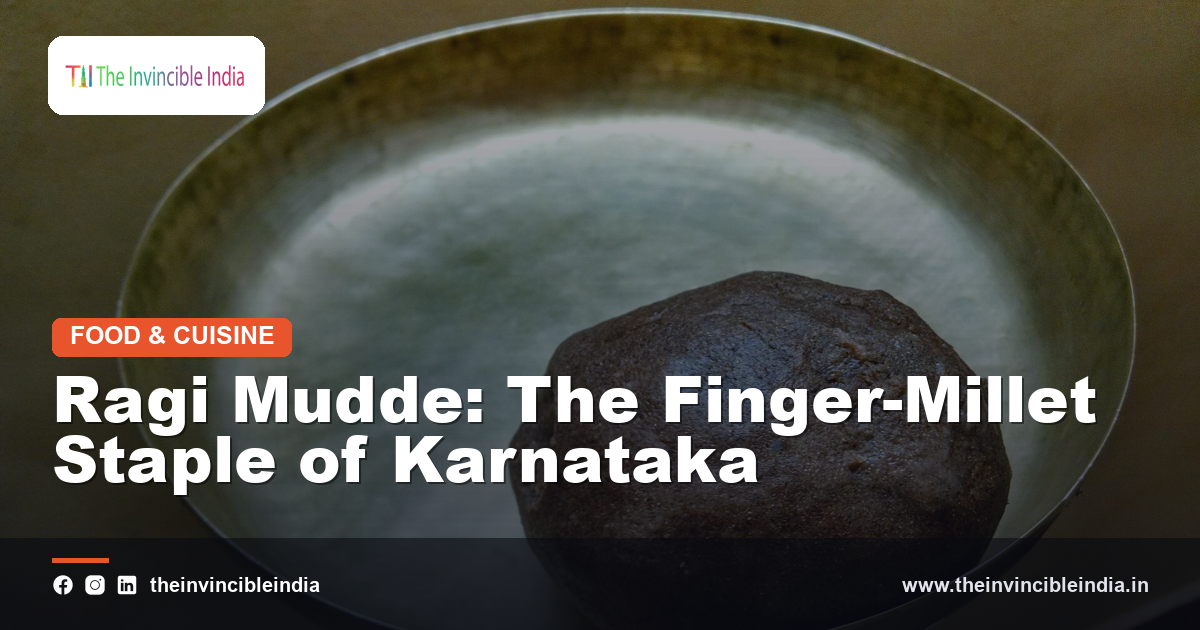
Ragi mudde, also called the ragi ball, finger-millet ball, or ragi sangati in the Telugu-speaking regions, is one of the most enduring staple foods of rural southern India. It is a smooth, dense ball made by cooking finger-millet flour with water until it forms a soft, cohesive mass, which is then shaped by hand and eaten with a soupy accompaniment. Within the wide range of dishes described in our overview of the regional cuisines of India, few foods are as closely tied to daily labour and the land as this one. This guide explains what ragi mudde is, how the grain shapes it, how it is prepared and eaten, and why it remains a symbol of Karnataka village life.
Quick answer: Ragi mudde is a staple food of rural Karnataka and parts of Andhra Pradesh and Telangana, made by cooking finger-millet (ragi) flour with hot water until it forms a thick, smooth dough that is rolled into a ball. It is eaten with sambar, saaru or rasam, or a spicy curry, and is swallowed in small portions rather than chewed. It is valued as a filling, long-lasting, everyday food.
Key Takeaways
- Ragi mudde is a cooked ball of finger-millet (ragi) flour, also known as the ragi ball and as ragi sangati in Telugu areas.
- It is a traditional staple of rural Karnataka and neighbouring parts of Andhra Pradesh and Telangana.
- The ball is made by stirring ragi flour into boiling water until it forms a smooth, dense, dough-like mass.
- It is eaten with a soupy accompaniment such as saaru, sambar, or a spicy meat or vegetable curry.
- Small pieces are pinched off, dipped in the gravy, and swallowed whole rather than chewed.
- Ragi is valued as a hardy millet that gives a filling meal and keeps a worker satisfied for a long time.
Read on for the ingredients, method, serving customs, and cultural role in detail.
Quick Facts
| Detail | Information |
|---|---|
| Dish | Ragi mudde (ragi ball) |
| Type | Cooked millet-flour ball / staple |
| Region | Rural Karnataka, parts of Andhra and Telangana |
| Main ingredient | Finger-millet (ragi) flour |
| Meal | Lunch and dinner staple |
| Taste | Mild, earthy, almost neutral |
| Served with | Saaru, sambar, or spicy curry |
| Eaten by | Swallowing small pieces, not chewing |
| Cultural role | Everyday food of farming households |
What Is Ragi Mudde?
Ragi mudde is a smooth, dense ball of cooked finger-millet flour that serves as a main staple in rural southern India. The flour is stirred into boiling water and cooked until it gathers into a thick, elastic mass, which is then gathered and rolled by hand into a round ball, usually the size of a fist. The ball is dark brown to almost grey in colour, soft to the touch, and mild in taste, so it carries the flavour of whatever it is eaten with. It is served alongside a thin, spiced gravy into which small pieces are dipped. Rather than a dish eaten on its own, ragi mudde is the base of a meal, much as rice or flatbread is elsewhere. Its plain character and filling nature are exactly what have made it a dependable everyday food for generations of working families.
What Is Ragi, the Grain Behind the Dish?
Ragi is the Indian name for finger millet, a hardy cereal grain grown widely across the dry regions of southern India and recognised by its small, round, reddish-brown seeds. The plant tolerates poor soil and uneven rainfall, which is why it has long been a dependable crop for farmers who cannot rely on irrigation. The grain is milled into a fine flour that is dark in colour and has a mild, earthy taste. Ragi is also known as finger millet in English, nachni in several northern and western languages, and keppai or kezhvaragu in Tamil. For ragi mudde, the whole-grain flour is used, which gives the ball its characteristic colour and density. Because the grain stores well and grows reliably, it became a cornerstone of rural food security. Understanding the grain is the first step to understanding why the dish is so deeply rooted in village life.
What Are the Other Names of Ragi Mudde?
Ragi mudde is known by several names across the regions where it is eaten, the most common being the ragi ball in English and ragi sangati in the Telugu-speaking areas. In Kannada the word mudde simply means a lump or ball, so ragi mudde literally describes a ball of ragi. In parts of Andhra Pradesh and Telangana a similar preparation is called sangati, though sangati is often made with a mix of ragi and cooked rice. In Tamil Nadu a related dish made from finger millet is known as kezhvaragu kali or ragi kali. These names all point to the same idea of a cooked, hand-shaped mass of millet. The spread of the dish under different names reflects how the grain is shared across the southern states. Recognising these names helps in identifying the same humble food wherever it appears on a regional table.
Where Does Ragi Mudde Come From?
Ragi mudde comes from the dry interior regions of southern India, especially the southern and eastern districts of Karnataka, where finger millet has been cultivated for a very long time. The dish is firmly associated with farming and rural households, where ragi was often easier to grow than rice. It is also eaten in neighbouring parts of Andhra Pradesh and Telangana, where it appears as sangati. No single inventor or exact date is recorded for the dish, and it is best understood as a food that grew naturally out of the crops a region could sustain. Because ragi was affordable and filling, the ball became the daily food of labourers, farmers, and families of modest means. Its origin lies in necessity and local agriculture rather than in any courtly or ceremonial tradition, which is part of why it carries such strong associations with ordinary working life.
What Ingredients Go Into Ragi Mudde?
Ragi mudde needs only two essential ingredients: finger-millet flour and water, with a pinch of salt and sometimes a little cooked rice added. The simplicity of the dish is central to its character, since it was designed as an affordable staple rather than a rich preparation. Some cooks add a small amount of cooked rice or rice flour to the ragi, which makes the ball softer and easier to shape, a practice especially common in the sangati of the Telugu regions. A little salt is usually stirred into the water, and a spoon of oil or ghee may be used to help bind the dough and keep it from sticking. Beyond these, nothing else goes into the ball itself, because all the flavour comes from the accompaniment. The short ingredient list means that the quality of the ragi flour and the technique of cooking matter far more than any elaborate addition.
How Is Ragi Mudde Made?
Ragi mudde is made by boiling water, stirring in the finger-millet flour, and cooking the mixture while stirring vigorously until it forms a smooth, thick mass that is then shaped into a ball. Water is brought to a rolling boil with a little salt, and a small amount of the flour may first be mixed into cold water to make a slurry that prevents lumps. The rest of the flour is added to the boiling water, and the mixture is stirred hard with a sturdy stick or ladle, often called a mudde kolu, until no dry flour remains and the dough pulls together. The pan is covered and left to cook on low heat for a few minutes so the flour cooks through. The hot dough is then gathered and rolled quickly between a wet bowl or wet hands into a smooth ball. The stirring is the demanding part and requires both strength and timing.
Why Is Ragi Mudde Swallowed Rather Than Chewed?
Ragi mudde is traditionally swallowed in small pieces rather than chewed because the dough is smooth and cohesive and is meant to slip down easily when dipped in gravy. Diners pinch off a bite-sized portion, press a small dent into it with the thumb, dip it in the saaru or curry so the gravy fills the hollow, and then swallow the piece whole. This way of eating is part of the custom and is often seen as the proper method, since chewing a plain ball of millet would release little flavour. Swallowing also allows a working person to eat a filling meal quickly. Newcomers to the dish sometimes find the practice unusual, but it is deeply embedded in the eating culture of the region. The method shows how the food and its accompaniment are designed to work together, with the gravy doing the work of flavour that the mild ball cannot.
What Is Ragi Mudde Served With?
Ragi mudde is served with a soupy or spicy accompaniment, most commonly a thin lentil-and-vegetable gravy called saaru or huli, a sambar, or a spicy meat curry. In many Karnataka households the ball is paired with bassaru, a flavourful broth made from boiled greens and lentils, or with a fiery mutton or country-chicken curry known for its heat. Vegetarian versions are eaten with sambar, rasam-like saaru, or a simple soppu saaru made from leafy greens. A dollop of ghee or a spoon of oil is sometimes added for richness. The gravy is always more liberally seasoned than the ball, because it carries all the flavour of the meal. The pairing of a plain, filling staple with a boldly spiced liquid is a pattern seen across the region, and it reflects the same logic found in the structure of a balanced Indian thali.
What Is the Place of Ragi Mudde in a Karnataka Meal?
Ragi mudde holds the central place in many rural Karnataka meals, taking the role that rice or flatbread plays elsewhere as the main source of bulk and energy. A typical meal pairs one or two balls with a bowl of saaru or curry, perhaps a side of greens, and a little pickle or chutney. For farmers and labourers it is most often the midday or evening meal, eaten after work in the fields, because it provides a lasting feeling of fullness. In many households it is cooked fresh for each meal, since the ball is best eaten warm. Urban families with rural roots often return to ragi mudde as a comforting link to their background. Its position in the meal is not decorative but functional, serving as the foundation around which the rest of the plate is arranged, much like the staples at the heart of other regional cuisines.
How Does Ragi Mudde Differ Across Regions?
Ragi mudde varies across the regions where it is eaten, mainly in the proportion of other grains added and the accompaniments served with it. In the heartland of southern Karnataka it is usually made from pure ragi flour, giving a dark, dense ball. In the Telugu-speaking regions the version called sangati often combines ragi with cooked rice, producing a softer, paler ball that is easier for some people to eat. In parts of Tamil Nadu the finger-millet preparation known as ragi kali may be slightly thinner in texture. The gravies also differ: bassaru and country-style meat curries are common in Karnataka, while the Telugu regions may serve sangati with a spicy chutney or a chilli-and-garlic paste called roti pachadi. These differences reflect local crops, tastes, and traditions, yet the core idea of a cooked millet ball eaten with a flavourful accompaniment remains the same throughout.
Is Ragi Mudde Considered Nutritious?
Ragi mudde is traditionally regarded as a wholesome, sustaining food, and finger millet has long been valued in rural kitchens as a hardy grain that keeps a worker satisfied through a day of labour. Ragi is widely described as a good source of dietary fibre and minerals, and it is often spoken of as a grain suited to those who need steady, lasting energy. Because the ball is cooked with only water and salt and eaten with a vegetable or lentil gravy, the meal as a whole is simple and modest in richness. These views reflect long household experience and general understanding rather than precise nutritional measurement. Anyone with particular dietary needs should treat such descriptions as traditional wisdom rather than exact claims. What can be said with confidence is that ragi mudde turns an inexpensive, reliably grown grain into a filling meal, which is itself a mark of practical food sense.
What Role Does Ragi Mudde Play in Rural Life?
Ragi mudde plays a central role in the rhythm of rural life in Karnataka, where it has fed farming families through generations of fieldwork. Because the grain grows in dry conditions and the dish is cheap and filling, it became the everyday food of those whose work demanded energy and endurance. The ball is easy to prepare in quantity, keeps a person full for long hours, and needs no special equipment beyond a pot and a sturdy stirring stick. For many older people it recalls childhood meals eaten with the whole family, and it carries a sense of belonging to the soil. Even as diets change, the dish remains a point of pride and identity for rural communities and for people who have moved to cities but keep their village food traditions. In this way ragi mudde is more than nourishment; it is woven into the social fabric of the countryside.
How Is Ragi Mudde Eaten by Hand?
Ragi mudde is eaten entirely by hand, following a practised method that turns the plain ball and its gravy into an efficient, satisfying meal. A piece is broken from the ball with the fingers of the right hand, gently rolled into a small bite, and pressed with the thumb to make a shallow cup. This hollow is dipped into the saaru or curry so that it holds a little of the liquid, and the whole piece is then swallowed without chewing. Diners usually keep the ball on one side of the plate and the gravy in a bowl or a well in the centre. The skill of taking neat, even pieces and dipping them cleanly is learned in childhood and performed without thought by those raised on the dish. Eating by hand in this way is considered the natural and respectful method, and it allows the diner to judge the warmth and softness of each bite.
What Are Common Mistakes When Making Ragi Mudde?
The most common mistakes in making ragi mudde are forming lumps, under-cooking the flour, and failing to stir the dough hard enough. Lumps occur when the flour is added too quickly to the boiling water without being stirred in steadily, which is why many cooks first make a thin slurry or sprinkle the flour gradually. Under-cooked ragi tastes raw and can feel gritty, so the covered dough must be left on low heat long enough for the flour to cook through. Insufficient stirring leaves the mass uneven and difficult to shape, since the dough needs vigorous mixing to become smooth and elastic. Using too much water makes the ball too soft to hold, while too little makes it dry and hard. Shaping the hot dough quickly, with wet hands or a wet bowl, prevents sticking and cracking. Avoiding these errors takes practice, but the result is a smooth, well-cooked ball that holds together cleanly.
What Does Ragi Mudde Mean Culturally?
Ragi mudde carries strong cultural meaning in Karnataka as a symbol of rural roots, hard work, and simple, honest food. It is often spoken of with affection and pride by those whose families grew up on it, and it features in folk songs, sayings, and everyday conversation as shorthand for the food of the land. Unlike elaborate festival sweets or rich celebratory dishes, ragi mudde is admired precisely for its plainness and for the strength it is believed to give. It appears in traditional restaurants and at gatherings that celebrate regional heritage, where it is served as a mark of authenticity. For many people the dish is tied to memories of grandparents, fields, and the taste of home. This emotional weight, attached to such a humble preparation, shows how deeply a staple food can become part of a community’s sense of who it is.
Ragi Mudde Today
Ragi mudde today remains a beloved staple in rural Karnataka while also gaining new attention in cities and among those interested in traditional grains. As millets are increasingly valued for their hardiness and wholesome reputation, the dish has moved from village kitchens onto the menus of restaurants that celebrate regional and heritage food. Urban families with rural backgrounds continue to prepare it at home, and it is often served at cultural events as a proud emblem of Karnataka cuisine. Convenience products such as ready ragi flour have made it easier to prepare, though the method of stirring and shaping the ball has hardly changed. Younger people are rediscovering the dish both for its taste and for its link to local farming traditions. Its enduring presence shows how a simple ball of finger millet, born of necessity, can remain a living and respected part of a region’s food culture.
Sources & Further Reading
- Ministry of Culture, Government of India (indiaculture.gov.in).
- Ministry of Tourism, Government of India (incredibleindia.gov.in).
Frequently Asked Questions
What is ragi mudde?
Ragi mudde is a staple food of rural Karnataka made by cooking finger-millet (ragi) flour with hot water until it forms a smooth, dense ball. It is eaten with a soupy accompaniment such as saaru, sambar, or a spicy curry. Small pieces are dipped in the gravy and swallowed whole rather than chewed.
What is ragi called in English?
Ragi is called finger millet in English. It is a hardy cereal grain with small reddish-brown seeds that grows well in dry regions. It is also known as nachni in several Indian languages and as kezhvaragu in Tamil.
Why is ragi mudde swallowed and not chewed?
Ragi mudde is swallowed because the dough is smooth and cohesive and is meant to slip down easily after being dipped in gravy. Diners pinch off a small piece, make a hollow with the thumb, fill it with saaru or curry, and swallow it whole. Chewing a plain millet ball would release little flavour, so the gravy provides the taste.
What is ragi mudde eaten with?
Ragi mudde is eaten with a thin, spiced gravy such as saaru or huli, with sambar, or with a spicy meat or vegetable curry. In Karnataka it is often served with bassaru, a broth of greens and lentils, or a fiery country-style meat curry. The ball is mild, so the accompaniment carries the flavour of the meal.
Is ragi mudde the same as sangati?
Ragi mudde and sangati are closely related, but sangati, common in Andhra Pradesh and Telangana, is often made with a mix of ragi and cooked rice. Pure ragi mudde in Karnataka is usually made from finger-millet flour alone. Both are hand-shaped balls eaten with a gravy.
Is ragi mudde considered healthy?
Ragi mudde is traditionally regarded as a wholesome, filling food, and finger millet is widely described as a good source of fibre and minerals. Because the ball is cooked with only water and salt and eaten with a vegetable or lentil gravy, the meal is simple and modest. These are general, traditional views rather than precise nutritional claims.


