

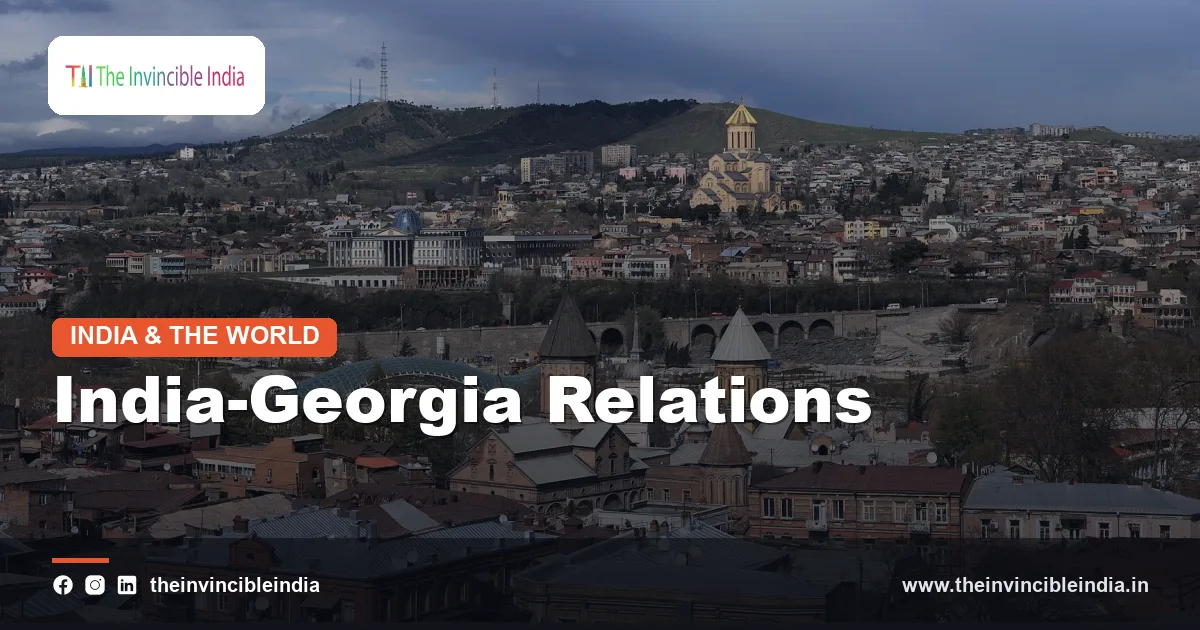
India-Georgia relations are the bilateral diplomatic, cultural, educational and economic ties between the Republic of India and Georgia, a South Caucasus country on the Black Sea whose capital is Tbilisi. Formal diplomatic links date from the early 1990s, soon after Georgia regained independence from the Soviet Union, and they rest on warm people-to-people contact rather than on large trade flows or strategic alliances.
The relationship is best known for a remarkable historical thread: the relics of Saint Queen Ketevan of Georgia, martyred in Persia in 1624, were traced to Old Goa in the early 2000s and a portion was returned to Georgia. Today the ties also include thousands of Indian students in Georgia, a steady rise in Indian tourists, and cooperation at the United Nations and other multilateral forums.
| Attribute | Details |
|---|---|
| Countries | Republic of India and Georgia (Sakartvelo) |
| Diplomatic relations | Established in the early 1990s, after Georgia’s independence from the Soviet Union |
| Georgian capital | Tbilisi, on the Kura (Mtkvari) river |
| Indian ministry in charge | Ministry of External Affairs (MEA) |
| Defining historical link | Relics of Saint Queen Ketevan, discovered in Old Goa and partly returned to Georgia |
| Largest people-to-people channel | Indian students, especially in medicine, and a growing tourist flow |
| Trade character | Modest in volume; India sends pharmaceuticals, machinery and tea, Georgia sends wine, mineral water and metals |
| Connectivity context | Black Sea ports and the Middle Corridor linking Central Asia to Europe |
| Multilateral overlap | Both are members of the United Nations and engage in the UN system |
Key Takeaways
- India-Georgia relations began formally in the early 1990s, after Georgia became an independent state following the dissolution of the Soviet Union.
- The relics of Saint Queen Ketevan of Georgia, who was martyred in Persia in 1624, were identified in Old Goa, India, in the early 2000s, and a portion was returned to Georgia.
- Georgia is a popular destination for Indian students, particularly those pursuing medical degrees, which makes education the most visible link between the two countries.
- Trade between India and Georgia is modest, and both governments regard connectivity through the Black Sea and the Caucasus as the main route to expanding it.
- India and Georgia cooperate in the United Nations system, and India has generally supported peaceful, law-based resolution of Georgia’s territorial disputes.
- Cultural affinity, including yoga, Indian cinema, cuisine and Georgia’s ancient wine tradition, gives India-Georgia relations a warm public dimension that official statistics do not capture.
What are India-Georgia relations?
India-Georgia relations describe the sum of official contact, trade, education, culture and tourism between two ancient civilisations that sit at opposite ends of a long overland trading world. India lies in South Asia, while Georgia sits where Europe and Asia meet, between the Greater Caucasus mountains and the Black Sea.
The two countries have never been neighbours and have no shared border or major historical rivalry. This absence of friction is a defining feature of India-Georgia relations. Neither side has a bilateral dispute to manage, so ties have grown quietly, led by students, travellers, cultural exchanges and occasional ministerial visits rather than by headline summits.
India’s Ministry of External Affairs (MEA) handles the relationship through its desk dealing with Eurasia and the Caucasus, supported by embassies in each capital. For much of the post-Soviet period, India covered the Caucasus through a limited diplomatic footprint, and the depth of contact has grown gradually as travel and education have expanded.
Where is Georgia and why does it matter to India?
Georgia is a small country in the South Caucasus, bordered by Russia to the north, Turkey and Armenia to the south, Azerbaijan to the east and the Black Sea to the west. Its population is under four million people, and its capital is Tbilisi.
For India, Georgia matters mainly because of geography. The country is a transit link between the Caspian Sea region and the Black Sea, and therefore between Central Asia and Europe. Its Black Sea ports, including Poti and Batumi, give landlocked Caucasus and Central Asian economies an outlet to global shipping. Any Indian effort to reach European and Eurasian markets by land and sea corridors naturally brings Georgia into view.
Georgia is also a candidate for membership of the European Union, has a free-trade agreement with the EU, and maintains separate trade arrangements with several other economies. That network of agreements makes it an attractive manufacturing and re-export base in principle, though Indian business interest has so far been limited.
Who was Saint Queen Ketevan and why is she central to the relationship?
Saint Queen Ketevan was a Georgian queen of the Kakheti kingdom who was tortured and killed in Persia in 1624 for refusing to renounce her Christian faith, and she is venerated as a martyr by the Georgian Orthodox Church. She is one of the best-loved figures in Georgian history and religion, and her story is taught as a symbol of national endurance.
Ketevan was taken captive by the Safavid ruler Shah Abbas I of Persia during the wars that devastated Kakheti in the early seventeenth century. After her death in Shiraz, Augustinian friars who were present in the region took parts of her remains in order to protect them. These friars later carried the relics to Goa, then the capital of Portuguese India, where the Augustinians maintained a large convent. For centuries, the whereabouts of the relics were largely forgotten in Georgia.
This episode gives India-Georgia relations a rare emotional core. A Georgian national saint is connected to an Indian town through the movement of relics along early modern trading and missionary routes. Georgians often cite this link when they speak warmly of India.
How were the Queen Ketevan relics found in Goa?
The relics were found through a joint search led by Georgian researchers in cooperation with Indian archaeologists and the Archaeological Survey of India (ASI), which looked for them in the ruins of the St Augustine convent complex in Old Goa. The convent, abandoned in the nineteenth century and now partly in ruins, is part of the Old Goa heritage area that is inscribed as a UNESCO World Heritage Site.
Georgian historians had read European and Portuguese records describing how Augustinian friars had brought parts of the queen’s body to Goa. Excavations in the early 2000s, backed by Indian authorities, led to the identification of a relic, understood to be a portion of the queen’s arm bone. Georgian and Indian specialists carried out examination, and the find was announced as the probable remains of the martyred queen.
A portion of the relics was then handed over to Georgia in a formal ceremony in the mid-2000s, with participation from both governments and the Georgian Orthodox Church. Public interest in Georgia was intense, and the return became a milestone in the bilateral story. The case is often described as an example of heritage diplomacy, where careful archaeological and historical cooperation yields goodwill between states.
Why the relics still matter
- The find shows that the Portuguese-era Goa had links with Persia and the wider Christian world well beyond the Indian coast.
- It created a lasting channel of Georgian curiosity about India’s history, especially Goa.
- It remains a regular reference in speeches by Indian and Georgian officials describing the depth of historical ties.
What is the timeline of India-Georgia relations?
The timeline of India-Georgia relations runs from medieval and early modern contact through Soviet-era separation to modern diplomacy, and it can be summarised in a few widely known milestones.
| Period | Development |
|---|---|
| Medieval era | Georgian travellers, merchants and chroniclers show awareness of India through Persian and Silk Road trade networks. |
| 1624 | Queen Ketevan is martyred in Persia; her remains are later carried to Goa by Augustinian friars. |
| Soviet period | Georgia is part of the Soviet Union and India deals with it through Moscow; contact is mostly cultural and educational. |
| Early 1990s | Georgia becomes independent and India establishes diplomatic relations. |
| Early 2000s | The Queen Ketevan relics are located in Old Goa after a joint search. |
| Mid-2000s | A portion of the relics is formally returned to Georgia. |
| 2010s onward | Student numbers grow, tourism increases, and each side expands its diplomatic and consular presence. |
How strong is trade between India and Georgia?
Trade between India and Georgia is modest, with annual flows that are small compared with India’s trade with major partners and that vary from year to year. Neither economy is large in the other’s trade basket, and there is no India-Georgia free-trade agreement.
India’s typical exports to Georgia include pharmaceuticals, machinery, vehicles and parts, electrical goods, tea, and some food and agricultural products. Georgia’s exports to India are dominated by metals and ferro-alloys, minerals, mineral water and wine, along with a small range of agricultural goods. Because quantities and values fluctuate, it is safest to describe the trade as limited but diversifiable.
Why trade has stayed small
- Distance and the lack of direct shipping or air cargo links raise costs.
- Georgia’s domestic market is small, with fewer than four million consumers.
- Indian companies have focused on larger markets in Europe, the Gulf, Africa and Southeast Asia.
- Awareness among businesses about the other market is limited.
Pharmaceuticals form an important opportunity. Indian generic medicines are widely used across developing and emerging markets, and Georgia’s healthcare sector is open to imports. Similarly, Indian IT and services firms could reach Georgian clients, although activity is small.
What is the connectivity potential between India and Georgia?
The connectivity potential between India and Georgia lies in linking the Indian Ocean to the Black Sea by combining sea routes, Central Asian rail and road links, and the Caspian crossing known as the Middle Corridor. Georgia sits at the western end of that corridor, which runs from China and Central Asia across the Caspian Sea, through Azerbaijan and into Georgia, and onward to Turkey and Europe.
India has its own connectivity interests in Eurasia, including the International North-South Transport Corridor (INSTC), which links the Indian Ocean ports with Iran, the Caspian region and Russia. Georgia is not formally a member of the INSTC, but it is a neighbour of the countries that are, and some analysts see its Black Sea ports as a complementary route to Europe. The idea of linking Indian goods to European markets through Georgian ports is attractive on paper, though it depends on stable regional conditions, reliable shipping schedules and competitive costs.
Practical enablers
- Direct or connecting air services that shorten travel for students and tourists.
- Customs and trade facilitation arrangements between Indian and Georgian authorities.
- Port, logistics and warehousing partnerships involving private Indian firms.
- Shared digital and payment systems that reduce friction in commerce.
Why do Indian students go to Georgia?
Indian students go to Georgia mainly to study medicine, because Georgian universities offer English-medium medical programmes at fees that many families find lower than private medical colleges in India. Tbilisi and other cities host several universities that teach foreign students, and Indians have become one of the larger groups among them.
The trend is partly explained by the intense competition for medical seats in India. Entrance to government medical colleges through the national entrance test is highly selective, and private seats can be costly. Georgia, like some other countries in the region, offers an alternative route. Students who study abroad must usually clear a screening examination in India before they can practise, which is a regulatory requirement set by Indian authorities.
The student community has several effects on the relationship. It builds personal and family networks across the two countries, creates demand for Indian food and services in Georgian cities, and draws the Indian Embassy into consular and welfare work. Student welfare, quality of education and safety are therefore recurring topics in Indian official engagement with Georgia.
Is Georgia a growing destination for Indian tourists?
Yes, Georgia has become a growing destination for Indian tourists, who are drawn by the mountains, wine regions, old towns, affordable travel and relatively simple visa procedures for visitors. Tbilisi’s historic quarter, the Kazbegi mountain region, the Black Sea resort city of Batumi and the wine district of Kakheti are the best-known attractions.
Georgia’s wine culture is especially distinctive. Wine made in clay vessels called qvevri is recognised by UNESCO as part of humanity’s intangible cultural heritage, and the country makes a strong claim to being among the oldest wine-making regions in the world. Indian travellers also appreciate the country’s cuisine, which includes breads and cheese dishes, dumplings, and walnut-based sauces.
Indian film and television shoots have occasionally used Georgian locations, and Bollywood remains familiar to many Georgians. Wedding and honeymoon tourism, along with group tours, have contributed to the rise. The numbers move with seasons, airline schedules and visa rules, so tourism is best viewed as a rising trend rather than a fixed figure.
How do India and Georgia cooperate at the United Nations?
India and Georgia cooperate at the United Nations through regular consultation, mutual support in elections to UN bodies, and shared positions on issues such as development, climate and peaceful settlement of disputes. Both are long-standing members of the UN, and their delegations meet routinely on the margins of the General Assembly.
Georgia has a particular interest in territorial integrity because of unresolved disputes over the regions of Abkhazia and South Ossetia, and it seeks international backing for its sovereignty. India has generally advocated peaceful, law-based settlement of such disputes and respect for the principles of the UN Charter. Georgia, for its part, has expressed support for India’s aspiration to a larger role in the UN, including a place in an expanded Security Council.
The exact wording of positions varies with the forum and the year, and the relationship remains free of controversy. This measured approach keeps India-Georgia relations stable even as the wider region experiences geopolitical tension.
What cultural and people-to-people ties link India and Georgia?
Cultural and people-to-people ties between India and Georgia include yoga and Ayurveda interest, Indian classical music and dance performances, Indian cinema, Indian restaurants, and academic exchange. The Indian Embassy and cultural bodies promote these links through events such as International Day of Yoga celebrations in Tbilisi.
Interest in Indian languages and philosophy has a long history in Georgian academia. Indology and the study of Sanskrit and Hindi have had a small but real presence at Georgian universities, and scholars have translated Indian literary works into Georgian. Indian festivals and food are visible in the Indian community’s gatherings, which include students, professionals and entrepreneurs.
Both countries also value ancient identity. India has one of the world’s oldest continuous civilisations, while Georgia has its own alphabet, a distinct language family called Kartvelian, and one of the earliest Christian traditions. This shared pride in heritage is a frequent theme in speeches and cultural events.
What is the future outlook for India-Georgia relations?
The future outlook for India-Georgia relations is cautiously positive, with scope to grow trade, connectivity, education, tourism and cultural cooperation. Because there is no history of conflict between the two states, expansion depends mostly on practical steps rather than on resolving disputes.
Several areas stand out for future cooperation:
- Easier air links and visa facilitation to support students and travellers.
- Pharmaceutical, digital and agri-food trade supported by business forums and trade delegations.
- Joint heritage projects, building on the Queen Ketevan episode.
- Collaboration in higher education, including exchange programmes and research partnerships.
- Coordination on connectivity corridors linking the Indian Ocean, the Caspian and the Black Sea.
The main constraints are geography, the small size of Georgia’s market, and the unsettled regional environment around the Caucasus. Even so, the relationship has a base of goodwill that few bilateral ties in Eurasia can match.
Bottom Line
India-Georgia relations are friendly, low-friction and built on people and heritage, from the rediscovery of Queen Ketevan’s relics in Goa to the thousands of Indian students living in Georgia. Trade and connectivity remain the largest untapped areas, and their growth will decide whether the relationship moves from goodwill to substantial partnership. Information on this page reflects well-established facts as of 17 October 2026.
Frequently Asked Questions
When were diplomatic relations between India and Georgia established?
India and Georgia established diplomatic relations in the early 1990s, after Georgia became independent following the dissolution of the Soviet Union. Since then, both countries have maintained diplomatic missions and engaged in regular political and cultural contact.
What is the Queen Ketevan connection between India and Georgia?
The Queen Ketevan connection is the discovery in Old Goa of relics of Saint Queen Ketevan, a Georgian queen martyred in Persia in 1624. Augustinian friars had carried her remains to Goa, and a portion was found there in the early 2000s and later returned to Georgia, which made the episode a lasting symbol of the relationship.
Why do so many Indian students study in Georgia?
Many Indian students study in Georgia because its universities offer English-medium medical degrees at fees that are often lower than those of private medical colleges in India. Students who return must usually pass a screening examination set by Indian authorities before practising, so they should check recognition rules before enrolling.
How big is trade between India and Georgia?
Trade between India and Georgia is modest and varies from year to year. India sends goods such as pharmaceuticals, machinery and tea, while Georgia sends metals, minerals, mineral water and wine, and the two countries do not have a free-trade agreement.
Is Georgia a good travel destination for Indians?
Georgia is a popular and growing travel destination for Indians because of its mountains, wine regions, historic old towns and relatively easy visa procedures for visitors. Travellers should check the current entry rules and flight options before booking, since visa policies and airline routes can change.
Do India and Georgia cooperate at the United Nations?
Yes, India and Georgia cooperate at the United Nations through regular consultations and shared support on many development and peaceful-settlement themes. India has generally favoured law-based resolution of Georgia’s territorial disputes, and Georgia has expressed support for India’s larger role in the UN system.
{“@context”:”https://schema.org”,”@graph”:[{“@type”:”FAQPage”,”mainEntity”:[{“@type”:”Question”,”name”:”When were diplomatic relations between India and Georgia established?”,”acceptedAnswer”:{“@type”:”Answer”,”text”:”India and Georgia established diplomatic relations in the early 1990s, after Georgia became independent following the dissolution of the Soviet Union. Since then, both countries have maintained diplomatic missions and engaged in regular political and cultural contact.”}},{“@type”:”Question”,”name”:”What is the Queen Ketevan connection between India and Georgia?”,”acceptedAnswer”:{“@type”:”Answer”,”text”:”The Queen Ketevan connection is the discovery in Old Goa of relics of Saint Queen Ketevan, a Georgian queen martyred in Persia in 1624. Augustinian friars had carried her remains to Goa, and a portion was found there in the early 2000s and later returned to Georgia, which made the episode a lasting symbol of the relationship.”}},{“@type”:”Question”,”name”:”Why do so many Indian students study in Georgia?”,”acceptedAnswer”:{“@type”:”Answer”,”text”:”Many Indian students study in Georgia because its universities offer English-medium medical degrees at fees that are often lower than those of private medical colleges in India. Students who return must usually pass a screening examination set by Indian authorities before practising, so they should check recognition rules before enrolling.”}},{“@type”:”Question”,”name”:”How big is trade between India and Georgia?”,”acceptedAnswer”:{“@type”:”Answer”,”text”:”Trade between India and Georgia is modest and varies from year to year. India sends goods such as pharmaceuticals, machinery and tea, while Georgia sends metals, minerals, mineral water and wine, and the two countries do not have a free-trade agreement.”}},{“@type”:”Question”,”name”:”Is Georgia a good travel destination for Indians?”,”acceptedAnswer”:{“@type”:”Answer”,”text”:”Georgia is a popular and growing travel destination for Indians because of its mountains, wine regions, historic old towns and relatively easy visa procedures for visitors. Travellers should check the current entry rules and flight options before booking, since visa policies and airline routes can change.”}},{“@type”:”Question”,”name”:”Do India and Georgia cooperate at the United Nations?”,”acceptedAnswer”:{“@type”:”Answer”,”text”:”Yes, India and Georgia cooperate at the United Nations through regular consultations and shared support on many development and peaceful-settlement themes. India has generally favoured law-based resolution of Georgia’s territorial disputes, and Georgia has expressed support for India’s larger role in the UN system.”}}]}]}


