

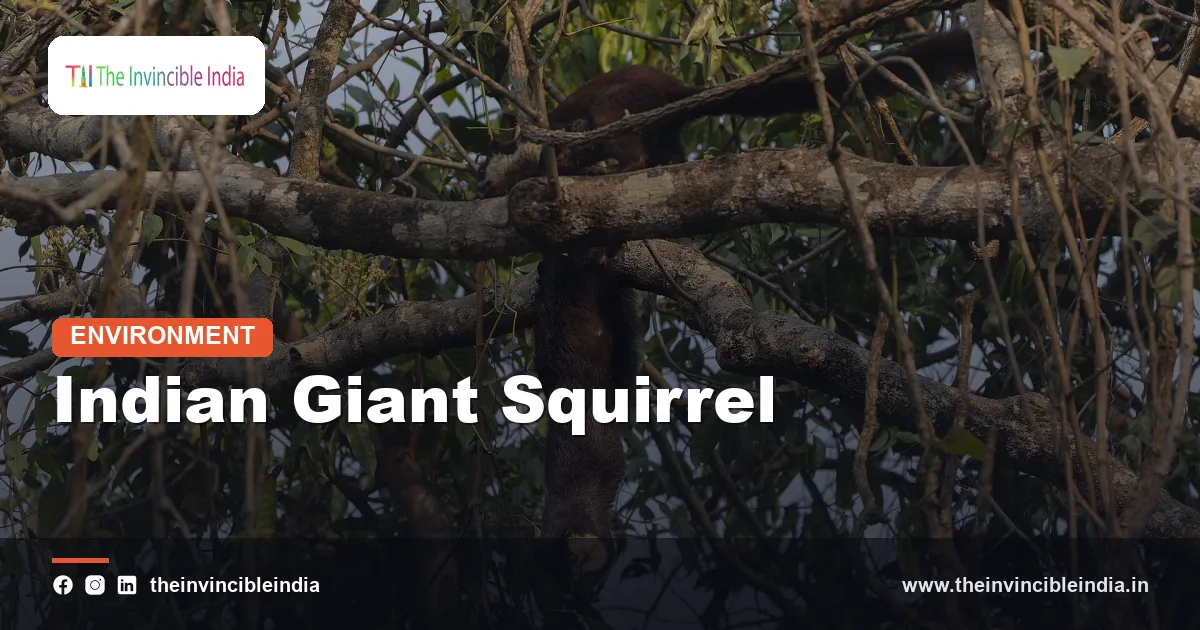
The Indian giant squirrel (Ratufa indica), also called the Malabar giant squirrel, is a large, brightly coloured tree squirrel native to the forests of peninsular India, where it spends nearly its whole life high in the canopy. It is the state animal of Maharashtra, where it is known locally as the shekru, and its conservation depends on protecting tall, connected stretches of tropical forest.
The species is listed as Least Concern globally but is declining in many places because of habitat loss and fragmentation. Understanding how the Indian giant squirrel lives, what it eats and where it is protected helps explain why even a common-looking forest animal needs careful management.
| Attribute | Details |
|---|---|
| Scientific name | Ratufa indica |
| Other names | Malabar giant squirrel; shekru in Marathi |
| Family | Sciuridae (squirrels), genus Ratufa (giant squirrels) |
| Status as state animal | State animal of Maharashtra |
| Habitat | Tall evergreen, semi-evergreen and moist deciduous forest with continuous canopy |
| Range | Western Ghats, Satpura and central Indian hills, and parts of the Eastern Ghats |
| Size | Head-and-body length of roughly 25 to 45 cm, with a tail about as long; weighs up to around two kilograms |
| Main diet | Fruits, flowers, seeds, nuts, bark and occasionally insects and bird eggs |
| Legal protection in India | Protected under the Wildlife (Protection) Act, 1972 |
Key Takeaways
- The Indian giant squirrel (Ratufa indica) is one of the largest tree squirrels in Asia and lives almost entirely in the forest canopy.
- The Indian giant squirrel is the state animal of Maharashtra, where it is called the shekru.
- Indian giant squirrels build spherical nests called dreys from leaves and twigs, and each animal often keeps several nests in the treetops.
- The species disperses seeds of forest trees by carrying and dropping fruits, which gives it an ecological role in forest regeneration.
- Habitat fragmentation, the felling of tall trees and the loss of continuous canopy are the main threats to the Indian giant squirrel.
- The Indian giant squirrel is protected under India’s Wildlife (Protection) Act, 1972, and it occurs in many national parks and sanctuaries.
What is the Indian giant squirrel?
The Indian giant squirrel is a large, diurnal tree squirrel of the family Sciuridae, found only in India and its tropical forests, noted for its rich mix of maroon, orange, buff, cream and brown fur. The species is scientifically named Ratufa indica, and its common alternate name, the Malabar giant squirrel, refers to the Malabar coast in the southern Western Ghats where it was first described from.
The animal is much larger than the familiar striped palm squirrel seen in towns. Its long, bushy tail is almost as long as its body and helps with balance when it leaps between branches. Fur colour varies by region. Squirrels in the southern Western Ghats are often darker, with maroon backs and cream underparts, while those in central India tend to be paler.
Because it lives so high in the trees and moves with great speed, the squirrel is often heard before it is seen. It gives a loud rattling call, especially when alarmed.
What are the subspecies of the Indian giant squirrel?
The Indian giant squirrel is generally divided into four regional subspecies that differ mainly in colour and range. Scientists use these names to describe populations across the species’ widely separated forest blocks.
| Subspecies | General region | Notable feature |
|---|---|---|
| Ratufa indica indica | Western Ghats of Maharashtra, Goa, Karnataka and Kerala | Dark maroon and rich buff colouring |
| Ratufa indica bengalensis | Eastern Ghats and parts of eastern and central India | Paler body with different head and shoulder colouring |
| Ratufa indica centralis | Satpura range and central Indian forests | Pale tones adapted to drier deciduous forest |
| Ratufa indica maxima | Southern Western Ghats | Very dark, large form |
Taxonomists continue to review these groupings, so the names should be viewed as a useful field guide rather than a final classification.
Where is the Indian giant squirrel found?
The Indian giant squirrel is found in the Western Ghats mountain chain, in forests of the Satpura and central Indian hills, and in parts of the Eastern Ghats, including forests in Odisha and Andhra Pradesh. The squirrel needs forest with tall trees and linked crowns, so it is absent from open scrub, farmland and heavily cleared areas.
Protected areas known for the species include Bhimashankar Wildlife Sanctuary in Maharashtra, which was set up with the shekru as a flagship species, as well as the forests of Phansad and other Western Ghats reserves. Elsewhere, sanctuaries in Karnataka, Kerala and Tamil Nadu support populations, and Satpura forests hold the central Indian forms.
The species is a good example of how a forest animal can be widespread on a map and yet restricted in practice. The Western Ghats are a global biodiversity hotspot, but their forests are broken up by roads, plantations, villages and reservoirs. Squirrels survive well only in the larger intact blocks.
How does the Indian giant squirrel live in the canopy?
The Indian giant squirrel lives almost entirely in the upper canopy, where it feeds, rests and sleeps, and it descends to the ground only rarely. Individuals are usually seen alone or in pairs, and the animals move along regular routes between trees by running along branches and leaping gaps of several metres.
Activity peaks in the early morning and again in late afternoon, with a quieter midday rest. The animal prefers tall trees with interlinked crowns, since gaps in the canopy force it to come to the ground, which exposes it to predators. Its strong hind legs and long tail make it an agile jumper.
Daily rhythm
- Early morning: foraging for fruits, flowers and leaf buds.
- Midday: resting in a nest or on a thick branch, often sunning itself.
- Late afternoon: a second feeding period before retiring to a nest.
Predators include large raptors, leopards and some snakes, and the squirrel’s alarm call serves as a warning to other forest animals.
What are dreys and how does the squirrel build them?
A drey is a large, ball-shaped nest built by the Indian giant squirrel from twigs and leaves and placed in the fork of a high tree. These nests are often visible from the ground as dark balls in the crown, and they serve as resting places, sleeping quarters and shelter for young.
An individual squirrel commonly maintains more than one nest within its home range. Researchers think the multiple nests help the animal avoid predators and parasites, and they let it rest wherever it happens to be at the end of the day. Nests are built from freshly cut leafy twigs that are woven together into a compact structure with an entrance on the side.
Female squirrels usually give birth to one or two young in a nest, and the young stay in it until they can move through the canopy. The abundance of nests in a forest can therefore be used as an indirect measure of squirrel numbers, and some surveys count nests rather than animals.
What does the Indian giant squirrel eat?
The Indian giant squirrel eats mainly fruits, seeds, nuts, flowers, bark and young leaves, and it sometimes takes insects and birds’ eggs. The diet changes with the season, following whichever trees are fruiting or flowering at the time.
The animal holds food in its forepaws while sitting upright on a branch and often drops half-eaten fruit. It uses a wide range of forest trees as food sources, including jackfruit, mango, figs and other native species. In cultivated areas next to forests, it may also feed on fruits in plantations, which can bring it into conflict with farmers.
Because the squirrel depends on many tree species, a diverse forest supports it better than a monoculture plantation. A variety of fruiting trees provides food across the whole year.
Why is the Indian giant squirrel important for forests?
The Indian giant squirrel is important for forests because it moves seeds, pollen and fruit around the canopy, which supports natural regeneration of trees. Seeds that are carried away from the parent tree or dropped in new places have a better chance of germinating without competition.
The species also acts as an indicator of forest health. Since it needs tall, connected trees, a healthy squirrel population signals that the canopy is intact and that fruiting trees are present. Where squirrels disappear from a patch of forest, it is often a sign that fragmentation or felling has broken the canopy.
In this sense, the animal is useful both as a seed disperser and as a flagship species. Wildlife managers in Maharashtra have used the shekru to draw attention to forest conservation more broadly.
What are the main threats to the Indian giant squirrel?
The main threats to the Indian giant squirrel are habitat fragmentation, deforestation, the felling of tall trees, and conversion of forest to plantations, roads and settlements. Because the squirrel is a canopy specialist, any break in the forest roof isolates populations.
Key pressures
- Fragmentation: roads, power lines, farmland and reservoirs cut forest into smaller patches, and squirrels can become trapped in isolated groups.
- Loss of large trees: selective logging removes the tall, fruiting trees the animals depend on for food and nesting.
- Hunting and trapping: in some places the animal is killed for meat or caught for the pet trade, even though both are illegal.
- Electrocution and road accidents: animals crossing gaps by wires or tarmac are vulnerable.
- Climate and fire: shifts in rainfall and forest fires can reduce food supply and damage nesting trees.
The species is classed as Least Concern by the International Union for Conservation of Nature (IUCN), which reflects its wide range, but the global population is thought to be declining in many local areas. A Least Concern label does not mean that local populations are secure.
How is the Indian giant squirrel protected in India?
The Indian giant squirrel is protected in India under the Wildlife (Protection) Act, 1972, which prohibits hunting, capture and trade in protected wild animals. The Act is administered by state forest departments, with oversight from the Ministry of Environment, Forest and Climate Change (MoEFCC).
Beyond the law, protection works mainly through a network of national parks, wildlife sanctuaries and reserved forests. Many Western Ghats reserves contain squirrel populations, and the species is covered by general forest management and anti-poaching patrols. Maharashtra’s designation of the shekru as its state animal adds symbolic and educational value, although it does not itself give extra legal protection.
Because the exact schedule listing of wildlife species has been revised over the years, readers should check the latest notification when they need legal specifics.
What can be done to conserve the Indian giant squirrel?
Conserving the Indian giant squirrel requires protecting large forest blocks, restoring canopy connectivity and managing human activity around reserves. The most effective approach is to keep forests continuous so that squirrels can travel without descending to the ground.
| Action | Purpose |
|---|---|
| Protecting remaining large forest blocks | Keeps the core habitat intact for breeding populations |
| Canopy bridges and rope crossings | Lets squirrels cross roads and gaps safely |
| Planting native fruiting trees | Restores food supply and connects forest fragments |
| Insulating power lines and managing roadsides | Reduces electrocution and road deaths |
| Regular surveys of animals and nests | Tracks population trends and detects decline early |
| Community education and awareness | Reduces hunting and builds local support for forest protection |
Local communities living near forests play an important role. Awareness programmes in Maharashtra and other states encourage people to see the shekru as a shared natural heritage rather than as a pest or food source.
Bottom Line
The Indian giant squirrel is a striking canopy animal whose survival depends on tall, connected forest in the Western Ghats and the wider Indian peninsula. Although the species is not globally endangered, fragmentation is steadily shrinking its habitat, so protecting forest continuity is the most useful long-term conservation step. This article was last reviewed as of 17 October 2026.
Frequently Asked Questions
What is the scientific name of the Indian giant squirrel?
The scientific name of the Indian giant squirrel is Ratufa indica. It is also called the Malabar giant squirrel and belongs to the squirrel family Sciuridae, in the genus Ratufa, which contains the giant squirrels of Asia.
Which Indian state has the Indian giant squirrel as its state animal?
Maharashtra has the Indian giant squirrel as its state animal. In Marathi the animal is called the shekru, and Bhimashankar Wildlife Sanctuary in the state is well known for protecting the species.
Where does the Indian giant squirrel live?
The Indian giant squirrel lives in tall tropical forests of the Western Ghats, the Satpura and central Indian hills, and parts of the Eastern Ghats. It stays high in the canopy and avoids open, heavily cleared areas.
What are the nests of the Indian giant squirrel called?
The nests of the Indian giant squirrel are called dreys. They are large, round structures built from twigs and leaves in tall treetops, and one squirrel often keeps several of them within its home range.
Is the Indian giant squirrel endangered?
The Indian giant squirrel is not considered globally endangered and is listed as Least Concern by the IUCN. However, local populations are shrinking where forests are fragmented or cleared, and the species is protected under the Wildlife (Protection) Act, 1972.
Why is the Indian giant squirrel important for the forest?
The Indian giant squirrel is important because it disperses seeds and helps forests regenerate. It also acts as an indicator species, since it needs tall, connected trees and a healthy canopy to survive.
{“@context”:”https://schema.org”,”@graph”:[{“@type”:”FAQPage”,”mainEntity”:[{“@type”:”Question”,”name”:”What is the scientific name of the Indian giant squirrel?”,”acceptedAnswer”:{“@type”:”Answer”,”text”:”The scientific name of the Indian giant squirrel is Ratufa indica. It is also called the Malabar giant squirrel and belongs to the squirrel family Sciuridae, in the genus Ratufa, which contains the giant squirrels of Asia.”}},{“@type”:”Question”,”name”:”Which Indian state has the Indian giant squirrel as its state animal?”,”acceptedAnswer”:{“@type”:”Answer”,”text”:”Maharashtra has the Indian giant squirrel as its state animal. In Marathi the animal is called the shekru, and Bhimashankar Wildlife Sanctuary in the state is well known for protecting the species.”}},{“@type”:”Question”,”name”:”Where does the Indian giant squirrel live?”,”acceptedAnswer”:{“@type”:”Answer”,”text”:”The Indian giant squirrel lives in tall tropical forests of the Western Ghats, the Satpura and central Indian hills, and parts of the Eastern Ghats. It stays high in the canopy and avoids open, heavily cleared areas.”}},{“@type”:”Question”,”name”:”What are the nests of the Indian giant squirrel called?”,”acceptedAnswer”:{“@type”:”Answer”,”text”:”The nests of the Indian giant squirrel are called dreys. They are large, round structures built from twigs and leaves in tall treetops, and one squirrel often keeps several of them within its home range.”}},{“@type”:”Question”,”name”:”Is the Indian giant squirrel endangered?”,”acceptedAnswer”:{“@type”:”Answer”,”text”:”The Indian giant squirrel is not considered globally endangered and is listed as Least Concern by the IUCN. However, local populations are shrinking where forests are fragmented or cleared, and the species is protected under the Wildlife (Protection) Act, 1972.”}},{“@type”:”Question”,”name”:”Why is the Indian giant squirrel important for the forest?”,”acceptedAnswer”:{“@type”:”Answer”,”text”:”The Indian giant squirrel is important because it disperses seeds and helps forests regenerate. It also acts as an indicator species, since it needs tall, connected trees and a healthy canopy to survive.”}}]}]}


