

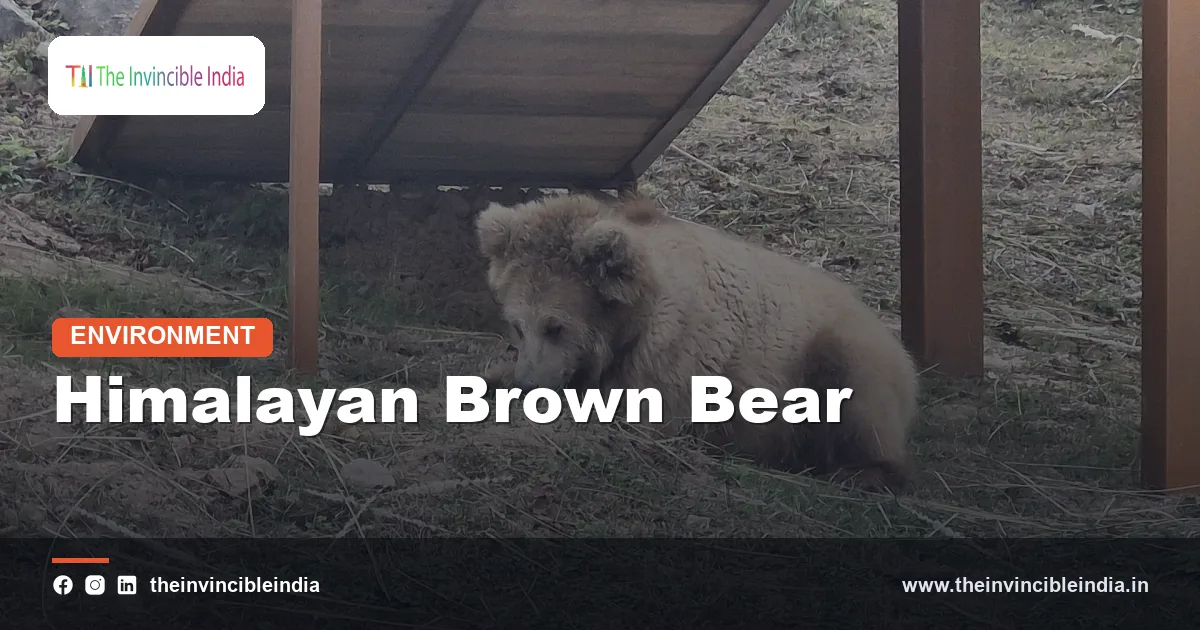
The Himalayan brown bear (Ursus arctos isabellinus) is a subspecies of the brown bear and the largest land carnivore of the western Himalayas, living in the high alpine meadows and cold deserts of Ladakh, Jammu and Kashmir, Himachal Pradesh and Uttarakhand. Although the brown bear as a species is widespread across the world, the Himalayan population is small, scattered and considered vulnerable to local extinction.
Himalayan brown bear conservation is a test of how India can protect large carnivores in high mountains where pastoral communities, tourism and infrastructure are expanding. The bear also holds a place in folklore, because scientists and storytellers have long linked it to the legend of the yeti. 17 October 2026
| Attribute | Detail |
|---|---|
| Common name | Himalayan brown bear (also called Himalayan red bear or Isabelline bear) |
| Scientific name | Ursus arctos isabellinus |
| Family | Ursidae (the bear family) |
| Status | The brown bear species is of Least Concern globally, but the Himalayan subspecies is small, fragmented and regarded as threatened |
| Indian range | Western Himalayas: Ladakh, Jammu and Kashmir, Himachal Pradesh, Uttarakhand |
| Habitat | Alpine meadows, subalpine scrub and cold, high-altitude steppe above the tree line |
| Diet | Omnivore: roots, grasses, berries, insects, marmots and carrion |
| Winter behaviour | Hibernation for several months in dens |
| Legal protection | Strictly protected under the Wildlife (Protection) Act, 1972; international trade regulated under CITES |
Key Takeaways
- The Himalayan brown bear (Ursus arctos isabellinus) is the largest carnivore of the western Himalayas and a subspecies of the brown bear.
- The Himalayan brown bear lives in alpine meadows and cold high-altitude landscapes across Ladakh, Jammu and Kashmir, Himachal Pradesh and Uttarakhand.
- The Himalayan brown bear hibernates through the cold winter months and emerges in spring to feed on roots, grasses, insects and marmots.
- Genetic research published in 2017 found that almost all supposed yeti relics tested by scientists came from Asian bears, including Himalayan brown bears, which helps explain the legend.
- The main threats to the Himalayan brown bear are habitat degradation, conflict with herders, retaliatory killing and poaching for body parts.
- Himalayan brown bear conservation relies on protected areas, compensation for livestock losses, safer waste management and cooperation with pastoral communities.
What is the Himalayan brown bear?
The Himalayan brown bear is a subspecies of the brown bear (Ursus arctos) adapted to the high, cold, dry mountains of South and Central Asia, and it is the biggest carnivore in the western Himalayas. It belongs to the bear family Ursidae and is closely related to the grizzly bear of North America and the brown bears of Europe and Russia.
The Himalayan form is usually somewhat smaller and paler than the largest brown bears elsewhere. Its coat ranges from sandy or pale reddish-brown to darker brown, and the hairs on the back and shoulders often have silvery or cream tips, which gives rise to the names “red bear” and “Isabelline bear”. It has a prominent shoulder hump made of muscle, a broad head and long, straight claws that are used for digging.
Adult males are considerably larger than females. The bear walks on all four legs but can stand on its hind legs to look around or to sniff the air. It has a keen sense of smell and moderate hearing, while its eyesight is average. These traits help it to locate food buried under snow or soil.
The classification of the bears of the Himalaya has been revised several times, and scientists still debate how many distinct groups of brown bears exist in Asia. The Himalayan brown bear is generally treated as one distinct lineage that is genetically different from other brown bear populations.
Where does the Himalayan brown bear live in India?
The Himalayan brown bear lives in the high-altitude zones of the western Himalayas, mostly above the tree line, across Ladakh, Jammu and Kashmir, Himachal Pradesh and Uttarakhand. Its range in India is patchy and the bears are generally present at low density, which makes them hard to survey.
Notable areas
- Jammu and Kashmir: the Kashmir valley and its surrounding mountains, including Dachigam National Park, have supported brown bears, as have the Kishtwar and Drass-Kargil regions.
- Ladakh: cold-desert landscapes, including areas in and around Hemis National Park, and the Zanskar and Suru valley areas are used by the bear.
- Himachal Pradesh: high-altitude areas of Lahaul and Spiti, Kinnaur and Kullu hold small populations, with protected areas such as the Great Himalayan National Park and Pin Valley National Park providing refuge.
- Uttarakhand: the upper reaches of the Garhwal and Kumaon Himalayas, including parts of Gangotri and Nanda Devi, have records of the bear.
Beyond India, the bear’s range extends through Pakistan (notably the Deosai plateau), Nepal, Tibet and Central Asia. Because the Indian population is at the edge of this range and is split into small units, connectivity between valleys is crucial to its long-term survival.
How does the Himalayan brown bear hibernate?
The Himalayan brown bear hibernates by entering a den in late autumn and remaining mostly inactive through much of the winter, living on stored body fat until spring. Hibernation lasts for several months, depending on altitude and the severity of the winter.
In the months before denning, the bear eats heavily in a phase called hyperphagia, building up fat reserves. It then digs or selects a den, often a cave, rock crevice or a hollow dug into a slope, which is lined with grass or other plant material. During hibernation the bear’s heart rate and metabolism fall, and the animal does not eat, drink, urinate or defecate in the usual way.
Hibernation is not as deep as in some small mammals, and a bear can be roused if disturbed. Females give birth during the winter in the den, typically to one to three small cubs, which are tiny and blind at birth. They drink their mother’s milk and grow while she remains in the den, and they emerge with her in spring.
This yearly cycle makes the bear sensitive to disturbance at certain times. A den disturbed by construction, tourism or herders can force a bear out when it has little energy to spare, which can reduce survival of both mother and cubs.
What does the Himalayan brown bear eat?
The Himalayan brown bear is an omnivore that eats a varied diet of grasses, roots, tubers, berries, insects, small mammals and carrion, with the Himalayan marmot being an especially important prey animal. Its diet changes with the season, and plant food usually makes up most of what it eats.
- Spring: fresh shoots, grasses and the carcasses of animals that died over the winter.
- Summer: roots and tubers, which the bear digs up with its claws, as well as insects and marmots.
- Autumn: berries, seeds and any available food to build fat reserves before hibernation.
Digging for marmots and roots leaves distinctive patches of turned-over soil in alpine meadows. This digging also aerates the soil and can help seed germination, so the bear plays a role as an ecosystem engineer. Occasionally the bear kills livestock such as sheep, goats or yaks, which is the main source of conflict with people. More often, however, it scavenges on animals that have already died.
What is the link between the Himalayan brown bear and the yeti?
The Himalayan brown bear is often proposed as a likely source of the yeti legend, because the bear’s large footprints, upright stance and elusive habits fit many of the stories told in Himalayan communities. The yeti is a legendary ape-like creature said to live in the snowy highlands, and the legend became internationally famous after mountaineers reported large footprints in the snow in the early twentieth century.
In 2017, a team of researchers led by Charlotte Lindqvist published a genetic study in the journal Proceedings of the Royal Society B that tested nine samples attributed to “yeti” or similar creatures, including bone, tooth, skin, hair and faecal material. The study concluded that the samples came from Asian bears, including Himalayan brown bears, Tibetan brown bears and Asiatic black bears, and one from a dog. The findings did not prove that no unknown creature exists, but they supported the view that bears account for many sightings and relics.
The folklore link has a conservation side. In some local cultures, bears are respected or feared as powerful beings, and understanding the myth can help conservationists to communicate with communities. It also raises public interest in a species that is otherwise little known.
What are the main threats to the Himalayan brown bear?
The main threats to the Himalayan brown bear are the loss and degradation of alpine habitat, conflict with people over livestock and crops, and poaching for body parts. Because the population is small and divided into isolated groups, even modest losses can threaten the survival of local populations.
Habitat degradation
Alpine meadows are used heavily for summer grazing by sheep, goats, yaks and other livestock. Overgrazing can reduce the plants and burrowing animals that bears rely on. Road building, hydropower projects, tunnels and tourism infrastructure fragment habitat and increase human presence. Climate change is shifting snow lines and vegetation, and may reduce the area of high-elevation habitat over time.
Human-bear conflict
- Bears may kill livestock, which causes economic loss for pastoral families.
- Bears raid orchards, crops and food stores in some valleys, especially where natural food is scarce.
- Poorly managed garbage near villages, army camps and tourist sites attracts bears and makes them bolder.
- Encounters can result in injuries to people and in retaliatory killing of bears.
Poaching and trade
Bear parts, including gall bladders, claws, skins and bile, are sought in illegal wildlife markets. Although the scale in India is less than in some other regions, the demand creates an incentive for poaching, and cross-border trade networks make enforcement difficult.
How is the Himalayan brown bear legally protected?
The Himalayan brown bear is protected in India under the Wildlife (Protection) Act, 1972, which gives the species strict protection and prohibits hunting and trade in its parts, and international trade is regulated through CITES. The law also allows the creation of national parks and wildlife sanctuaries in the bear’s mountain range.
Several protected areas in the western Himalayas shelter the bear, including Dachigam National Park, Hemis National Park, the Great Himalayan National Park and Pin Valley National Park. Protected areas, however, cover only a part of the bear’s range, and many bears move through community-used lands and reserved forests.
At the international level, the brown bear is listed in the appendices of CITES, with the Himalayan population given a high level of trade control. The IUCN lists the brown bear as a species of Least Concern globally, yet it also recognises that some populations, including the Himalayan one, are small and need specific attention.
What is being done to conserve the Himalayan brown bear?
Himalayan brown bear conservation in India relies on protected areas, scientific research, conflict mitigation and community participation. Because the bear lives in remote country, partnerships between forest departments, research institutions and local communities are central.
Main conservation measures
- Research and monitoring: camera traps, genetic sampling of scat and hair, and field surveys by institutions such as the Wildlife Institute of India help estimate numbers and map habitat.
- Conflict mitigation: compensation schemes for livestock lost to wildlife, predator-proof corrals for sheep and goats, and electric fencing around orchards.
- Waste management: bear-proof bins and better garbage disposal near villages and tourist stops reduce food-conditioning.
- Anti-poaching efforts: patrols, intelligence sharing and cooperation with border and customs agencies to stop trade in bear parts.
- Community engagement: awareness programmes and involvement of herders, who know the high pastures better than anyone.
- Landscape planning: reviewing roads, tunnels and hydropower projects for their effect on bear habitat and movement corridors.
| Conservation challenge | Typical response |
|---|---|
| Livestock losses to bears | Compensation, sturdier night enclosures, guard dogs |
| Orchard and crop raiding | Fencing, deterrents, early warning among villages |
| Garbage attracting bears | Bear-proof waste storage and regular collection |
| Poaching for parts | Patrolling, enforcement and trade monitoring |
| Habitat fragmentation | Protected corridors and careful infrastructure planning |
| Lack of data | Surveys, genetic sampling and long-term monitoring |
How does the Himalayan brown bear differ from other Indian bears?
The Himalayan brown bear differs from India’s other bears mainly in its larger size, its alpine habitat and its pale brown coat. India is home to four bear species: the Himalayan brown bear, the Asiatic black bear, the sloth bear and the sun bear, each of which occupies a different habitat.
| Bear | Typical habitat in India | Distinguishing feature |
|---|---|---|
| Himalayan brown bear | Alpine meadows and cold deserts of the western Himalayas | Large, sandy to reddish-brown coat with a shoulder hump |
| Asiatic black bear | Himalayan forests at lower and middle altitudes | Black coat with a pale V-shaped chest mark |
| Sloth bear | Dry forests and scrub in peninsular India | Shaggy black coat and long snout adapted to eating termites |
| Sun bear | Tropical forests of the north-east | Smallest bear, with a short coat and a pale chest patch |
The Himalayan brown bear and the Asiatic black bear can overlap in some middle-altitude zones, but the brown bear generally lives higher and in more open country.
Why does the Himalayan brown bear matter?
The Himalayan brown bear matters because it is a top omnivore of the alpine ecosystem, shaping soil, vegetation and prey populations, and because it is a symbol of the wild highlands. The loss of the bear would be a sign that the high Himalayan ecosystem was losing its ecological balance.
The bear digs and turns over soil, feeds on marmots and so regulates their numbers, and disperses seeds through its droppings. It also scavenges carcasses, which helps recycle nutrients. In regions where snow leopards, wolves and the bear overlap, it forms part of a wider predator community that reflects the health of the mountain environment.
Conservation of the bear also benefits mountain communities. Healthy alpine pastures, clean water and well-managed tourism depend on the same careful land stewardship that bears need.
Bottom Line
The Himalayan brown bear is a rare, hibernating giant of India’s high western Himalayas, linked by science to the yeti legend and threatened by habitat change, conflict and poaching. Protecting it requires safe pastures, fair compensation and cooperation with herders. Himalayan brown bear conservation is ultimately about keeping the high mountains wild and productive.
Frequently Asked Questions
What is the Himalayan brown bear?
The Himalayan brown bear is a subspecies of the brown bear, with the scientific name Ursus arctos isabellinus, and it is the largest carnivore of the western Himalayas. It has a sandy to reddish-brown coat and a muscular shoulder hump. It lives in high alpine meadows and cold deserts.
Where is the Himalayan brown bear found in India?
The Himalayan brown bear is found in the western Himalayas, mainly in Ladakh, Jammu and Kashmir, Himachal Pradesh and Uttarakhand. It lives above the tree line in alpine meadows and cold steppe. Its numbers are low and its range is patchy.
Does the Himalayan brown bear hibernate?
Yes, the Himalayan brown bear hibernates through the cold winter months in a den, living on stored fat. Females give birth in the den and emerge with their cubs in spring. The length of hibernation depends on altitude and the severity of winter.
Is the Himalayan brown bear the yeti?
No, the Himalayan brown bear is not the yeti, but it is widely considered a likely source of yeti stories. A 2017 genetic study of supposed yeti relics found that nearly all the samples came from Asian bears, including Himalayan brown bears. The bear’s large tracks and upright posture may explain many sightings.
What are the main threats to the Himalayan brown bear?
The main threats are the degradation of alpine habitat, conflict with herders over livestock and crops, and poaching for body parts. Garbage near villages and tourist sites can also draw bears into conflict. The small, fragmented population makes these threats more serious.
Is the Himalayan brown bear protected in India?
Yes, the Himalayan brown bear is strictly protected under the Wildlife (Protection) Act, 1972, and its international trade is regulated under CITES. Several national parks in the western Himalayas shelter it. Protection also depends on community cooperation, because many bears live outside protected areas.
{“@context”:”https://schema.org”,”@graph”:[{“@type”:”FAQPage”,”mainEntity”:[{“@type”:”Question”,”name”:”What is the Himalayan brown bear?”,”acceptedAnswer”:{“@type”:”Answer”,”text”:”The Himalayan brown bear is a subspecies of the brown bear, with the scientific name Ursus arctos isabellinus, and it is the largest carnivore of the western Himalayas. It has a sandy to reddish-brown coat and a muscular shoulder hump. It lives in high alpine meadows and cold deserts.”}},{“@type”:”Question”,”name”:”Where is the Himalayan brown bear found in India?”,”acceptedAnswer”:{“@type”:”Answer”,”text”:”The Himalayan brown bear is found in the western Himalayas, mainly in Ladakh, Jammu and Kashmir, Himachal Pradesh and Uttarakhand. It lives above the tree line in alpine meadows and cold steppe. Its numbers are low and its range is patchy.”}},{“@type”:”Question”,”name”:”Does the Himalayan brown bear hibernate?”,”acceptedAnswer”:{“@type”:”Answer”,”text”:”Yes, the Himalayan brown bear hibernates through the cold winter months in a den, living on stored fat. Females give birth in the den and emerge with their cubs in spring. The length of hibernation depends on altitude and the severity of winter.”}},{“@type”:”Question”,”name”:”Is the Himalayan brown bear the yeti?”,”acceptedAnswer”:{“@type”:”Answer”,”text”:”No, the Himalayan brown bear is not the yeti, but it is widely considered a likely source of yeti stories. A 2017 genetic study of supposed yeti relics found that nearly all the samples came from Asian bears, including Himalayan brown bears. The bear’s large tracks and upright posture may explain many sightings.”}},{“@type”:”Question”,”name”:”What are the main threats to the Himalayan brown bear?”,”acceptedAnswer”:{“@type”:”Answer”,”text”:”The main threats are the degradation of alpine habitat, conflict with herders over livestock and crops, and poaching for body parts. Garbage near villages and tourist sites can also draw bears into conflict. The small, fragmented population makes these threats more serious.”}},{“@type”:”Question”,”name”:”Is the Himalayan brown bear protected in India?”,”acceptedAnswer”:{“@type”:”Answer”,”text”:”Yes, the Himalayan brown bear is strictly protected under the Wildlife (Protection) Act, 1972, and its international trade is regulated under CITES. Several national parks in the western Himalayas shelter it. Protection also depends on community cooperation, because many bears live outside protected areas.”}}]}]}


