

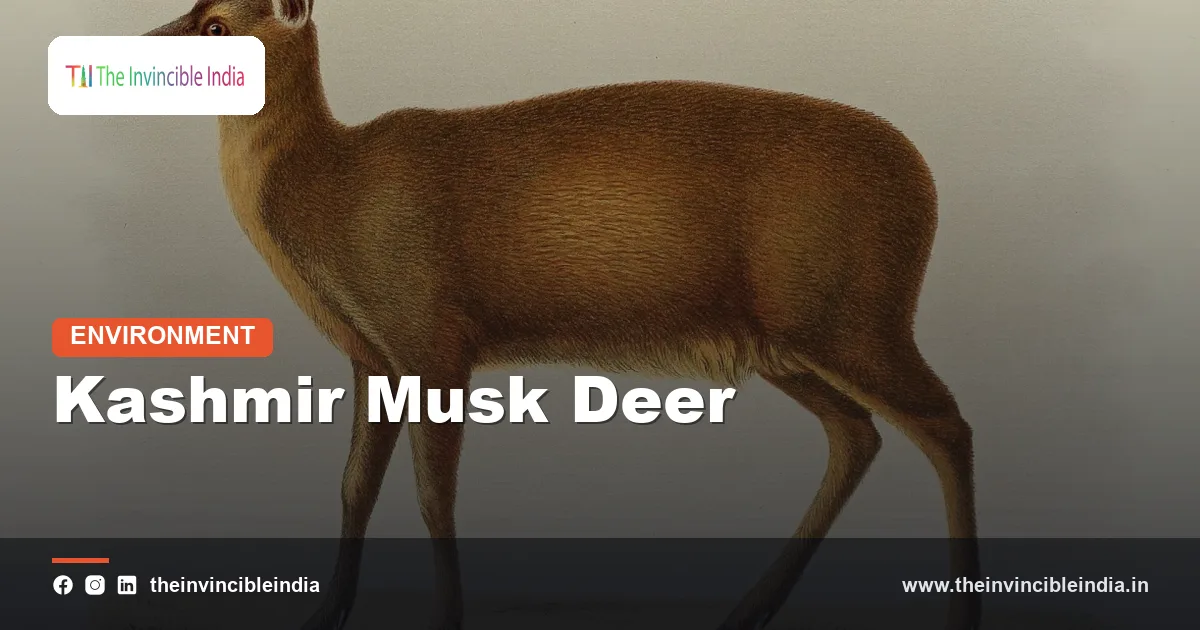
The Kashmir musk deer (Moschus cupreus) is a small, antlerless, fanged forest ruminant of the western Himalayas, and the male is famous for the musk gland that has made the species one of the most heavily poached mammals in Asia. The species lives in the high birch, rhododendron and conifer forests of Jammu and Kashmir, Himachal Pradesh and Uttarakhand, and it is classified as Endangered by the International Union for Conservation of Nature (IUCN).
Kashmir musk deer conservation is important because the animal is shy, solitary and easily overlooked, yet it has been hunted for centuries for a substance used in perfumery and traditional medicine. Protecting the species means controlling illegal trade and safeguarding the subalpine forests where it lives. 17 October 2026
| Attribute | Detail |
|---|---|
| Common name | Kashmir musk deer |
| Scientific name | Moschus cupreus |
| Family | Moschidae (the musk deer family, separate from true deer) |
| Size | Small, about a metre long and weighing roughly 10 to 15 kg |
| IUCN status | Endangered |
| Range in India | Western Himalayas: Jammu and Kashmir, Himachal Pradesh and Uttarakhand |
| Habitat | Subalpine and temperate forests with birch, fir, rhododendron and juniper, on steep rocky slopes |
| Distinctive features | No antlers; males have long canine tusks and a musk gland |
| Legal protection | Strictly protected under the Wildlife (Protection) Act, 1972; Indian populations are covered by the strictest controls on international trade under CITES |
Key Takeaways
- The Kashmir musk deer (Moschus cupreus) is a small, antlerless deer-like animal of the western Himalayas, and the male carries long upper canine teeth shaped like tusks.
- The male Kashmir musk deer produces musk in a gland near the abdomen, and the high value of musk has driven heavy illegal hunting.
- The Kashmir musk deer is a shy, solitary animal that lives in steep subalpine forests and is active mostly at dawn and dusk.
- The IUCN classifies the Kashmir musk deer as Endangered, mainly because of poaching and habitat loss.
- The Kashmir musk deer is strictly protected under the Wildlife (Protection) Act, 1972, and international trade in musk is controlled under CITES.
- Conservation of the Kashmir musk deer depends on anti-poaching enforcement, forest protection, captive-breeding research and the replacement of natural musk with synthetic alternatives.
What is the Kashmir musk deer?
The Kashmir musk deer is a small forest-dwelling mammal of the musk deer family, Moschidae, found in the western Himalayas, and despite its name it is not a true deer. Musk deer differ from true deer in several ways: they have no antlers, no facial scent glands and a gall bladder, and the males bear a musk gland.
The animal is roughly a metre in length and stands about half a metre tall at the shoulder, with a dark brown to greyish-brown coat that is often flecked with lighter hairs. Its hind legs are much longer than its forelegs, giving it a hunched, arched back, and its feet are narrow with large, flexible hooves that help it grip on steep and rocky ground. Its ears are large and rounded, and its tail is tiny and mostly hidden.
The most noticeable feature of the male is a pair of long, curved canine teeth that project downward from the upper jaw like small tusks, often several centimetres long. The tusks are used in fights between males during the breeding season and for digging in some situations. Females lack these tusks.
Taxonomists have revised the classification of musk deer several times. In the past, all Himalayan musk deer were grouped as one species, but genetic and anatomical work has led to the recognition of several species. The Kashmir musk deer is the form that ranges across the western Himalayas, while other species, such as the Himalayan musk deer (Moschus leucogaster), occupy parts of the central and eastern Himalayas.
Where does the Kashmir musk deer live?
The Kashmir musk deer lives in the high-altitude forests of the western Himalayas in Jammu and Kashmir, Himachal Pradesh and Uttarakhand, and extends into adjoining parts of Nepal, Pakistan and Afghanistan. It is a mountain specialist and is usually found on steep, rocky, forested slopes between roughly 2,500 and 4,000 metres above sea level, though the exact limits depend on the region and season.
Habitat features
- Forests of Himalayan birch (Betula utilis), silver fir, spruce, rhododendron and juniper provide cover and food.
- Rocky outcrops and cliffs provide safe retreats from predators.
- Dense undergrowth allows the animal to move quietly and remain hidden.
- Seasonal movements take the deer slightly higher in summer and lower in winter, following snow cover and food.
Protected areas that shelter the species
Several protected areas in the Indian Himalaya hold musk deer habitat. Kedarnath Wildlife Sanctuary and Askot Wildlife Sanctuary in Uttarakhand are well known for musk deer, and Kedarnath was in fact created partly with musk deer protection in mind. Other important areas include Dachigam National Park in Jammu and Kashmir, the Great Himalayan National Park in Himachal Pradesh and Govind Pashu Vihar in Uttarakhand.
What is the musk gland, and why has it made the deer a target?
The musk gland is a small pouch of skin located between the navel and the genitals of the adult male Kashmir musk deer, and it secretes a waxy, strongly scented substance called musk that has been used for centuries in perfumes and traditional medicines. Only males possess the gland, which is believed to play a role in marking territory and signalling to females during the breeding season.
A single gland produces only a small quantity of musk, typically a few tens of grams. Natural musk has long been among the most valuable animal products by weight, and demand from the perfume industry and from some traditional medicine systems has created a lucrative black market. This price incentive has made the species a prime target for poachers.
Extracting musk usually means killing the animal, because the gland is removed after death. Poachers who snare musk deer cannot tell the sex of an animal in advance, so many females and young animals are killed in addition to males. This waste makes the toll on the population far heavier than the number of glands collected suggests.
Today most commercial perfumery uses synthetic musks, which have largely replaced natural musk. Demand for the natural product persists in some traditional medicine markets, however, so illegal hunting continues. Conservationists argue that continued use of natural musk is unnecessary and that effective synthetic and plant-based alternatives exist.
How does the Kashmir musk deer behave?
The Kashmir musk deer is a solitary, shy and mostly crepuscular animal that is active at dawn and dusk and hides among rocks and thick vegetation during the day. Because of this elusive behaviour, it is rarely seen, and much of what is known comes from tracks, droppings and camera traps.
The animal is an agile climber and jumper. It can leap across rocky slopes and balance on narrow ledges, using its long hind legs and sharp hooves. It feeds on leaves, shoots, twigs, grasses, mosses and lichens, and in winter it relies heavily on lichens that grow on trees. Individuals tend to occupy small home ranges and use the same paths and latrine sites repeatedly, which poachers exploit when setting snares.
Breeding
The breeding season, or rut, takes place in the cold months, usually from late autumn into winter. Males compete for females using their tusks, and the musk scent is thought to attract mates. After a gestation of roughly six months, the female usually gives birth to one or two fawns in the following summer. The fawns are well camouflaged, spend their early weeks hidden, and are nursed by the mother until they are old enough to follow her. Musk deer reproduce slowly, which means populations recover only gradually from any losses.
Natural predators include the snow leopard, the common leopard, the yellow-throated marten, foxes, wolves and large birds of prey. Fawns are especially vulnerable.
What are the main threats to the Kashmir musk deer?
The main threats to the Kashmir musk deer are poaching for the musk gland and the loss and degradation of its forest habitat. Both threats have acted together for decades, and the combined effect has reduced the species to scattered, small populations in many places.
- Poaching: hunters use snares and traps along known deer trails; because snares are indiscriminate, females and juveniles are caught as well.
- Illegal trade: musk is smuggled across borders in small, valuable quantities that are easy to hide, making enforcement hard.
- Habitat loss: felling of trees for fuelwood, timber and construction, along with forest fires and clearing for roads, reduces cover.
- Overgrazing: livestock grazing in summer pastures competes with wild herbivores and degrades the understorey.
- Collection of medicinal plants: large numbers of collectors entering forests in season cause disturbance and sometimes carry out poaching on the side.
- Predation and low reproduction: a slow breeding rate makes it difficult for populations to rebound.
- Climate change: shifts in snow cover and vegetation can alter the habitat zone the deer depends on.
Estimating the number of musk deer is difficult because the animals are so secretive. Surveys using dung counts and camera traps suggest that populations have declined substantially across their range, although exact figures vary between studies and sites. For this reason, numbers should be treated cautiously.
How is the Kashmir musk deer legally protected?
The Kashmir musk deer is protected in India under the Wildlife (Protection) Act, 1972, which gives the species the highest level of protection, and its international trade is regulated under CITES. Hunting, trapping and trade in musk and other body parts are prohibited by Indian law, and violations carry serious penalties.
The Wildlife (Protection) Act, 1972 is India’s principal wildlife law. It allows the creation of national parks and sanctuaries, controls the possession and sale of protected species and their parts, and gives forest and police officers powers to investigate and prosecute offences.
At the international level, the Convention on International Trade in Endangered Species of Wild Fauna and Flora (CITES) lists musk deer in its appendices. The populations of India and some neighbouring Himalayan countries are placed in the strictest category, which in effect bans commercial international trade. This coordinated approach is designed to cut off the market for poached musk.
| Level | Instrument | What it does |
|---|---|---|
| National | Wildlife (Protection) Act, 1972 | Bans hunting and trade; allows protected areas |
| International | CITES | Regulates or prohibits cross-border trade in musk |
| Global assessment | IUCN Red List | Classifies the species as Endangered and guides priorities |
| State level | Forest departments of Jammu and Kashmir, Himachal Pradesh, Uttarakhand | Patrol, manage protected areas and run breeding centres |
What is being done to conserve the Kashmir musk deer?
Kashmir musk deer conservation in India includes protected areas, anti-poaching patrols, captive-breeding research, scientific surveys and awareness among forest communities. State forest departments lead most efforts, often with help from research institutions such as the Wildlife Institute of India and conservation organisations.
Protected areas and patrolling
Sanctuaries such as Kedarnath and Askot in Uttarakhand were established with the explicit aim of protecting musk deer habitat. Forest guards and patrols remove snares, monitor trails and track suspicious activity. In some regions, community members have been engaged as informers and monitors.
Captive breeding
A musk deer breeding centre was set up at Kanchula Kharak in Chamoli district of Uttarakhand in the early 1980s, and other facilities have been established in the region. The aim was to learn how to breed musk deer in captivity, to study their biology and, in principle, to support wild populations. Musk deer are delicate and stress-prone in captivity, so results have been mixed, and experts emphasise that protecting wild populations remains the priority.
Research and monitoring
- Field surveys using pellet counts and camera traps to estimate presence and abundance.
- Genetic studies to clarify which species occur where, which is vital for management.
- Studies of seasonal movement and habitat use to plan protection of key areas.
Working with communities
Many musk deer live near villages and seasonal herding camps. Programmes that create alternative livelihoods, support sustainable collection of medicinal plants and raise awareness about the legal and ecological status of the deer help reduce pressure on the animals. Local knowledge of deer trails and habits is also valuable for monitoring.
How does the Kashmir musk deer differ from true deer?
The Kashmir musk deer differs from true deer in lacking antlers, having long upper canine tusks in males, and possessing a musk gland, which together place it in a separate family, Moschidae. Although it looks like a small deer, its evolutionary relationships are closer to cattle and antelopes than to the Cervidae, the family of true deer.
| Feature | Kashmir musk deer | True deer (for example, red deer or sambar) |
|---|---|---|
| Family | Moschidae | Cervidae |
| Antlers | Absent in both sexes | Present in males of most species |
| Upper canine teeth | Long tusks in males | Absent or small in most species |
| Musk gland | Present in males | Absent |
| Typical body size | Small, about 10 to 15 kg | Medium to very large |
| Habit | Solitary and secretive | Often live in herds |
Within the Indian Himalaya, other musk deer forms are also reported. The Himalayan musk deer occupies parts of the central and eastern Himalayas, and the exact ranges of different species are still being clarified through genetic study.
Why does the Kashmir musk deer matter?
The Kashmir musk deer matters because it is a distinctive, ecologically significant animal of Himalayan forests and a symbol of the wider problem of wildlife trade. Its decline shows how a single valuable body part can drive a species towards extinction.
In the forest ecosystem, the Kashmir musk deer is a browser that feeds on a wide range of plants and a prey species for several carnivores, including the snow leopard and leopard. Reducing its numbers can affect the food supply of these predators. Its presence also indicates relatively undisturbed forest on steep terrain.
The species also has cultural and historical interest. Musk from the Himalaya has been traded across Asia for centuries, and the scent features in traditional accounts and literature. Today, the focus is on protecting the living animal rather than the product.
Bottom Line
The Kashmir musk deer is a shy, tusked, antlerless deer-like animal whose valuable musk gland has led to heavy poaching across the western Himalayas. Strict legal protection, patrolling, forest conservation and the move away from natural musk are the keys to its survival. Kashmir musk deer conservation depends on cutting demand and keeping the high Himalayan forests intact.
Frequently Asked Questions
What is the Kashmir musk deer?
The Kashmir musk deer is a small, antlerless, deer-like animal of the western Himalayas with the scientific name Moschus cupreus. Males have long canine tusks and a musk gland. It is classified as Endangered by the IUCN.
Where does the Kashmir musk deer live?
The Kashmir musk deer lives in the high-altitude forests of Jammu and Kashmir, Himachal Pradesh and Uttarakhand, and in neighbouring Himalayan countries. It prefers steep, rocky slopes covered with birch, fir and rhododendron. It is rarely seen because it is shy and solitary.
Why is the Kashmir musk deer hunted?
The Kashmir musk deer is hunted for the musk gland of the male, which produces a valuable scented substance used in perfumery and traditional medicine. Because the gland is removed after death, the animal is killed. Snares also catch females and young, which makes the damage greater.
Does the Kashmir musk deer have antlers?
No, the Kashmir musk deer has no antlers in either sex. Instead, the male has long, curved upper canine teeth that look like small tusks. These are used in fights between males during the breeding season.
Is the Kashmir musk deer protected in India?
Yes, the Kashmir musk deer is strictly protected under the Wildlife (Protection) Act, 1972, which prohibits hunting and trade in musk and other parts. International trade is also controlled under CITES. Enforcement in remote Himalayan forests remains a major challenge.
How can the Kashmir musk deer be saved?
The Kashmir musk deer can be saved by combining strict anti-poaching enforcement with the protection of its forest habitat and support for local communities. Reducing demand for natural musk, through synthetic and plant-based alternatives, is also essential. Scientific monitoring helps target protection where it is most needed.
{“@context”:”https://schema.org”,”@graph”:[{“@type”:”FAQPage”,”mainEntity”:[{“@type”:”Question”,”name”:”What is the Kashmir musk deer?”,”acceptedAnswer”:{“@type”:”Answer”,”text”:”The Kashmir musk deer is a small, antlerless, deer-like animal of the western Himalayas with the scientific name Moschus cupreus. Males have long canine tusks and a musk gland. It is classified as Endangered by the IUCN.”}},{“@type”:”Question”,”name”:”Where does the Kashmir musk deer live?”,”acceptedAnswer”:{“@type”:”Answer”,”text”:”The Kashmir musk deer lives in the high-altitude forests of Jammu and Kashmir, Himachal Pradesh and Uttarakhand, and in neighbouring Himalayan countries. It prefers steep, rocky slopes covered with birch, fir and rhododendron. It is rarely seen because it is shy and solitary.”}},{“@type”:”Question”,”name”:”Why is the Kashmir musk deer hunted?”,”acceptedAnswer”:{“@type”:”Answer”,”text”:”The Kashmir musk deer is hunted for the musk gland of the male, which produces a valuable scented substance used in perfumery and traditional medicine. Because the gland is removed after death, the animal is killed. Snares also catch females and young, which makes the damage greater.”}},{“@type”:”Question”,”name”:”Does the Kashmir musk deer have antlers?”,”acceptedAnswer”:{“@type”:”Answer”,”text”:”No, the Kashmir musk deer has no antlers in either sex. Instead, the male has long, curved upper canine teeth that look like small tusks. These are used in fights between males during the breeding season.”}},{“@type”:”Question”,”name”:”Is the Kashmir musk deer protected in India?”,”acceptedAnswer”:{“@type”:”Answer”,”text”:”Yes, the Kashmir musk deer is strictly protected under the Wildlife (Protection) Act, 1972, which prohibits hunting and trade in musk and other parts. International trade is also controlled under CITES. Enforcement in remote Himalayan forests remains a major challenge.”}},{“@type”:”Question”,”name”:”How can the Kashmir musk deer be saved?”,”acceptedAnswer”:{“@type”:”Answer”,”text”:”The Kashmir musk deer can be saved by combining strict anti-poaching enforcement with the protection of its forest habitat and support for local communities. Reducing demand for natural musk, through synthetic and plant-based alternatives, is also essential. Scientific monitoring helps target protection where it is most needed.”}}]}]}


