

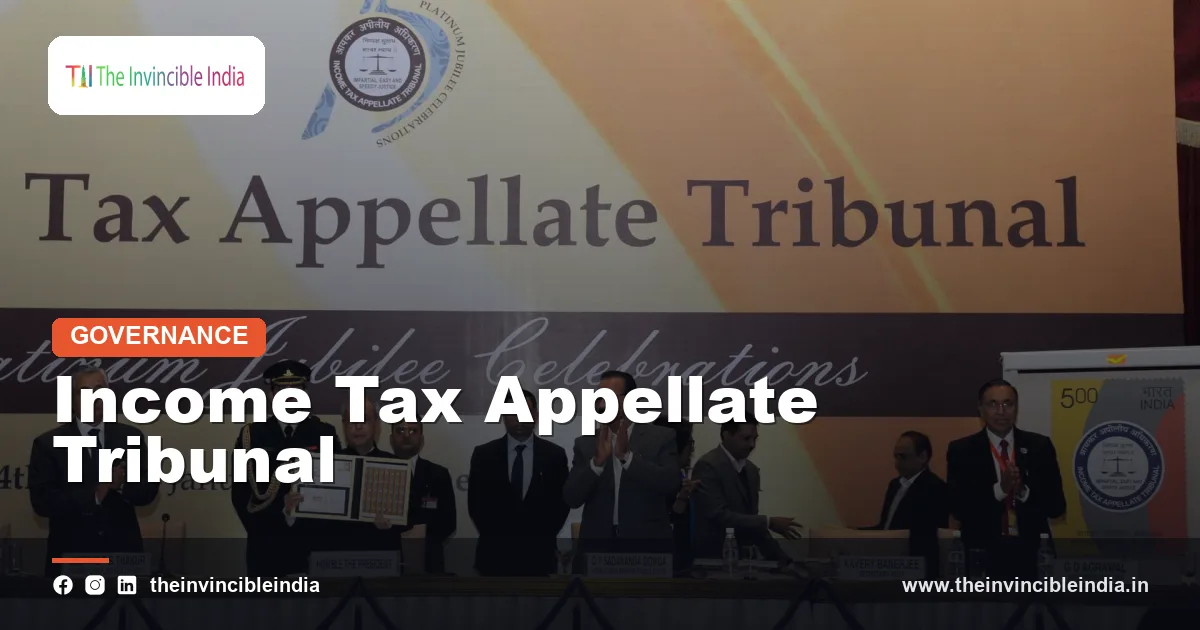
The Income Tax Appellate Tribunal (ITAT) is India’s specialised quasi-judicial body that hears second appeals in direct-tax disputes between taxpayers and the Income Tax Department, and it is the final fact-finding authority in such cases. Established in January 1941 and functioning under the Ministry of Law and Justice, the Income Tax Appellate Tribunal is often called the “mother tribunal” of India because it is the oldest of the country’s tribunals.
A taxpayer or the tax department that is unhappy with the order of the first appellate authority can approach the ITAT, whose benches sit in cities across the country. This explainer covers the Tribunal’s history, composition, jurisdiction, procedure, and the route of further appeal to the High Courts and the Supreme Court. Content was last reviewed on 17 October 2026.
| Attribute | Detail |
|---|---|
| Full name | Income Tax Appellate Tribunal (ITAT) |
| Established | 25 January 1941 |
| Nature | Quasi-judicial appellate tribunal for direct taxes |
| Administrative ministry | Ministry of Law and Justice |
| Statutory basis | Section 252 of the Income-tax Act, 1961 |
| Headed by | A President, usually a former or serving High Court judge |
| Members | Judicial Members and Accountant Members |
| Headquarters | New Delhi, with benches in many cities |
| Further appeal | High Court on substantial questions of law, then the Supreme Court |
Key Takeaways
- The Income Tax Appellate Tribunal (ITAT) is a quasi-judicial body constituted in 1941 to hear appeals against orders passed in direct-tax matters.
- Section 252 of the Income-tax Act, 1961 provides for the constitution of the Income Tax Appellate Tribunal, which consists of Judicial Members and Accountant Members.
- The ITAT is the last forum that can re-examine the facts of a direct-tax case, and its findings of fact are generally final.
- Appeals against ITAT orders lie to the High Court under Section 260A of the Income-tax Act, 1961, but only on a substantial question of law.
- The ITAT is described as the “mother tribunal” because it was the first tribunal of its kind in India and served as a model for later ones.
- The ITAT sits in benches located in many Indian cities, so that taxpayers do not have to travel to the capital for hearings.
What is the Income Tax Appellate Tribunal?
The Income Tax Appellate Tribunal is an independent appellate body that hears appeals filed by taxpayers or the Income Tax Department against orders of certain income-tax authorities. It does not collect tax or run investigations. Its role is limited to deciding appeals and applying the law to the facts presented.
The ITAT sits after the departmental stages of assessment and first appeal. A dispute typically begins with an assessment by the Assessing Officer, moves to the Commissioner of Income Tax (Appeals), and then reaches the Tribunal. For most taxpayers, the ITAT is the first fully independent forum outside the Income Tax Department, which is why it carries such weight in tax litigation.
The Tribunal deals with income tax, and, in the past, also with matters under related direct-tax laws such as wealth tax, as well as the Black Money Act and the Prohibition of Benami Property Transactions Act in the relevant cases. The central place of the income-tax cases remains the core of its work.
When and why was the ITAT set up?
The Income Tax Appellate Tribunal was set up on 25 January 1941 under the Indian Income-tax Act, 1922, to give taxpayers an impartial appeal forum outside the executive. Before 1941, appeals from the Appellate Assistant Commissioner went to the High Court on questions of law, but there was no independent forum that could revisit the facts.
The need became sharper as the volume of tax assessments grew during the Second World War period. The government of the time created the Tribunal under an amendment to the 1922 Act, and its first benches began work in the early 1940s. After Independence, the Tribunal continued under the Income-tax Act, 1961, which remains the main statute for income tax in India.
Because it predated nearly every other specialised tribunal in the country, the ITAT came to be called the “mother tribunal”. Its working method, with a mix of judicial and technical members, was later copied in many tribunals created for other fields such as customs, company law and service matters.
Why is the ITAT called the “mother tribunal”?
The Income Tax Appellate Tribunal is called the “mother tribunal” because it is the oldest functioning tribunal in India and became the model for the Indian tribunal system. When Parliament and State Governments later created other specialised tribunals, the ITAT’s structure of mixed judicial and expert membership was a reference point.
The title reflects history rather than a special legal status. In law, the ITAT stands on the same footing as other statutory tribunals. Its reputation comes from the long tradition of reasoned orders, the depth of its tax jurisprudence and the way its decisions are cited across the country. Many principles of Indian tax law, including those on business expenditure, capital gains and transfer pricing, have been shaped by ITAT rulings later approved or refined by High Courts and the Supreme Court.
How is the ITAT composed?
The Income Tax Appellate Tribunal is composed of Judicial Members and Accountant Members, and it is headed by a President. This blend lets each bench combine legal skill with practical understanding of accounts and taxation.
The President
The President is the head of the Tribunal and is usually a serving or retired judge of a High Court. The President is responsible for the administration of the Tribunal, constitutes benches, assigns cases and can allot special benches for matters of larger importance. Vice-Presidents help the President with administrative work across the benches.
Judicial Members
Judicial Members are drawn from persons with judicial experience or from advocates and others with legal experience of a prescribed length. They bring expertise on questions of law, procedure and evidence.
Accountant Members
Accountant Members are typically senior officers with long experience in the Income Tax Department or chartered accountants with significant practice. They bring knowledge of accounting standards, commercial practices and tax administration.
A normal bench consists of one Judicial Member and one Accountant Member. Cases involving smaller sums can be heard by a single member, within thresholds set by law. When a matter involves an important or conflicting point of law, the President may constitute a Special Bench of three or more members. If two members disagree, the question is referred to a third member, and the decision follows the majority view.
What cases can the ITAT hear?
The Income Tax Appellate Tribunal can hear appeals against orders passed by the Commissioner of Income Tax (Appeals), by the Principal Commissioner or Commissioner in certain revision matters, and by the Dispute Resolution Panel in specified cases. Both the taxpayer and the Income Tax Department may file appeals.
Common categories include:
- Appeals against assessments of income, including additions made by assessing officers.
- Penalty orders for concealment of income or non-compliance.
- Disputes on transfer pricing in transactions between related companies across borders.
- Questions on registration or exemption for charitable and religious trusts.
- Cases of search and seizure assessments.
- Appeals under related laws that give the ITAT jurisdiction.
The Tribunal does not decide questions of constitutional validity of a tax law in the manner of a High Court, and it cannot grant relief beyond what the Income-tax Act permits. However, it can interpret the law and apply it to the facts of each case, and in doing so it routinely decides issues of high commercial importance.
How does the appeal process before the ITAT work?
An appeal to the ITAT is filed by submitting a prescribed form with the Tribunal’s registry, along with the required fee, within 60 days of the date when the order is received. The Tribunal can condone delay if the appellant shows sufficient cause.
The typical path for a tax dispute looks like this.
| Stage | Authority | Nature of review |
|---|---|---|
| 1 | Assessing Officer | Original assessment of income and tax |
| 2 | Commissioner of Income Tax (Appeals) | First appeal within the Department, on facts and law |
| 3 | Income Tax Appellate Tribunal | Second appeal, on facts and law, by an independent body |
| 4 | High Court | Appeal on a substantial question of law |
| 5 | Supreme Court | Special leave or appeal on important questions of law |
After the appeal is registered, notices are issued and the matter is listed for hearing. The appellant argues through an authorised representative, such as a chartered accountant or advocate, while the Department is represented by a Departmental Representative. Both sides file written submissions, and the bench hears arguments before reserving or pronouncing its order.
The law requires the Tribunal to pass its order within a specified period from the conclusion of the hearing. The Tribunal may also correct mistakes apparent from the record on application within a set time. It can pass interim orders, including stay of recovery of disputed tax demands, subject to statutory time limits.
Fees for filing are linked to the amount of income involved in the appeal, and they rise in slabs, up to a ceiling. Current fee amounts should be checked on the official Tribunal website or in the latest rules.
Who can appear before the ITAT?
A taxpayer can appear before the Income Tax Appellate Tribunal in person or through an authorised representative, who is usually a chartered accountant, an advocate or a similarly qualified person recognised by the Income-tax Act. The Income Tax Department appears through its Departmental Representative.
The right of chartered accountants to represent clients before the Tribunal is an unusual feature of Indian tax practice, and it is a result of Section 288 of the Income-tax Act. This practice helps to make the process affordable for small businesses and individuals. In more complex matters, parties often engage senior advocates alongside chartered accountants.
Good practice for taxpayers involves keeping organised records, filing clear grounds of appeal, preparing a paper book of key documents and being ready to explain the facts in simple terms to a mixed bench.
Where do ITAT benches sit?
The Income Tax Appellate Tribunal sits in benches across India, with its headquarters in New Delhi and benches in many major cities and regional centres. The aim is to make justice accessible to taxpayers where they live and work.
Benches have been established in cities such as Delhi, Mumbai, Kolkata, Chennai, Bengaluru, Hyderabad, Ahmedabad, Pune, Jaipur, Lucknow, Chandigarh, Cochin, Nagpur, Patna, Indore, Guwahati and Visakhapatnam, among others. Several cities have more than one bench because of the volume of cases. The jurisdiction of each bench is defined by the territorial areas of the Income Tax authorities within it.
The President decides on the number of benches and their composition, and the government notifies new benches or changes. In recent years the Tribunal has also adopted virtual hearings, which allow parties to appear remotely, and has put orders and cause lists online, reducing the need to travel.
Is the ITAT the final authority on facts?
Yes, the Income Tax Appellate Tribunal is the final authority on questions of fact in direct-tax cases, and its findings of fact are generally not disturbed by higher courts. Once the ITAT has decided what happened on the evidence, the High Court normally accepts those findings.
This is why the Tribunal’s role is central. A taxpayer who wants to challenge the facts, such as whether a transaction was genuine, whether expenses were incurred for business, or what the true value of an asset was, must make that case before the ITAT. Higher courts do not usually revisit factual conclusions unless the Tribunal has ignored relevant evidence, relied on irrelevant material, or reached a perverse conclusion that no reasonable body could have reached.
That is the reason both parties prepare their case in detail before the Tribunal, including documents, accounts, valuation reports and expert opinions.
Can ITAT orders be challenged in a High Court or the Supreme Court?
An order of the Income Tax Appellate Tribunal can be challenged in the High Court under Section 260A of the Income-tax Act, 1961, but only if the case involves a substantial question of law. The appeal must generally be filed within 120 days of receiving the Tribunal’s order.
If the High Court admits the appeal, it frames the substantial question of law and decides only that question. Its decision can then be taken to the Supreme Court of India, usually by a special leave petition under Article 136 of the Constitution, or in cases where the High Court certifies that the matter is fit for appeal.
In addition, the writ jurisdiction of High Courts under Articles 226 and 227 of the Constitution survives against tribunal orders. The Supreme Court held in L. Chandra Kumar v. Union of India (1997) that tribunal decisions are subject to judicial review by High Courts, which keeps the tribunal system within the constitutional framework.
How has the tribunal system around the ITAT evolved?
The tribunal system around the ITAT has changed over the decades through new Acts, judicial scrutiny and reforms that standardised the service conditions of members. The timeline below shows some key milestones.
| Year | Development |
|---|---|
| 1941 | ITAT constituted under the Indian Income-tax Act, 1922 |
| 1961 | Income-tax Act, 1961 enacted; ITAT continued under Section 252 |
| 1997 | L. Chandra Kumar decision confirms High Court review over tribunals |
| 2005 | National Tax Tribunal Act passed to create a separate forum for tax-law appeals |
| 2014 | Supreme Court strikes down the National Tax Tribunal Act as unconstitutional |
| 2020s | Faceless assessment and appeal schemes and online hearing systems expanded |
| 2021 | Tribunals Reforms Act brings changes to tenure and conditions of members across tribunals |
The National Tax Tribunal Act, 2005 would have moved appeals from the High Courts to a new tax tribunal, but the Supreme Court in Madras Bar Association v. Union of India (2014) held it unconstitutional. As a result, the High Court remained the forum for substantial questions of law.
The Tribunals Reforms Act, 2021, and the litigation around it, have addressed tenure, appointments and the independence of members. Readers should check the latest legal position, because these rules have been the subject of ongoing court review.
Why does the ITAT matter for taxpayers and the economy?
The Income Tax Appellate Tribunal matters because it gives taxpayers a quick, specialised and independent forum to resolve large tax disputes without going straight to the constitutional courts. Tax certainty is important for investment, and an effective appellate system reduces the cost and uncertainty of litigation.
Disputed demand has been a recurring concern in India’s tax administration, and the ITAT is the principal point where many of these disputes get a reasoned, independent decision. The Tribunal’s role in interpreting transfer pricing and international taxation also affects cross-border investment decisions.
At the same time, the pendency of cases has been a long-standing issue. Governments and courts have tried to address it through more benches, virtual hearings, monetary limits on appeals by the Department and dispute-resolution schemes.
Bottom Line
The Income Tax Appellate Tribunal is India’s oldest tribunal and the principal independent forum for second appeals in direct-tax disputes, with final say on facts and a route to High Courts on questions of law. Its mixed judicial and accountant benches, spread across the country, make it central to tax justice and to the stability of the tax system.
Frequently Asked Questions
What is the Income Tax Appellate Tribunal (ITAT)?
The ITAT is a quasi-judicial tribunal that hears second appeals in direct-tax matters, set up in 1941 and functioning under the Ministry of Law and Justice. It decides appeals against orders of the Commissioner of Income Tax (Appeals) and certain other authorities. It has benches in many cities across India.
Why is the ITAT called the mother tribunal?
The ITAT is called the mother tribunal because it is the oldest tribunal in India and became the model for later tribunals. Its structure of Judicial and Accountant Members was widely copied. The title reflects its historical importance rather than any special legal status.
Who are the members of the ITAT?
The ITAT consists of a President, who is usually a High Court judge, along with Judicial Members and Accountant Members. A typical bench has one of each. This combination brings together legal skill and understanding of accounts and taxation.
Is the ITAT the final court for tax disputes?
No, but the ITAT is the final authority on facts, while further appeals on substantial questions of law lie to the High Court. A High Court decision can then be taken to the Supreme Court. Writ remedies under Articles 226 and 227 also remain available in limited cases.
How long does one have to file an appeal before the ITAT?
An appeal to the ITAT must generally be filed within 60 days of receiving the order being challenged. The Tribunal may condone a delay if the appellant shows sufficient cause. Fees depend on the amount of income involved in the dispute.
Can the tax department also appeal to the ITAT?
Yes, the Income Tax Department can file appeals before the ITAT against orders that favour a taxpayer, subject to internal rules and monetary limits on such appeals. Both sides have equal standing before the bench. The Department is represented by its Departmental Representative.
{“@context”:”https://schema.org”,”@graph”:[{“@type”:”FAQPage”,”mainEntity”:[{“@type”:”Question”,”name”:”What is the Income Tax Appellate Tribunal (ITAT)?”,”acceptedAnswer”:{“@type”:”Answer”,”text”:”The ITAT is a quasi-judicial tribunal that hears second appeals in direct-tax matters, set up in 1941 and functioning under the Ministry of Law and Justice. It decides appeals against orders of the Commissioner of Income Tax (Appeals) and certain other authorities. It has benches in many cities across India.”}},{“@type”:”Question”,”name”:”Why is the ITAT called the mother tribunal?”,”acceptedAnswer”:{“@type”:”Answer”,”text”:”The ITAT is called the mother tribunal because it is the oldest tribunal in India and became the model for later tribunals. Its structure of Judicial and Accountant Members was widely copied. The title reflects its historical importance rather than any special legal status.”}},{“@type”:”Question”,”name”:”Who are the members of the ITAT?”,”acceptedAnswer”:{“@type”:”Answer”,”text”:”The ITAT consists of a President, who is usually a High Court judge, along with Judicial Members and Accountant Members. A typical bench has one of each. This combination brings together legal skill and understanding of accounts and taxation.”}},{“@type”:”Question”,”name”:”Is the ITAT the final court for tax disputes?”,”acceptedAnswer”:{“@type”:”Answer”,”text”:”No, but the ITAT is the final authority on facts, while further appeals on substantial questions of law lie to the High Court. A High Court decision can then be taken to the Supreme Court. Writ remedies under Articles 226 and 227 also remain available in limited cases.”}},{“@type”:”Question”,”name”:”How long does one have to file an appeal before the ITAT?”,”acceptedAnswer”:{“@type”:”Answer”,”text”:”An appeal to the ITAT must generally be filed within 60 days of receiving the order being challenged. The Tribunal may condone a delay if the appellant shows sufficient cause. Fees depend on the amount of income involved in the dispute.”}},{“@type”:”Question”,”name”:”Can the tax department also appeal to the ITAT?”,”acceptedAnswer”:{“@type”:”Answer”,”text”:”Yes, the Income Tax Department can file appeals before the ITAT against orders that favour a taxpayer, subject to internal rules and monetary limits on such appeals. Both sides have equal standing before the bench. The Department is represented by its Departmental Representative.”}}]}]}


