

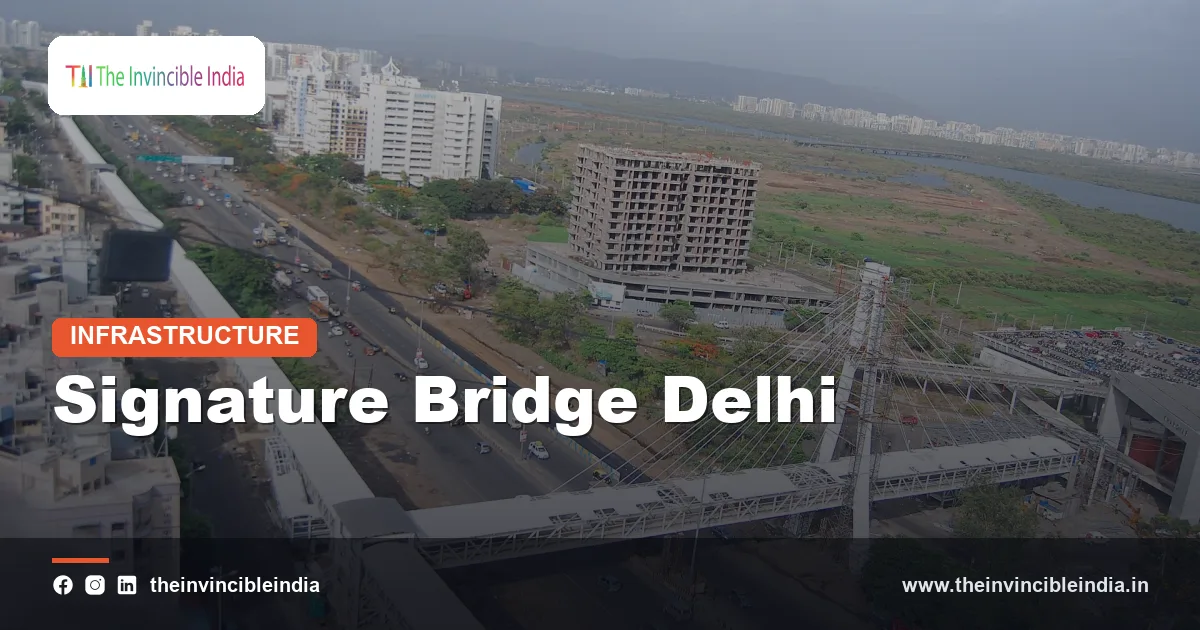
The Signature Bridge is a cable-stayed road bridge across the Yamuna river at Wazirabad in north Delhi, opened to traffic in November 2018 and notable as India’s first asymmetrical cable-stayed bridge, with a single inclined steel pylon rising about 154 metres. The Signature Bridge was planned to relieve the congested, ageing Wazirabad bridge and to link the Wazirabad and Outer Ring Road corridor with north-east Delhi, while also giving the capital a modern architectural landmark.
The Signature Bridge is as well known for its long construction history as for its looks. Approved in the early 2000s with the Commonwealth Games of 2010 in mind, the project was delayed for years by design revisions, cost escalation and contractual problems before it finally opened in 2018. This explainer sets out what the bridge is, how a cable-stayed design works, what the pylon and glass viewing gallery are, and why the project took so long.
| Attribute | Detail |
|---|---|
| Official name | Signature Bridge |
| Location | Over the Yamuna river at Wazirabad, north Delhi |
| Type | Asymmetrical cable-stayed bridge with a single inclined steel pylon |
| Opened to the public | 4 November 2018 |
| Pylon height | About 154 metres (roughly 505 feet) |
| Notable first | India’s first asymmetrical cable-stayed bridge |
| Owner and project agency | Government of the National Capital Territory (NCT) of Delhi, executed largely through the Delhi Tourism and Transportation Development Corporation (DTTDC) |
| Main purpose | Easing traffic on the old Wazirabad bridge and improving links with north-east Delhi |
| Special feature | Glass-fronted viewing gallery planned on the pylon |
Key Takeaways
- The Signature Bridge is a cable-stayed bridge over the Yamuna at Wazirabad in Delhi that opened to traffic on 4 November 2018.
- The Signature Bridge is described as India’s first asymmetrical cable-stayed bridge because its single steel pylon leans to one side and supports the deck with cables on one side only.
- The inclined pylon of the Signature Bridge rises to about 154 metres, which is more than twice the height of the Qutub Minar in Delhi.
- The Signature Bridge was conceived to reduce pressure on the old Wazirabad bridge, one of the few Yamuna crossings in north Delhi.
- The Signature Bridge was first planned for completion before the 2010 Commonwealth Games, but its cost and timeline grew several times over before it opened.
- The Signature Bridge is both a traffic project and a tourism landmark, with a viewing gallery on the pylon intended to give visitors a view over the Yamuna floodplain and the city.
What Is the Signature Bridge in Delhi?
The Signature Bridge in Delhi is a modern cable-stayed river bridge across the Yamuna at Wazirabad that doubles as an urban landmark. It carries road traffic over the river between the Wazirabad side of the city and the north-east Delhi side, and it was designed to be recognisable from a distance, which is where the word “signature” in its name comes from.
Unlike most bridges in the capital, which are plain concrete girder structures, the Signature Bridge has a tall steel pylon and a fan of steel cables that hold up the deck. The pylon is the structure’s defining feature and is visible from many parts of north Delhi. The bridge is part of the city’s effort to add river crossings across the Yamuna, which divides Delhi into a larger western and a smaller eastern half.
The bridge is owned and maintained by the Delhi government. It is a road bridge, designed for motor vehicles and with provision for pedestrians, and it is not a rail bridge or a toll bridge.
Where Is the Signature Bridge Located?
The Signature Bridge is located on the Yamuna at Wazirabad, in the northern part of the National Capital Territory of Delhi, a short distance downstream of the Wazirabad barrage and water-treatment area. Wazirabad is a place of strategic importance for the city because it is the point where much of Delhi’s raw drinking water is drawn from the river.
On the western bank, the bridge connects to the Wazirabad Road and Outer Ring Road corridor, which brings traffic from Civil Lines, Burari and the trans-Delhi belt of north-west Delhi. On the eastern bank, it links to roads serving north-east Delhi neighbourhoods and the routes that lead towards Uttar Pradesh and Ghaziabad.
The site was chosen because the stretch of the Yamuna at Wazirabad had a long-standing bottleneck. Before the new bridge, the older Wazirabad bridge was among the very few crossings serving the north of the city, and daily travel between the two banks was slow.
Why Was the Signature Bridge Built?
The Signature Bridge was built mainly to ease congestion at the old Wazirabad bridge and to give the fast-growing north-east and north Delhi areas a second major crossing of the Yamuna. Traffic from the eastern bank headed for places like Burari, the Outer Ring Road, Civil Lines and the national highways to the north had few alternatives, so the old bridge carried far more vehicles than it was designed for.
Planners had several aims in mind:
- Reduce traffic jams on the old Wazirabad bridge and on the roads feeding it, especially at peak hours.
- Improve connectivity between north-east Delhi and the Outer Ring Road, shortening trips that previously required a long detour via other Yamuna bridges.
- Cut travel time and fuel use for commuters and freight vehicles shifting between the two banks.
- Create a landmark that could attract tourists and improve the image of the capital’s riverfront.
The tourism idea is a distinctive feature of the project. Most Indian road bridges are justified only on traffic grounds, but the Signature Bridge was also pitched as a visitor attraction, with a viewing gallery and landscaping around its approaches.
How Does a Cable-Stayed Bridge Like the Signature Bridge Work?
A cable-stayed bridge works by hanging the road deck directly from straight cables that run to one or more tall towers, called pylons or towers, so that the towers take the load in compression while the cables carry it in tension. The Signature Bridge follows this principle, with steel stay cables running from the single pylon down to anchor points along the deck.
The basic components are easy to list:
- Pylon: the tall tower that carries the cable loads down into the foundations.
- Stay cables: the steel cables fanning from the pylon to points along the deck, each carrying a share of the deck’s weight.
- Deck: the roadway itself, built of steel and concrete elements.
- Foundations: deep piles sunk into the river bed and banks to support the pylon and deck ends.
Cable-stayed versus suspension bridges
A cable-stayed bridge differs from a suspension bridge, even though both use cables. A suspension bridge hangs its deck from vertical hangers attached to two huge main cables that drape between towers and are anchored far into the ground at both ends. A cable-stayed bridge connects each cable straight from the tower to the deck, so it needs no massive end anchorages and often suits medium spans of a few hundred metres, such as a river crossing.
Why a single pylon needs a counterbalance
With only one pylon and cables on one side, the Signature Bridge needs a way to balance the forces. Engineers solve this by inclining the pylon and by arranging the cables and anchorages so that the pull from the cables is balanced by the weight and the backward-leaning geometry of the pylon. This balancing act is what makes an asymmetrical single-pylon design more complex than a conventional symmetrical bridge with towers at both ends.
Why Is the Signature Bridge Called India’s First Asymmetrical Cable-Stayed Bridge?
The Signature Bridge is called India’s first asymmetrical cable-stayed bridge because it has one inclined pylon placed off-centre, with cables arranged unevenly on the two sides of that pylon, rather than a symmetrical arrangement of towers and cables. In a symmetrical cable-stayed bridge, a tower stands at the centre or two towers stand evenly, and the cables fan out equally on both sides. The Signature Bridge breaks that symmetry deliberately.
Earlier cable-stayed bridges in India, such as the Second Hooghly Bridge (Vidyasagar Setu) in Kolkata and the Bandra-Worli Sea Link in Mumbai, use more conventional layouts. The Signature Bridge’s single leaning tower gives it a distinctive profile that is often compared in popular accounts to a harp or a sail, and sometimes to a spear.
The claim “first of its kind” should be read narrowly. It refers to the asymmetrical single-pylon arrangement in India, not to the technology of cable-stayed bridges in general, which have been built in India since the late twentieth century.
How Tall Is the Signature Bridge and What Is the Viewing Gallery?
The Signature Bridge’s pylon is about 154 metres tall, which makes it one of the tallest structures in Delhi and roughly twice the height of the Qutub Minar. The pylon is made of steel and leans at an angle, and it is the part of the structure that people see first from a distance.
The pylon also carries a glass-fronted viewing gallery, often described as a glass box, intended to give visitors a panoramic view of the Yamuna, the Wazirabad area and the wider city. Visitors were meant to reach the gallery by lift. In practice, public access to the viewing gallery has been a matter of repeated announcements and delays, and readers should check current status before planning a visit, since access rules for high-level structures can change.
Key physical features at a glance
- A single inclined steel pylon of about 154 metres.
- A multi-lane carriageway with provision for pedestrians.
- A length of well over half a kilometre including approaches.
- Cables that carry the deck load to the pylon, tied back to anchorages on the bridge structure.
- Night lighting designed to make the pylon a visible landmark.
Dimensions quoted in news reports vary slightly depending on whether approach viaducts are counted, so the figures above are best treated as approximate.
Why Did the Signature Bridge Take So Long to Build?
The Signature Bridge took roughly fifteen years from approval to opening because of repeated design changes, cost escalation, contractor problems and the technical difficulty of building a steel pylon of that height and geometry. The project was first intended to be ready before the Commonwealth Games in Delhi in October 2010, a deadline it missed by many years.
The main reasons that contributed to the delay, as reported over the years, include:
- Complex design: the asymmetrical single-pylon concept was new to India and required detailed engineering and review.
- Escalating cost: the estimate rose several times from the early figure to well above the thousand-crore mark, as scope, steel quantities and time-related costs grew.
- Contractual and financing issues: disputes and changes in the executing arrangements slowed progress at several points.
- Steel fabrication and erection: large steel components had to be fabricated, transported and lifted into place with precision.
- Site constraints: work in a river floodplain, close to the barrage and the water-works, limited working windows.
The long delay became a common reference in discussions about public project management in India, because the early cost estimate was a small fraction of the final cost. Exact figures vary by report, so this article avoids quoting a single number as definitive.
What Is the Timeline of the Signature Bridge?
The Signature Bridge timeline runs from planning in the early 2000s to the opening in 2018, with the following broad milestones. The dates below are given in approximate form where sources differ.
| Period | Milestone |
|---|---|
| Early 2000s | Need for a new Yamuna crossing at Wazirabad identified; project conceived and approved. |
| Mid to late 2000s | Design finalised and construction work begins, with the 2010 Commonwealth Games as the target. |
| 2010 | Original target date passes without completion. |
| 2010s | Repeated revisions of cost and schedule; steel pylon erection and cable installation proceed in stages. |
| 4 November 2018 | Bridge opened to the public by the Delhi government. |
| After opening | Traffic management, safety measures and viewing gallery access remain topics of public discussion. |
How Did the Signature Bridge Change Traffic at Wazirabad?
The Signature Bridge gave north-east Delhi commuters a second major crossing near Wazirabad, which shifted a share of traffic away from the old Wazirabad bridge and shortened some cross-river journeys. It did not eliminate congestion in the area, because heavy traffic volumes on the connecting roads, junction design and the number of vehicles on Delhi’s roads all affect the outcome.
The effect on traffic is easiest to understand through three channels:
- Route choice: drivers heading from the Outer Ring Road side to north-east Delhi can use the new bridge instead of queuing at the older crossing.
- Journey time: some trips became shorter because they no longer need a long detour to another Yamuna bridge.
- Network resilience: having two nearby crossings means that a blockage on one has less impact on the other.
Traffic benefits on a crossing like this depend heavily on the quality of the junctions at either end. Planners often point out that a bridge only delivers its full benefit if the connecting roads can absorb the added flow.
How Does the Signature Bridge Compare With Other Major Indian Bridges?
The Signature Bridge is smaller in length than India’s long sea and river bridges, but it is distinctive for its single-pylon asymmetrical design and its urban setting. The table below compares it with a few other well-known Indian bridges, using approximate and widely reported descriptions.
| Bridge | Location | Type | Notable point |
|---|---|---|---|
| Signature Bridge | Delhi (Yamuna) | Asymmetrical cable-stayed, single pylon | Opened 2018; about 154 m pylon |
| Vidyasagar Setu (Second Hooghly Bridge) | Kolkata (Hooghly) | Cable-stayed | Opened in the 1990s; long-span city river crossing |
| Bandra-Worli Sea Link | Mumbai | Cable-stayed sea link | Opened 2009-2010; landmark sea crossing |
| Bogibeel Bridge | Assam (Brahmaputra) | Rail-cum-road girder bridge | Opened December 2018; among India’s longest rail-road bridges |
| Atal Setu | Mumbai (Mumbai Trans Harbour Link) | Long sea bridge | Opened 2024; India’s longest sea bridge |
What sets the Signature Bridge apart is not scale but form: it was conceived as an architectural statement as much as a traffic link, in a city where most river bridges are plain.
Is the Signature Bridge Safe and What Are the Rules for Visitors?
The Signature Bridge is designed and maintained as a road bridge, and authorities have restricted stunts, crowding and unsafe behaviour on it. Because the bridge became a popular spot for photography and night drives after it opened, there have been reports of overcrowding, vehicles stopping on the carriageway and risky stunts, which led the authorities to step up policing and traffic control.
Practical points that apply to visitors and drivers include:
- Stopping or parking on the carriageway is unsafe and generally prohibited.
- Stunt driving and racing are dangerous and punishable under traffic law.
- Pedestrian access and viewing gallery entry follow rules that the authorities can change, so current notices should be checked.
- Photography is best done from designated viewpoints and approach areas rather than from the traffic lanes.
As with any major public structure, the maintenance of cables, bearings and expansion joints is part of ongoing inspection, which is routine for cable-stayed bridges anywhere in the world.
Bottom Line
The Signature Bridge is a cable-stayed Yamuna crossing at Wazirabad, Delhi, opened in November 2018, and is known for being India’s first asymmetrical cable-stayed bridge with a single inclined pylon of about 154 metres. It was built to ease traffic at the old Wazirabad bridge and to create a landmark, and its long construction saga remains a case study in project delay and cost growth.
Frequently Asked Questions
When was the Signature Bridge in Delhi opened?
The Signature Bridge was opened to the public on 4 November 2018. It had originally been planned for completion before the 2010 Commonwealth Games, so it opened roughly eight years later than first intended. The project was executed by Delhi government agencies, notably the Delhi Tourism and Transportation Development Corporation.
How tall is the Signature Bridge pylon?
The pylon of the Signature Bridge is about 154 metres tall, or roughly 505 feet. This makes it far taller than the Qutub Minar in Delhi, which is about 73 metres. Reported dimensions vary slightly between sources, so the figure is best treated as approximate.
Why is the Signature Bridge called India’s first asymmetrical cable-stayed bridge?
The Signature Bridge is called India’s first asymmetrical cable-stayed bridge because it uses a single inclined pylon with cables arranged unevenly rather than a symmetrical tower-and-cable layout. This design is more complex to engineer than a conventional symmetrical bridge. The claim refers to this specific arrangement, not to cable-stayed bridges in general, which already existed in India.
What was the purpose of building the Signature Bridge?
The Signature Bridge was built mainly to reduce traffic on the old Wazirabad bridge and to improve connectivity between north-east Delhi and the Outer Ring Road corridor. It was also designed as a tourism landmark with a viewing gallery on the pylon. The bridge offers an additional crossing over the Yamuna in a part of Delhi that had few of them.
Why did the Signature Bridge take so long to complete?
The Signature Bridge took about fifteen years because of design complexity, cost escalation, contractual issues and the difficulty of erecting a tall steel pylon. It missed the 2010 Commonwealth Games target by many years. The gap between the early estimate and the final cost is widely discussed as a lesson in public project planning.
Can visitors go up to the glass viewing gallery on the Signature Bridge?
Public access to the glass viewing gallery on the Signature Bridge has been uncertain and subject to announcements and changes since the bridge opened. The gallery was designed to give panoramic views of the Yamuna and the city. Anyone planning a visit should check the latest official notice from the Delhi government before travelling.
{“@context”:”https://schema.org”,”@graph”:[{“@type”:”FAQPage”,”mainEntity”:[{“@type”:”Question”,”name”:”When was the Signature Bridge in Delhi opened?”,”acceptedAnswer”:{“@type”:”Answer”,”text”:”The Signature Bridge was opened to the public on 4 November 2018. It had originally been planned for completion before the 2010 Commonwealth Games, so it opened roughly eight years later than first intended. The project was executed by Delhi government agencies, notably the Delhi Tourism and Transportation Development Corporation.”}},{“@type”:”Question”,”name”:”How tall is the Signature Bridge pylon?”,”acceptedAnswer”:{“@type”:”Answer”,”text”:”The pylon of the Signature Bridge is about 154 metres tall, or roughly 505 feet. This makes it far taller than the Qutub Minar in Delhi, which is about 73 metres. Reported dimensions vary slightly between sources, so the figure is best treated as approximate.”}},{“@type”:”Question”,”name”:”Why is the Signature Bridge called India’s first asymmetrical cable-stayed bridge?”,”acceptedAnswer”:{“@type”:”Answer”,”text”:”The Signature Bridge is called India’s first asymmetrical cable-stayed bridge because it uses a single inclined pylon with cables arranged unevenly rather than a symmetrical tower-and-cable layout. This design is more complex to engineer than a conventional symmetrical bridge. The claim refers to this specific arrangement, not to cable-stayed bridges in general, which already existed in India.”}},{“@type”:”Question”,”name”:”What was the purpose of building the Signature Bridge?”,”acceptedAnswer”:{“@type”:”Answer”,”text”:”The Signature Bridge was built mainly to reduce traffic on the old Wazirabad bridge and to improve connectivity between north-east Delhi and the Outer Ring Road corridor. It was also designed as a tourism landmark with a viewing gallery on the pylon. The bridge offers an additional crossing over the Yamuna in a part of Delhi that had few of them.”}},{“@type”:”Question”,”name”:”Why did the Signature Bridge take so long to complete?”,”acceptedAnswer”:{“@type”:”Answer”,”text”:”The Signature Bridge took about fifteen years because of design complexity, cost escalation, contractual issues and the difficulty of erecting a tall steel pylon. It missed the 2010 Commonwealth Games target by many years. The gap between the early estimate and the final cost is widely discussed as a lesson in public project planning.”}},{“@type”:”Question”,”name”:”Can visitors go up to the glass viewing gallery on the Signature Bridge?”,”acceptedAnswer”:{“@type”:”Answer”,”text”:”Public access to the glass viewing gallery on the Signature Bridge has been uncertain and subject to announcements and changes since the bridge opened. The gallery was designed to give panoramic views of the Yamuna and the city. Anyone planning a visit should check the latest official notice from the Delhi government before travelling.”}}]}]}


