

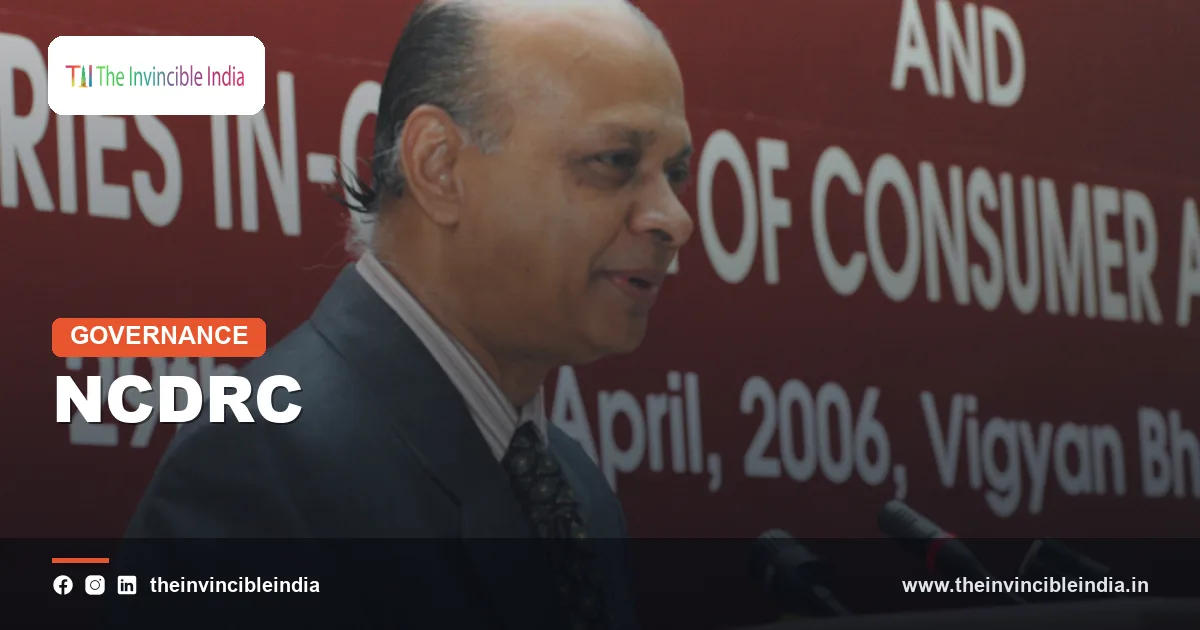
The National Consumer Disputes Redressal Commission (NCDRC) is India’s apex consumer court, a quasi-judicial body set up in 1988 under the Consumer Protection Act, 1986, and now functioning under the Consumer Protection Act, 2019, to resolve high-value and appellate consumer disputes. It sits at the top of a three-tier system that includes District and State Commissions, and its decisions can be appealed only to the Supreme Court of India.
The National Consumer Disputes Redressal Commission, based in New Delhi, decides original complaints above a high money limit, hears appeals from State Commissions, and exercises revision powers. This explainer covers its history, jurisdiction, powers, procedure and role in protecting consumer rights. Content was last reviewed on 17 October 2026.
| Attribute | Detail |
|---|---|
| Full name | National Consumer Disputes Redressal Commission (NCDRC) |
| Established | 1988, under the Consumer Protection Act, 1986 |
| Current law | Consumer Protection Act, 2019 (in force from July 2020) |
| Type | Apex quasi-judicial consumer court |
| Headquarters | New Delhi |
| Head | A President, who is a sitting or retired Supreme Court judge |
| Tiers | District Commission, State Commission, National Commission |
| Original jurisdiction | Complaints where the value of goods or services paid as consideration exceeds Rs 2 crore |
| Appeals from NCDRC | Supreme Court of India |
Key Takeaways
- The National Consumer Disputes Redressal Commission is the highest consumer forum in India and was created in 1988 under the Consumer Protection Act, 1986.
- The Consumer Protection Act, 2019, which replaced the 1986 Act, sets out the powers, jurisdiction and procedures of the National Consumer Disputes Redressal Commission.
- India’s consumer dispute system has three tiers, namely the District Commission, the State Commission and the National Commission, divided by the value of the consideration paid.
- Under the pecuniary limits notified in 2021, the NCDRC hears original complaints where the consideration exceeds Rs 2 crore, and also appeals and revision petitions.
- Decisions of the NCDRC can be appealed to the Supreme Court of India within 30 days under the 2019 Act.
- Consumers can file complaints online through government portals, and the 2019 Act provides for mediation, product liability claims and action against unfair trade practices.
What is the National Consumer Disputes Redressal Commission?
The National Consumer Disputes Redressal Commission is the national-level forum that resolves consumer disputes in India, especially those of high value, and supervises the consumer commissions below it. It was created to give consumers a fast, inexpensive and informal route to justice, as an alternative to slow civil courts.
The Commission is called a quasi-judicial body because it decides disputes through a judicial process, but it follows simpler procedures than regular civil courts. It is headed by a President who is a sitting or retired judge of the Supreme Court, supported by members with experience in law, commerce, public affairs or related fields.
Its work covers complaints about defective goods, deficient services, unfair trade practices and unfair contracts. Because it is an apex forum, its rulings on interpretation of consumer law have guided commissions throughout the country.
When was the NCDRC set up and why?
The National Consumer Disputes Redressal Commission was set up in 1988 under the Consumer Protection Act, 1986, which Parliament passed at the end of 1986 to protect consumer interests. The Act came after years of public demand for a faster remedy than ordinary civil litigation could provide.
Before the Act, an aggrieved buyer had to file a civil suit, which meant court fees, lawyers and years of delay. The 1986 Act created a separate system of consumer councils and consumer disputes redressal agencies. The national body began functioning in 1988, with its seat in New Delhi.
India observes National Consumer Day on 24 December to mark the date on which the 1986 Act received the President’s assent. In 2019, Parliament enacted a new Consumer Protection Act, which came into effect in July 2020 and replaced the older law with stronger tools to deal with modern issues such as e-commerce, misleading advertising and product liability.
How is the three-tier consumer system structured?
India’s consumer dispute system has three tiers, the District Consumer Disputes Redressal Commission, the State Consumer Disputes Redressal Commission and the National Consumer Disputes Redressal Commission, with each tier hearing cases according to the value of the claim. This hierarchy places smaller disputes close to the consumer and reserves the apex forum for larger and appellate matters.
| Tier | Original jurisdiction (value of consideration paid) | Appeals heard |
|---|---|---|
| District Commission | Up to Rs 50 lakh | None; its orders can be appealed to the State Commission |
| State Commission | More than Rs 50 lakh and up to Rs 2 crore | Appeals from District Commissions in the State |
| National Commission | More than Rs 2 crore | Appeals from State Commissions, and certain appeals against regulator orders |
Each State and Union Territory has a State Commission, and each district has at least one District Commission. The limits above are those notified in 2021 under rules framed under the 2019 Act. Under the earlier 1986 Act, the limits were based on the value of goods or services plus compensation claimed, but the 2019 Act and its rules link them to the consideration actually paid. Readers should confirm current limits with the latest government notification.
What is the pecuniary jurisdiction of the NCDRC?
The pecuniary jurisdiction of the National Consumer Disputes Redressal Commission covers original complaints in which the value of goods or services paid as consideration exceeds Rs 2 crore. This is the figure fixed in the Consumer Protection (Jurisdiction of the District Commission, the State Commission and the National Commission) Rules, 2021.
Before these rules, the 2019 Act had set the national threshold at Rs 10 crore, and the 1986 Act had earlier used figures based on claims. The change shifted many more cases to the State and District levels, relieving the apex body so that it can concentrate on the largest disputes and appeals.
The test is the consideration paid, not the compensation demanded. A buyer who paid Rs 40 lakh for a flat and claims Rs 2 crore as compensation for harassment would still file before the District Commission, because jurisdiction depends on the price paid.
What cases does the NCDRC decide?
The NCDRC decides original complaints above its monetary limit, appeals from State Commissions, revision petitions, and certain appeals against orders of consumer regulators. Its powers are laid out in the Consumer Protection Act, 2019.
- Original complaints: Complaints of defective goods, deficiency in service and unfair or restrictive trade practices where the consideration paid exceeds the specified limit.
- Appellate jurisdiction: Appeals against orders of State Commissions, which is a major part of its docket.
- Revision powers: Revision of orders of State Commissions where the State Commission appears to have exercised jurisdiction not vested in it or acted illegally.
- Unfair contracts: Complaints about unfair contract terms, when the value falls within the Commission’s jurisdiction.
- Regulator orders: Appeals against orders of the Central Consumer Protection Authority (CCPA).
Typical disputes include delayed possession of flats by builders, insurance claim rejections, medical negligence claims, banking and credit-card complaints, airline services, and faulty vehicles or appliances. The Commission also handles class-type disputes, where one or more consumers sue on behalf of many with the same interest.
How can a consumer file a complaint?
A consumer can file a complaint by submitting a written complaint with the relevant fee to the appropriate Commission, either in person, by post or online through the government’s e-filing portals. The complaint must be filed within two years of the date on which the cause of action arose, though the Commission may condone a delay for sufficient reason.
Choosing the right forum
A complainant must first work out which Commission has pecuniary jurisdiction, based on the consideration paid. The 2019 Act also allows the complainant to file the case where they reside or personally work for gain, which is much easier than travelling to the seller’s place of business.
E-filing through e-Daakhil
The government introduced the e-Daakhil portal to allow consumers to file complaints, pay fees and track cases online, and it was later extended to all States and Union Territories. The government has also been moving cases to a newer integrated platform, e-Jagriti, so the exact portal in use should be checked on the official consumer affairs website.
Fees
Complaints with a consideration of up to Rs 5 lakh do not attract a fee, and higher claims attract slab-based fees that increase with the value of the claim, up to a ceiling. A lawyer is not mandatory, and consumers can argue their own cases.
The Act envisages that complaints should be decided within three months of notice to the opposite party, or five months when laboratory testing of goods is needed. In practice, large pendency often means that cases take longer.
What is the appeal route from district to the Supreme Court?
The appeal route in consumer cases runs from the District Commission to the State Commission, then to the National Commission, and finally to the Supreme Court of India. Each stage has its own time limit and conditions.
| Order passed by | Appeal to | Time limit |
|---|---|---|
| District Commission | State Commission | 45 days |
| State Commission (in original jurisdiction) | National Commission | 30 days |
| National Commission (in original jurisdiction) | Supreme Court | 30 days |
An appellant who has been ordered to pay money must usually deposit 50 per cent of the amount awarded before the appeal is entertained. The Commission can condone delay if the appellant shows sufficient cause.
The Supreme Court, in addition, hears appeals against NCDRC orders passed in its original jurisdiction. For appeals decided by the NCDRC that arose from State Commission orders, a further remedy lies only in limited circumstances, such as through a special leave petition under Article 136 of the Constitution.
How does mediation work in consumer cases?
Mediation in consumer cases is a voluntary settlement process, built into the 2019 Act, in which a trained mediator helps the parties reach an agreement outside formal adjudication. The Act provides for Consumer Mediation Cells attached to the District, State and National Commissions.
Mediation may be suggested by the Commission at the first hearing if there seems to be scope for settlement, provided both parties agree in writing. A settlement reached through mediation is recorded and has the force of an order. If mediation fails, the case returns to the Commission for hearing on merits.
This process benefits both consumers and businesses by saving time and cost. The mediation has to be completed within a limited period, and the outcome is confidential in nature, which can encourage honest discussion.
What is product liability under the Consumer Protection Act, 2019?
Product liability under the Consumer Protection Act, 2019 is the responsibility of a product manufacturer, product service provider or product seller to compensate a consumer for harm caused by a defective product or deficient service. This is a new feature that the 1986 Act did not contain in the same form.
A product manufacturer can be held liable if the product has a manufacturing defect, a design defect, deviates from specifications, does not conform to the express warranty, or lacks adequate warnings or instructions. A service provider can be liable for faulty or inadequate service. A seller can also be liable in certain cases, for example where it exercised control over the product or made an independent express warranty.
The Act lists exceptions, and not every injury from a product leads to liability. For example, the seller or manufacturer may not be liable when a product was misused or altered, or where the harm resulted from the buyer’s own conduct. The provisions allow a consumer to claim for harm such as personal injury, property damage or mental agony.
How does the NCDRC deal with unfair trade practices and misleading advertisements?
The NCDRC deals with unfair trade practices by adjudicating complaints against traders and service providers who use deceptive or unfair methods, and the 2019 Act also created the Central Consumer Protection Authority (CCPA) to act against such practices in the wider public interest. An unfair trade practice includes false representations, misleading claims about quality or price, and refusal to take back defective goods or refund payment.
The CCPA, established in 2019, can investigate violations of consumer rights, order recalls of unsafe goods, direct refunds, and penalise misleading advertisements. It can also take class-wide action, unlike an individual complaint. Appeals against orders of the CCPA lie to the National Commission.
The Commission may order the removal of defects, replacement of goods, refund of price, payment of compensation, discontinuation of the unfair practice, and the payment of punitive damages in suitable cases. It can also direct that corrective advertisements be issued.
Which landmark rulings have shaped consumer law in India?
Several Supreme Court and NCDRC rulings have shaped consumer law in India, especially on what counts as a service and who is a consumer. The following examples are commonly cited.
- Lucknow Development Authority v. M.K. Gupta (1994) held that services provided by statutory development authorities, such as housing, can fall within the consumer law.
- Indian Medical Association v. V.P. Shantha (1995) held that most medical services, apart from certain free services, are covered by consumer law.
- Rulings on delayed possession of flats have reaffirmed that buyers can claim refund and compensation from builders for deficiency in service.
- Decisions on insurance claims have required insurers to act fairly and to give reasons for repudiation.
These decisions extend the reach of consumer law to sectors such as housing, health care and finance. Together with the Real Estate (Regulation and Development) Act, 2016, they give home buyers more than one avenue for relief.
Why does the NCDRC matter for ordinary consumers?
The National Consumer Disputes Redressal Commission matters because it provides a low-cost, accessible and specialised system for consumers, and its decisions set standards for fair dealing across all sectors. Millions of consumers deal with sellers who are far larger and better resourced, so an informal forum levels the field.
The apex body also guides lower Commissions through its judgments, which helps to create consistency. At the same time, the system faces challenges, including a large backlog, vacancies in State and District Commissions and delays in enforcement of orders. Digital filing, mediation and virtual hearings are among the steps taken to ease these pressures.
Consumers who understand their rights, keep invoices, warranty cards and correspondence, and send a written notice to the seller before filing, are better placed to succeed.
Bottom Line
The National Consumer Disputes Redressal Commission is the top tier of India’s three-level consumer court system, handling high-value complaints, appeals and revisions under the Consumer Protection Act, 2019. With online filing, mediation, product liability and unfair trade practice provisions, it gives consumers a practical route to redress, with final appeals before the Supreme Court.
Frequently Asked Questions
What is the NCDRC in India?
The NCDRC is the apex consumer court in India, set up in 1988 and based in New Delhi. It hears high-value consumer complaints, appeals from State Commissions and revision petitions. Its work is governed by the Consumer Protection Act, 2019.
What cases go to the National Consumer Commission?
The National Commission hears original complaints where the consideration paid for goods or services exceeds Rs 2 crore, as per the 2021 jurisdiction rules. It also hears appeals against State Commission orders and certain appeals against orders of the Central Consumer Protection Authority. Smaller disputes go to the District or State Commissions.
How can I file a consumer complaint online?
A consumer can file a complaint online through the government’s e-Daakhil portal, which is now being integrated into the e-Jagriti platform. The complainant registers, fills in the details, uploads documents and pays the fee, if any. Complaints up to Rs 5 lakh in consideration attract no fee.
Is a lawyer necessary to file a case before a consumer commission?
No, a lawyer is not necessary, because consumers are free to present their own cases before consumer commissions. The procedure is designed to be simple and informal. Many consumers still choose to hire advocates for complex disputes.
Can NCDRC orders be appealed?
Yes, an order passed by the NCDRC in its original jurisdiction can be appealed to the Supreme Court of India within 30 days. The appellant may have to deposit half of the awarded amount. The Supreme Court may condone a delay if there is sufficient cause.
What is the time limit to file a consumer complaint?
A consumer complaint must generally be filed within two years from the date on which the cause of action arose. The Commission can accept a later complaint if the complainant gives sufficient reasons for the delay. Keeping documents safe helps to prove the date and the grievance.
{“@context”:”https://schema.org”,”@graph”:[{“@type”:”FAQPage”,”mainEntity”:[{“@type”:”Question”,”name”:”What is the NCDRC in India?”,”acceptedAnswer”:{“@type”:”Answer”,”text”:”The NCDRC is the apex consumer court in India, set up in 1988 and based in New Delhi. It hears high-value consumer complaints, appeals from State Commissions and revision petitions. Its work is governed by the Consumer Protection Act, 2019.”}},{“@type”:”Question”,”name”:”What cases go to the National Consumer Commission?”,”acceptedAnswer”:{“@type”:”Answer”,”text”:”The National Commission hears original complaints where the consideration paid for goods or services exceeds Rs 2 crore, as per the 2021 jurisdiction rules. It also hears appeals against State Commission orders and certain appeals against orders of the Central Consumer Protection Authority. Smaller disputes go to the District or State Commissions.”}},{“@type”:”Question”,”name”:”How can I file a consumer complaint online?”,”acceptedAnswer”:{“@type”:”Answer”,”text”:”A consumer can file a complaint online through the government’s e-Daakhil portal, which is now being integrated into the e-Jagriti platform. The complainant registers, fills in the details, uploads documents and pays the fee, if any. Complaints up to Rs 5 lakh in consideration attract no fee.”}},{“@type”:”Question”,”name”:”Is a lawyer necessary to file a case before a consumer commission?”,”acceptedAnswer”:{“@type”:”Answer”,”text”:”No, a lawyer is not necessary, because consumers are free to present their own cases before consumer commissions. The procedure is designed to be simple and informal. Many consumers still choose to hire advocates for complex disputes.”}},{“@type”:”Question”,”name”:”Can NCDRC orders be appealed?”,”acceptedAnswer”:{“@type”:”Answer”,”text”:”Yes, an order passed by the NCDRC in its original jurisdiction can be appealed to the Supreme Court of India within 30 days. The appellant may have to deposit half of the awarded amount. The Supreme Court may condone a delay if there is sufficient cause.”}},{“@type”:”Question”,”name”:”What is the time limit to file a consumer complaint?”,”acceptedAnswer”:{“@type”:”Answer”,”text”:”A consumer complaint must generally be filed within two years from the date on which the cause of action arose. The Commission can accept a later complaint if the complainant gives sufficient reasons for the delay. Keeping documents safe helps to prove the date and the grievance.”}}]}]}


