

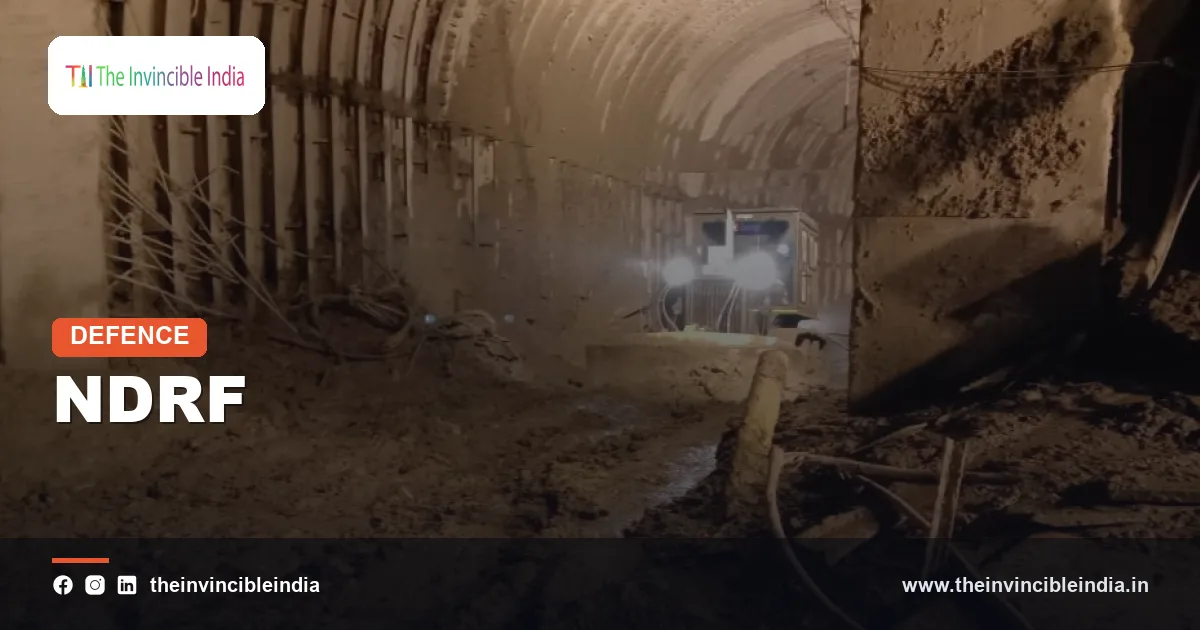
The National Disaster Response Force (NDRF) is India’s specialised, multi-disciplinary force for responding to natural and man-made disasters, raised in 2006 under the Disaster Management Act, 2005 and functioning under the National Disaster Management Authority (NDMA). Its trained battalions rescue people from floods, cyclones, earthquakes, landslides, building collapses and chemical or nuclear emergencies, and are positioned across the country for rapid deployment.
The National Disaster Response Force is staffed by personnel on deputation from India’s Central Armed Police Forces and works under the Ministry of Home Affairs. This explainer covers its origin, structure, training, equipment, notable operations and international missions. Content was last reviewed on 17 October 2026.
| Attribute | Detail |
|---|---|
| Full name | National Disaster Response Force (NDRF) |
| Raised | 2006 |
| Legal basis | Section 44 of the Disaster Management Act, 2005 |
| Parent body | National Disaster Management Authority (NDMA), under the Ministry of Home Affairs |
| Type | Specialised disaster response force with battalion structure |
| Personnel source | Central Armed Police Forces such as BSF, CRPF, CISF, ITBP and SSB |
| Battalions | 16 battalions in recent years, after starting with 8 |
| Headquarters | New Delhi, headed by a Director General |
| Motto | Aapda Seva Sadaiv Sarvatra (Disaster Service, Always and Everywhere) |
Key Takeaways
- The National Disaster Response Force is a specialised force of India constituted under Section 44 of the Disaster Management Act, 2005, and raised in 2006.
- The National Disaster Response Force is staffed with personnel drawn on deputation from the Central Armed Police Forces, including the BSF, CRPF, CISF, ITBP and SSB.
- The NDRF began with eight battalions and has expanded over time to a larger number, with its teams placed in different States so that they can reach affected areas quickly.
- NDRF personnel are trained for floods, collapsed structures, earthquakes, cyclones and chemical, biological, radiological and nuclear (CBRN) emergencies.
- The NDRF has carried out major rescue operations in India, including during the Kerala floods of 2018, and has also served abroad in Nepal in 2015 and Turkey in 2023.
- The NDRF complements, and does not replace, the State Disaster Response Forces (SDRF), which are the first responders at the State level.
What is the National Disaster Response Force?
The National Disaster Response Force is a dedicated, professionally trained force that responds to natural and man-made disasters anywhere in India at the request of the State governments or the central government. It is a unique force, because unlike the police or paramilitary units, its main job is search, rescue and relief during emergencies.
The NDRF acts as a specialist response arm of India’s disaster management system. Its teams carry boats, cutting tools, medical kits, communication gear, and trained rescue dogs. They can work in difficult conditions, including flooded villages, collapsed buildings, landslide zones and contaminated sites.
The NDRF also trains local people, State responders and community volunteers, which extends its impact beyond direct rescue. It is under the overall guidance of the National Disaster Management Authority, which is the apex body for disaster policy in India.
Why was the NDRF created?
The NDRF was created because a series of major disasters in India in the 1990s and early 2000s showed the need for a dedicated, trained national response force. The Odisha super cyclone of 1999, the Gujarat earthquake of 2001 and the Indian Ocean tsunami of 2004 exposed gaps in coordination, equipment and specialised rescue skills.
After the 2004 tsunami, Parliament passed the Disaster Management Act, 2005, which created a three-level institutional framework: the National Disaster Management Authority at the national level, State Disaster Management Authorities in the States, and District Disaster Management Authorities in the districts. Section 44 of the Act provided for a specialist response force, which became the NDRF.
The force was formally raised in 2006. Earlier, disaster response was largely left to the Army, the civil administration and ad hoc teams, which was effective but not specialised. The NDRF was meant to fill that gap with a standing, trained and equipped force that could be deployed fast.
How is the NDRF structured?
The NDRF is structured as a set of battalions, each organised into specialist teams, with a Director General at the headquarters in New Delhi. Each battalion is self-contained and can operate on its own with its own equipment.
Battalions and teams
The force started with eight battalions in 2006, drawn from the BSF, CRPF, CISF and ITBP. More battalions were added over the following years, including from the Sashastra Seema Bal (SSB), and the number has risen to 16 in recent years. A battalion has roughly one thousand personnel and is divided into specialised search and rescue teams, plus medical and paramedical elements.
Strategic positioning
Battalions are stationed in different parts of India, chosen in view of the regional hazard profile. For example, some are located in disaster-prone regions of the east coast for cyclones, in the Himalayan belt for earthquakes and landslides, and in flood-prone basins such as the Brahmaputra. In addition, regional response centres allow quick staging of personnel and equipment.
Pre-positioning
When a cyclone or severe flood warning is issued, the NDRF pre-positions teams in vulnerable areas ahead of the event, often before landfall. This approach has helped to save lives through early evacuations and rapid response.
Who runs the NDRF?
The NDRF is run by a Director General, who is a senior Indian Police Service officer, under the policy direction of the National Disaster Management Authority and the administrative control of the Ministry of Home Affairs. The NDMA is chaired by the Prime Minister, and it lays down national disaster management policies, plans and guidelines.
Day-to-day command rests with the NDRF’s own leadership, who work with State governments, district magistrates and local authorities. The force generally acts when the State government requests assistance, since States have primary responsibility for disaster response within their territory.
Personnel come on deputation from the parent Central Armed Police Forces, and return to their forces after a tenure. This arrangement brings in a pool of disciplined and physically fit personnel, who then receive specialist disaster training.
How are NDRF personnel trained?
NDRF personnel undergo intensive training in specialist rescue skills, including flood and water rescue, collapsed structure search and rescue, medical first response and response to CBRN emergencies. The training is continuous, and it combines classroom instruction, field exercises and mock drills.
- Flood rescue: Boat handling, swimming, diving and rescuing people from swift water.
- Collapsed structure search and rescue: Use of cutting, lifting and shoring tools and listening devices to locate trapped people in rubble.
- Medical first response: Stabilising injured people on site and moving them safely.
- CBRN response: Operating in environments contaminated by chemical, biological, radiological or nuclear hazards.
- Mountain and landslide rescue: Operating at height and on unstable terrain.
The force has a training academy in Nagpur and uses other facilities and partner institutions. Personnel also train with international agencies and attend courses on urban search and rescue standards, in line with guidelines of the International Search and Rescue Advisory Group. In addition, the NDRF runs awareness programmes for schools, communities and local volunteers, under the name Aapda Mitra and other initiatives.
What equipment does the NDRF use?
The NDRF uses specialised equipment for rescue, medical support, communication and protection, including boats, life jackets, rescue ropes, hydraulic cutters, breathing apparatus and detection devices. Each team carries items suited to the kinds of disasters it may face.
| Category | Typical equipment |
|---|---|
| Flood rescue | Inflatable boats, outboard motors, life jackets, life buoys, diving gear |
| Collapsed structures | Concrete cutters, hydraulic jacks, rescue ropes, acoustic listening devices, search cameras |
| Medical support | First aid kits, stretchers, oxygen, trauma equipment |
| CBRN | Protective suits, detectors, decontamination equipment |
| Communication | Satellite phones, radio sets, GPS devices |
| Animal support | Trained canine units for locating survivors |
The NDRF also has trained dog squads, which can find people trapped under debris by scent. Some dogs have been honoured for their work during missions.
What are some famous NDRF rescue operations in India?
Famous NDRF operations in India include the Kerala floods of 2018, several major cyclones on the east and west coasts, the Uttarakhand disasters in the Himalayas and numerous building collapses in cities. In each of these, NDRF teams rescued large numbers of people and carried out relief work.
- Kerala floods, 2018: NDRF teams, along with the armed forces, state agencies and local fishermen, rescued thousands of stranded people in one of the worst floods in the State in a century.
- Cyclones: During cyclones such as Phailin (2013), Hudhud (2014), Fani (2019), Amphan (2020) and Biparjoy (2023), the NDRF pre-positioned teams and helped evacuations, which are credited with keeping casualties low.
- Uttarakhand, 2013 and 2021: NDRF personnel took part in rescue operations after the Kedarnath flood disaster and after the Chamoli glacier burst.
- Building collapses: Teams have been deployed after collapses in cities including Mumbai and Delhi to dig out trapped residents.
- Train accidents: The NDRF has helped in rescue operations at major rail accidents, working with the railways and local authorities.
These operations are described in broad terms because casualty and rescue figures are updated by authorities after events, and exact numbers differ across reports.
Has the NDRF served outside India?
Yes, the NDRF has taken part in international relief missions, deploying teams to Nepal in 2015 and Turkey in 2023, among other humanitarian efforts. These missions are part of India’s wider disaster diplomacy and its support for neighbours and partners.
Nepal, 2015
After the devastating Nepal earthquake of April 2015, India launched Operation Maitri. NDRF teams, along with other Indian agencies, flew to Nepal to search for survivors, clear rubble and provide medical help in affected areas, including around Kathmandu.
Turkey, 2023
After the major earthquakes in Turkey and Syria in February 2023, India sent NDRF teams with specialised equipment and dog squads under Operation Dost. The teams worked in the affected areas of Turkey and set up medical facilities, and they were recognised by the Turkish authorities for their work.
The NDRF has also supported other international exercises and trainings. Such missions allow the force to share experience and learn global best practices.
How does the NDRF differ from the SDRF and the Army?
The NDRF differs from the State Disaster Response Force (SDRF) in that it is a central force deployed across States, while the SDRF is a State-level force that acts as first responder within its own State. The Army, in turn, is a defence force that supports civil authorities in major disasters when asked.
| Feature | NDRF | SDRF | Armed forces |
|---|---|---|---|
| Level | National | State | National defence force |
| Main role | Specialist disaster response | First response within the State | Defence; assists civil authorities in major disasters |
| Legal basis | Section 44, Disaster Management Act, 2005 | Disaster Management Act, 2005, and State constitution of units | Defence laws; aid to civil authority |
| Deployment | On request of States or the central government | Within the State | On request when civil resources are insufficient |
| Funding | Central funds | State Disaster Response Fund with central contribution | Defence budget |
This layered approach lets the nearest and fastest force respond first, with the NDRF and the armed forces supporting if the disaster is beyond local capacity.
Why does the NDRF matter?
The NDRF matters because it gives India a standing, professional force that can respond quickly to disasters in a country exposed to floods, cyclones, earthquakes, landslides and droughts. A large share of India’s land area is vulnerable to one or more natural hazards, and the density of population raises the human cost of every event.
The NDRF has helped to shift India’s approach from relief after the event to preparedness and prevention. Its training of local communities, its pre-positioning ahead of warnings and its close work with the India Meteorological Department and State authorities have become standard parts of the response system.
The force also faces challenges, such as the need for more personnel in remote regions, modern equipment, aerial support and better coordination with local bodies. The government has expanded the force and stressed its modernisation as part of disaster-resilience plans.
Bottom Line
The National Disaster Response Force is India’s specialist disaster rescue force, raised in 2006 under the Disaster Management Act, 2005 and manned by personnel from the Central Armed Police Forces. Trained for floods, collapses, cyclones and hazardous-material emergencies, the NDRF works with the NDMA, States and the armed forces, and has served abroad in Nepal and Turkey.
Frequently Asked Questions
What is the NDRF in India?
The NDRF is the National Disaster Response Force, a specialised force raised in 2006 under the Disaster Management Act, 2005 to respond to natural and man-made disasters. It works under the National Disaster Management Authority and the Ministry of Home Affairs. Its battalions are based across India.
Who forms the NDRF battalions?
NDRF battalions are formed from personnel on deputation from the Central Armed Police Forces, such as the BSF, CRPF, CISF, ITBP and SSB. They receive specialist training in disaster response. After a tenure, they return to their parent forces.
How many battalions does the NDRF have?
The NDRF started with eight battalions in 2006 and has expanded to 16 in recent years. Each battalion has around a thousand personnel and several specialist rescue teams. The number may increase further as the government expands the force.
What types of disasters does the NDRF handle?
The NDRF handles a wide range of natural and man-made disasters, including floods, cyclones, earthquakes, landslides, building collapses and chemical, biological, radiological and nuclear emergencies. Its teams are trained and equipped for each of these. It also supports relief and evacuation efforts.
Has the NDRF worked in other countries?
Yes, the NDRF has deployed teams abroad, including to Nepal after the 2015 earthquake under Operation Maitri and to Turkey after the 2023 earthquakes under Operation Dost. These missions involved search and rescue and medical support. They form part of India’s humanitarian assistance to other countries.
What is the difference between the NDRF and the SDRF?
The NDRF is a national force that can be deployed anywhere in India, while the SDRF is a State-level force that responds within its own State. The SDRF is usually the first responder, and the NDRF supports it in larger disasters. Both operate under the framework of the Disaster Management Act, 2005.
{“@context”:”https://schema.org”,”@graph”:[{“@type”:”FAQPage”,”mainEntity”:[{“@type”:”Question”,”name”:”What is the NDRF in India?”,”acceptedAnswer”:{“@type”:”Answer”,”text”:”The NDRF is the National Disaster Response Force, a specialised force raised in 2006 under the Disaster Management Act, 2005 to respond to natural and man-made disasters. It works under the National Disaster Management Authority and the Ministry of Home Affairs. Its battalions are based across India.”}},{“@type”:”Question”,”name”:”Who forms the NDRF battalions?”,”acceptedAnswer”:{“@type”:”Answer”,”text”:”NDRF battalions are formed from personnel on deputation from the Central Armed Police Forces, such as the BSF, CRPF, CISF, ITBP and SSB. They receive specialist training in disaster response. After a tenure, they return to their parent forces.”}},{“@type”:”Question”,”name”:”How many battalions does the NDRF have?”,”acceptedAnswer”:{“@type”:”Answer”,”text”:”The NDRF started with eight battalions in 2006 and has expanded to 16 in recent years. Each battalion has around a thousand personnel and several specialist rescue teams. The number may increase further as the government expands the force.”}},{“@type”:”Question”,”name”:”What types of disasters does the NDRF handle?”,”acceptedAnswer”:{“@type”:”Answer”,”text”:”The NDRF handles a wide range of natural and man-made disasters, including floods, cyclones, earthquakes, landslides, building collapses and chemical, biological, radiological and nuclear emergencies. Its teams are trained and equipped for each of these. It also supports relief and evacuation efforts.”}},{“@type”:”Question”,”name”:”Has the NDRF worked in other countries?”,”acceptedAnswer”:{“@type”:”Answer”,”text”:”Yes, the NDRF has deployed teams abroad, including to Nepal after the 2015 earthquake under Operation Maitri and to Turkey after the 2023 earthquakes under Operation Dost. These missions involved search and rescue and medical support. They form part of India’s humanitarian assistance to other countries.”}},{“@type”:”Question”,”name”:”What is the difference between the NDRF and the SDRF?”,”acceptedAnswer”:{“@type”:”Answer”,”text”:”The NDRF is a national force that can be deployed anywhere in India, while the SDRF is a State-level force that responds within its own State. The SDRF is usually the first responder, and the NDRF supports it in larger disasters. Both operate under the framework of the Disaster Management Act, 2005.”}}]}]}


