

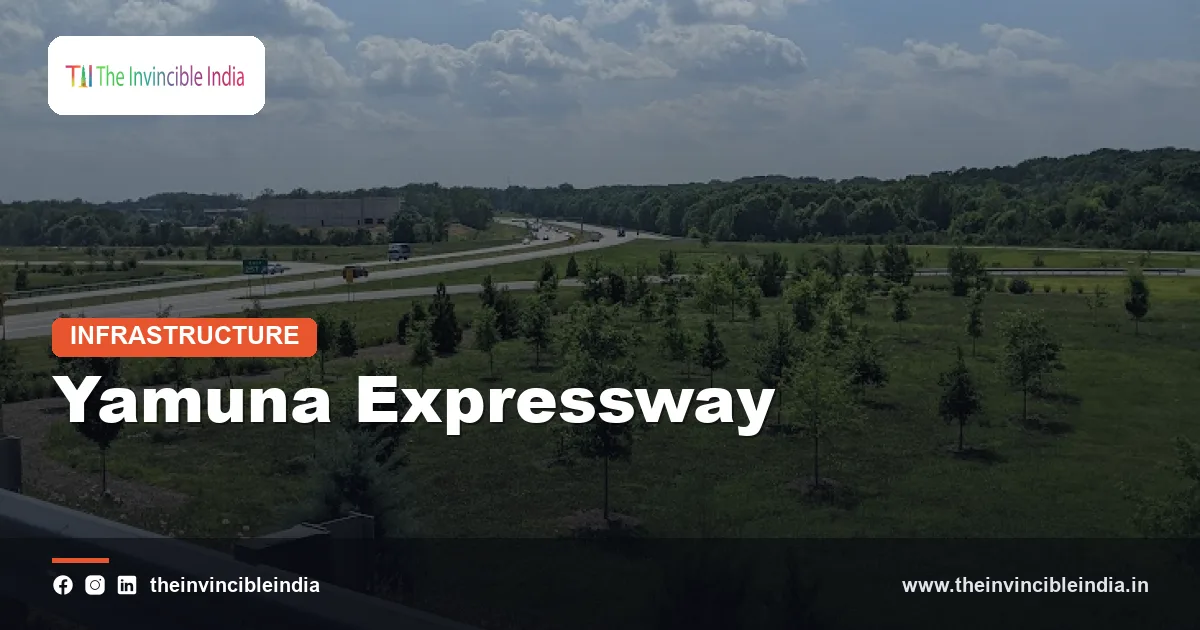
The Yamuna Expressway is a roughly 165 km, six-lane (expandable to eight-lane) access-controlled tolled expressway in Uttar Pradesh that connects Greater Noida with Agra and runs largely parallel to the Yamuna river. The Yamuna Expressway was developed by Jaypee Infratech Limited (JIL) under a concession from the Yamuna Expressway Industrial Development Authority (YEIDA) and was opened to traffic in 2012, making Delhi-Agra road travel significantly faster.
The Yamuna Expressway matters for three reasons: it provides the quickest road access from the national capital region to the Taj Mahal, it anchors a belt of planned urban and industrial development including the Noida International Airport at Jewar, and it has become well known for road-safety concerns on its long, straight stretches. This explainer covers the route, the builders, the financing model, the tourism and airport links, and the safety debate.
| Attribute | Detail |
|---|---|
| Official name | Yamuna Expressway (formerly known in planning as the Taj Expressway) |
| Approximate length | About 165 km |
| Type | Six-lane, access-controlled, tolled expressway; designed to be expandable to eight lanes |
| Authority | Yamuna Expressway Industrial Development Authority (YEIDA) |
| Concessionaire | Jaypee Infratech Limited (JIL), a Jaypee Group company |
| Opened | August 2012 |
| Termini | Greater Noida (Noida side) to the Agra outskirts |
| Districts crossed | Gautam Buddh Nagar, Bulandshahr, Aligarh, Mathura and Agra |
| Associated landmarks | Buddh International Circuit, Noida International Airport (Jewar), Noida Film City proposal |
Key Takeaways
- The Yamuna Expressway is an approximately 165 km six-lane, access-controlled tolled expressway between Greater Noida and Agra in Uttar Pradesh.
- The Yamuna Expressway was opened in August 2012 and was developed by Jaypee Infratech Limited under a long-term concession from the Yamuna Expressway Industrial Development Authority (YEIDA).
- The Yamuna Expressway passes through five districts, Gautam Buddh Nagar, Bulandshahr, Aligarh, Mathura and Agra, and cut the Delhi region to Agra drive to a few hours.
- The Yamuna Expressway runs close to Jewar, the site of the Noida International Airport, and to the Buddh International Circuit, which hosted the Indian Grand Prix in the early 2010s.
- The Yamuna Expressway is widely used by tourists travelling to the Taj Mahal, and it also serves pilgrims heading to Mathura and Vrindavan.
- The Yamuna Expressway has become known for accidents caused by speeding, driver fatigue, tyre bursts and winter fog, which has led to repeated safety measures.
What is the Yamuna Expressway?
The Yamuna Expressway is a limited-access highway that carries fast, long-distance traffic between the Delhi-Noida region and Agra without level crossings or local access. Vehicles use designated entry and exit points, and the road is fenced and divided, which sets it apart from older national highways such as the Delhi-Agra route through Mathura.
The Yamuna Expressway was one of the first large expressways built in Uttar Pradesh and was seen as a template for the state’s later projects, including the Agra-Lucknow, Purvanchal, Bundelkhand and Ganga expressways. At the time it opened, it was among the longest six-lane concrete expressways in India. The posted speed limit for light vehicles is around 100 km/h, and the road is tolled by vehicle class and distance.
Where does the Yamuna Expressway run?
The Yamuna Expressway runs from the Noida and Greater Noida region, in Gautam Buddh Nagar district, southward to Agra, passing through Bulandshahr, Aligarh and Mathura on the way. On the Noida side it connects to the Noida-Greater Noida Expressway, which in turn links to Delhi, and at the Agra end it joins the main highway network near the city.
The alignment follows the Yamuna river’s western plain, so the route is flat and mostly straight, passing through farmland and villages. Interchanges serve places such as Jewar, Tappal, Mathura and Vrindavan, and Agra. Because the road bypasses city centres, drivers get few visual cues or stops, which is a factor in the fatigue-related accident debate discussed later.
Who built the Yamuna Expressway?
Jaypee Infratech Limited (JIL), part of the Jaypee Group, built the Yamuna Expressway under a build-own-operate-transfer style concession awarded by the Yamuna Expressway Industrial Development Authority (YEIDA). YEIDA is the Uttar Pradesh government body that plans and regulates development along the expressway.
Under the concession, JIL built the road and collects toll for a long period, reported to be about 36 years, after which the asset reverts to the state. The project cost was reported to be well above ten thousand crore rupees. The expressway was constructed in roughly three years, and it opened in August 2012, ahead of the later generation of state-built expressways in Uttar Pradesh.
- Authority: Yamuna Expressway Industrial Development Authority (YEIDA).
- Developer and concessionaire: Jaypee Infratech Limited (JIL).
- Concession term: a long multi-decade period, reported at about 36 years.
- Government role: land acquisition, regulation and area planning.
How was the Yamuna Expressway financed?
The Yamuna Expressway was financed through a mix of borrowing, equity and the right to develop large land parcels along the route, in addition to toll revenue. The state government allowed the developer to build townships and commercial properties on parcels near the expressway, so that real estate earnings could help cover the road’s cost.
This model reduced the burden on public funds but tied the road’s finances to the property market. When demand for real estate in the Noida region weakened in the mid-2010s, the developer faced severe financial stress. Jaypee Infratech later entered a corporate insolvency resolution process, and its course has been long and complex. Readers who need the current ownership or toll arrangements should check recent official and court announcements, since these details have changed over time.
Why was the Yamuna Expressway built?
The Yamuna Expressway was built to speed up travel between the Delhi region and Agra, relieve the congested Delhi-Agra national highway, and open up land along the Yamuna for urban and industrial development. The older highway ran through Faridabad, Palwal and Mathura and was slow because of traffic and local crossings.
Agra receives millions of domestic and international visitors for the Taj Mahal, Agra Fort and Fatehpur Sikri, and the journey from Delhi was a long-standing pain point for tourism. Planners also wanted to shift growth away from the saturated Delhi-Noida core toward the Greater Noida and Yamuna belt. The expressway was therefore both a transport project and an urban development strategy.
How does the Yamuna Expressway help tourism and the Taj Mahal?
The Yamuna Expressway helps tourism by making day trips from Delhi and Noida to the Taj Mahal and other Agra monuments practical, with a drive that takes a few hours instead of most of a day. This has benefited the hotel, guide, handicraft and transport sectors in Agra.
The expressway also improves access to Mathura and Vrindavan, major pilgrimage centres associated with Lord Krishna, as well as to the Braj region more broadly. Bus and cab operators run frequent services along the route. At the same time, tourism officials point out that faster access can encourage short, rushed visits, and they have urged travellers to stay longer in Agra to support local businesses.
What is the Yamuna Expressway’s link with Noida International Airport at Jewar?
The Yamuna Expressway is the main road artery to the Noida International Airport, also called Jewar Airport, which is being built in the Jewar area of Gautam Buddh Nagar district close to the expressway. The airport was conceived to relieve Delhi’s Indira Gandhi International Airport and to serve western Uttar Pradesh.
The airport project was awarded to a concessionaire led by Zurich Airport International, and its foundation stone was laid in late 2021. The opening schedule has been revised several times, so readers should rely on current official updates. Once operational, the airport is expected to drive demand for logistics, aviation, hospitality and warehousing along the Yamuna Expressway, and to increase traffic on the road.
What is Noida Film City and what else is planned along the Yamuna Expressway?
Noida Film City is a proposed large film and media complex in the Yamuna Expressway region, planned by YEIDA to attract film production, studios and related industry. It is meant to give Uttar Pradesh a major entertainment hub and generate jobs, though progress has been slower than first announced.
Other developments planned or underway near the Yamuna Expressway include industrial parks, a medical devices park, data centres, electronics and toy manufacturing clusters, townships and educational institutions. The Buddh International Circuit, a Formula One-grade motor racing track, sits near the expressway and hosted the Indian Grand Prix in the early 2010s. The pace and scale of each project differ, and announcements should be distinguished from completed work.
| Development | Role along the Yamuna Expressway |
|---|---|
| Noida International Airport (Jewar) | Second airport for the Delhi region and a logistics magnet |
| Noida Film City (proposed) | Film, television and media production hub |
| Buddh International Circuit | Motorsport venue that hosted Formula One races in the early 2010s |
| Industrial and logistics parks | Manufacturing, warehousing and electronics clusters |
| Residential townships | New housing for commuters and workers |
Why is road safety a concern on the Yamuna Expressway?
Road safety is a concern on the Yamuna Expressway because its long, straight, flat alignment encourages speeding and can induce driver fatigue, and these factors have contributed to many serious accidents. Tyre bursts at high speed, sudden braking, stray animals and dense winter fog add to the risk.
Authorities have responded with measures such as speed cameras, lane discipline enforcement, patrol vehicles, ambulances, cranes and awareness campaigns, and they have discussed bans or limits on certain slow vehicles. Experts recommend regular rest breaks, correct tyre pressure and avoiding night driving when tired. Reducing accidents is considered a shared responsibility of the concessionaire, the state authorities and individual drivers.
What can drivers do to stay safe?
Drivers can stay safe on the Yamuna Expressway by keeping to the speed limit, taking a break every couple of hours, checking tyres before the trip, avoiding driving when drowsy and slowing down in fog. Lane discipline matters too, since heavy vehicles are expected to use the left lane.
How does tolling work on the Yamuna Expressway?
Tolling on the Yamuna Expressway is charged by vehicle class and distance at toll plazas along the route, and electronic payment through FASTag is standard. The toll rights lie with the concessionaire under the agreement with YEIDA, and rates are revised from time to time.
The Yamuna Expressway is often described as relatively expensive for a drive of its length, which has been a source of public complaints. Because the concession terms and the insolvency proceedings of the developer have affected the arrangements, travellers should check the latest toll schedule instead of relying on older figures.
What is the future outlook for the Yamuna Expressway?
The future outlook for the Yamuna Expressway is tied to the growth of the Jewar airport area, the success of planned industrial and media projects, and a resolution of the financial problems of its developer. If these come together, traffic is likely to rise and the planned widening from six to eight lanes may become necessary.
The Yamuna Expressway is also becoming part of a larger network, as it connects with newer expressways in Uttar Pradesh and with the national highway grid. Improved safety management and clearer governance are the main steps needed to make the road a model of reliable, modern infrastructure.
How does the Yamuna Expressway compare with other Uttar Pradesh expressways?
The Yamuna Expressway differs from newer Uttar Pradesh expressways mainly in its ownership model, because it was built by a private developer under a concession, whereas later roads such as the Purvanchal, Bundelkhand and Ganga expressways were built by a state agency using public funds. This difference affects who collects toll, who maintains the road and how quickly disputes can be settled.
The Yamuna Expressway is also shorter than several of the newer state-built expressways but carries heavier tourism-related traffic, since it serves the Delhi-Agra-Mathura circuit. Its experience with concession finance, real estate linkages and safety management is closely watched by planners designing future corridors.
Bottom Line
The Yamuna Expressway is a roughly 165 km six-lane tolled expressway linking Greater Noida with Agra, and it has reshaped access to the Taj Mahal and the Noida-Jewar belt. Its future depends on airport-led growth, better road safety and settled governance of the concession.
Frequently Asked Questions
How long is the Yamuna Expressway?
The Yamuna Expressway is roughly 165 km long. It runs from Greater Noida to the outskirts of Agra, mostly parallel to the Yamuna river. Official sources sometimes quote the length slightly differently, so it is best treated as approximately 165 km.
When did the Yamuna Expressway open?
The Yamuna Expressway opened in August 2012. It was developed by Jaypee Infratech Limited under a concession from the Yamuna Expressway Industrial Development Authority (YEIDA). It was one of the first long expressways in Uttar Pradesh.
Who built and operates the Yamuna Expressway?
Jaypee Infratech Limited (JIL) built the Yamuna Expressway under a long-term concession from YEIDA. The concessionaire collects toll for the concession period, after which the road reverts to the state. The company has been through an insolvency process, so readers should check current arrangements.
How many lanes does the Yamuna Expressway have?
The Yamuna Expressway has six lanes, three in each direction. It was designed so that it can be expanded to eight lanes in future. Widening would depend on how traffic grows.
How is the Yamuna Expressway connected to Noida International Airport?
The Yamuna Expressway is the main road route to Noida International Airport at Jewar. The airport site lies close to the expressway in Gautam Buddh Nagar district. Once the airport is fully operational, it is expected to raise traffic and trigger logistics and industrial growth along the road.
Why are there so many accidents on the Yamuna Expressway?
Accidents on the Yamuna Expressway are mainly linked to high speeds, driver fatigue on long straight stretches, tyre bursts and fog in winter. The road’s flat, monotonous alignment makes it easy to lose attention. Authorities have added cameras, patrols and awareness measures, but safe driving habits remain essential.
{“@context”:”https://schema.org”,”@graph”:[{“@type”:”FAQPage”,”mainEntity”:[{“@type”:”Question”,”name”:”How long is the Yamuna Expressway?”,”acceptedAnswer”:{“@type”:”Answer”,”text”:”The Yamuna Expressway is roughly 165 km long. It runs from Greater Noida to the outskirts of Agra, mostly parallel to the Yamuna river. Official sources sometimes quote the length slightly differently, so it is best treated as approximately 165 km.”}},{“@type”:”Question”,”name”:”When did the Yamuna Expressway open?”,”acceptedAnswer”:{“@type”:”Answer”,”text”:”The Yamuna Expressway opened in August 2012. It was developed by Jaypee Infratech Limited under a concession from the Yamuna Expressway Industrial Development Authority (YEIDA). It was one of the first long expressways in Uttar Pradesh.”}},{“@type”:”Question”,”name”:”Who built and operates the Yamuna Expressway?”,”acceptedAnswer”:{“@type”:”Answer”,”text”:”Jaypee Infratech Limited (JIL) built the Yamuna Expressway under a long-term concession from YEIDA. The concessionaire collects toll for the concession period, after which the road reverts to the state. The company has been through an insolvency process, so readers should check current arrangements.”}},{“@type”:”Question”,”name”:”How many lanes does the Yamuna Expressway have?”,”acceptedAnswer”:{“@type”:”Answer”,”text”:”The Yamuna Expressway has six lanes, three in each direction. It was designed so that it can be expanded to eight lanes in future. Widening would depend on how traffic grows.”}},{“@type”:”Question”,”name”:”How is the Yamuna Expressway connected to Noida International Airport?”,”acceptedAnswer”:{“@type”:”Answer”,”text”:”The Yamuna Expressway is the main road route to Noida International Airport at Jewar. The airport site lies close to the expressway in Gautam Buddh Nagar district. Once the airport is fully operational, it is expected to raise traffic and trigger logistics and industrial growth along the road.”}},{“@type”:”Question”,”name”:”Why are there so many accidents on the Yamuna Expressway?”,”acceptedAnswer”:{“@type”:”Answer”,”text”:”Accidents on the Yamuna Expressway are mainly linked to high speeds, driver fatigue on long straight stretches, tyre bursts and fog in winter. The road’s flat, monotonous alignment makes it easy to lose attention. Authorities have added cameras, patrols and awareness measures, but safe driving habits remain essential.”}}]}]}


