

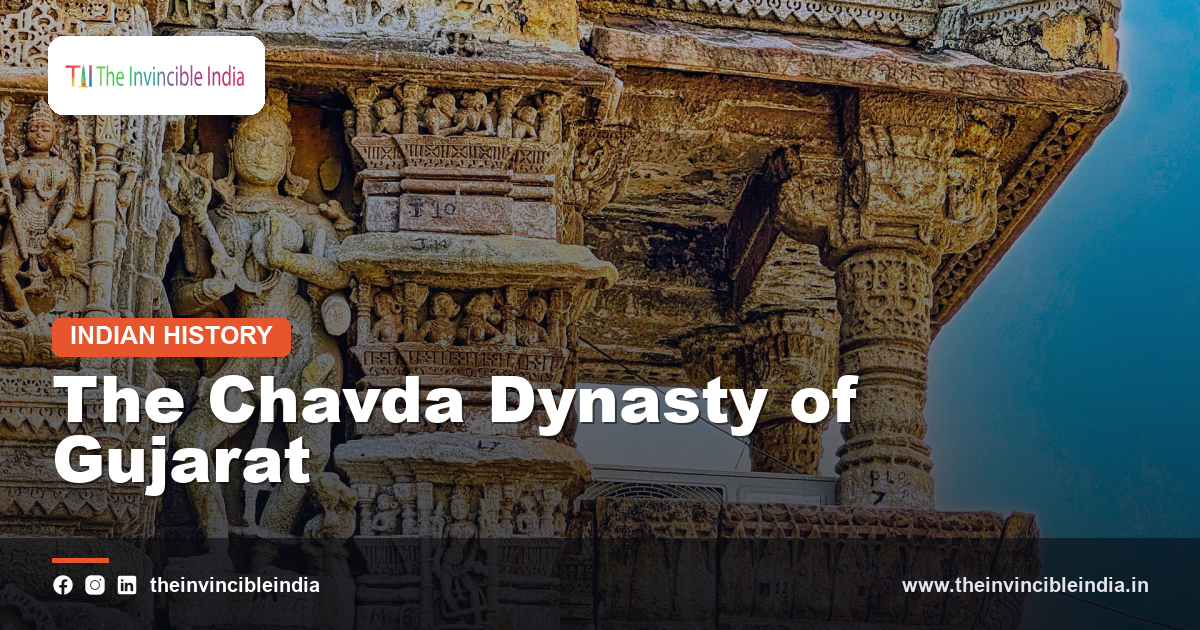
The Chavda dynasty, also spelled Chavada or Chawda and known in Sanskrit sources as the Chapa or Chavotkata, was an early ruling house of Gujarat that is generally dated to roughly the seventh to the tenth centuries and is remembered above all as the line that preceded the great Chaulukyas. Tradition credits the dynasty, and especially the ruler Vanaraja Chavda, with the founding of Anhilwara, the city known today as Patan, which went on to become the celebrated capital of medieval Gujarat. Because the surviving evidence is fragmentary and much of the story comes from later tradition, the Chavdas are known in broad outline rather than precise detail. They belonged to the same world of early Rajput-era kingdoms as the clans described in the Rajputs. This guide therefore flags legends as tradition and keeps to general terms.
Quick answer: The Chavda dynasty was an early ruling house of Gujarat, also called the Chapa or Chavotkata, generally dated to about the seventh to tenth centuries. Tradition credits it, and especially the ruler Vanaraja Chavda, with founding the city of Anhilwara, now Patan, which became the great capital of medieval Gujarat. The Chavdas preceded the Chaulukyas, or Solankis, who succeeded them and raised Gujarat to its height. Much of the dynasty’s story survives only in later tradition and is treated cautiously by historians.
Key Takeaways
- The Chavda dynasty, also called the Chapa or Chavotkata, was an early ruling house of Gujarat, generally dated to about the seventh to tenth centuries.
- Tradition credits the ruler Vanaraja Chavda with founding Anhilwara, the city now known as Patan.
- The founding of Anhilwara is traditionally dated to the mid-eighth century, a date treated as tradition rather than certain fact.
- The Chavdas preceded and were succeeded by the Chaulukyas, or Solankis, of Gujarat.
- Anhilwara Patan went on to become the great capital of medieval Gujarat for centuries.
- Much of the dynasty’s history survives only in later literary tradition and is reconstructed cautiously.
Read on for the history, culture, and legacy in detail.
Quick Facts
| Detail | Information |
|---|---|
| Dynasty | Chavda dynasty (Chapa / Chavotkata) |
| Period | Roughly seventh to tenth centuries, dates debated |
| Region | Gujarat, in western India |
| Capital | Anhilwara (modern Patan), by tradition |
| Founder | Vanaraja Chavda, by tradition |
| Notable For | Traditional founding of Anhilwara Patan |
| Patronage | Hindu and Jain religious traditions |
| Legacy | Preceded the Chaulukyas (Solankis) of Gujarat |
| Succeeded By | Chaulukya (Solanki) dynasty |
Who Were the Chavdas?
The Chavdas were an early ruling family of Gujarat who are counted among the first notable dynasties of the region in the early medieval period. Their name appears in several forms, including Chavda, Chavada, Chawda and the Sanskritised Chapa and Chavotkata, reflecting the different sources that preserve their memory. They belonged to the martial aristocracy of western India during an age of many small and emerging kingdoms, and they are associated in tradition with Rajput lineages. The dynasty is remembered chiefly through later literary and traditional accounts rather than through an abundant contemporary record, so much about them is known only in outline. What tradition agrees upon is that they held power in Gujarat before the rise of the Chaulukyas. The Chavdas therefore represent an early layer in the long dynastic history of the region, important as the forerunners of Gujarat’s medieval greatness.
Where Did the Chavda Dynasty Rule?
The Chavda dynasty ruled in Gujarat, the region of western India stretching along the Arabian Sea and including fertile plains, trading towns and ancient centres of pilgrimage. Their authority is associated chiefly with the northern parts of Gujarat, the country around the site that became Anhilwara, later Patan. This was a land well placed for agriculture and for trade routes linking the coast with the interior and with Rajasthan to the north. Smaller kingdoms and chieftaincies dotted the region in this early period, and the Chavdas were one power among several before Gujarat was unified under later dynasties. The exact extent of their territory is uncertain and is reconstructed from tradition. The geography of northern Gujarat nonetheless shaped the dynasty’s fortunes and its choice of a capital that would endure for centuries.
When Did the Chavdas Rule?
The Chavdas are generally dated to roughly the seventh to the tenth centuries, placing them in the early medieval period before the rise of the Chaulukyas of Gujarat. This dating is approximate, because the dynasty is known largely through later tradition and a limited body of evidence, so historians express the chronology in broad terms rather than with firm dates. The dynasty is said to have endured for several generations, spanning a period of some two centuries by traditional reckoning. During this time Gujarat and neighbouring regions saw the rise and fall of numerous small kingdoms, and the Chavdas occupied their place within that shifting landscape. The precise beginning and end of their rule remain debated. What is widely accepted is that they belong to the centuries immediately preceding the Chaulukya age, serving as its historical prelude.
Who Was Vanaraja Chavda?
Vanaraja Chavda is the most celebrated figure of the dynasty, remembered in tradition as its greatest ruler and as the founder of the city of Anhilwara. Later accounts surround his life with romantic and legendary detail, describing a youth of hardship followed by the establishment of a kingdom and a splendid capital. Tradition credits him with uniting territory in northern Gujarat and with founding a city that would become the heart of the region’s power. Because these stories come largely from later literary sources, historians treat the colourful details as tradition rather than established fact while accepting the broad memory of an important early ruler. Vanaraja nonetheless stands at the centre of the Chavda story and of the legends surrounding the origins of Patan. He is remembered as the king who gave Gujarat one of its most famous capitals.
How Was Anhilwara Patan Founded?
The founding of Anhilwara, the city known today as Patan, is traditionally attributed to Vanaraja Chavda and is dated in tradition to the middle of the eighth century, a date flagged by historians as traditional rather than certain. According to the legendary accounts, Vanaraja established the city and named it after a companion or herdsman associated with the choosing of the auspicious site, and he made it the seat of his new kingdom. The story is preserved in later chronicles and literary works that blend history with legend, so the details are treated with caution. What endured from this foundation was a city that grew into one of the great capitals of western India. The founding of Anhilwara is therefore the single most celebrated achievement associated with the Chavda dynasty. It links the dynasty permanently to the long and illustrious history of Patan.
Why Was Anhilwara Patan Important?
Anhilwara Patan was important because it became the capital not only of the Chavdas but, far more famously, of the Chaulukyas and Vaghelas who followed, serving as the heart of Gujarat for centuries. From modest beginnings the city grew into a major centre of administration, trade, learning and religion, renowned across the subcontinent. Its markets connected Gujarat’s prosperous coast and interior, and its temples and institutions made it a focus of cultural life. By founding this city, the Chavda dynasty gave Gujarat a capital that would outlast their own rule and shape the region’s destiny. The later splendour of Patan under the Chaulukyas, including its famous water architecture, rested on these early foundations. Anhilwara Patan therefore represents the most lasting contribution of the Chavda age to the history of Gujarat, long after the dynasty itself had passed from power.
What Do Legends Say About the Chavdas?
Legends about the Chavdas, preserved in later chronicles and literary works, surround the dynasty with vivid stories of adventure, exile and the founding of kingdoms. The tales of Vanaraja in particular describe a dramatic rise from difficult early circumstances to the establishment of a capital and a royal line, complete with loyal companions and symbolic incidents. These narratives, composed well after the events they describe, blend genuine historical memory with romance and moral lesson in the manner common to medieval tradition. Historians value them as evidence of how later generations remembered the dynasty, while treating specific episodes as legend rather than fact. The legends also explain the names and origins of places associated with the dynasty. Read with care, they enrich our picture of the Chavdas even where they cannot be taken literally, and they flag clearly where history shades into tradition.
Who Were the Later Chavda Rulers?
The later Chavda rulers, the successors of Vanaraja, are known mainly through genealogical lists preserved in tradition, which name a sequence of kings who held Anhilwara after its founding. These accounts describe a line of several rulers who maintained the kingdom through the ninth and into the tenth centuries, though the details of their reigns are sparse. Because the evidence is limited and largely traditional, the names, order and achievements of these later kings are uncertain and debated among scholars. The dynasty appears to have governed a modest but established kingdom in northern Gujarat during this period. Its later rulers did not leave the abundant record that their Chaulukya successors would. The later Chavdas are therefore remembered chiefly as the custodians of Anhilwara in the generations between its founding and the rise of the dynasty that would make it famous.
What Was Chavda Society and Administration Like?
Chavda society and administration followed the patterns of early medieval western India, in which a warrior ruling class governed an agrarian and trading population through a court and local officials. The king stood at the head of the kingdom, supported by kinsmen, chiefs and officers who managed the land, collected revenue and provided military service. Agriculture formed the basis of the economy, supplemented by trade along the routes that crossed Gujarat and by the commerce of its towns. Religious communities, both Hindu and Jain, held an important place in society, and rulers were expected to patronise temples and learned men. Because detailed records are lacking, this picture is drawn in general terms from what is known of the age. The Chavda state was modest compared with later Gujarat, but it established the framework of settled kingship on which its successors would build.
How Did the Chavdas Patronise Religion?
The Chavdas, like other rulers of early medieval Gujarat, are associated in tradition with the patronage of religion, supporting both Hindu and Jain institutions in a region where these traditions flourished side by side. Royal endowments to temples, gifts to Brahmins and the support of religious festivals were expected duties of kingship, binding rulers to the spiritual life of their people. Gujarat had a strong and influential Jain community, and tradition links the Chavda court with Jain teachers and institutions as well as with Hindu worship. The founding of a capital would have involved the establishment of temples and sacred sites appropriate to a royal city. Because the record is limited, specific endowments cannot be detailed with certainty. The Chavdas nonetheless belong to the tradition of religious patronage that made medieval Gujarat a centre of both Hindu and Jain devotion and art.
What Was the Chavda Connection to Jainism?
The Chavda connection to Jainism reflects the prominence of the Jain community in Gujarat from early times, a prominence that would grow still greater under later dynasties. Tradition associates the Chavda court, and the founding legends of Anhilwara, with Jain monks and advisers, in keeping with the influential role that Jain teachers and wealthy Jain merchants played in the region. Jainism was deeply rooted in Gujarat’s towns and trading communities, and its monks were respected as scholars and spiritual guides. The patronage that rulers extended to Jain institutions helped make Gujarat one of the great centres of Jain religion, learning and art in India. While specific details of Chavda patronage rest on tradition, the broader picture of a society in which Jainism flourished is well established. The Chavda age therefore forms part of the long and distinguished history of Jainism in Gujarat.
How Did the Chavda Dynasty End?
The Chavda dynasty came to an end around the tenth century when power in Gujarat passed to the Chaulukyas, also known as the Solankis, who established a new and far more powerful ruling house at Anhilwara. Tradition holds that the transition came through a connection between the two families, with the Chaulukya founder Mularaja linked by kinship or marriage to the Chavda line before taking the throne for himself. The details of this transition are preserved in later accounts and are treated cautiously by historians. What is clear is that the modest Chavda kingdom gave way to the Chaulukya dynasty, which would raise Gujarat to the height of its medieval glory. The Chavda rulers thus handed on their capital and kingdom to successors who would eclipse them. The end of the Chavdas marked the beginning of Gujarat’s greatest age.
What Was the Transition to the Chaulukyas?
The transition to the Chaulukyas, or Solankis, was the pivotal event that transformed the modest Chavda kingdom into the powerful medieval state of Gujarat. According to tradition, Mularaja, the founder of the Chaulukya dynasty, was connected to the Chavda royal family and established his own rule at Anhilwara around the tenth century, inaugurating a line that would govern Gujarat for generations. The Chaulukyas inherited the Chavda capital and built upon it, extending their power and raising Patan to new heights of splendour and importance. The change of dynasty brought greater political strength, wider territory and a flowering of architecture and culture. Later chronicles preserve the story of this transition, blending history with legend in the usual manner. The passage from Chavda to Chaulukya rule therefore marks the dividing line between early and classical medieval Gujarat.
How Do Historians Study the Chavdas?
Historians study the Chavdas using a limited range of evidence, chiefly later chronicles, literary works, genealogical traditions and scattered references, since the dynasty left few abundant contemporary records of its own. Medieval Gujarati and Jain literary traditions preserve much of the story, including the legends of Vanaraja and the founding of Anhilwara, but these were composed well after the events and mix history with romance. Inscriptions and the accounts of neighbouring powers add fragments of information. Scholars compare these sources critically, distinguishing the broad historical outline from the embellishments of tradition, and they remain cautious about names, dates and specific events. As a result, the Chavdas are known more dimly than the Chaulukyas who followed. This careful, source-aware approach allows historians to place the dynasty in its proper context while acknowledging how much about it remains uncertain.
Why Are the Chavdas Significant in Indian History?
The Chavdas are significant in Indian history as the early dynasty that laid the foundations of medieval Gujarat and, by tradition, founded its enduring capital of Anhilwara Patan. Though their own kingdom was modest and their record sparse, their greatest legacy was the city that their successors would make one of the foremost centres of western India. Their age represents the establishment of settled, cultured kingship in northern Gujarat before the rise of the Chaulukyas. The legends surrounding the dynasty also offer a window into how medieval Gujarat remembered its own origins. For students of Indian history, the Chavdas illustrate the way early dynasties prepared the ground for the greater kingdoms that followed. Their significance lies less in conquest than in foundation, in the beginnings they gave to one of India’s most historically rich regions.
The Chavda Dynasty Today
The Chavda dynasty is remembered today chiefly through the historic city of Patan and the traditions that surround its founding, which keep alive the memory of Vanaraja and the earliest age of medieval Gujarat. Patan, long after the Chavdas, became famous for its temples, its scholarship and its celebrated water architecture, and its story is woven into the cultural heritage of the region. The legends of the Chavda kings survive in literature and local tradition, recalling the origins of Gujarat’s great capital. Historians continue to sift the traditional accounts to understand this early dynasty and its place in the region’s past. For readers of Indian history, the Chavdas offer a glimpse of the beginnings from which the glory of medieval Gujarat would grow. Their legacy endures quietly in the name and heritage of Patan.
Sources & Further Reading
- Archaeological Survey of India (asi.nic.in).
- Ministry of Culture, Government of India (indiaculture.gov.in).
- Gujarat Tourism, Government of Gujarat (gujarattourism.com).
Frequently Asked Questions
Who were the Chavdas?
The Chavdas, also called the Chapa or Chavotkata, were an early ruling dynasty of Gujarat generally dated to about the seventh to tenth centuries. They are remembered chiefly as the line that preceded the Chaulukyas, or Solankis, of Gujarat.
Who was Vanaraja Chavda?
Vanaraja Chavda is remembered in tradition as the greatest ruler of the Chavda dynasty and the founder of the city of Anhilwara, now Patan. Later accounts surround his life with legendary detail, which historians treat as tradition rather than certain fact.
When was Anhilwara Patan founded?
Tradition attributes the founding of Anhilwara, now Patan, to Vanaraja Chavda in the middle of the eighth century. This date is treated as traditional rather than firmly established, but the city went on to become the great capital of medieval Gujarat.
Which dynasty came after the Chavdas?
The Chaulukyas, also known as the Solankis, succeeded the Chavdas as the ruling house of Gujarat around the tenth century. Their founder Mularaja is linked by tradition to the Chavda line, and the Chaulukyas raised Gujarat to its medieval height.
Why are the Chavdas important?
The Chavdas are important as the early dynasty that, by tradition, founded Anhilwara Patan, which became the enduring capital of medieval Gujarat. They laid the foundations of settled kingship in the region before the rise of the more powerful Chaulukyas.
Why is so little known about the Chavdas?
Little is known about the Chavdas because the dynasty left few contemporary records, and its history survives mainly in later chronicles and legends. Historians therefore reconstruct the dynasty in broad outline and treat many traditional details with caution.


