

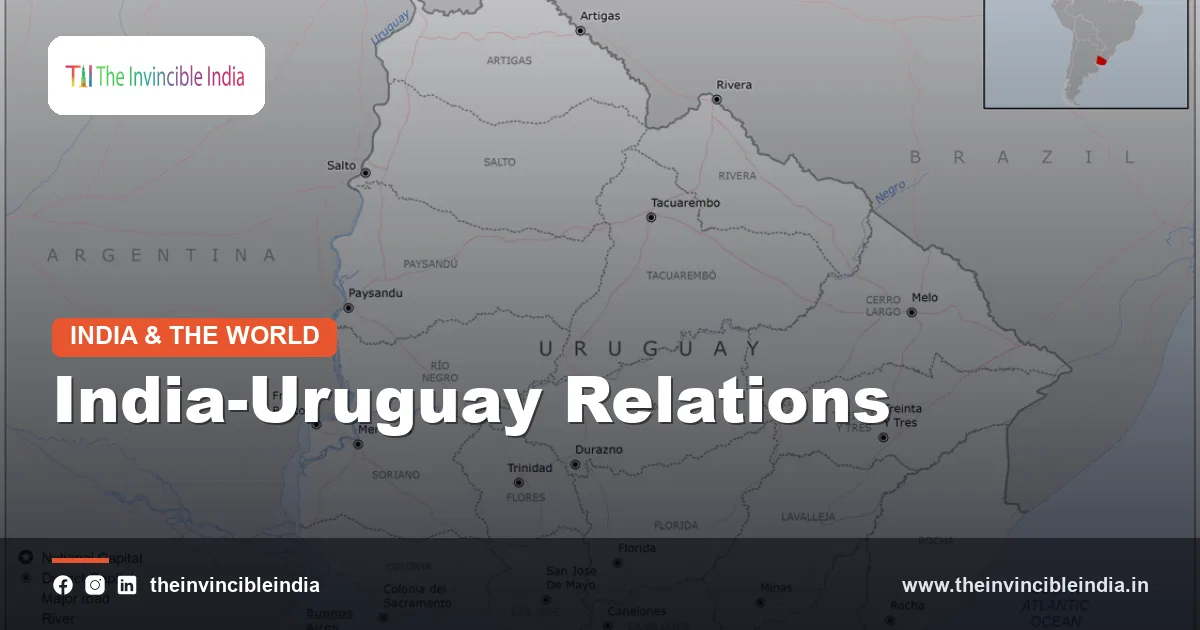
India-Uruguay relations are the bilateral ties between the Republic of India and the Oriental Republic of Uruguay, a small and stable South American democracy and founding member of Mercosur, marked by warm diplomacy since the early 1950s, trade under the India-Mercosur Preferential Trade Agreement, cooperation in information technology and pharmaceuticals, and shared positions at the United Nations. The relationship is among the more comfortable in India’s Latin American portfolio, helped by Uruguay’s open economy and institutional predictability.
Uruguay has a population of roughly three and a half million people, yet it hosts the Mercosur secretariat in Montevideo and punches above its weight in agriculture, renewable energy and software services. This explainer covers how India-Uruguay relations developed, what the two countries trade, how Mercosur frames the partnership and where cooperation could grow. Numbers are expressed as broad ranges because they change annually (last updated 17 October 2026).
Quick Facts: India-Uruguay Relations
| Attribute | Detail |
|---|---|
| Countries | Republic of India and the Oriental Republic of Uruguay |
| Diplomatic ties | Established in the early 1950s; resident embassies operate in both capitals |
| Uruguay’s capital | Montevideo, which also hosts the Mercosur secretariat |
| Regional bloc | Uruguay is a founding member of Mercosur (Treaty of Asunción, 1991) |
| Trade framework | India-Mercosur Preferential Trade Agreement, in force since 2009 |
| Main Indian exports | Pharmaceuticals, chemicals, vehicles and parts, machinery, textiles |
| Main Uruguayan exports | Beef, soybeans, dairy, wool, wood pulp, rice |
| Services link | Indian IT firms, notably Tata Consultancy Services, have operated delivery centres in Uruguay since the early 2000s |
| Indian nodal ministry | Ministry of External Affairs (MEA), with the Ministry of Commerce and Industry on trade |
Key Takeaways
- India-Uruguay relations are cordial and stable, with diplomatic ties dating to the early 1950s and no significant bilateral disputes.
- Uruguay is a founding member of Mercosur and hosts its secretariat in Montevideo, so Uruguay is a natural interlocutor for India on Mercosur trade questions.
- The India-Mercosur Preferential Trade Agreement, which entered into force in 2009, gives Indian and Uruguayan exporters tariff preferences on a limited list of products.
- Tata Consultancy Services established a software delivery centre in Montevideo in the early 2000s, making information technology one of the most visible Indian commercial footprints in Uruguay.
- India and Uruguay both contribute to United Nations peacekeeping and are parties to the Antarctic Treaty, giving them shared multilateral interests.
- Bilateral trade is modest compared with India’s trade with Brazil and Argentina, but it has potential in agriculture, pharmaceuticals and digital services.
What are India-Uruguay relations?
India-Uruguay relations are the diplomatic, commercial and cultural links between New Delhi and Montevideo, characterised by friendly political contact, tariff preferences under Mercosur and a small but diverse range of trade. The two countries are both democracies, support multilateral cooperation and describe each other as like-minded partners in the developing world.
Official ties run through embassies, foreign office consultations, joint commissions and meetings at the United Nations and other forums. Uruguay’s open investment climate, strong rule of law and relatively high income per person make it a comfortable base for Indian companies exploring the wider Southern Cone market.
Why Uruguay stands out in the region
Uruguay is often called the “Switzerland of South America” because of its political stability, strong institutions and low corruption relative to many regional peers. For a partner such as India, that predictability reduces risk in trade and investment even though the domestic market is small.
How did India-Uruguay relations develop?
India-Uruguay relations developed over seven decades, beginning with diplomatic recognition in the early 1950s and gaining depth when India opened up its economy in the 1990s and when both countries engaged with Mercosur in the 2000s. Early exchanges were mainly diplomatic, but commercial links gradually broadened to include medicines, machinery and information technology.
A short timeline
| Period | Development |
|---|---|
| Early 1950s | Diplomatic relations established between India and Uruguay |
| 1986 | The Uruguay Round of GATT trade negotiations opens at Punta del Este, Uruguay, with India an active participant |
| 1991 | Uruguay becomes a founding member of Mercosur |
| Early 2000s | Tata Consultancy Services sets up operations in Montevideo |
| 2009 | The India-Mercosur Preferential Trade Agreement enters into force |
| 2010s to 2020s | Ministerial visits, training cooperation and talks on widening the trade agreement continue |
The Uruguay Round, launched in 1986 at Punta del Este and concluded in 1994, led to the creation of the World Trade Organization (WTO) in 1995. The name of the round is a reminder of how Uruguay features in the history of global trade rules that also govern India’s commerce.
How does the India-Mercosur agreement affect Uruguay?
The India-Mercosur Preferential Trade Agreement (PTA) affects Uruguay by granting preferential tariff access on a limited list of goods between India and the four founding Mercosur members, Argentina, Brazil, Paraguay and Uruguay. The PTA entered into force in 2009 and covers several hundred tariff lines on each side, which is far fewer than a full free trade agreement.
For Uruguay, the PTA has mainly helped exporters of selected agricultural and industrial products, and it lowers costs for Indian goods entering Uruguay. Both India and Mercosur have discussed enlarging the agreement. Because Mercosur negotiates as a bloc, Uruguay coordinates its positions with the other members, though it has at times argued for greater flexibility to pursue its own trade deals.
Why Montevideo matters in the process
The Mercosur secretariat is based in Montevideo, so technical work on tariff schedules and trade rules often passes through the city. Indian diplomats and trade officials interact with the bloc’s institutions there.
What do India and Uruguay trade?
India and Uruguay trade a diverse but small range of goods, with India exporting pharmaceuticals, chemicals, vehicles and parts, machinery and textiles, and Uruguay supplying agricultural and forestry products such as wool, wood-related goods and certain foods. Total bilateral trade has generally been in the hundreds of millions of US dollars, with large year-to-year swings tied to commodity prices.
Uruguay is a major world exporter of beef, soybeans, dairy products and cellulose pulp, but not all of these find markets in India because of India’s dietary patterns, import rules and domestic production. Wool, hides and certain agricultural inputs have been more relevant to Indian industries.
Typical trade profile
| Direction | Typical product groups | Remarks |
|---|---|---|
| India to Uruguay | Medicines, chemicals, vehicles and parts, machinery, textiles | Indian generics and two-wheelers are well known |
| Uruguay to India | Wool, forestry and agricultural products, other commodities | Volumes vary with prices and Indian demand |
| Possible growth areas | Pulses and edible oils, dairy technology, IT services, renewable-energy equipment, healthcare | Depends on regulation and logistics |
Why is information technology important in India-Uruguay relations?
Information technology is important in India-Uruguay relations because it is the sector in which Indian companies have built the most visible long-term presence in Uruguay. Tata Consultancy Services (TCS) began operating in Montevideo in the early 2000s and served clients across Latin America from there, taking advantage of Uruguay’s time zone alignment with North America, bilingual workforce and stable telecom infrastructure.
Uruguay has its own growing software and services industry, supported by free-trade zones and a government agenda for digital transformation. India has expertise in digital public infrastructure, such as unified payment interfaces and national identity systems, and has offered to share its experience with partner countries. That creates scope for cooperation in e-governance and financial technology.
What is the role of pharmaceuticals and healthcare?
Pharmaceuticals play a significant role in India-Uruguay relations because Indian drug makers supply affordable generic medicines to Uruguayan hospitals, pharmacies and public purchasers. India is among the world’s largest producers of generic medicines by volume, and Latin American markets have been steady destinations.
Uruguay has a well-developed public health system and regulatory agencies, so Indian exporters must meet recognised quality standards. Future cooperation could include mutual recognition of regulatory approvals, joint research, medical devices and traditional medicine, since Indian practices such as Ayurveda and yoga attract interest in Uruguayan wellness circles.
How do India and Uruguay cooperate in multilateral forums?
India and Uruguay cooperate in multilateral forums mainly at the United Nations, the World Trade Organization and bodies dealing with climate, health and development, where both support rules-based multilateralism and the interests of developing countries. Uruguay has expressed support for reform of the United Nations and for a larger role for India in global governance, and the two countries often vote in similar ways on development and disarmament issues.
Shared areas of interest
- Peacekeeping: Both India and Uruguay have contributed troops and observers to UN peacekeeping missions, and Uruguay has been counted among the larger contributors relative to its size.
- Antarctica: Both are parties to the Antarctic Treaty and maintain research interests in the continent, which offers scope for scientific collaboration and logistical dialogue.
- Climate and energy: Both promote renewable energy as part of their climate commitments.
- Trade rules: Both favour a predictable, rules-based WTO system, particularly on agricultural trade.
What development and cultural cooperation exists?
Development and cultural cooperation between India and Uruguay consists of training courses, scholarships, cultural events and educational exchanges. India offers training in fields such as information technology, agriculture and public administration through the Indian Technical and Economic Cooperation (ITEC) programme, and scholarships through the Indian Council for Cultural Relations (ICCR).
Cultural ties centre on yoga, Indian dance and music, cinema and cuisine. Yoga has an established following in Montevideo and other Uruguayan cities, and the Indian embassy marks the International Day of Yoga each year. The Indian community in Uruguay is small, and Indian business interests are concentrated in services and trading.
What are the challenges and the future outlook?
The main challenges facing India-Uruguay relations are geographic distance, a small market, limited direct connectivity and a narrow trade agreement, while the outlook is for gradual growth in agriculture, technology and renewable energy. Cargo from India reaches Montevideo by long sea routes, and there are no regular direct flights between the two countries, raising costs and slowing contact.
Opportunities for expansion
- Widening the India-Mercosur PTA to cover more products.
- Expanding Indian investment in software, healthcare and manufacturing in Uruguayan free-trade zones.
- Cooperating on renewable energy, since Uruguay generates most of its electricity from wind, hydro, solar and biomass.
- Deepening agricultural cooperation, including food processing, dairy technology and pulses.
- Increasing educational exchanges and scholarships.
Progress will depend on Mercosur’s collective decisions, on global commodity markets and on the willingness of businesses to build links across a long distance.
How can agriculture and renewable energy deepen India-Uruguay relations?
Agriculture and renewable energy can deepen India-Uruguay relations because Uruguay is a major, technologically advanced food producer with a largely renewable electricity system, while India needs food security, edible oils, pulses and clean-energy technology at very large scale. The two economies are complementary in these areas even though trade volumes are presently small.
Uruguay’s livestock sector uses traceability systems that track cattle from farm to export, and its dairy and rice industries are export-oriented. India, the world’s largest milk producer, has a different structure built around small farms and cooperatives, so technology and knowledge exchange can flow in both directions. Uruguay has also moved most of its electricity generation to wind, hydropower, solar and biomass within about a decade, an experience that interests Indian policymakers pursuing renewable targets.
Specific areas of possible cooperation
- Pulses and edible oils, where India is a large importer and Uruguay and its neighbours are producers.
- Cattle genetics, animal health and dairy processing technology.
- Wind and solar project development, grid integration and storage.
- Biomass and bioenergy, including lessons from Uruguay’s pulp and wood industries.
- Agricultural research partnerships between universities and public institutes.
Who visits whom? Political and business exchanges
Political and business exchanges between India and Uruguay take place through occasional ministerial visits, parliamentary delegations, foreign office consultations and trade missions, though they are less frequent than India’s exchanges with larger Latin American countries. Uruguayan delegations have visited India for trade fairs and conferences, and Indian officials have travelled to Montevideo for Mercosur-related meetings and bilateral talks.
Business chambers in both countries support these contacts. Uruguay’s export-promotion agency, Uruguay XXI, and Indian industry associations periodically organise seminars to introduce companies to each other’s markets. Such events are valuable because lack of familiarity is one of the main brakes on trade, and many firms in both countries are small or medium sized.
Bottom Line
India-Uruguay relations are warm, stable and practical, built on Mercosur trade preferences, information technology, pharmaceuticals and shared multilateral interests. The partnership is small in scale, but Uruguay’s predictability and openness make it a useful gateway for India to the Southern Cone.
Frequently Asked Questions
When were diplomatic relations between India and Uruguay established?
Diplomatic relations between India and Uruguay were established in the early 1950s. Both countries now maintain resident embassies in each other’s capitals. The relationship has been free of major disputes.
What does India export to Uruguay?
India mainly exports pharmaceuticals, chemicals, vehicles and parts, machinery and textiles to Uruguay. Indian generic medicines and two-wheelers are among the best-known products. Trade values change from year to year.
How does Mercosur affect India-Uruguay trade?
Mercosur affects India-Uruguay trade because the India-Mercosur Preferential Trade Agreement, in force since 2009, sets tariff preferences on a limited list of goods. Uruguay is a founding Mercosur member and hosts the bloc’s secretariat. Both sides have discussed widening the agreement.
Which Indian companies are present in Uruguay?
Tata Consultancy Services is the best-known Indian company in Uruguay, operating a software delivery centre in Montevideo since the early 2000s. Other Indian firms are active in pharmaceuticals, trading and services. Indian business presence is concentrated in services rather than heavy industry.
Do India and Uruguay cooperate at the United Nations?
Yes, India and Uruguay cooperate at the United Nations on development, peacekeeping, climate and trade issues, and Uruguay has voiced support for United Nations reform. Both contribute to UN peacekeeping missions. They also share an interest in the Antarctic Treaty system.
What is the future of India-Uruguay relations?
The future of India-Uruguay relations points to steady growth in agriculture, information technology, pharmaceuticals and renewable energy. A wider India-Mercosur trade agreement would help. Distance and a small market remain the main limits.
{“@context”:”https://schema.org”,”@graph”:[{“@type”:”FAQPage”,”mainEntity”:[{“@type”:”Question”,”name”:”When were diplomatic relations between India and Uruguay established?”,”acceptedAnswer”:{“@type”:”Answer”,”text”:”Diplomatic relations between India and Uruguay were established in the early 1950s. Both countries now maintain resident embassies in each other’s capitals. The relationship has been free of major disputes.”}},{“@type”:”Question”,”name”:”What does India export to Uruguay?”,”acceptedAnswer”:{“@type”:”Answer”,”text”:”India mainly exports pharmaceuticals, chemicals, vehicles and parts, machinery and textiles to Uruguay. Indian generic medicines and two-wheelers are among the best-known products. Trade values change from year to year.”}},{“@type”:”Question”,”name”:”How does Mercosur affect India-Uruguay trade?”,”acceptedAnswer”:{“@type”:”Answer”,”text”:”Mercosur affects India-Uruguay trade because the India-Mercosur Preferential Trade Agreement, in force since 2009, sets tariff preferences on a limited list of goods. Uruguay is a founding Mercosur member and hosts the bloc’s secretariat. Both sides have discussed widening the agreement.”}},{“@type”:”Question”,”name”:”Which Indian companies are present in Uruguay?”,”acceptedAnswer”:{“@type”:”Answer”,”text”:”Tata Consultancy Services is the best-known Indian company in Uruguay, operating a software delivery centre in Montevideo since the early 2000s. Other Indian firms are active in pharmaceuticals, trading and services. Indian business presence is concentrated in services rather than heavy industry.”}},{“@type”:”Question”,”name”:”Do India and Uruguay cooperate at the United Nations?”,”acceptedAnswer”:{“@type”:”Answer”,”text”:”Yes, India and Uruguay cooperate at the United Nations on development, peacekeeping, climate and trade issues, and Uruguay has voiced support for United Nations reform. Both contribute to UN peacekeeping missions. They also share an interest in the Antarctic Treaty system.”}},{“@type”:”Question”,”name”:”What is the future of India-Uruguay relations?”,”acceptedAnswer”:{“@type”:”Answer”,”text”:”The future of India-Uruguay relations points to steady growth in agriculture, information technology, pharmaceuticals and renewable energy. A wider India-Mercosur trade agreement would help. Distance and a small market remain the main limits.”}}]}]}


