

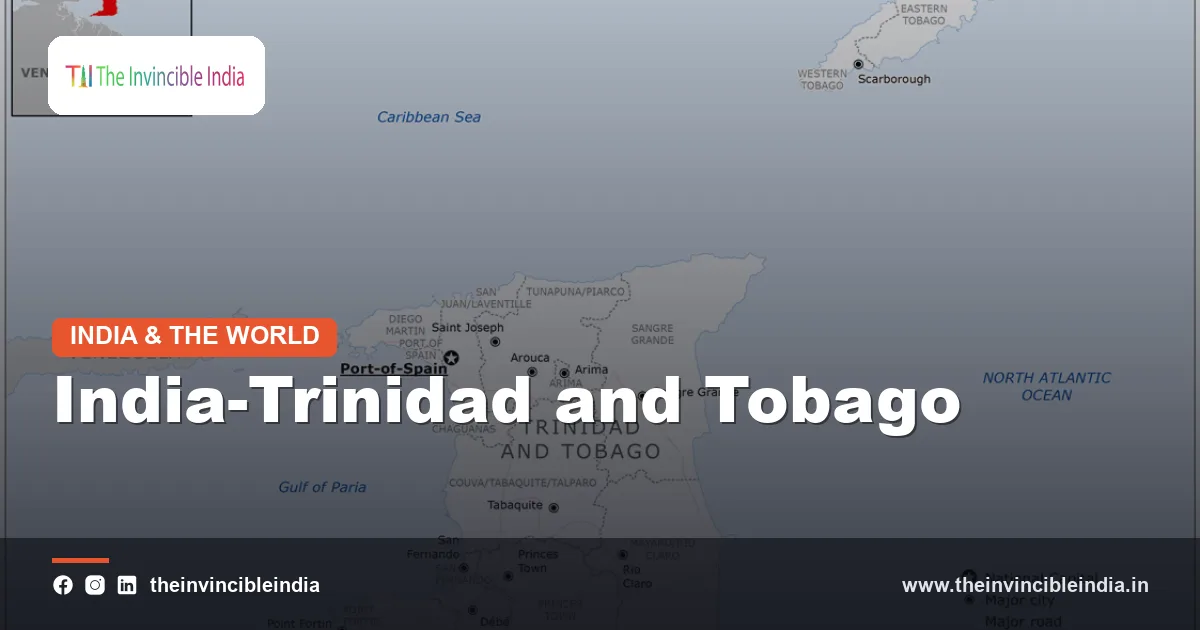
India-Trinidad and Tobago relations are the bilateral ties between the Republic of India and the Republic of Trinidad and Tobago, a Caribbean twin-island nation where people of Indian descent make up roughly a third or more of the population, and they combine deep historical and cultural bonds from the era of indentured labour with growing cooperation in energy, trade, health and development. The relationship is among the warmest India has in the Caribbean, and it is often described as a link between two peoples rather than only between two governments.
This explainer covers how Indians first reached Trinidad in 1845, how diplomatic ties developed after independence, why the Indo-Trinidadian community is central, how culture and festivals keep the connection alive, and what trade, energy and aid cooperation look like today. Statistics are quoted approximately and dated where possible.
| Attribute | Detail |
|---|---|
| Countries | Republic of India and Republic of Trinidad and Tobago |
| Diplomatic relations | Established around Trinidad and Tobago’s independence in 1962; India’s High Commission in Port of Spain has operated since the 1960s |
| First Indian arrival | 30 May 1845, aboard the ship Fatel Razack at Port of Spain; marked as Indian Arrival Day |
| Indentured period | 1845 to 1917, with roughly 140,000 Indian labourers brought to Trinidad |
| Population of Indian origin | About 35 percent of the population in the 2011 census, among the largest shares in the Caribbean |
| Main economic link | Energy, petrochemicals, pharmaceuticals, vehicles and textiles |
| Regional framework | India-CARICOM Summit; Trinidad and Tobago is a founding member of the Caribbean Community (CARICOM) |
| Recent milestone | State visit of India’s Prime Minister Narendra Modi to Port of Spain in July 2025 |
Key Takeaways
- The first Indian indentured labourers reached Trinidad on 30 May 1845 aboard the Fatel Razack, and the date is observed as Indian Arrival Day in Trinidad and Tobago.
- People of Indian origin made up about 35 percent of Trinidad and Tobago’s population in the 2011 census, which gives the country one of the largest Indian-origin shares in the Western Hemisphere.
- India and Trinidad and Tobago established diplomatic relations around the latter’s independence in 1962, and the two countries have never had a significant bilateral dispute.
- Trinidad and Tobago is a major Caribbean producer of natural gas, ammonia and methanol, which gives energy a central place in economic ties with India.
- Diwali, Phagwa, Ramleela, chutney music and Indian-influenced food are part of everyday national culture in Trinidad and Tobago.
- India and Trinidad and Tobago cooperate through CARICOM, the United Nations, India’s ITEC programme and scholarships from the Indian Council for Cultural Relations (ICCR).
What are India-Trinidad and Tobago relations?
India-Trinidad and Tobago relations are a close partnership grounded in the shared history of Indian indentured migration, enriched by cultural exchange and supported by cooperation in energy, trade, education and health. The two countries have no disputes, support each other in international forums and treat the Indian diaspora as a bridge between them.
Trinidad and Tobago is the southernmost nation of the Caribbean, lying just off the coast of Venezuela. It has a population of roughly 1.3 to 1.4 million, an economy built on oil, natural gas and petrochemicals, and a multi-ethnic society in which people of African and Indian descent form the two largest groups. India’s government treats the country as a priority partner within its Caribbean outreach, and Indian leaders often describe the diaspora in Trinidad and Tobago as an enduring human link.
Unlike many of India’s bilateral relationships, this one is shaped less by strategy than by identity. Hindi film songs, temple festivals, Indian-style cooking and family histories traced to villages in Uttar Pradesh and Bihar all form part of the connection.
How did Indians come to Trinidad and Tobago?
Indians came to Trinidad and Tobago as indentured labourers recruited by the British colonial government to replace enslaved workers on sugar estates after slavery was abolished in the British Empire in the 1830s. The first ship, the Fatel Razack, arrived at Port of Spain on 30 May 1845 carrying more than two hundred passengers who had sailed from Calcutta, and further ships followed until the system ended in 1917.
Over those seven decades, roughly 140,000 Indians were brought to Trinidad. Most came from the Gangetic plain, especially the regions that are now eastern Uttar Pradesh and Bihar, and from other parts of north and south India. Recruits signed contracts, usually of five years, with promises of wages and, in some cases, a return passage or a land grant. Conditions on the estates were harsh, and mortality, debt and restrictions on movement were common, but many families chose to stay.
A large proportion of the descendants of these labourers remained in Trinidad, took up rice, cane and market farming, and moved gradually into trade, the professions and politics. They preserved religion, language and food, and they adapted them to local life. Many people in the community still use the word jahaji, meaning shipmate, to describe fellow descendants of the migrants.
When did diplomatic ties begin and how have they developed?
Diplomatic ties between India and Trinidad and Tobago began around 1962, when Trinidad and Tobago became independent from Britain on 31 August, and India established a High Commission in Port of Spain in the following years. Both countries were members of the Commonwealth and the Non-Aligned Movement, which gave them natural common ground from the outset.
The relationship developed through exchange of visits, cultural agreements and educational cooperation. India set up a cultural centre in Port of Spain, and the Indian government has provided scholarships, teaching posts and other support for Hindi and Indian studies, including an ICCR chair at the University of the West Indies. Trinidad and Tobago, for its part, has held high-profile events for the diaspora and has welcomed Indian ministers and cultural delegations.
Highlights of the relationship in recent decades include India’s decision to invite diaspora leaders to its annual Pravasi Bharatiya Divas conference, the creation of the Overseas Citizen of India (OCI) scheme, and a number of joint commission meetings and foreign office consultations. The July 2025 visit of Prime Minister Narendra Modi, the first by an Indian prime minister to the country in more than two decades, gave the relationship a new political impetus.
Why is the Indo-Trinidadian community central to the relationship?
The Indo-Trinidadian community is central because it forms about 35 percent of the population, holds prominent positions in politics, business, law, media and culture, and gives both governments a reason to maintain regular contact. The term Indo-Trinidadian refers to citizens of Indian descent, and many of them trace their ancestry to indentured labourers who arrived between 1845 and 1917.
Members of the community have held the highest political offices. Basdeo Panday became the country’s first prime minister of Indian origin in 1995, and Kamla Persad-Bissessar became its first woman prime minister in 2010 and returned to office after the 2025 election. Trinidad and Tobago’s political life has long been shaped by competition between parties with different ethnic bases, though leaders from all communities emphasise national unity.
The community also contributes to the arts and sports. The writer V. S. Naipaul, born in Trinidad to a family of Indian origin, won the Nobel Prize in Literature in 2001. The cricketers Sonny Ramadhin, Dinanath Ramnarine and Sunil Narine are further examples of the community’s role in national life.
How do culture and festivals connect India and Trinidad and Tobago?
Culture and festivals connect India and Trinidad and Tobago through shared religious observance, music, food and language, which make Indian heritage a visible part of everyday national identity. Divali, the festival of lights, is a public holiday in Trinidad and Tobago, and the country is known for its Divali Nagar celebrations, where thousands of lamps, stalls and performances draw visitors. Phagwa, the local form of Holi, is celebrated in March with coloured powder and traditional songs, and Eid-ul-Fitr, observed by the Muslim community of Indian origin, is also a public holiday.
Music, food and language
- Chutney and chutney soca: Chutney is a genre that grew from Bhojpuri folk songs sung by women at weddings, and chutney soca blends it with Caribbean soca rhythms. Singers such as Drupatee Ramgoonai helped bring it to a national audience.
- Tassa drumming: This is a drumming tradition from Indian communities that is played at weddings and festivals and is distinctive to Indo-Caribbean culture.
- Cuisine: Roti, curry, doubles, dhalpuri and other dishes from Indian cooking have become national favourites, and doubles is regarded as one of the country’s most popular street foods.
- Language: Trinidad Bhojpuri, a dialect that came from the Bhojpuri-speaking regions of India, was once widely spoken, though English and Trinidadian Creole are now dominant and Hindi is taught at cultural bodies and some institutions.
- Ramleela and religion: Hindu temples, Ramleela performances, and Ramcharitmanas recitals continue traditions that the early migrants carried with them.
Bollywood films and music remain popular, and Indian classical dance and music are taught at cultural centres. Indian Arrival Day on 30 May is a public holiday and an occasion for processions, speeches and cultural shows.
What role does energy play in India-Trinidad and Tobago relations?
Energy plays a significant role in India-Trinidad and Tobago relations because Trinidad and Tobago is a leading Western Hemisphere producer of natural gas and a major exporter of liquefied natural gas (LNG), ammonia and methanol, while India is a large and growing energy importer. The petrochemical sector built around Point Lisas Industrial Estate is one of the Caribbean’s largest industrial clusters.
India imports significant quantities of ammonia, methanol and fertilizer inputs from many suppliers, and Trinidad and Tobago is one possible source. India has also bought LNG cargoes from Atlantic suppliers from time to time as it expands gas use in power, fertilizer and city gas distribution. Indian energy companies and officials have discussed supply, investment and technology cooperation with their Trinidadian counterparts, although long-term supply arrangements have been limited.
Both countries face declining legacy output on one side and rising demand on the other. Trinidad and Tobago is working to sustain gas production and diversify, while India is trying to diversify its import sources and expand cleaner fuels. That pairing provides scope for further cooperation, including in renewable energy and downstream industry.
What is the trade and investment picture between the two countries?
The trade picture between India and Trinidad and Tobago is moderate, with bilateral trade usually in the range of a few hundred million US dollars a year, and with India exporting more manufactured goods and importing chemicals and energy products. The figures vary significantly from year to year with commodity prices.
| Direction | Typical goods |
|---|---|
| India to Trinidad and Tobago | Pharmaceuticals, motor vehicles and two-wheelers, textiles and garments, rice and food products, machinery, auto parts |
| Trinidad and Tobago to India | Ammonia, methanol, petrochemicals, fertilizer inputs, steel products and occasional hydrocarbons |
| Investment | Indian firms are present in sectors such as information technology, pharmaceuticals and services, mostly on a small scale |
| Services and people | Tourism, education and medical travel, with diaspora visitors forming a sizeable share of travel |
Neither country has a bilateral free trade agreement with the other, and trade follows normal tariff terms. Trinidad and Tobago has trading arrangements within CARICOM, while India has bilateral and regional agreements with other partners. Business forums, chambers of commerce and diaspora networks play an important role in matching buyers and sellers.
What development aid and capacity building does India provide?
India provides development assistance to Trinidad and Tobago mainly through training, scholarships, cultural support, humanitarian help and concessional programmes, rather than large infrastructure loans. Under the Indian Technical and Economic Cooperation (ITEC) programme, Trinidadian officials and professionals attend courses in India, and ICCR scholarships support students in fields from engineering and medicine to the arts.
India has also supported the Hindi teaching and cultural activities in Port of Spain, funded community projects and provided medical supplies. During the COVID-19 pandemic, India sent medicines and vaccine doses to Caribbean countries, including Trinidad and Tobago, which strengthened goodwill. Indian pharmaceutical generics are used in the Caribbean health system.
More recently, the two governments have discussed cooperation on digital public infrastructure, including India’s Unified Payments Interface (UPI), as well as Ayurveda and traditional medicine, capacity-building for civil servants, agriculture and disaster response. Hurricane and flood resilience is a particular Caribbean priority, and India has launched initiatives with small island states in that area.
How do India and Trinidad and Tobago cooperate in CARICOM and multilateral forums?
India and Trinidad and Tobago cooperate through CARICOM, the United Nations, the Commonwealth and the Non-Aligned Movement, and they generally support each other on questions such as development finance, climate action and the reform of global institutions. Trinidad and Tobago is a founding member of CARICOM, created in 1973. The Treaty of Chaguaramas, which created the community, was signed in Trinidad.
India has built a structured relationship with the 15-member bloc through the India-CARICOM Summit. The first summit was held on the sidelines of the United Nations General Assembly in 2019, and the second took place in Georgetown, Guyana, in November 2024. These meetings produced announcements on capacity-building, climate resilience, health, and cultural and technological exchange. Trinidad and Tobago has been a regular participant.
India has also invited Caribbean states to join international initiatives that it leads, including the International Solar Alliance and the Coalition for Disaster Resilient Infrastructure, and it supports Caribbean calls for climate finance in the face of rising sea levels.
What were the highlights of recent high-level visits?
The highlight of recent high-level contact was Prime Minister Narendra Modi’s state visit to Trinidad and Tobago in July 2025, which included talks with the Trinidadian prime minister, reported engagements with the country’s Parliament and meetings with members of the Indian-origin community. Reports at the time said that the visit led to several agreements and announcements.
- Trinidad and Tobago conferred its highest national honour on the Indian prime minister during the visit.
- India announced that Overseas Citizen of India (OCI) cards would be extended to the sixth generation of persons of Indian origin in Trinidad and Tobago.
- The two sides signed or announced cooperation documents covering areas such as cultural exchange, health, digital payments and training.
- The leaders discussed energy, trade and the use of India’s technology for governance and payments.
Earlier, leaders and ministers from Trinidad and Tobago had visited India for diaspora events and bilateral talks. These contacts show how the diaspora tie keeps the relationship active at the highest level.
What challenges and prospects does the relationship have?
The main challenges for India-Trinidad and Tobago relations are distance, limited direct connectivity, a modest trade base and the risk of relying on cultural sentiment without commercial depth, while the main prospects lie in energy, pharmaceuticals, digital technology and education. There are no regular direct flights between the two countries, which raises travel costs for businesses, students and diaspora visitors.
- Connectivity: Direct air and shipping links would reduce costs and encourage tourism and trade.
- Diversification: Trade depends heavily on a few products, notably energy-related goods.
- Diaspora engagement: Younger generations are further removed from India, and cultural programmes must adapt to remain relevant.
- Opportunities: Pharmaceuticals, IT services, renewable energy, medical tourism, education and disaster resilience offer room for expansion.
Observers generally expect the relationship to continue deepening, helped by regular summits, the OCI extension and the visibility created by recent visits.
Bottom Line
India-Trinidad and Tobago relations rest on one of the strongest diaspora links in the Caribbean, which began with the arrival of the Fatel Razack in 1845 and still shapes festivals, music, politics and food. Energy, pharmaceuticals and digital cooperation give the relationship a modern economic dimension, and regular summits keep it active. Details are current as of 17 October 2026.
Frequently Asked Questions
Why are India and Trinidad and Tobago so closely connected?
India and Trinidad and Tobago are closely connected because about 35 percent of Trinidad and Tobago’s population is of Indian descent, mostly from indentured labourers who arrived between 1845 and 1917. This shared ancestry shapes festivals, music, food and politics. Government cooperation in energy, trade and development builds on that human link.
When did Indians first arrive in Trinidad and Tobago?
The first Indians arrived in Trinidad on 30 May 1845 aboard the ship Fatel Razack at Port of Spain. They came as indentured labourers to work on sugar estates after the abolition of slavery. The date is observed each year as Indian Arrival Day.
When were diplomatic relations established between India and Trinidad and Tobago?
India and Trinidad and Tobago established diplomatic relations around the latter’s independence in 1962. India opened a High Commission in Port of Spain in the following years. Both are members of the Commonwealth and the United Nations.
What does India import from and export to Trinidad and Tobago?
India exports pharmaceuticals, vehicles, textiles, food products and machinery to Trinidad and Tobago, and imports mainly ammonia, methanol and other petrochemical or energy-related products. Bilateral trade is moderate, usually a few hundred million US dollars a year. No free trade agreement between the two countries is in force.
What Indian festivals and traditions are celebrated in Trinidad and Tobago?
Trinidad and Tobago celebrates Divali, Phagwa (Holi), Ramleela, Eid and Indian Arrival Day, and Divali and Eid-ul-Fitr are public holidays. Indian-influenced music such as chutney and tassa drumming, and foods such as roti and doubles, are part of national culture. These traditions have been preserved and adapted over nearly two centuries.
What happened during Prime Minister Modi’s 2025 visit to Trinidad and Tobago?
Prime Minister Narendra Modi made a state visit to Trinidad and Tobago in July 2025, reportedly the first by an Indian prime minister in more than two decades. India announced that Overseas Citizen of India cards would be extended to the sixth generation of persons of Indian origin there. The two sides also discussed cooperation in culture, health, digital payments, energy and trade.
{“@context”:”https://schema.org”,”@graph”:[{“@type”:”FAQPage”,”mainEntity”:[{“@type”:”Question”,”name”:”Why are India and Trinidad and Tobago so closely connected?”,”acceptedAnswer”:{“@type”:”Answer”,”text”:”India and Trinidad and Tobago are closely connected because about 35 percent of Trinidad and Tobago’s population is of Indian descent, mostly from indentured labourers who arrived between 1845 and 1917. This shared ancestry shapes festivals, music, food and politics. Government cooperation in energy, trade and development builds on that human link.”}},{“@type”:”Question”,”name”:”When did Indians first arrive in Trinidad and Tobago?”,”acceptedAnswer”:{“@type”:”Answer”,”text”:”The first Indians arrived in Trinidad on 30 May 1845 aboard the ship Fatel Razack at Port of Spain. They came as indentured labourers to work on sugar estates after the abolition of slavery. The date is observed each year as Indian Arrival Day.”}},{“@type”:”Question”,”name”:”When were diplomatic relations established between India and Trinidad and Tobago?”,”acceptedAnswer”:{“@type”:”Answer”,”text”:”India and Trinidad and Tobago established diplomatic relations around the latter’s independence in 1962. India opened a High Commission in Port of Spain in the following years. Both are members of the Commonwealth and the United Nations.”}},{“@type”:”Question”,”name”:”What does India import from and export to Trinidad and Tobago?”,”acceptedAnswer”:{“@type”:”Answer”,”text”:”India exports pharmaceuticals, vehicles, textiles, food products and machinery to Trinidad and Tobago, and imports mainly ammonia, methanol and other petrochemical or energy-related products. Bilateral trade is moderate, usually a few hundred million US dollars a year. No free trade agreement between the two countries is in force.”}},{“@type”:”Question”,”name”:”What Indian festivals and traditions are celebrated in Trinidad and Tobago?”,”acceptedAnswer”:{“@type”:”Answer”,”text”:”Trinidad and Tobago celebrates Divali, Phagwa (Holi), Ramleela, Eid and Indian Arrival Day, and Divali and Eid-ul-Fitr are public holidays. Indian-influenced music such as chutney and tassa drumming, and foods such as roti and doubles, are part of national culture. These traditions have been preserved and adapted over nearly two centuries.”}},{“@type”:”Question”,”name”:”What happened during Prime Minister Modi’s 2025 visit to Trinidad and Tobago?”,”acceptedAnswer”:{“@type”:”Answer”,”text”:”Prime Minister Narendra Modi made a state visit to Trinidad and Tobago in July 2025, reportedly the first by an Indian prime minister in more than two decades. India announced that Overseas Citizen of India cards would be extended to the sixth generation of persons of Indian origin there. The two sides also discussed cooperation in culture, health, digital payments, energy and trade.”}}]}]}


