

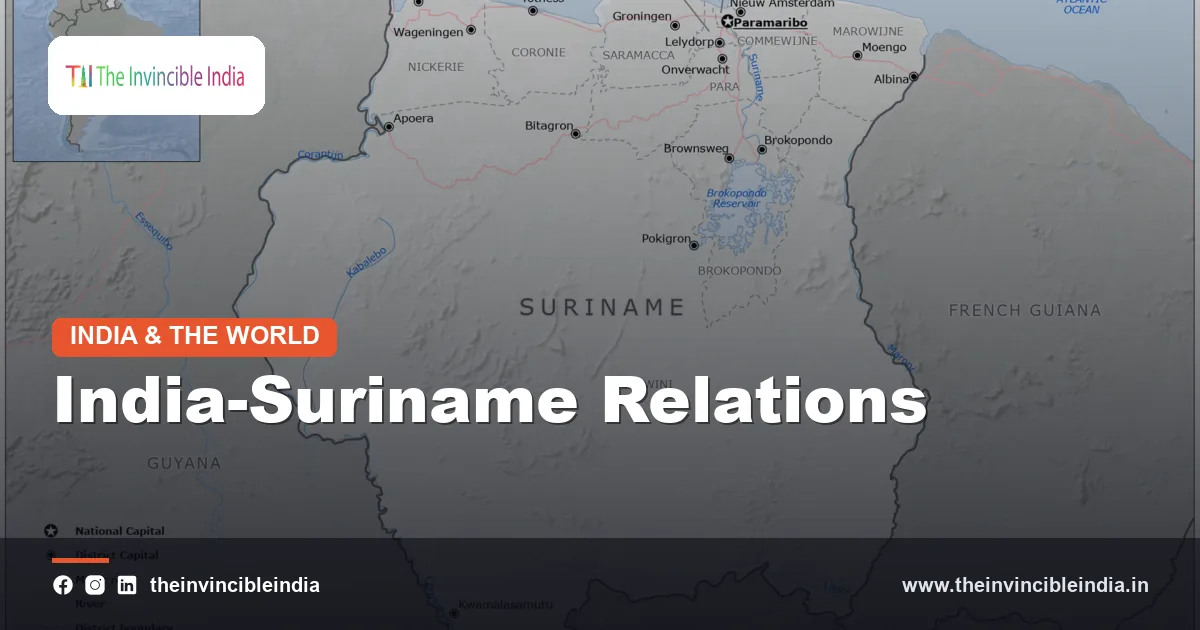
India-Suriname relations are the bilateral ties between the Republic of India and the Republic of Suriname, a small Dutch-speaking country on the northeastern coast of South America where people of Indian origin, known as Hindustanis, make up roughly a quarter of the population, and they rest on a shared history of indentured migration, a common Bhojpuri-rooted heritage, development cooperation and growing trade. The relationship is warm and stable, with regular high-level contact, including state visits by Indian presidents in 2018 and 2025.
This explainer describes how Indians reached Suriname in 1873, how diplomatic ties began after independence in 1975, why the Hindustani community and the Sarnami language matter, what the economic and aid links look like and which challenges and opportunities lie ahead. Figures are approximate and are intended as context rather than precise statistics.
| Attribute | Detail |
|---|---|
| Countries | Republic of India and Republic of Suriname |
| Diplomatic relations | Established around Suriname’s independence from the Netherlands on 25 November 1975; India has an embassy in Paramaribo |
| First Indian arrival | 5 June 1873, aboard the ship Lalla Rookh at Paramaribo; observed as Hindustani Immigration Day |
| Indentured period | 1873 to 1916, with about 34,000 Indians brought to Suriname; a substantial number later returned to India |
| Population of Indian origin | Roughly 27 percent in the 2012 census, the largest single ethnic group in that census |
| Language heritage | Sarnami Hindustani (Sarnami), derived from Bhojpuri and related north Indian dialects |
| Regional framework | India-CARICOM Summit; Suriname joined the Caribbean Community (CARICOM) in 1995 |
| Recent milestone | State visit of India’s President Droupadi Murmu to Suriname in June 2025 |
Key Takeaways
- The first Indian indentured labourers reached Suriname on 5 June 1873 aboard the ship Lalla Rookh, and the date is observed as Hindustani Immigration Day.
- About 34,000 Indians were brought to Suriname between 1873 and 1916, and their descendants make up roughly 27 percent of the country’s population today.
- Sarnami Hindustani, spoken by many Surinamese of Indian origin, developed from Bhojpuri and related dialects of north India.
- India and Suriname established diplomatic relations around Suriname’s independence from the Netherlands in 1975.
- Indian presidents have made state visits to Suriname twice, in 2018 and in June 2025, and Suriname’s president was the chief guest at India’s Pravasi Bharatiya Divas in 2023.
- India’s links with Suriname include development assistance, training, scholarships, pharmaceuticals, vehicles and growing interest in energy and digital cooperation.
What are India-Suriname relations?
India-Suriname relations are a close partnership between two developing countries, grounded in the history of Indian indentured migration, strengthened by cultural and language ties and supported by cooperation in development, trade and international forums. Suriname is the smallest independent country in South America by population, with fewer than 700,000 people, and the only one where Dutch is the official language.
The country has one of the most diverse societies in the world. Its main groups include Hindustanis, who are of Indian descent, Maroons, Creoles, Javanese, Indigenous peoples, Chinese and others, and its politics is built on coalitions between these communities. Because of this mix, India’s engagement is carried out in a way that includes the whole country, even though the Indian diaspora is the natural bridge.
India sees Suriname as a friendly Caribbean-region partner, a member of CARICOM and a potential source of energy and minerals. Suriname sees India as a development partner and a source of affordable technology, medicines and training.
How did Indians come to Suriname?
Indians came to Suriname as contract labourers recruited under an agreement between the British and Dutch governments to work on sugar, cocoa and coffee plantations after slavery was abolished in the Dutch colony in 1863. The Lalla Rookh, the first ship, arrived at Paramaribo on 5 June 1873 with around 400 passengers who had sailed from Calcutta.
Between 1873 and 1916, about 34,000 Indians travelled to Suriname. Most came from the regions that are now eastern Uttar Pradesh and Bihar, which is why their language was influenced strongly by Bhojpuri and Awadhi. They were bound to plantations for five-year contracts, worked in difficult conditions, and were offered the choice of returning or staying. Roughly a third returned to India, and the rest settled, took up farming, small trade and later the professions.
Today the descendants of these migrants are known as Hindustanis, and many remain proud of their origin. Their ancestors are remembered at monuments and in annual commemorations, and 2023 marked 150 years since the arrival of the first ship, with celebrations in Paramaribo.
| Milestone | Year |
|---|---|
| Abolition of slavery in Suriname | 1863 |
| Arrival of the Lalla Rookh at Paramaribo | 1873 |
| End of Indian indentured migration to Suriname | 1916 |
| Independence of Suriname from the Netherlands | 1975 |
| Seventh World Hindi Conference held in Paramaribo | 2003 |
| Visit of India’s President Ram Nath Kovind | 2018 |
| 150th anniversary of Indian arrival | 2023 |
| State visit of India’s President Droupadi Murmu | 2025 |
When and how did diplomatic relations begin?
Diplomatic relations between India and Suriname began around Suriname’s independence from the Netherlands on 25 November 1975, and India subsequently opened an embassy in Paramaribo. India had earlier developed contact with the Hindustani community through cultural and religious organisations, and the independence of the country created an official channel.
The relationship grew through cultural agreements, scholarship offers and ministerial visits. India supported the establishment of a cultural centre in Paramaribo, usually named after Swami Vivekananda, and it has promoted Hindi, classical music and dance. Suriname has welcomed Indian delegations and has sent students, officials and religious leaders to India.
A new phase began in 2018 when President Ram Nath Kovind made what was reported to be the first state visit by an Indian president to Suriname. In January 2023, Suriname’s president Chandrikapersad Santokhi, who is himself of Indian descent, was chief guest at the Pravasi Bharatiya Divas conference of the Indian diaspora held in Indore. In June 2025, President Droupadi Murmu paid a state visit to Paramaribo, and the host country is reported to have conferred its highest national honour on her.
Why does the Hindustani community matter?
The Hindustani community matters because it forms roughly 27 percent of Suriname’s population, holds significant political and economic influence, and acts as a living link between Suriname and India. The word Hindustani is the local term for Surinamese people of Indian origin, and it recalls the language and the region from which their ancestors came.
Members of the community have held top posts. Ram Sewak Shankar served as Suriname’s president from 1988 to 1990, and Chandrikapersad Santokhi served as president from 2020 to 2025. Hindustani political parties, such as the Progressive Reform Party (VHP), have been major players in coalition governments. As in other multi-ethnic societies, however, political competition is not purely ethnic and coalitions regularly cross community lines.
A large number of Surinamese of Indian origin also live in the Netherlands, where many migrated around the time of independence. The Dutch Hindustani community maintains strong ties with both Suriname and India, adding another layer to the network of connections.
What is Sarnami and how does it link India and Suriname?
Sarnami Hindustani, often called Sarnami, is the language spoken by many Surinamese of Indian origin, and it links India and Suriname because it descended from Bhojpuri and related north Indian dialects brought by the indentured labourers. The word sarnami is generally explained as meaning of Suriname, and the language has absorbed words from Dutch, English and Sranan Tongo, the local lingua franca.
Standard Hindi is taught at cultural centres and temples, and Sarnami continues in homes, songs and storytelling. The musical form known as baithak gana, which derives from folk songs sung at gatherings, is a distinctive tradition that blends Bhojpuri roots with Caribbean influences. Bollywood film songs remain popular, and Hindi cinema is widely watched.
Suriname hosted the seventh World Hindi Conference in Paramaribo in 2003, which is often cited as a milestone for the language in the Caribbean region. The event drew scholars from India and the diaspora and highlighted the continuing use of Hindi and Bhojpuri-derived speech far from the subcontinent.
How do culture and festivals connect the two countries?
Culture and festivals connect India and Suriname through shared religious practice, music, food and public holidays, which make Indian heritage an accepted part of Surinamese life. Hindustani Immigration Day on 5 June, Diwali and Holi (called Phagwa) are marked publicly, and Muslim festivals such as Eid are also celebrated by the Indian-origin Muslim community.
- Religion: Hindu temples and Muslim mosques are visible in Paramaribo and rural districts, alongside churches, synagogues and Javanese mosques, which reflects the country’s tolerance.
- Cuisine: Roti, curry and chicken dishes, often served with local vegetables, are popular, and the country’s food blends Indian, Javanese, African and Dutch influences.
- Festivals: Phagwa involves the throwing of coloured powder, and the festival is often a public celebration with songs and processions.
- Arts: Classical dance, devotional music and Bollywood performances are taught and staged at cultural centres.
- Heritage: Memorials to the first arrivals and to Mahatma Gandhi keep the history visible.
Cultural diplomacy has been among the most effective parts of the relationship, and many Surinamese students have received scholarships from the Indian Council for Cultural Relations (ICCR).
What trade and economic links exist between India and Suriname?
The trade and economic links between India and Suriname are modest but growing, with India exporting pharmaceuticals, vehicles, machinery and textiles, and Suriname supplying commodities such as crude oil, gold and other raw materials in varying amounts. Bilateral trade is usually counted in tens to a few hundred million US dollars a year and varies with commodity prices.
| Area | Description |
|---|---|
| Indian exports | Pharmaceuticals, motor vehicles and two-wheelers, machinery, textiles, rice-milling and agricultural equipment |
| Surinamese exports to India | Occasional crude oil cargoes, minerals and other commodities, varying by year |
| Energy | Offshore discoveries have attracted international firms, and Indian companies have shown interest in the sector |
| Agriculture | Suriname produces rice and bananas, and both countries are interested in agricultural technology |
| Investment | Small Indian presence, including some businesses owned by the Indian diaspora |
Suriname’s economy relies strongly on gold, oil and other extractive industries. Offshore exploration in recent years, including a major project operated by TotalEnergies in the Block 58 area, has raised hopes of a new energy sector later in this decade. Indian interest in the sector is reported, but long-term arrangements should be verified through official sources.
What development assistance does India provide to Suriname?
India provides development assistance to Suriname through training, scholarships, concessional credit, equipment and humanitarian support, within the framework of its South-South cooperation. Under the Indian Technical and Economic Cooperation (ITEC) programme, Surinamese officials and professionals attend courses in India, and ICCR scholarships support university study.
India has also extended lines of credit and grants for projects in areas such as power, agriculture and community development, and has provided medicines and other health support. During the COVID-19 pandemic, India supplied vaccine doses to Suriname under its Vaccine Maitri initiative, which was welcomed by the government. Cooperation on information technology, digital governance, space and renewable energy has been discussed in recent years.
The approach is typically described as demand-driven, with Suriname choosing the priorities. For a small country with limited fiscal space, such assistance can have a meaningful impact, particularly in training and health.
How do India and Suriname cooperate in multilateral forums?
India and Suriname cooperate in multilateral forums such as the United Nations, CARICOM, the Non-Aligned Movement and the Group of 77 developing countries, and they usually agree on questions of development, climate finance and reform of global institutions. Suriname joined CARICOM in 1995 and takes part in the India-CARICOM Summit, the second of which took place in Guyana in November 2024.
Suriname is also a member of the Amazon Cooperation Treaty Organization, and it is among the most heavily forested countries in the world, with most of its territory covered by tropical rainforest. This makes climate and biodiversity a shared concern. India and Suriname have both stressed the importance of climate finance and adaptation support for vulnerable developing states.
Suriname has generally been supportive of India’s candidacies and initiatives at international bodies, and India has supported Suriname’s development priorities. These links also feed into India’s broader Caribbean outreach.
What challenges and prospects does the relationship have?
The main challenges for India-Suriname relations are distance, the lack of direct flights, the small size of Suriname’s market and economy and the need to turn goodwill into trade and investment, while the prospects lie in energy, health, digital cooperation, education and culture. There is no regular direct air route between the two countries, so travel involves connections through Europe, the Caribbean or the United States.
- Connectivity: Direct flights or shipping services would lower costs for trade and visits.
- Economic base: Suriname’s economy depends on a few commodities, and it has faced debt and currency pressures in recent years.
- Language: Dutch is the official language, which makes English and Hindi courses and translation important.
- Diaspora change: Younger Hindustanis are more distant from the language and rituals of their ancestors, so cultural programmes need to remain relevant.
- Opportunities: Oil and gas services, agriculture, pharmaceuticals, IT, tourism and education offer potential for cooperation.
With regular summits, anniversaries and state visits, both governments have been signalling their wish to build on the existing foundation.
Bottom Line
India-Suriname relations are built on the voyage of the Lalla Rookh in 1873, a community of Indian descent that preserves Sarnami speech and Hindu and Muslim traditions, and a growing programme of development and economic cooperation. The relationship is warm, steady and likely to deepen, particularly in energy, health and education. Details are current as of 17 October 2026.
Frequently Asked Questions
Why does India have close ties with Suriname?
India has close ties with Suriname because roughly 27 percent of Suriname’s population is of Indian origin, descended from about 34,000 indentured labourers who arrived between 1873 and 1916. They kept their religion, music, food and Sarnami language. Development cooperation and regular high-level visits build on this link.
When did Indians first arrive in Suriname?
The first Indians arrived in Suriname on 5 June 1873 aboard the ship Lalla Rookh at Paramaribo. They came as contract labourers for plantations after slavery was abolished in 1863. The date is observed as Hindustani Immigration Day.
What is Sarnami Hindustani?
Sarnami Hindustani, or Sarnami, is the language spoken by many Surinamese of Indian origin. It developed from Bhojpuri and related north Indian dialects and has absorbed Dutch, English and Sranan Tongo words. Standard Hindi is also taught, and Suriname hosted the seventh World Hindi Conference in 2003.
When were India-Suriname diplomatic relations established?
India and Suriname established diplomatic relations around Suriname’s independence from the Netherlands on 25 November 1975. India later opened an embassy in Paramaribo. Both countries have maintained friendly relations without any bilateral dispute.
Have Indian leaders visited Suriname?
Yes, Indian presidents have visited Suriname twice: Ram Nath Kovind in 2018 and Droupadi Murmu in June 2025. Suriname’s president Chandrikapersad Santokhi was chief guest at India’s Pravasi Bharatiya Divas in Indore in January 2023. Suriname also took part in the India-CARICOM Summit process.
What does India offer Suriname in development cooperation?
India offers Suriname training through the ITEC programme, ICCR scholarships, concessional credit, equipment, medicines and cultural support. During the pandemic India supplied vaccine doses under its Vaccine Maitri initiative. Cooperation on digital governance, energy and agriculture has also been discussed.
{“@context”:”https://schema.org”,”@graph”:[{“@type”:”FAQPage”,”mainEntity”:[{“@type”:”Question”,”name”:”Why does India have close ties with Suriname?”,”acceptedAnswer”:{“@type”:”Answer”,”text”:”India has close ties with Suriname because roughly 27 percent of Suriname’s population is of Indian origin, descended from about 34,000 indentured labourers who arrived between 1873 and 1916. They kept their religion, music, food and Sarnami language. Development cooperation and regular high-level visits build on this link.”}},{“@type”:”Question”,”name”:”When did Indians first arrive in Suriname?”,”acceptedAnswer”:{“@type”:”Answer”,”text”:”The first Indians arrived in Suriname on 5 June 1873 aboard the ship Lalla Rookh at Paramaribo. They came as contract labourers for plantations after slavery was abolished in 1863. The date is observed as Hindustani Immigration Day.”}},{“@type”:”Question”,”name”:”What is Sarnami Hindustani?”,”acceptedAnswer”:{“@type”:”Answer”,”text”:”Sarnami Hindustani, or Sarnami, is the language spoken by many Surinamese of Indian origin. It developed from Bhojpuri and related north Indian dialects and has absorbed Dutch, English and Sranan Tongo words. Standard Hindi is also taught, and Suriname hosted the seventh World Hindi Conference in 2003.”}},{“@type”:”Question”,”name”:”When were India-Suriname diplomatic relations established?”,”acceptedAnswer”:{“@type”:”Answer”,”text”:”India and Suriname established diplomatic relations around Suriname’s independence from the Netherlands on 25 November 1975. India later opened an embassy in Paramaribo. Both countries have maintained friendly relations without any bilateral dispute.”}},{“@type”:”Question”,”name”:”Have Indian leaders visited Suriname?”,”acceptedAnswer”:{“@type”:”Answer”,”text”:”Yes, Indian presidents have visited Suriname twice: Ram Nath Kovind in 2018 and Droupadi Murmu in June 2025. Suriname’s president Chandrikapersad Santokhi was chief guest at India’s Pravasi Bharatiya Divas in Indore in January 2023. Suriname also took part in the India-CARICOM Summit process.”}},{“@type”:”Question”,”name”:”What does India offer Suriname in development cooperation?”,”acceptedAnswer”:{“@type”:”Answer”,”text”:”India offers Suriname training through the ITEC programme, ICCR scholarships, concessional credit, equipment, medicines and cultural support. During the pandemic India supplied vaccine doses under its Vaccine Maitri initiative. Cooperation on digital governance, energy and agriculture has also been discussed.”}}]}]}


