

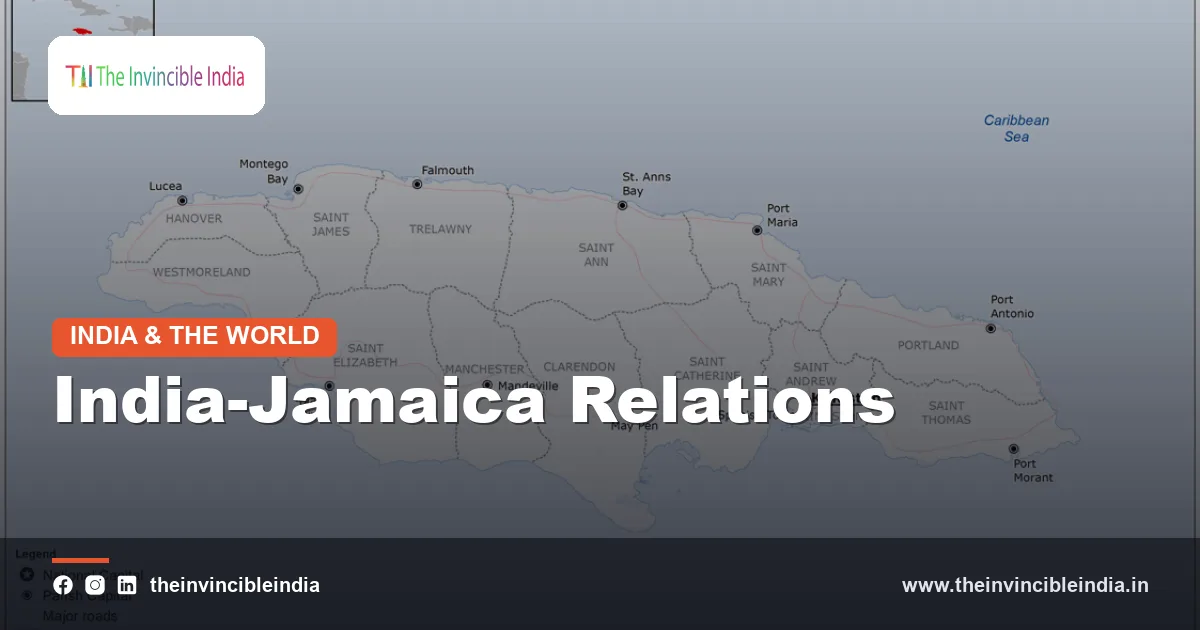
India-Jamaica relations are the friendly bilateral ties between the Republic of India and Jamaica, a Caribbean island nation, built on shared Commonwealth membership, a diaspora whose roots go back to the arrival of Indian indentured labourers in 1845, and a steadily widening agenda of trade, training, culture and sport. The two countries have had formal diplomatic relations since Jamaica became independent from Britain in 1962, and the relationship has always been warm, low-friction and people-centred rather than strategic or contentious.
India-Jamaica relations matter beyond their modest size because Jamaica is one of the largest and most influential members of the Caribbean Community (CARICOM), and because India increasingly treats the Caribbean as part of its outreach to the Global South and to small island developing states. This explainer sets out the history, the Indian-origin community, the institutional framework, economic and capacity-building cooperation, and the cultural and sporting bonds. Figures are given as rounded, widely cited estimates and may change; this page was last updated on 17 October 2026.
Quick Facts
| Attribute | Detail |
|---|---|
| Countries | Republic of India and Jamaica |
| Diplomatic relations | Established in 1962, when Jamaica gained independence on 6 August |
| Indian missions | High Commission of India in Kingston; Jamaica is also represented in New Delhi |
| First Indian arrivals | May 1845, as indentured labourers on Jamaican plantations |
| Indentured migration ended | 1917 (the system was abolished across the British Empire) |
| Indian-origin population | Commonly estimated at around 70,000, a few percent of Jamaica’s roughly 2.8 million people |
| Multilateral overlap | Commonwealth, United Nations, Non-Aligned Movement heritage, India-CARICOM dialogue |
| Main areas of cooperation | Training and scholarships, information technology, health, renewable energy, culture, sport |
| Trade | Modest in value; India sells pharmaceuticals, vehicles and textiles, and buys limited Jamaican goods |
Key Takeaways
- India-Jamaica relations date to 1962, the year Jamaica became independent, and have remained consistently cordial since then.
- The first Indian indentured labourers reached Jamaica in 1845, and their descendants today number roughly 70,000 people.
- Jamaica is a founding member of the Caribbean Community (CARICOM), which makes it a natural partner for India’s outreach to the 15-member Caribbean bloc.
- India supports Jamaica mainly through soft cooperation: Indian Technical and Economic Cooperation (ITEC) training, scholarships, information technology capacity and, in 2021, a gift of COVID-19 vaccine doses.
- Trade between India and Jamaica is small compared with India’s trade with larger partners, so its growth potential rests on pharmaceuticals, renewable energy, information technology and services.
- Cricket, reggae, yoga, curry dishes and Bollywood form an informal cultural bridge between the two societies.
What is the history of India-Jamaica relations?
The history of India-Jamaica relations begins in the colonial era, when both territories were part of the British Empire, and became a diplomatic relationship in 1962 when Jamaica gained independence. For more than a century before that, the connection ran through the movement of people: Indians were recruited to work on Jamaican sugar estates under the indenture system, and a small number of Jamaican and wider West Indian soldiers and administrators served in imperial networks that also linked India.
After 1947, independent India became a vocal supporter of decolonisation, and Indian leaders expressed solidarity with colonised peoples in the Caribbean and Africa. When Jamaica became independent, India was among the countries that welcomed it, and the two sides soon exchanged diplomatic representation. Their shared membership of the Commonwealth, the United Nations and, for India, the Non-Aligned Movement created a common space where their positions often aligned on issues such as decolonisation, development finance, apartheid and climate vulnerability.
From colonial links to modern diplomacy
In the decades after independence, the relationship was maintained through visits, cultural events and the work of the Indian High Commission in Kingston. Because Jamaica is a small economy and India was focused on its own development, the early agenda was limited. The pace of engagement increased from the 2000s, when India began to expand its development partnerships with the Caribbean, set up training programmes and offered concessional financing across the region.
How did Indians come to Jamaica?
Indians came to Jamaica as indentured labourers, recruited under multi-year contracts to replace the enslaved workforce on sugar plantations after slavery was abolished in the British Empire in the 1830s. The first ships carrying Indian workers reached Jamaica in May 1845, and indentured migration continued in batches until the system ended in 1917.
Historians commonly estimate that roughly 36,000 Indians were brought to Jamaica over this period, a smaller number than the totals sent to Guyana or Trinidad and Tobago. Most came from the Gangetic plains of present-day Uttar Pradesh and Bihar, with others from other parts of the subcontinent, and they travelled from ports such as Calcutta (now Kolkata). Contracts generally ran for five years, and many workers eventually stayed rather than accept the return passage that was offered.
- Working conditions: Labourers faced hard plantation work, low wages and strict contract rules, and mortality in the early years was high.
- Settlement: After their contracts ended, many took up small farming, market gardening, shopkeeping and later professions.
- Legacy: Indian foodways, words, religious practices and surnames became part of Jamaican life.
Jamaica recognises this heritage through events such as Indian Heritage Month in May, which marks the 1845 arrival, and community organisations that preserve language, music and religious traditions.
Who are the Indian-origin community in Jamaica?
The Indian-origin community in Jamaica consists of the descendants of indentured labourers together with a smaller group of more recent Indian migrants, and it is generally estimated at around 70,000 people. Within Indian government usage, descendants of earlier migrants are classed as Persons of Indian Origin (PIOs), and the community is a living link that gives the relationship an emotional depth beyond official diplomacy.
Many descendants have blended into the wider Afro-Jamaican, mixed and Chinese-Jamaican society that characterises the island, and a large share belong to Christian churches, while others follow Hindu or Muslim practices. Unlike in Guyana and Trinidad, where people of Indian origin form a large share of the population, the community in Jamaica is a minority whose cultural footprint is nevertheless visible.
Traces of Indian heritage
- Food: Curry goat, roti, chutneys and spiced rice dishes are staples of Jamaican cooking and are widely recognised as inherited from Indian migrants.
- Language: The word “ganja” for cannabis entered Jamaican usage from Hindi, and a number of other terms came with the same migration.
- Religion and festivals: Hindu temples, Diwali celebrations and the Hosay (Muharram) commemoration at certain communities reflect the transplanted traditions.
- Names and places: Surnames and some place associations preserve the Indian record.
India engages this diaspora through the Pravasi Bharatiya Divas conferences, scholarships and cultural programmes, and the Indian High Commission regularly collaborates with community groups on commemorations.
How does India engage with Jamaica through CARICOM?
India engages with Jamaica both bilaterally and through the Caribbean Community (CARICOM), a regional grouping of 15 member states of which Jamaica is a prominent member. The India-CARICOM dialogue gives New Delhi a single platform to speak to the Caribbean on trade, climate, health and capacity-building, and it gives Kingston a larger stage to present Caribbean priorities.
A milestone came in September 2019, when Prime Minister Narendra Modi met CARICOM leaders on the sidelines of the United Nations General Assembly in New York in the first India-CARICOM leaders’ meeting of its kind. India announced grant assistance for community development projects and a line of credit for solar, renewable energy and climate-related initiatives in the region. A later India-CARICOM summit was held in Georgetown, Guyana, in 2024, where the sides reviewed cooperation on food security, health and the blue economy, according to published official accounts.
Shared positions at multilateral forums
Both countries typically cooperate in the United Nations system on topics such as climate finance for vulnerable countries, reform of international financial institutions and the needs of small island developing states (SIDS). Jamaica has generally voiced support for a larger role for India in global governance, including reform of the UN Security Council, while India has supported Caribbean positions on climate adaptation and disaster resilience. Shared interest in solar energy and other energy-transition platforms is a further point of contact.
How strong is India-Jamaica trade and economic cooperation?
India-Jamaica trade and economic cooperation is modest in volume but diverse in potential, with annual bilateral trade generally estimated in the low hundreds of millions of US dollars or below, and a balance that has tended to favour India. Jamaica’s small market, the distance between the two countries and the lack of direct shipping and flight connections have kept the relationship below its capacity.
India’s main exports to Jamaica include pharmaceutical products, vehicles and auto components, textiles and machinery, while Jamaica’s exports to India have historically been limited, with items linked to its mineral and agricultural sectors. Official statistics vary from year to year, so any single figure should be treated as indicative.
| Sector | Why it matters for India and Jamaica |
|---|---|
| Pharmaceuticals and healthcare | Indian generic medicines are cost-effective for a small health system, and Indian firms seek Caribbean market access |
| Information technology | Training and IT centres support Jamaica’s digital and business-process sectors |
| Renewable energy | Jamaica seeks to cut fuel-import dependence, and India offers solar expertise and credit lines |
| Agro-processing and food | Both sides value food security and value-added processing |
| Logistics and shipping | Kingston’s container port is a regional transhipment hub, relevant to Indian exporters |
| Tourism | Jamaica attracts few Indian tourists today, but incomes and interest are rising |
The two governments have also explored institutional steps such as joint trade committees, business delegations and bilateral agreements on matters like visa facilitation for official passports. Indian firms with a presence in Jamaica operate largely in services, telecommunications-related supply, pharmaceuticals and small manufacturing.
What capacity-building and development support does India provide Jamaica?
India provides Jamaica with capacity-building support primarily through the Indian Technical and Economic Cooperation (ITEC) programme, Indian Council for Cultural Relations (ICCR) scholarships and project-based assistance. ITEC, launched in 1964, offers short and medium-term training courses in India for officials and professionals from partner countries, and Jamaicans have regularly taken part in fields such as public administration, agriculture, small enterprises and information technology.
Several features stand out in this support:
- Training and scholarships: Jamaican officials and students attend courses in India, creating a network of alumni familiar with Indian institutions.
- Information technology centre: India supported a Centre of Excellence in information technology in Jamaica, which was designed to build digital skills for students and professionals.
- Health cooperation: In 2021, under the Vaccine Maitri initiative, India gifted about 50,000 doses of COVID-19 vaccine to Jamaica, an act widely noted in the Caribbean.
- Disaster and climate support: India has extended relief and offered resilience assistance to Caribbean states hit by hurricanes and other climate events, and Jamaica is among the countries repeatedly exposed to such hazards.
- Lines of credit: Regional credit lines for renewable energy and development can be used by CARICOM members, including Jamaica, subject to project approval.
Unlike large infrastructure-led partnerships, India’s approach in Jamaica is demand-driven and light in cost, reflecting India’s “South-South cooperation” philosophy of sharing experience rather than imposing conditions.
What cultural and sporting links connect India and Jamaica?
Cultural and sporting links connect India and Jamaica through cricket, music, cuisine, yoga and shared festivals, forming one of the most visible parts of the relationship. Cricket is the strongest bridge: Jamaica provides a large share of West Indies players, and Jamaican-born cricketers such as Chris Gayle and Andre Russell are household names in India because of their long associations with the Indian Premier League (IPL).
West Indies tours of India and Indian tours of the Caribbean, including matches at Sabina Park in Kingston, have built decades of shared sporting memory. The famous links with legendary West Indian fast bowlers and batters are part of cricketing folklore in India.
Music, film and wellness
- Reggae in India: Bob Marley and reggae music enjoy a loyal following in India, particularly among young audiences and in cities with active live-music scenes.
- Bollywood in the Caribbean: Hindi films and songs have long been popular in the Caribbean, and they shaped the “chutney” musical style in the wider region.
- Yoga and Ayurveda: International Day of Yoga events are held in Kingston each June, and wellness tourism is a growing interest.
- Athletics: Jamaica’s sprinting culture, led by names such as Usain Bolt, has fans in India and has prompted occasional exchange of coaching ideas.
The Indian High Commission and Jamaican community organisations also host festivals, film screenings, dance performances and Independence Day events, which keep the cultural conversation going outside government channels.
Which milestones define India-Jamaica relations?
The milestones that define India-Jamaica relations run from the 1845 arrival of indentured labourers to modern summit-level contacts between India and the Caribbean. The table below summarises the main stages.
| Period | Milestone |
|---|---|
| 1845 | First ships carrying Indian indentured labourers reach Jamaica in May |
| 1917 | Indentured migration ends across the British Empire |
| 1947 | India becomes independent and backs decolonisation in the Caribbean |
| 1962 | Jamaica gains independence on 6 August, and diplomatic relations are established |
| 2000s | India expands training, scholarships and IT cooperation with the Caribbean |
| 2019 | First India-CARICOM leaders’ meeting in New York, with announcements on grants and credit |
| 2021 | India gifts COVID-19 vaccine doses to Jamaica under Vaccine Maitri |
| 2024 | India-CARICOM summit in Georgetown reviews cooperation on food, health and the blue economy |
What challenges and opportunities shape India-Jamaica relations?
India-Jamaica relations face the practical challenges of distance and scale but also real opportunities in energy, health, technology and people-to-people exchange. There are no regular direct flights between the two countries, the trade base is small, and both governments have limited diplomatic bandwidth for a relationship that is not a top priority for either.
Main challenges
- Long travel times and the cost of shipping and flights discourage trade and tourism.
- Information about market opportunities is limited on both sides, particularly for small and medium-sized firms.
- Competition for Caribbean attention from the United States, Canada, the European Union, China and others.
- Jamaica’s debt and fiscal constraints can limit its capacity to absorb large projects.
Main opportunities
- Renewable energy and climate resilience, where India has scale and Jamaica has urgent need.
- Affordable generic medicines and digital health tools.
- Digital public infrastructure and fintech, areas in which India has sought to share its experience with partner countries.
- Education exchange, including scholarships and partnerships between universities.
- Use of the diaspora as a bridge for trade, tourism and heritage travel.
Why do India-Jamaica relations matter for India and the Caribbean?
India-Jamaica relations matter because they demonstrate how India builds influence through goodwill, shared history and development partnership rather than through hard power. For India, Jamaica is a respected voice in the Caribbean, in the Commonwealth and at the United Nations, where every vote counts on issues such as climate finance and multilateral reform.
For Jamaica, India is a large, fast-growing partner that offers technology, training and affordable products without heavy political conditions. For the diaspora, the relationship gives recognition to a heritage of resilience that began with the voyages of 1845. Taken together, these strands make India-Jamaica relations a quiet but durable example of South-South friendship.
Bottom Line
India-Jamaica relations are old in people and young in policy: the bond started with indentured voyages in 1845 and has grown into a cordial partnership focused on training, health, technology, culture and sport. The trade base remains small, but the Indian-origin community, CARICOM engagement and shared global interests give the relationship room to deepen.
Frequently Asked Questions
When did India and Jamaica establish diplomatic relations?
India and Jamaica established diplomatic relations in 1962, the year Jamaica became independent from Britain on 6 August. India maintains a High Commission in Kingston, and Jamaica has its own representation in New Delhi. The two countries are also linked through the Commonwealth and the United Nations.
How many people of Indian origin live in Jamaica?
Estimates commonly put the Indian-origin population of Jamaica at around 70,000, which is a few percent of the island’s roughly 2.8 million people. Most are descendants of indentured labourers who arrived between 1845 and 1917. Exact counts vary depending on how ancestry is recorded.
Why did Indians go to Jamaica?
Indians went to Jamaica as indentured labourers to work on sugar plantations after slavery was abolished in the British Empire. The first ships arrived in May 1845, and roughly 36,000 Indians are estimated to have been brought over until the system ended in 1917. Many stayed after their contracts expired and settled as farmers, traders and professionals.
What is India’s role in CARICOM?
India is not a CARICOM member but holds a regular dialogue with the 15-member bloc, of which Jamaica is a leading state. The first India-CARICOM leaders’ meeting took place in New York in September 2019, and a later summit was held in Georgetown, Guyana, in 2024. Cooperation covers climate, renewable energy, health, food security and capacity-building.
What does India export to Jamaica?
India exports pharmaceuticals, vehicles and auto parts, textiles and machinery to Jamaica, while Jamaica’s sales to India are limited. Total bilateral trade is modest, generally estimated in the low hundreds of millions of US dollars or less, and annual figures vary. Pharmaceuticals, renewable energy and information technology are seen as the sectors with the most room to grow.
How are India and Jamaica connected through cricket and culture?
India and Jamaica are connected through cricket, reggae, cuisine and yoga, which form an informal bridge between the societies. Jamaican players such as Chris Gayle and Andre Russell are popular in India through the Indian Premier League, and Bob Marley’s music has a loyal following in India. In Jamaica, Indian-origin dishes like curry goat and roti are everyday food, and yoga and Indian festivals are marked by the community.
{“@context”:”https://schema.org”,”@graph”:[{“@type”:”FAQPage”,”mainEntity”:[{“@type”:”Question”,”name”:”When did India and Jamaica establish diplomatic relations?”,”acceptedAnswer”:{“@type”:”Answer”,”text”:”India and Jamaica established diplomatic relations in 1962, the year Jamaica became independent from Britain on 6 August. India maintains a High Commission in Kingston, and Jamaica has its own representation in New Delhi. The two countries are also linked through the Commonwealth and the United Nations.”}},{“@type”:”Question”,”name”:”How many people of Indian origin live in Jamaica?”,”acceptedAnswer”:{“@type”:”Answer”,”text”:”Estimates commonly put the Indian-origin population of Jamaica at around 70,000, which is a few percent of the island’s roughly 2.8 million people. Most are descendants of indentured labourers who arrived between 1845 and 1917. Exact counts vary depending on how ancestry is recorded.”}},{“@type”:”Question”,”name”:”Why did Indians go to Jamaica?”,”acceptedAnswer”:{“@type”:”Answer”,”text”:”Indians went to Jamaica as indentured labourers to work on sugar plantations after slavery was abolished in the British Empire. The first ships arrived in May 1845, and roughly 36,000 Indians are estimated to have been brought over until the system ended in 1917. Many stayed after their contracts expired and settled as farmers, traders and professionals.”}},{“@type”:”Question”,”name”:”What is India’s role in CARICOM?”,”acceptedAnswer”:{“@type”:”Answer”,”text”:”India is not a CARICOM member but holds a regular dialogue with the 15-member bloc, of which Jamaica is a leading state. The first India-CARICOM leaders’ meeting took place in New York in September 2019, and a later summit was held in Georgetown, Guyana, in 2024. Cooperation covers climate, renewable energy, health, food security and capacity-building.”}},{“@type”:”Question”,”name”:”What does India export to Jamaica?”,”acceptedAnswer”:{“@type”:”Answer”,”text”:”India exports pharmaceuticals, vehicles and auto parts, textiles and machinery to Jamaica, while Jamaica’s sales to India are limited. Total bilateral trade is modest, generally estimated in the low hundreds of millions of US dollars or less, and annual figures vary. Pharmaceuticals, renewable energy and information technology are seen as the sectors with the most room to grow.”}},{“@type”:”Question”,”name”:”How are India and Jamaica connected through cricket and culture?”,”acceptedAnswer”:{“@type”:”Answer”,”text”:”India and Jamaica are connected through cricket, reggae, cuisine and yoga, which form an informal bridge between the societies. Jamaican players such as Chris Gayle and Andre Russell are popular in India through the Indian Premier League, and Bob Marley’s music has a loyal following in India. In Jamaica, Indian-origin dishes like curry goat and roti are everyday food, and yoga and Indian festivals are marked by the community.”}}]}]}


