

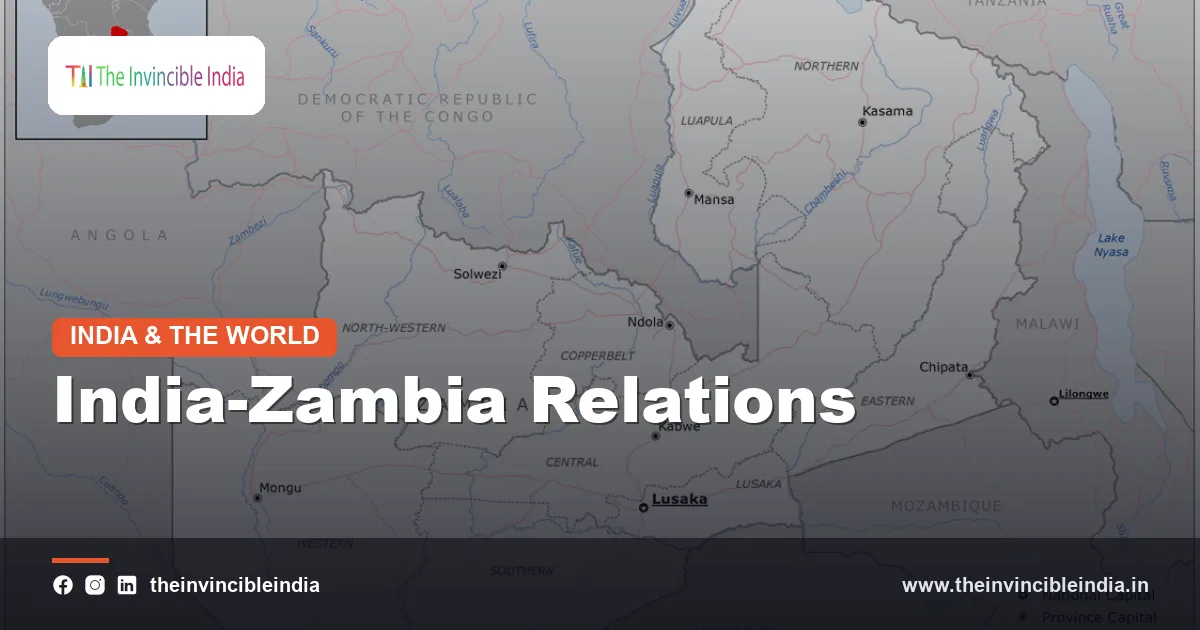
India-Zambia relations are the bilateral ties between the Republic of India and the Republic of Zambia, a partnership of long standing that combines political friendship from the era of decolonisation with present-day cooperation in copper and other minerals, health, agriculture, power and capacity-building. Zambia, a landlocked and mineral-rich country in southern Africa, has been a significant destination for Indian investment, concessional credit and training schemes.
The warmth of the relationship goes back to Zambia’s independence in 1964 and the close association between its first president, Kenneth Kaunda, and Indian leaders. Today, India-Zambia relations are shaped by commercial interests, including Indian mining operations and pharmaceutical exports, and by a well-established Indian-origin community that has lived in Zambia for generations.
| Quick Facts: India-Zambia Relations | |
|---|---|
| Type of relationship | Bilateral relations between two Commonwealth members; development and commerce-led partnership |
| Zambia’s independence | 24 October 1964, from Britain (previously Northern Rhodesia) |
| Indian mission | High Commission of India, Lusaka |
| Zambian capital | Lusaka |
| Main Zambian export of interest | Copper, with cobalt and other minerals |
| Prominent Indian investment | Konkola Copper Mines (KCM), associated with Vedanta Resources |
| Development finance | Lines of credit through the Export-Import Bank of India (EXIM Bank) for health, agriculture, power and other sectors |
| Capacity-building | ITEC and ICCR scholarships; Pan-African e-Network participation |
| Diaspora | Indian-origin community estimated in the tens of thousands |
Key Takeaways
- India-Zambia relations date from Zambia’s independence on 24 October 1964, and they were shaped by the friendship between Kenneth Kaunda and Indian leaders.
- Copper is the backbone of Zambia’s economy and of its commercial links with India, which imports copper and other minerals from Zambia.
- Konkola Copper Mines, one of Zambia’s largest copper operations, has been linked with the Indian-owned Vedanta group for much of the past two decades.
- India has extended lines of credit to Zambia through EXIM Bank for sectors including health, agriculture and power.
- The Indian-origin community in Zambia, estimated in the tens of thousands, is active in trade, manufacturing, mining services and the professions.
- India supports Zambia’s skills development through the Indian Technical and Economic Cooperation (ITEC) programme and scholarships.
What is the history of India-Zambia relations?
The history of India-Zambia relations begins before Zambia’s independence, when India backed the movement against colonial rule and the Central African Federation in Northern Rhodesia. After Zambia became independent on 24 October 1964, India was among the first countries to establish diplomatic ties, and an Indian mission opened in Lusaka in the mid-1960s.
Kenneth Kaunda, Zambia’s president from 1964 to 1991, was a leading figure of the Non-Aligned Movement (NAM) and shared India’s commitment to non-alignment, anti-colonialism and opposition to apartheid. Lusaka hosted the Non-Aligned Summit in 1970, where India and Zambia worked on the same side on decolonisation and economic development. Kaunda visited India several times and was remembered in India for his admiration of Mahatma Gandhi and his personal ties with Indian leaders.
Zambia was a frontline state in the struggle against white-minority rule in Rhodesia, Namibia and South Africa, and it housed liberation movements. India offered political and material support to the same causes. This shared history created a base of trust that has survived changes of government in both capitals.
The Indian-origin community
Indians started to arrive in what is now Zambia in the late nineteenth and early twentieth centuries, mainly as traders, artisans and clerks, many of them from Gujarat, Punjab and Kerala. Several families today are in their third or fourth generation in Zambia. The community has been involved in retail, wholesale, manufacturing, farming and professional services, and it forms a human bridge between the two countries.
Why is copper important to India-Zambia relations?
Copper is important to India-Zambia relations because Zambia is one of Africa’s largest copper producers, India is a large consumer of refined copper, and Indian companies have invested in Zambia’s mining industry. The Copperbelt region in northern Zambia has been mined on an industrial scale since the 1920s, and copper still makes up the largest share of Zambia’s export earnings.
India’s own copper demand grows with infrastructure, electrification, the power sector and electronics manufacturing. India has limited domestic copper ore reserves and relies on imported concentrate and refined metal. Zambia, along with Chile, Peru and some other countries, is therefore a strategic source. The wider push for critical minerals for batteries and renewable energy also increases the interest in Zambia’s cobalt and other metals.
For Zambia, India is both a buyer and an investor. Indian firms bring capital, mining services and a workforce familiar with large-scale operations, while Zambia seeks higher value addition inside its borders rather than only exporting raw concentrate. That tension between export of raw materials and local processing is a recurring theme in the relationship.
What is the role of Konkola Copper Mines in the relationship?
Konkola Copper Mines (KCM) is the best-known Indian-linked mining operation in Zambia, and it has been owned or controlled by the Vedanta Resources group for much of the period since 2004. KCM operates large underground and open-pit mines and a smelter in Zambia’s Copperbelt, and it has been among the country’s largest private employers.
The company’s record has been mixed and has attracted attention in both countries. Vedanta has said that it invested heavily in expanding production. Zambian civil society groups and some communities have raised concerns about pollution and the treatment of local residents, which have been the subject of litigation abroad. In 2019 the Zambian authorities placed KCM into provisional liquidation over a dispute with the owners, and the matter went through courts and negotiations for several years. Reports in 2024 indicated that control was returned to Vedanta under an agreed arrangement, although the details were contested at different stages.
The episode shows how a single corporate dispute can affect wider perceptions. Government officials in both countries have generally said that they treat such disputes as commercial and legal matters that should not damage the broader relationship.
How do Indian lines of credit support Zambia?
Indian lines of credit (LoCs) support Zambia by financing development projects at concessional rates, with the Export-Import Bank of India (EXIM Bank) providing the funds on behalf of the Government of India and Indian companies undertaking the work. Zambia has received several such lines, reported in total at several hundred million US dollars across sectors, although exact amounts vary by source.
The credits have been directed mostly at areas of high development need:
- Health: Equipment and hospital infrastructure, and the supply of Indian-made medicines and diagnostics
- Agriculture: Farm mechanisation, tractors, irrigation and agro-processing
- Power: Power generation and transmission projects, in a country whose electricity supply depends heavily on hydropower such as the Kafue Gorge and Kariba schemes
- Water and infrastructure: Drinking water and rural development works
Zambia has faced debt difficulties in recent years. It defaulted on its external bonds in 2020 and went through a debt restructuring process with official and private creditors. Indian credits are relatively small compared with Chinese and multilateral lending, and they are structured as concessional loans, so they have not been the central issue in the restructuring. The debt situation has, however, made Lusaka more selective about new borrowing.
How does India support Zambia in health and agriculture?
India supports Zambia in health and agriculture through concessional credit, exports of affordable generic medicines, training courses and technical exchanges. Zambia’s health system depends on imported pharmaceuticals, and Indian generics dominate the supply of many essential medicines in southern Africa.
Health
Indian firms supply antiretroviral drugs, anti-malarial medicines and vaccines that are important in a country with a high burden of HIV and malaria. Zambian patients also travel to India for specialised treatment, and Indian doctors and nurses have worked in Zambian hospitals. India’s Pan-African e-Network project, launched in 2009 and later followed by newer digital initiatives, offered tele-education and telemedicine links to African institutions, and Zambia was one of the participating countries.
Agriculture
Agriculture employs a large share of Zambians, and maize is the staple crop. Indian cooperation includes farm machinery, solar irrigation, seed technology and training of agricultural extension workers. Indian companies have also taken up farmland for crops such as soybeans and sugar. The sector is climate-sensitive, and droughts in the region in recent years, including the severe drought of 2024, have increased interest in resilient farming and humanitarian support.
What is the state of India-Zambia trade?
India-Zambia trade consists mainly of Indian imports of copper and other minerals from Zambia and Indian exports of pharmaceuticals, machinery, vehicles and manufactured goods. Bilateral trade has generally been in the range of a billion US dollars or more in recent years, though it moves sharply with global copper prices.
| Direction | Main products | Comment |
|---|---|---|
| India imports from Zambia | Copper (concentrate and refined), cobalt, other ores and minerals | Copper dominates, so value rises and falls with world prices |
| India exports to Zambia | Pharmaceuticals, machinery, electrical equipment, vehicles, iron and steel products, cereals, textiles | Pharmaceuticals and engineering goods are leading categories |
| Investment | Mining, manufacturing, agriculture, retail and services | Indian investors are among Zambia’s longer-standing foreign investors |
| Trade pattern | Commodity-for-manufactures exchange | Zambia wishes to add value locally |
The pattern is typical of India’s trade with resource-rich African countries. Efforts to broaden it include business forums, trade fairs and joint working groups on mining and agribusiness.
How does India help build Zambian skills and institutions?
India helps build Zambian skills and institutions mainly through the Indian Technical and Economic Cooperation (ITEC) programme, scholarships from the Indian Council for Cultural Relations (ICCR) and the establishment of training centres. Hundreds of Zambian civil servants, engineers, teachers, doctors and entrepreneurs have attended short and long courses in India.
ITEC courses cover areas such as public administration, information technology, agriculture, rural development, small-business management and renewable energy. The training is funded by the Government of India, and participants are usually nominated by Zambian ministries. India has also set up or supported vocational and entrepreneurship centres in African countries, and Zambia has seen similar activity in skills and ICT.
Zambian students enrol in Indian universities in fields such as medicine, pharmacy, engineering and management, with a number supported by scholarships. These alumni networks help sustain the relationship at the personal level.
How do India and Zambia cooperate in multilateral forums?
India and Zambia cooperate in multilateral forums such as the United Nations, the Commonwealth, the Non-Aligned Movement and the India-Africa Forum Summit process. Both countries are Commonwealth members and have a record of similar positions on development, climate finance and the reform of global governance.
Zambia is a member of the African Union, the Southern African Development Community (SADC) and the Common Market for Eastern and Southern Africa (COMESA), which gives Indian businesses an indirect route to regional markets. At the African Union level, India has supported the grouping’s growing role in global affairs, including its admission to the G20 in 2023 during India’s presidency.
India has also invited African countries to join India-led initiatives such as the International Solar Alliance and the Global Biofuels Alliance. Cooperation on solar energy is particularly relevant to Zambia, which has experienced power shortages when droughts reduced hydropower output.
What are the main milestones in India-Zambia relations?
The main milestones in India-Zambia relations run from Zambian independence and the Kaunda era to the commercial and development agenda of the twenty-first century. The table below gives approximate dating where sources differ.
| Period | Milestone |
|---|---|
| 1964 | Zambia becomes independent on 24 October; diplomatic relations established |
| 1970 | Lusaka hosts the Non-Aligned Movement summit |
| 1970s to 1980s | India and Zambia support liberation movements in southern Africa |
| 1991 | Zambia’s multiparty transition ends the Kaunda presidency; ties continue |
| 2004 | Vedanta group acquires a major stake in Konkola Copper Mines |
| 2009 | Pan-African e-Network project begins, with African partner countries including Zambia |
| 2015 | Zambia takes part in the third India-Africa Forum Summit in New Delhi |
| 2019 to 2024 | KCM dispute and its eventual settlement shape the commercial climate |
What challenges affect India-Zambia relations?
The main challenges in India-Zambia relations are a dependence on copper, debates over mining practices, Zambia’s debt problems and competition from other partners. The relationship is also affected by public perceptions of foreign investors in the mining sector.
- Commodity dependence: Copper prices drive trade volumes, so the relationship moves with the commodity cycle.
- Mining governance: Disputes over environmental performance, taxes and ownership have drawn scrutiny to Indian-linked operations.
- Debt and fiscal pressure: Zambia’s restructuring process limits its room for new loans.
- Competition: China is Zambia’s largest bilateral creditor and a major trade partner, and Western, Gulf and Canadian firms are active in mining.
- Logistics: Zambia is landlocked and depends on corridors through Tanzania, Mozambique and South Africa for exports and imports.
Both governments describe the relationship as stable and mutually beneficial, while acknowledging the need for transparency and local value addition.
What is the outlook for India-Zambia relations?
The outlook for India-Zambia relations is steady growth, with copper and critical minerals, health, agriculture and renewable energy as the likely drivers. Zambia has set an ambition to raise copper output substantially over the coming decade, and India’s demand for the metal is expected to increase with its manufacturing and energy transition.
New areas include solar and other renewable energy projects, digital payments, pharmaceutical manufacturing in Zambia and education. India has promoted its Unified Payments Interface (UPI) abroad, and several African countries have shown interest in digital public infrastructure, which may be a field of cooperation. The Indian-origin community and Zambian alumni of Indian universities provide a ready pool of intermediaries.
The outcome will depend on whether commercial relationships are seen as fair by Zambian communities. Investments that create local jobs, process minerals domestically and meet environmental standards are likely to strengthen the political relationship, while disputes may weaken it.
Bottom Line
India-Zambia relations combine the friendship of the Nehru and Kaunda generations with a modern agenda of minerals, medicine, credit and training. Copper is the commercial core, and Indian-linked mining has brought both investment and controversy. The relationship is most likely to deepen where cooperation creates jobs, skills and value in Zambia itself.
Frequently Asked Questions
When did India and Zambia establish diplomatic relations?
India and Zambia established diplomatic relations soon after Zambia became independent on 24 October 1964. India was among the early countries to open a mission in Lusaka. The ties were reinforced by the shared outlook of the Non-Aligned Movement.
Why is Zambia important to India?
Zambia is important to India mainly because it is a major source of copper, cobalt and other minerals needed for India’s growing industry and energy transition. It is also a market for Indian pharmaceuticals and machinery. A long-established Indian-origin community adds a human link.
What is Konkola Copper Mines?
Konkola Copper Mines (KCM) is one of Zambia’s largest copper mining operations, located in the Copperbelt, and it has been linked with the Indian-owned Vedanta group since 2004. It was placed under provisional liquidation by Zambian authorities in 2019 after a dispute. Reports in 2024 indicated that control was returned to Vedanta under an agreed arrangement.
Has India given lines of credit to Zambia?
Yes, India has extended lines of credit to Zambia through the Export-Import Bank of India, reported in total at several hundred million US dollars. The credits have supported sectors such as health, agriculture and power. Exact amounts and utilisation vary by source.
How many Indians live in Zambia?
The Indian-origin community in Zambia is generally estimated in the tens of thousands, though figures vary by source and definition. Many families have lived in Zambia for several generations. They work in trade, manufacturing, mining services, agriculture and professions such as medicine and teaching.
What does India offer Zambia in capacity-building?
India offers Zambia capacity-building mainly through the ITEC programme and ICCR scholarships. Zambian officials and professionals attend courses in India in fields such as public administration, IT, agriculture and entrepreneurship. Zambian students also study medicine, engineering and other subjects at Indian universities.
{“@context”:”https://schema.org”,”@graph”:[{“@type”:”FAQPage”,”mainEntity”:[{“@type”:”Question”,”name”:”When did India and Zambia establish diplomatic relations?”,”acceptedAnswer”:{“@type”:”Answer”,”text”:”India and Zambia established diplomatic relations soon after Zambia became independent on 24 October 1964. India was among the early countries to open a mission in Lusaka. The ties were reinforced by the shared outlook of the Non-Aligned Movement.”}},{“@type”:”Question”,”name”:”Why is Zambia important to India?”,”acceptedAnswer”:{“@type”:”Answer”,”text”:”Zambia is important to India mainly because it is a major source of copper, cobalt and other minerals needed for India’s growing industry and energy transition. It is also a market for Indian pharmaceuticals and machinery. A long-established Indian-origin community adds a human link.”}},{“@type”:”Question”,”name”:”What is Konkola Copper Mines?”,”acceptedAnswer”:{“@type”:”Answer”,”text”:”Konkola Copper Mines (KCM) is one of Zambia’s largest copper mining operations, located in the Copperbelt, and it has been linked with the Indian-owned Vedanta group since 2004. It was placed under provisional liquidation by Zambian authorities in 2019 after a dispute. Reports in 2024 indicated that control was returned to Vedanta under an agreed arrangement.”}},{“@type”:”Question”,”name”:”Has India given lines of credit to Zambia?”,”acceptedAnswer”:{“@type”:”Answer”,”text”:”Yes, India has extended lines of credit to Zambia through the Export-Import Bank of India, reported in total at several hundred million US dollars. The credits have supported sectors such as health, agriculture and power. Exact amounts and utilisation vary by source.”}},{“@type”:”Question”,”name”:”How many Indians live in Zambia?”,”acceptedAnswer”:{“@type”:”Answer”,”text”:”The Indian-origin community in Zambia is generally estimated in the tens of thousands, though figures vary by source and definition. Many families have lived in Zambia for several generations. They work in trade, manufacturing, mining services, agriculture and professions such as medicine and teaching.”}},{“@type”:”Question”,”name”:”What does India offer Zambia in capacity-building?”,”acceptedAnswer”:{“@type”:”Answer”,”text”:”India offers Zambia capacity-building mainly through the ITEC programme and ICCR scholarships. Zambian officials and professionals attend courses in India in fields such as public administration, IT, agriculture and entrepreneurship. Zambian students also study medicine, engineering and other subjects at Indian universities.”}}]}]}


