

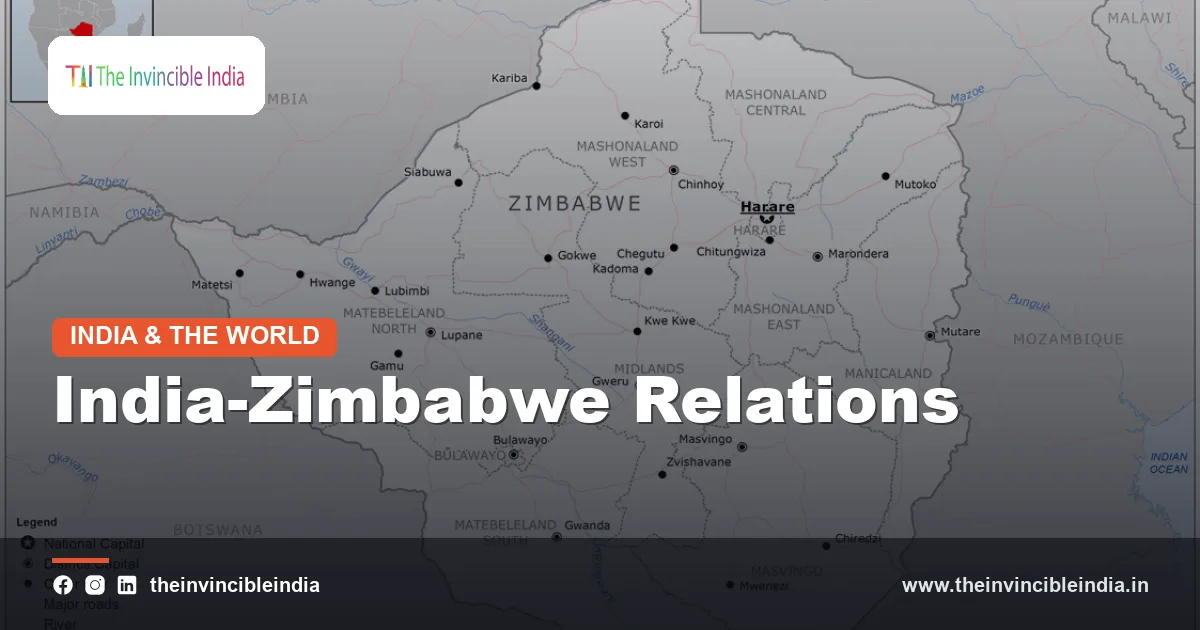
India-Zimbabwe relations are the bilateral ties between the Republic of India and the Republic of Zimbabwe, a long-standing friendship that began with Indian support for Zimbabwe’s liberation struggle and now covers lines of credit for power and agriculture, mining, pharmaceuticals, trade and capacity-building. The two countries share a colonial past under British rule and a record of cooperation in the Non-Aligned Movement.
India was among the countries that backed the end of white-minority rule in Rhodesia, and it established diplomatic relations with Zimbabwe when the country became independent in 1980. Since then, India-Zimbabwe relations have continued through changes of government and through years of Western sanctions on Zimbabwe, with India keeping channels open and offering development assistance that is practical rather than political in tone.
| Quick Facts: India-Zimbabwe Relations | |
|---|---|
| Type of relationship | Bilateral relations between two developing countries; development and trade-led partnership |
| Zimbabwe’s independence | 18 April 1980 (formerly Southern Rhodesia / Rhodesia) |
| Diplomatic relations | Established at Zimbabwe’s independence in 1980 |
| Indian mission | High Commission of India, Harare |
| Zimbabwean capital | Harare |
| Development finance | Lines of credit through the Export-Import Bank of India (EXIM Bank), including for power (Hwange) and agriculture |
| Key sectors | Power, agriculture and farm equipment, mining, pharmaceuticals, information technology |
| Capacity-building | ITEC and ICCR scholarships; Pan-African e-Network |
| Historic NAM link | Harare hosted the Non-Aligned Movement summit in 1986, which set up the AFRICA Fund |
Key Takeaways
- India-Zimbabwe relations were established when Zimbabwe became independent on 18 April 1980, after India had supported the liberation struggle against white-minority rule.
- Harare hosted the Non-Aligned Movement summit in 1986, where the AFRICA Fund to support the front-line states against apartheid was launched with India as a prominent contributor.
- India has extended lines of credit to Zimbabwe through EXIM Bank, including for rehabilitation of the Hwange thermal power station and for agriculture.
- India supplies Zimbabwe with pharmaceuticals, vehicles, machinery and farm equipment, and buys tobacco, minerals and ferroalloys in smaller volumes.
- Many Zimbabweans have attended courses in India under the Indian Technical and Economic Cooperation (ITEC) programme and Indian scholarships.
- India has maintained engagement with Zimbabwe despite Western sanctions and Zimbabwe’s 2003 exit from the Commonwealth.
What is the history of India-Zimbabwe relations?
The history of India-Zimbabwe relations starts with India’s anti-colonial diplomacy, in which New Delhi opposed the white-minority regime in Rhodesia and supported African nationalist movements. India did not recognise the 1965 unilateral declaration of independence by the Rhodesian government and supported United Nations sanctions against it.
Zimbabwe became independent on 18 April 1980 after the Lancaster House negotiations and a transition supervised by Britain. India welcomed the new state quickly, set up diplomatic relations and opened a mission in Harare. Indian leaders attended or sent representatives to independence-related events, and the early 1980s saw exchanges of ministerial visits.
Zimbabwe’s first prime minister and later president, Robert Mugabe, was widely regarded in New Delhi as a leader of the liberation generation, and relations in that period were cordial. The non-aligned outlook shared by both countries gave the relationship its political frame. Even when Zimbabwe faced economic crisis and Western isolation in the 2000s, India continued trade and development cooperation and did not join unilateral sanctions.
The 1986 Harare summit and the AFRICA Fund
Harare hosted the Eighth Summit of the Non-Aligned Movement in 1986. At that summit the movement set up the Action for Resisting Invasion, Colonialism and Apartheid Fund, known as the AFRICA Fund, to assist the front-line states against South Africa’s apartheid regime. India took a leading role in proposing and funding it. The episode is one of the clearest examples of India and Zimbabwe working together on a shared political cause.
Why does Indian credit matter to Zimbabwe?
Indian credit matters to Zimbabwe because the country has had limited access to international lending since the late 1990s, and concessional Indian loans have helped to finance power, agriculture and industrial equipment. Zimbabwe has carried large arrears to some international lenders and has been unable to borrow freely from multilateral institutions for long periods.
India’s lines of credit (LoCs) are extended by the Export-Import Bank of India (EXIM Bank) on behalf of the Government of India. They are tied to Indian goods and services, and the borrower repays over a long period at low interest. Zimbabwe has been a recipient of several such lines, reported in total at several hundred million US dollars, although exact numbers differ by source and by year.
The most commonly cited project is the rehabilitation and upgrading of the Hwange thermal power station, Zimbabwe’s biggest coal-fired plant, where Indian engineering companies were involved in refurbishing ageing units. Other credits have supported farm mechanisation, including the supply of Indian-made tractors and equipment, as well as irrigation and rural development. For a country that has experienced chronic power cuts and falling farm productivity, such projects address urgent needs.
How does India support power and agriculture in Zimbabwe?
India supports power and agriculture in Zimbabwe through concessional credit, supply of equipment, engineering contracts and technical training. These two sectors are the core of the development agenda because Zimbabwe’s economy depends on electricity for mining and manufacturing and on agriculture for jobs and exports.
Power
Zimbabwe generates electricity mainly from the Kariba hydropower station on the Zambezi River, shared with Zambia, and from coal at Hwange. Both are vulnerable: Kariba is affected by low rainfall and water levels, and the coal units at Hwange are old. Indian credit for the rehabilitation of Hwange was intended to raise reliability. India has also promoted solar cooperation through the International Solar Alliance, an Indian-led initiative of which many African countries are members.
Agriculture
Zimbabwe’s land reform programme from 2000 changed farm ownership and reduced commercial output, and the country needs machinery and inputs. Indian tractors, irrigation equipment and implements have been supplied under credit lines and commercial contracts. Training courses in India cover agricultural extension, food processing and rural development.
The effectiveness of these programmes depends on maintenance, spare parts and access to finance for farmers, which are recurring limits in the sector.
What is the state of India-Zimbabwe trade?
India-Zimbabwe trade is modest and has typically been worth a few hundred million US dollars a year, with India exporting more than it imports. The figures fluctuate with Zimbabwe’s foreign-exchange availability and global commodity prices, so any single number should be treated as an approximation.
| Direction | Main products | Comment |
|---|---|---|
| India exports to Zimbabwe | Pharmaceuticals, vehicles and parts, machinery, tractors, electrical goods, plastics, cereals and textiles | Pharmaceuticals and engineering goods lead |
| India imports from Zimbabwe | Tobacco, ores and minerals, ferroalloys and other metal products, some agricultural products | Zimbabwe’s exports to India are concentrated in a few commodities |
| Balance of trade | Usually in India’s favour | Zimbabwe seeks to expand exports |
| Payment and finance | Commercial contracts, credit lines, and trade finance | Currency instability and arrears have been constraints |
Zimbabwe is a member of regional groupings such as the Southern African Development Community (SADC) and the Common Market for Eastern and Southern Africa (COMESA). These give Indian companies indirect access to wider regional markets, and some firms use Zimbabwe as a base for southern Africa.
What role do mining and pharmaceuticals play?
Mining and pharmaceuticals are two of the most commercially active sectors in India-Zimbabwe relations. Zimbabwe has deposits of gold, platinum group metals, chrome, coal, nickel, diamonds and lithium, and Indian firms have shown interest in several of them.
In mining, Indian companies have been involved in ferrochrome and chrome ore, coal and mining services, and Indian diamond traders and cutters have watched developments around the Marange diamond fields. Lithium has attracted fresh attention because of demand for batteries, although Chinese companies have taken most of the large investments so far. India’s interest in critical minerals and its establishment of mineral-sourcing partnerships in Africa make Zimbabwe a potential partner, subject to Zimbabwe’s policy on exports of unprocessed lithium.
In pharmaceuticals, Indian generics are widely used in Zimbabwe’s public and private health systems, including medicines for HIV, tuberculosis and malaria. Indian firms and local distributors dominate parts of the market. The Government of India has also donated medicines and equipment during emergencies, and Indian vaccines have been supplied to Zimbabwe on commercial and humanitarian terms.
How does India build skills and institutions in Zimbabwe?
India builds skills and institutions in Zimbabwe mainly through the Indian Technical and Economic Cooperation (ITEC) programme, Indian Council for Cultural Relations (ICCR) scholarships and the Pan-African e-Network project. Many Zimbabwean civil servants, military officers, teachers, engineers and entrepreneurs have studied in India.
ITEC courses are held in Indian institutions and cover public administration, information technology, agriculture, banking, small-business development, renewable energy and diplomacy. They are funded by the Government of India and are open to nominees of partner governments. Zimbabwean students also enrol in Indian universities for medicine, engineering, pharmacy and management, some on scholarships and some self-funded.
India has also supported institution-building such as vocational training and IT centres in Africa, and has offered Zimbabwe participation in telemedicine and tele-education. Cooperation in these fields is valued because it creates lasting links between professionals in both countries.
How do India and Zimbabwe cooperate internationally?
India and Zimbabwe cooperate internationally through the United Nations, the Non-Aligned Movement, the African Union-India summit process and the broader Global South grouping. They frequently support each other’s positions on development, sovereignty and the reform of global institutions.
India has sought African support for a permanent seat in a reformed United Nations Security Council, and Zimbabwe is part of the African Union position that Africa should also have permanent representation. Zimbabwe participates in the India-Africa Forum Summit process, whose third edition in New Delhi in 2015 saw participation from nearly all African states.
Zimbabwe left the Commonwealth in 2003 and is not a member, while India remains an active member. The difference has not affected bilateral ties, since the relationship is maintained directly. India has said generally that development partnerships should respect national sovereignty and not be conditional on political demands, a stance welcomed in Harare.
What are the main milestones in India-Zimbabwe relations?
The main milestones in India-Zimbabwe relations run from the anti-colonial solidarity of the 1960s and 1970s to development financing in the 2010s and beyond. The table gives approximate dating where sources vary.
| Period | Milestone |
|---|---|
| 1965 | India rejects the Rhodesian unilateral declaration of independence |
| 1980 | Zimbabwe becomes independent on 18 April; diplomatic relations established |
| 1986 | Harare hosts the Non-Aligned summit; the AFRICA Fund is launched |
| 1990s | Economic liberalisation and growth of Indian business presence |
| 2003 | Zimbabwe leaves the Commonwealth; India continues bilateral engagement |
| 2009 | Pan-African e-Network project begins across African partner countries |
| 2015 | Zimbabwe takes part in the third India-Africa Forum Summit in New Delhi |
| 2010s onward | EXIM Bank lines of credit for power and agriculture |
What challenges affect India-Zimbabwe relations?
The main challenges in India-Zimbabwe relations are Zimbabwe’s economic instability, debt arrears and sanctions-related banking difficulties, along with competition from other partners and limited trade volumes. These factors make large projects slower to finance and complete.
- Currency and payments: Zimbabwe has experienced hyperinflation, currency changes and shortages of foreign exchange, which complicate payments to Indian suppliers.
- Debt arrears: Unresolved arrears to international lenders limit access to new credit.
- Sanctions and compliance: Western sanctions on certain Zimbabwean entities make banking and shipping more complicated for companies from third countries.
- Competition: China, Russia, South Africa and Gulf states are active in Zimbabwe’s mining and infrastructure.
- Project delivery: Projects financed under credit lines have sometimes been delayed by funding gaps and procurement issues.
India typically approaches these issues through quiet diplomacy, joint commissions and project-by-project follow-up rather than public criticism.
What is the outlook for India-Zimbabwe relations?
The outlook for India-Zimbabwe relations is steady, with cooperation likely to focus on power, agriculture, critical minerals, health and digital skills. Zimbabwe’s reform efforts, including attempts to settle arrears and stabilise its currency, would make larger Indian participation easier.
Renewable energy is a promising area. Zimbabwe has high solar potential and an electricity shortfall, and India has technology and experience in solar manufacturing and rooftop programmes. Climate-resilient farming is another field, since southern Africa has faced severe drought in recent years. India has at times offered food and medical aid to drought-hit African countries.
The relationship may also gain from India’s wider Africa strategy, which emphasises demand-driven partnerships, capacity-building and the interests of the Global South. For Zimbabwe, India offers a partner that does not attach political conditions to cooperation. For India, Zimbabwe offers minerals, a regional foothold and a long record of goodwill.
Bottom Line
India-Zimbabwe relations rest on shared anti-colonial history and a pragmatic development agenda. Lines of credit for power and agriculture, pharmaceutical trade, mining interests and training schemes form the working core. Progress depends largely on Zimbabwe’s economic stability and on the pace at which announced projects are completed.
Frequently Asked Questions
When did India and Zimbabwe establish diplomatic relations?
India and Zimbabwe established diplomatic relations when Zimbabwe became independent on 18 April 1980. India had supported the liberation struggle against white-minority rule and welcomed the new state quickly. A mission was opened in Harare soon afterwards.
What is the AFRICA Fund and what was India’s role?
The AFRICA Fund (Action for Resisting Invasion, Colonialism and Apartheid) was set up at the 1986 Non-Aligned Movement summit in Harare to support the front-line states against apartheid South Africa. India played a leading role in proposing and funding it. The summit and the fund are among the best-known examples of India-Zimbabwe cooperation.
Has India given lines of credit to Zimbabwe?
Yes, India has extended lines of credit to Zimbabwe through the Export-Import Bank of India. They have supported power sector work, including the Hwange thermal power station, and agriculture. Reported totals are in the hundreds of millions of US dollars, with exact figures varying by source.
What does India trade with Zimbabwe?
India exports pharmaceuticals, vehicles, machinery, tractors and other manufactured goods to Zimbabwe. It imports tobacco, ores, minerals and ferroalloys. Trade is modest, typically a few hundred million US dollars a year, and usually favours India.
Does India provide training to Zimbabweans?
Yes, India trains Zimbabweans mainly through the Indian Technical and Economic Cooperation (ITEC) programme and scholarships from the Indian Council for Cultural Relations. Courses cover public administration, IT, agriculture, banking and small business. Zimbabwean students also study medicine and engineering at Indian universities.
Is Zimbabwe a member of the Commonwealth like India?
No, Zimbabwe left the Commonwealth in 2003 and is not currently a member, while India remains an active member. The difference has not prevented bilateral cooperation. India engages with Zimbabwe directly and through forums such as the United Nations and the Non-Aligned Movement.
{“@context”:”https://schema.org”,”@graph”:[{“@type”:”FAQPage”,”mainEntity”:[{“@type”:”Question”,”name”:”When did India and Zimbabwe establish diplomatic relations?”,”acceptedAnswer”:{“@type”:”Answer”,”text”:”India and Zimbabwe established diplomatic relations when Zimbabwe became independent on 18 April 1980. India had supported the liberation struggle against white-minority rule and welcomed the new state quickly. A mission was opened in Harare soon afterwards.”}},{“@type”:”Question”,”name”:”What is the AFRICA Fund and what was India’s role?”,”acceptedAnswer”:{“@type”:”Answer”,”text”:”The AFRICA Fund (Action for Resisting Invasion, Colonialism and Apartheid) was set up at the 1986 Non-Aligned Movement summit in Harare to support the front-line states against apartheid South Africa. India played a leading role in proposing and funding it. The summit and the fund are among the best-known examples of India-Zimbabwe cooperation.”}},{“@type”:”Question”,”name”:”Has India given lines of credit to Zimbabwe?”,”acceptedAnswer”:{“@type”:”Answer”,”text”:”Yes, India has extended lines of credit to Zimbabwe through the Export-Import Bank of India. They have supported power sector work, including the Hwange thermal power station, and agriculture. Reported totals are in the hundreds of millions of US dollars, with exact figures varying by source.”}},{“@type”:”Question”,”name”:”What does India trade with Zimbabwe?”,”acceptedAnswer”:{“@type”:”Answer”,”text”:”India exports pharmaceuticals, vehicles, machinery, tractors and other manufactured goods to Zimbabwe. It imports tobacco, ores, minerals and ferroalloys. Trade is modest, typically a few hundred million US dollars a year, and usually favours India.”}},{“@type”:”Question”,”name”:”Does India provide training to Zimbabweans?”,”acceptedAnswer”:{“@type”:”Answer”,”text”:”Yes, India trains Zimbabweans mainly through the Indian Technical and Economic Cooperation (ITEC) programme and scholarships from the Indian Council for Cultural Relations. Courses cover public administration, IT, agriculture, banking and small business. Zimbabwean students also study medicine and engineering at Indian universities.”}},{“@type”:”Question”,”name”:”Is Zimbabwe a member of the Commonwealth like India?”,”acceptedAnswer”:{“@type”:”Answer”,”text”:”No, Zimbabwe left the Commonwealth in 2003 and is not currently a member, while India remains an active member. The difference has not prevented bilateral cooperation. India engages with Zimbabwe directly and through forums such as the United Nations and the Non-Aligned Movement.”}}]}]}


