

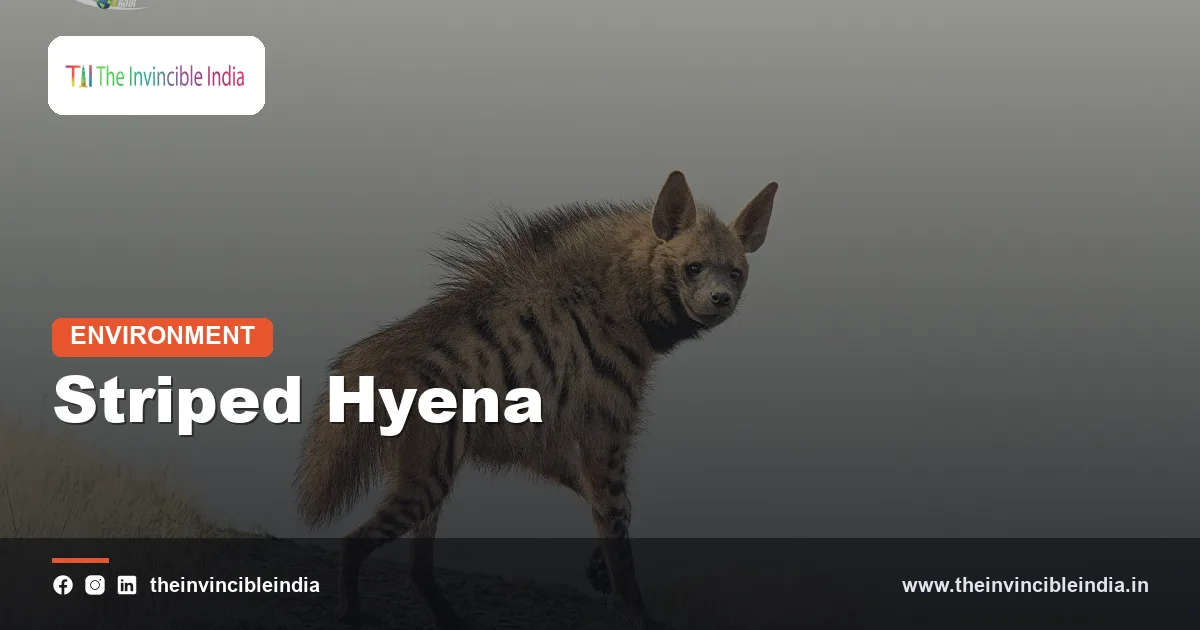
The striped hyena (Hyaena hyaena) is a medium-sized, nocturnal scavenging carnivore that lives in the scrub, dry forest and rocky country of India and is classified as Near Threatened by the International Union for Conservation of Nature (IUCN). It is the only hyena species found in India, and its habit of eating carcasses makes it one of the most useful, and least appreciated, sanitation workers in the subcontinent’s dry landscapes.
Striped hyena conservation in India is a story of a quiet, misunderstood animal that survives mostly outside protected areas, close to villages, farms and highways. This explainer covers what the animal is, where it lives, what it does for the ecosystem, why its numbers are believed to be falling, and what legal and community-based protection exists.
| Attribute | Detail |
|---|---|
| Common name | Striped hyena (also called lakkadbagha in Hindi and several regional names across India) |
| Scientific name | Hyaena hyaena (family Hyaenidae) |
| Global IUCN status | Near Threatened, with a declining population trend |
| Legal protection in India | Protected under the Wildlife (Protection) Act, 1972 (commonly cited as a Schedule III species; check the latest schedules after amendments) |
| Typical body weight | Roughly 25 to 55 kg, with a shoulder height of about 60 to 80 cm |
| Main habitat in India | Scrub, dry deciduous forest, semi-arid grassland, rocky hills and ravines |
| Feeding habit | Mainly scavenger of carcasses, supplemented by fruit, insects and small animals |
| Activity pattern | Nocturnal and largely solitary, with den sites reused over time |
Key Takeaways
- The striped hyena is the only hyena species in India and is listed as Near Threatened by the IUCN.
- Striped hyenas act as natural sanitation agents by eating carcasses of livestock and wild animals, which reduces the spread of disease in dry landscapes.
- Most striped hyenas in India live outside national parks and sanctuaries, in scrub, farmland edges and village commons.
- Persecution driven by superstition, accidental killing on roads and the illegal use of body parts are among the main reported threats to the striped hyena in India.
- No reliable, recent national population estimate exists for the striped hyena in India, which makes monitoring and policy planning difficult.
- Striped hyenas are not canids; hyenas form their own family, Hyaenidae, which is more closely related to mongooses and cats than to dogs.
What is a striped hyena?
A striped hyena is a medium-sized carnivore with a sloping back, a long erect mane running from the neck to the tail, and dark vertical stripes on a grey or buff coat. It is the smallest of the living hyena species and the only one that ranges widely beyond Africa, extending through the Middle East and Central Asia into the Indian subcontinent.
The animal is built for long, patient travel in search of food. Its forelegs are longer than its hind legs, giving the body a slanted profile, and its large ears are well suited to picking up faint sounds at night. When threatened, the striped hyena raises its mane, which makes it look considerably larger than it is. This display is often enough to deter rivals at a carcass without a fight.
Although it resembles a dog at a glance, the striped hyena is not closely related to dogs, wolves or jackals. Hyenas belong to the suborder Feliformia, the cat-like carnivores, and their nearest relatives include mongooses, civets and cats. This is an important point for readers, because many local myths treat the animal as a kind of wild dog or as a supernatural creature.
Where does the striped hyena live in India?
The striped hyena lives across much of peninsular, western and northern India, wherever dry open habitats, scrub and rocky outcrops provide cover for dens and a steady supply of carrion. It is generally absent from dense wet evergreen forests, high mountain regions and the humid northeast, where the habitat does not suit its way of life.
States commonly reported to hold striped hyenas include Rajasthan, Gujarat, Maharashtra, Madhya Pradesh, Uttar Pradesh, Karnataka, Andhra Pradesh, Telangana and Tamil Nadu, among others. The species is also recorded in the dry fringes of several tiger reserves and in many rocky hill ranges that are not formally protected at all. Exact distribution maps remain incomplete because the animal is secretive and few systematic surveys have targeted it.
Within these regions, the striped hyena prefers:
- Caves, rock crevices and eroded ravines for denning during the day.
- Scrub forest and semi-arid grassland where it can move freely at night.
- Areas close to human settlements, where dead cattle, carcass dumps and slaughter waste provide a reliable food supply.
This tolerance for human-modified land explains why the species persists in places where larger carnivores have long since disappeared. It also explains why its fate depends so heavily on how local communities treat it.
What does the striped hyena eat, and how does it hunt?
The striped hyena eats mostly carrion, using its powerful jaws and bone-crushing teeth to consume meat, skin and even bone from carcasses that other animals have left behind. It is primarily a scavenger rather than a hunter, though it will also take small animals, insects, eggs and wild fruit when available.
In India, the diet typically includes:
- Carcasses of cattle, buffalo, goats and other livestock that die in or near villages.
- Remains of kills made by tigers, leopards, wolves and other large predators.
- Small mammals, reptiles and birds caught opportunistically.
- Insects such as termites and beetles, and fallen wild fruits.
- Agricultural produce such as melons and other fruit in some areas.
The striped hyena forages alone and may travel many kilometres in a single night. It relies heavily on smell to locate carrion. Because it can break and digest bone, it leaves little trace of a carcass behind, and the calcium in the bone helps it, and the cubs it nurses, stay healthy.
It will sometimes carry food back to its den, particularly when it has cubs. Researchers have noted that bones collected inside hyena dens can accumulate over time, and such deposits are of interest to palaeontologists who study ancient animal remains.
Why does the striped hyena matter to ecosystems?
The striped hyena matters because it removes carcasses from the landscape, which lowers the chance that pathogens spread to livestock, wildlife and people. This clean-up service is performed free of charge in rural India, where dead animals are often left in open fields or at the edge of a village.
Scavengers form a vital part of every healthy ecosystem, and India has seen the dramatic consequences of losing them. When vultures declined sharply in the 1990s and 2000s, largely because of the veterinary drug diclofenac, carcasses stayed in the open for longer. Feral dogs and other opportunistic feeders benefited, raising concerns about disease transmission. In this context, the striped hyena has become a more important part of the scavenger guild than before.
The ecological value of the striped hyena can be summarised as follows:
- Disease control: rapid removal of carcasses reduces the build-up of bacteria and parasites.
- Nutrient cycling: bones, skin and tissue are broken down and returned to the soil through droppings.
- Food web support: hyenas share carcasses with vultures, jackals and other scavengers, and their dens shelter other small animals.
- Indicator role: a healthy hyena population suggests that scrub and dry-country habitats are still functioning.
How does the striped hyena live and breed?
The striped hyena lives a largely solitary or small-family life, emerging after dark to forage and returning to a den before dawn. Adults often forage alone, but a female and her young, and sometimes a pair or small group of related animals, may share a den site.
Breeding can occur through much of the year in India. After a gestation period of roughly three months, a female usually gives birth to a small litter, commonly two to four cubs, in a den. The cubs are born with their eyes closed and depend on the mother for several months. They are weaned gradually and begin to follow adults on foraging trips as they grow. Both parents, and in some cases other group members, may bring food to the den.
Striped hyenas rely on scent marking and vocal signals, rather than aggressive fights, to communicate with neighbours. They produce a paste from a gland near the tail and deposit it on grass stems and rocks to mark territory. They are generally silent compared with the spotted hyena of Africa, though they can make low calls, growls and, in some situations, a cackling sound.
In the wild, a striped hyena may live around a dozen years, though many die earlier because of human-caused mortality.
What are the main threats to the striped hyena in India?
The main threats to the striped hyena in India are persecution by people, road accidents, loss and degradation of habitat, the illegal use of body parts, and the reduction of carcass supplies and wild prey. Each threat may be modest on its own, but together they add up to a steady decline in many districts.
Persecution and superstition
Striped hyenas are widely feared in rural India, and many folk tales describe them as dangerous or magical animals. Such beliefs can lead to people trapping, poisoning or beating hyenas to death, even though attacks on humans are very rare. Some local traditions also ascribe special powers to hyena body parts, which fuels illegal killing.
Roadkill
Because the striped hyena travels far at night and often follows roadside carcasses, it is frequently hit by vehicles on highways cutting through scrub and grassland. Expanding road networks have increased this risk in recent decades.
Body-part trade
Parts of the animal, including skin, teeth, paws and tail, have been reported in illegal wildlife trade and in folk medicine and charm markets. Because these items are small and easy to conceal, enforcement agencies find them difficult to track.
Habitat and food loss
Conversion of scrub and grassland into farms, quarries, industrial areas and plantations removes denning sites. At the same time, changes in livestock disposal, such as burying or burning carcasses, and reduced wild prey in some regions, mean less carrion is available to scavengers.
Poisoning and dogs
Poisoned baits laid for stray dogs, jackals or other animals can kill hyenas by accident. Free-ranging dogs also compete for carrion and can harass hyenas, and may carry diseases.
What is the legal status of the striped hyena in India?
The striped hyena is legally protected in India under the Wildlife (Protection) Act, 1972, which prohibits hunting, trapping and trade in the species and its parts. The species is commonly cited as being listed in Schedule III of the Act, but because the schedules have been revised by amendment, readers should consult the latest official text for the exact current placement.
Internationally, the IUCN Red List classifies the striped hyena as Near Threatened. The species has not been a major focus of international trade regulation, and its protection in India depends mainly on national law and state forest departments. Enforcement is difficult because most hyenas live outside protected areas, close to settlements where wildlife offences are rarely detected.
Key legal and policy points include:
- Hunting or harming a protected wild animal is an offence under the Wildlife (Protection) Act, 1972.
- Possession of or trade in body parts of protected species is also an offence.
- State forest departments, the Wildlife Crime Control Bureau (WCCB) and local police share responsibility for enforcement.
- Compensation schemes for livestock loss, where they exist, usually apply to large carnivores and may not cover hyenas.
How many striped hyenas are there in India?
No dependable, recent national count of striped hyenas in India exists, and most figures quoted in public reports are rough estimates based on limited surveys. Because the animal is nocturnal, shy and spread thinly across large landscapes, standard tiger-style counting methods do not work well for it.
Some regional surveys, using camera traps, den searches and interviews with villagers, have suggested that the species still occurs widely but at low densities. Scientists generally agree that the overall population trend is downward, which is consistent with the global Near Threatened classification. Estimates should therefore be treated cautiously, and any specific number should be read as an approximate figure tied to a particular survey area and year.
Better monitoring would involve:
- Standardised camera-trap and sign surveys outside protected areas.
- Recording hyena presence during routine forest and tiger monitoring exercises.
- Collecting road-kill data on highways passing through scrub and dry forest.
- Involving local residents, who often know den sites well, as citizen scientists.
How does the striped hyena compare with other Indian scavengers and carnivores?
The striped hyena differs from other Indian scavengers in being a mammal that can crush bone, while vultures remove soft tissue and jackals take smaller scraps. Together they share the work of clearing carcasses, each filling a slightly different role.
| Species | Group | Scavenging role | Typical habitat |
|---|---|---|---|
| Striped hyena | Hyaenidae | Crushes bone and eats carcasses of all sizes | Scrub, dry forest, rocky hills |
| Golden jackal | Canidae | Eats scraps, small carcasses and waste | Wide range, including village edges |
| Indian wolf | Canidae | Mainly hunts, occasionally scavenges | Open grassland and semi-arid land |
| Vultures | Birds of prey | Strip soft tissue from large carcasses rapidly | Open country and cliffs |
| Free-ranging dog | Canidae | Opportunistic feeder on waste and carrion | Villages and towns |
This comparison shows why losing one scavenger affects the others. When vultures decline, carcasses persist longer, hyenas and dogs take more of the load, and disease risk rises if the remaining scavengers cannot keep pace.
How can striped hyenas be conserved in India?
Striped hyenas can be conserved in India mainly by reducing human-caused deaths, protecting denning habitat outside reserves and improving public understanding of the animal. Because the species lives alongside people, community goodwill is as important as formal protection.
Practical conservation measures include:
- Awareness work: correcting myths in villages and schools so that hyenas are not killed out of fear.
- Safer roads: signs, speed controls and, where feasible, wildlife crossings on highways through hyena habitat.
- Habitat protection: recognising scrub, ravines and rocky hills as valuable ecosystems rather than “wastelands”.
- Law enforcement: targeting the trade in hyena parts and acting against poisoning and trapping.
- Research: funding long-term studies of population, movement and diet outside protected areas.
- Carcass management: keeping safe disposal sites where scavengers can feed, while avoiding drugs such as diclofenac that poison scavengers.
A hopeful point is that striped hyenas appear to tolerate people better than many other carnivores, so modest changes in local behaviour can make a real difference.
Why should readers care about the striped hyena?
Readers should care about the striped hyena because its fate reflects the health of India’s dry-country ecosystems, which are often overlooked in conservation planning. These landscapes, including scrub, ravines and semi-arid grasslands, support many species but receive little attention compared with forests.
The hyena also illustrates a wider lesson in wildlife protection: species that carry negative cultural images tend to receive less public support, even when their ecological role is valuable. Changing how people see the animal, from a feared nuisance to a useful neighbour, may be the most cost-effective conservation tool available.
Bottom Line
The striped hyena is India’s only hyena and an important but poorly monitored scavenger of dry landscapes. Protecting it requires fewer road deaths, less persecution, secure denning habitat and better population data. Last updated: 17 October 2026.
Frequently Asked Questions
Is the striped hyena dangerous to humans?
The striped hyena is generally not dangerous to humans and rarely attacks people. It is shy and mainly avoids contact, and most conflict arises from fear and folklore rather than real incidents. Hyenas may defend themselves or their dens if cornered, so people should keep their distance.
Is the striped hyena endangered in India?
The striped hyena is classified globally as Near Threatened rather than Endangered, but its numbers in India are believed to be declining. Threats include persecution, road accidents and loss of habitat. Because no dependable national count exists, the true scale of the decline is uncertain.
What does the striped hyena eat?
The striped hyena mainly eats carrion, including carcasses of livestock and wild animals. It also eats small animals, insects and wild fruit when they are available. Its strong jaws allow it to crush and digest bones that other scavengers leave behind.
Where can the striped hyena be found in India?
The striped hyena is found across dry and semi-arid parts of India, including states such as Rajasthan, Gujarat, Maharashtra, Madhya Pradesh and Karnataka. It prefers scrub, rocky hills and ravines, and it is largely absent from wet evergreen forests and the northeast. Many individuals live outside protected areas, near villages.
Is the striped hyena protected by law in India?
Yes, the striped hyena is protected under the Wildlife (Protection) Act, 1972, which prohibits hunting and trade in the species and its parts. It is commonly cited as a Schedule III species, but readers should check the latest schedules since amendments have revised them. Enforcement remains a challenge because most hyenas live outside reserves.
Is a hyena a dog or a cat?
A hyena is neither a dog nor a cat, although it is more closely related to cats than to dogs. Hyenas belong to their own family, Hyaenidae, within the cat-like carnivores. Their nearest relatives include mongooses and civets, which is why they look dog-like only superficially.
{“@context”:”https://schema.org”,”@graph”:[{“@type”:”FAQPage”,”mainEntity”:[{“@type”:”Question”,”name”:”Is the striped hyena dangerous to humans?”,”acceptedAnswer”:{“@type”:”Answer”,”text”:”The striped hyena is generally not dangerous to humans and rarely attacks people. It is shy and mainly avoids contact, and most conflict arises from fear and folklore rather than real incidents. Hyenas may defend themselves or their dens if cornered, so people should keep their distance.”}},{“@type”:”Question”,”name”:”Is the striped hyena endangered in India?”,”acceptedAnswer”:{“@type”:”Answer”,”text”:”The striped hyena is classified globally as Near Threatened rather than Endangered, but its numbers in India are believed to be declining. Threats include persecution, road accidents and loss of habitat. Because no dependable national count exists, the true scale of the decline is uncertain.”}},{“@type”:”Question”,”name”:”What does the striped hyena eat?”,”acceptedAnswer”:{“@type”:”Answer”,”text”:”The striped hyena mainly eats carrion, including carcasses of livestock and wild animals. It also eats small animals, insects and wild fruit when they are available. Its strong jaws allow it to crush and digest bones that other scavengers leave behind.”}},{“@type”:”Question”,”name”:”Where can the striped hyena be found in India?”,”acceptedAnswer”:{“@type”:”Answer”,”text”:”The striped hyena is found across dry and semi-arid parts of India, including states such as Rajasthan, Gujarat, Maharashtra, Madhya Pradesh and Karnataka. It prefers scrub, rocky hills and ravines, and it is largely absent from wet evergreen forests and the northeast. Many individuals live outside protected areas, near villages.”}},{“@type”:”Question”,”name”:”Is the striped hyena protected by law in India?”,”acceptedAnswer”:{“@type”:”Answer”,”text”:”Yes, the striped hyena is protected under the Wildlife (Protection) Act, 1972, which prohibits hunting and trade in the species and its parts. It is commonly cited as a Schedule III species, but readers should check the latest schedules since amendments have revised them. Enforcement remains a challenge because most hyenas live outside reserves.”}},{“@type”:”Question”,”name”:”Is a hyena a dog or a cat?”,”acceptedAnswer”:{“@type”:”Answer”,”text”:”A hyena is neither a dog nor a cat, although it is more closely related to cats than to dogs. Hyenas belong to their own family, Hyaenidae, within the cat-like carnivores. Their nearest relatives include mongooses and civets, which is why they look dog-like only superficially.”}}]}]}


