

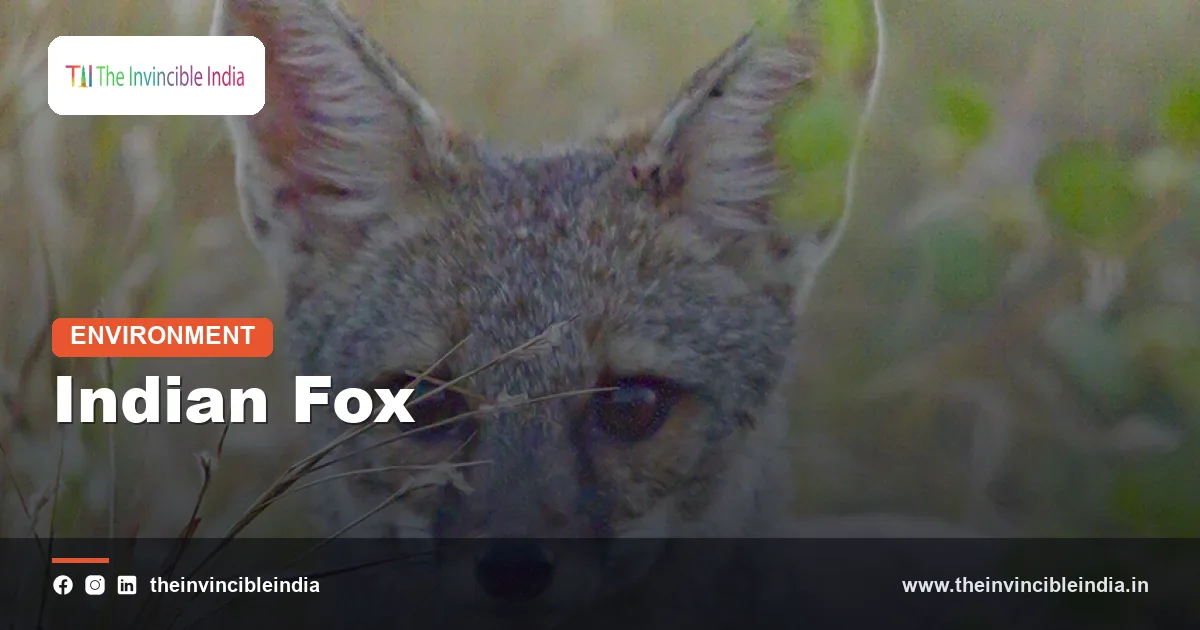
The Indian fox (Vulpes bengalensis), also called the Bengal fox, is a small, slender fox endemic to the Indian subcontinent that lives in open grassland, scrub and semi-arid country and is listed as Least Concern on the IUCN Red List. Although the species is still widespread, it depends on a habitat that India’s planners have long mislabelled as wasteland, and local populations are shrinking wherever grasslands are ploughed, built over or planted with trees.
Indian fox conservation therefore has less to do with rescuing a species on the brink and more to do with protecting an ordinary, valuable animal before it becomes rare. This explainer covers the biology of the Indian fox, its role in grassland ecology, the threats it faces and the protection it receives under Indian law.
| Attribute | Detail |
|---|---|
| Common names | Indian fox, Bengal fox |
| Scientific name | Vulpes bengalensis (family Canidae) |
| Global IUCN status | Least Concern, though local populations are believed to be declining |
| Range | Endemic to the Indian subcontinent, from the Himalayan foothills southward, including India, Nepal, Pakistan and Bangladesh |
| Legal protection in India | Protected under the Wildlife (Protection) Act, 1972 (schedule placement has been revised over time, so check the current text) |
| Typical size | About 2 to 3 kg in weight, with a body length of roughly 45 to 60 cm and a black-tipped tail |
| Habitat | Open grassland, scrub, semi-arid plains and thorn forest edges |
| Social system | Mostly monogamous pairs that share a burrow and raise pups together |
Key Takeaways
- The Indian fox is a small canid found only in the Indian subcontinent and is classified as Least Concern by the IUCN.
- Indian foxes usually live in monogamous pairs and raise their pups in burrows dug in open ground.
- The Indian fox feeds on insects, rodents, reptiles, birds, eggs and fruit, which helps keep pest populations in check.
- Conversion of grassland into farms, plantations and industrial land is considered the largest threat to the Indian fox.
- Hunting for meat, tails and bones, and capture for superstition or sport, continue to affect Indian foxes in parts of the country.
- Indian foxes are legally protected in India, but they live mostly in unprotected open land, so enforcement is difficult.
What is the Indian fox?
The Indian fox is a small, long-legged fox with a pale sandy to grey-brown coat, a slim muzzle, and a bushy tail tipped with black. It is one of the smaller fox species in the world and is easily distinguished from jackals and wolves by its size, lightweight build and fine features.
The Indian fox belongs to the genus Vulpes, the true foxes, within the dog family Canidae. Its scientific name, Vulpes bengalensis, reflects the early description of specimens from the Bengal region, but the animal occurs far beyond Bengal. Its relatives in the subcontinent include the red fox of the northern mountains and the desert fox of the Thar and Kutch regions.
Several features help identify the Indian fox:
- A slender frame, long legs and a relatively small head.
- A coat that is often grey-buff above and paler below.
- Dark markings around the eyes and muzzle in many individuals.
- A tail with a black tip, used for balance when running and turning quickly.
The Indian fox is among the few canids found only in a single region of the world, which makes the Indian subcontinent its sole stronghold.
Where is the Indian fox found?
The Indian fox is found across most of peninsular India and the plains of the subcontinent, wherever there is open grassland, scrub or semi-arid land. It occurs from the foothills of the Himalayas southward to the tip of the peninsula, but avoids dense forest, true desert and very high mountains.
Within India, the species is recorded in states such as Rajasthan, Gujarat, Maharashtra, Karnataka, Andhra Pradesh, Telangana, Tamil Nadu, Madhya Pradesh, Uttar Pradesh and parts of eastern India. The animal is common in some dry grassland reserves and in wildlife sanctuaries set aside for blackbuck and great Indian bustard, because those habitats overlap with its own.
Typical habitats include:
- Open short-grass plains and fallow farmland.
- Thorn scrub and degraded dry deciduous forest.
- Rocky or undulating country with soft soil for digging.
- Edges of villages, where the animal hunts rodents.
The Indian fox tends to avoid areas with heavy tree cover. This habit makes the species an indicator of open ecosystems rather than forests.
How does the Indian fox live and breed?
The Indian fox lives in monogamous pairs that share a burrow and defend a modest territory, with both parents raising the pups. This pair-bonding is unusual among small carnivores and is one of the species’ most characteristic features.
A pair digs a burrow in open ground, often in a mound, along a field bund or in a gully, and may use several entrances for escape. Burrows are reused across seasons, and abandoned ones can later shelter other animals such as mongooses, snakes or porcupines.
Breeding generally takes place in the cooler months, between roughly December and March in many regions, though timing varies. The female gives birth after a gestation of about two months to a litter of two to four pups, and the male brings food to the mother and young. Pups leave the den as they mature, and young foxes may remain near their parents for some time.
The Indian fox is mainly crepuscular and nocturnal, which means it is most active at dusk, at night and around dawn. In less disturbed areas it may be seen during the day, resting near the burrow or moving across short grass.
The species is generally silent but can use a series of barks and yelps, particularly to communicate with its mate or pups.
What does the Indian fox eat?
The Indian fox eats a varied diet of insects, rodents, reptiles, birds, eggs and wild fruit, making it an omnivorous generalist. Its feeding habits vary with the seasons and with what the habitat offers at any given time.
Typical food items include:
- Grasshoppers, termites, beetles and other insects, which are often the main food in many areas.
- Field mice, gerbils, voles and other small rodents.
- Lizards, snakes and ground-nesting birds, along with eggs.
- Fruits such as ber, and other seasonal wild fruit.
- Carrion and scraps near villages when available.
The animal usually hunts alone, stalking prey and pouncing, and may dig out small burrowing animals. Because it eats large numbers of rodents and insects, it quietly reduces crop pests. Farmers rarely notice this benefit, and sometimes accuse foxes of taking poultry. In practice, poultry losses are relatively small compared with the benefits of pest control.
What is the role of the Indian fox in grassland ecology?
The Indian fox plays the role of a small mesopredator in grassland ecosystems, controlling populations of rodents and insects and serving as prey for larger carnivores and raptors. This position in the middle of the food chain makes the species an important link between plant-eating animals and the top predators of open habitats.
Its ecological functions include:
- Pest control: by eating rodents and insects, the Indian fox limits damage to grass and crops.
- Prey base: foxes and their pups are eaten by wolves, large owls, eagles and other predators, supporting wider food webs.
- Soil engineering: burrows aerate soil and create shelters used by other small animals.
- Seed dispersal: fruits eaten by foxes pass through the gut, and seeds are deposited in new places.
India’s grasslands are among its most threatened ecosystems, and they are also home to the Indian wolf, blackbuck, great Indian bustard, lesser florican and many reptiles. The presence of a healthy Indian fox population is generally a sign that a grassland remains functional. Its decline, in contrast, suggests that open habitats are being fragmented or lost.
What are the main threats to the Indian fox?
The main threats to the Indian fox are the loss of grassland and scrub habitat, hunting and trapping, road accidents, poisoning and attacks by free-ranging dogs. Although the species is still widespread, these pressures are cumulative and are reducing local populations.
Habitat loss
Grasslands and scrub have often been classified as “wasteland” in official records, which has made it easy to convert them into farms, tree plantations, solar parks, quarries, townships and industrial estates. Afforestation drives that plant trees on natural grassland can also harm foxes, which prefer open ground.
Hunting and trapping
Indian foxes have been hunted for meat, and parts such as the tail, teeth and bones have been used in folk beliefs and charms in some regions. Foxes are also captured by nomadic and local hunters, or killed by hunters with dogs for sport. These activities are illegal under wildlife law, yet they persist in some areas.
Poisoning and conflict
Rodenticides used in fields can poison foxes that eat contaminated prey. Foxes are sometimes killed in retaliation for taking poultry, even though such incidents are limited.
Roads and dogs
Highways cutting through grasslands cause accidental deaths. Free-ranging dogs can kill foxes, compete with them for food and spread diseases such as canine distemper and rabies.
What is the legal status of the Indian fox in India?
The Indian fox is protected in India under the Wildlife (Protection) Act, 1972, which bans hunting, capture and trade in the species and its body parts. The exact schedule in which the species appears has been revised in various amendments, so readers who need the precise listing should consult the latest official schedules.
Internationally, the IUCN lists the Indian fox as Least Concern. In trade terms, the species has appeared on the CITES appendices through listing at India’s request, which allows monitoring of international movement of the animal and its products. Trade controls are only one part of protection, however, since most threats are local.
Protection operates at several levels:
- Hunting, trapping and possession of the animal or its parts is prohibited under national law.
- National parks and wildlife sanctuaries that include grassland shelter the species indirectly.
- State forest departments and the Wildlife Crime Control Bureau (WCCB) are responsible for enforcement.
- Because many foxes live on revenue and community land, effective protection also depends on village-level cooperation.
How does the Indian fox compare with other Indian foxes?
The Indian fox is smaller and more lightly built than the red fox, and it lives in open plains rather than mountains or true desert. India hosts several wild fox species, each adapted to a different habitat zone.
| Species | Scientific name | Main habitat in India | Distinctive feature |
|---|---|---|---|
| Indian (Bengal) fox | Vulpes bengalensis | Grassland, scrub, semi-arid plains | Small, black-tipped tail, found only in the subcontinent |
| Red fox | Vulpes vulpes | Himalayan and trans-Himalayan regions | Larger, reddish coat, found across much of the Northern Hemisphere |
| Desert fox | Vulpes vulpes pusilla (often treated as a red fox subspecies) | Thar Desert and Kutch | Pale sandy coat suited to arid areas |
| Tibetan sand fox | Vulpes ferrilata | High-altitude Ladakh and Sikkim plateaus | Boxy face, adapted to cold steppe |
Taxonomic treatment of some of these forms differs between authorities, so readers will find varying lists in different references. The key point for conservation is that the Indian fox alone is endemic to the subcontinent, which raises its importance to India.
How many Indian foxes are there?
There is no precise, recent national estimate of Indian fox numbers, and the species is generally described as widespread but declining in many local areas. Because foxes are nocturnal and live in open land outside reserves, they are rarely counted in routine wildlife surveys.
Studies in individual grassland landscapes have reported fox densities that vary widely, depending on habitat quality and human disturbance. The global Least Concern classification reflects the large range of the species rather than a confirmed stable population. Researchers caution that grassland loss continues to chip away at available habitat, so local extinctions are possible even though the species as a whole is not yet at risk.
To improve monitoring, conservationists suggest:
- Recording fox burrows and sightings during grassland and blackbuck surveys.
- Using camera traps and spotlight surveys in key grassland habitats.
- Combining village interviews with field data to map presence outside protected areas.
How can Indian fox populations be protected?
Indian fox populations can be protected mainly by conserving grassland and scrub habitat, ending illegal hunting and reducing accidental deaths. Since the species lives on community and revenue land, working with villagers is as important as formal protected areas.
Recommended measures include:
- Recognising grasslands: reclassifying open natural ecosystems as valuable habitat rather than wasteland, so that they are not automatically earmarked for plantations or development.
- Protecting burrows: identifying and safeguarding active den sites, particularly in agricultural landscapes.
- Stopping hunting: enforcing laws against trapping and the sale of fox parts, and working with traditional hunting communities on alternative livelihoods.
- Reducing poisons: promoting safer pest control that does not poison wildlife.
- Dog management: vaccinating and sterilising free-ranging dogs near wildlife habitats.
- Education: showing farmers the pest-control value of foxes.
Such steps also benefit other grassland species, including the Indian wolf, blackbuck and several threatened birds, making the Indian fox a useful flagship for open habitats.
Bottom Line
The Indian fox is a widespread but quietly declining endemic canid whose future is tied to the survival of India’s grasslands. Protecting burrows, ending hunting and valuing open habitats can keep it common. Last updated: 17 October 2026.
Frequently Asked Questions
Is the Indian fox the same as the Bengal fox?
Yes, the Indian fox and the Bengal fox are two names for the same species, Vulpes bengalensis. The name Bengal fox comes from the region where early specimens were described, but the animal lives across most of the Indian subcontinent. Both names are widely used in books and field guides.
Is the Indian fox endangered?
No, the Indian fox is not classified as endangered; the IUCN lists it as Least Concern. However, local populations are believed to be declining because grassland and scrub habitat is being converted to other uses. This means the species could become threatened in the future if habitat loss continues.
What does the Indian fox eat?
The Indian fox eats a mix of insects, rodents, reptiles, birds, eggs and wild fruit. It hunts mainly at dusk and at night, and it also scavenges when food is available. Its diet makes it useful in controlling crop pests.
Does the Indian fox live in pairs?
Yes, the Indian fox typically lives in monogamous pairs that share a burrow. Both the male and female help raise the pups, with the male bringing food to the mother and young. This stable pairing is a notable feature of the species.
Is hunting the Indian fox illegal in India?
Yes, hunting, trapping and trading in Indian foxes or their body parts is illegal under the Wildlife (Protection) Act, 1972. The schedule listing has been revised over time, so the latest official text should be checked for precise details. Despite the law, illegal killing for meat and charms still occurs in some regions.
Where can I see an Indian fox in India?
Indian foxes can be seen in open grassland and scrub habitats, including some wildlife sanctuaries and grassland reserves in states such as Rajasthan, Gujarat, Maharashtra and Karnataka. The best chances are at dawn or dusk, when the animals are most active. Sightings are never guaranteed, as the species is shy and spread across wide areas.
{“@context”:”https://schema.org”,”@graph”:[{“@type”:”FAQPage”,”mainEntity”:[{“@type”:”Question”,”name”:”Is the Indian fox the same as the Bengal fox?”,”acceptedAnswer”:{“@type”:”Answer”,”text”:”Yes, the Indian fox and the Bengal fox are two names for the same species, Vulpes bengalensis. The name Bengal fox comes from the region where early specimens were described, but the animal lives across most of the Indian subcontinent. Both names are widely used in books and field guides.”}},{“@type”:”Question”,”name”:”Is the Indian fox endangered?”,”acceptedAnswer”:{“@type”:”Answer”,”text”:”No, the Indian fox is not classified as endangered; the IUCN lists it as Least Concern. However, local populations are believed to be declining because grassland and scrub habitat is being converted to other uses. This means the species could become threatened in the future if habitat loss continues.”}},{“@type”:”Question”,”name”:”What does the Indian fox eat?”,”acceptedAnswer”:{“@type”:”Answer”,”text”:”The Indian fox eats a mix of insects, rodents, reptiles, birds, eggs and wild fruit. It hunts mainly at dusk and at night, and it also scavenges when food is available. Its diet makes it useful in controlling crop pests.”}},{“@type”:”Question”,”name”:”Does the Indian fox live in pairs?”,”acceptedAnswer”:{“@type”:”Answer”,”text”:”Yes, the Indian fox typically lives in monogamous pairs that share a burrow. Both the male and female help raise the pups, with the male bringing food to the mother and young. This stable pairing is a notable feature of the species.”}},{“@type”:”Question”,”name”:”Is hunting the Indian fox illegal in India?”,”acceptedAnswer”:{“@type”:”Answer”,”text”:”Yes, hunting, trapping and trading in Indian foxes or their body parts is illegal under the Wildlife (Protection) Act, 1972. The schedule listing has been revised over time, so the latest official text should be checked for precise details. Despite the law, illegal killing for meat and charms still occurs in some regions.”}},{“@type”:”Question”,”name”:”Where can I see an Indian fox in India?”,”acceptedAnswer”:{“@type”:”Answer”,”text”:”Indian foxes can be seen in open grassland and scrub habitats, including some wildlife sanctuaries and grassland reserves in states such as Rajasthan, Gujarat, Maharashtra and Karnataka. The best chances are at dawn or dusk, when the animals are most active. Sightings are never guaranteed, as the species is shy and spread across wide areas.”}}]}]}


