

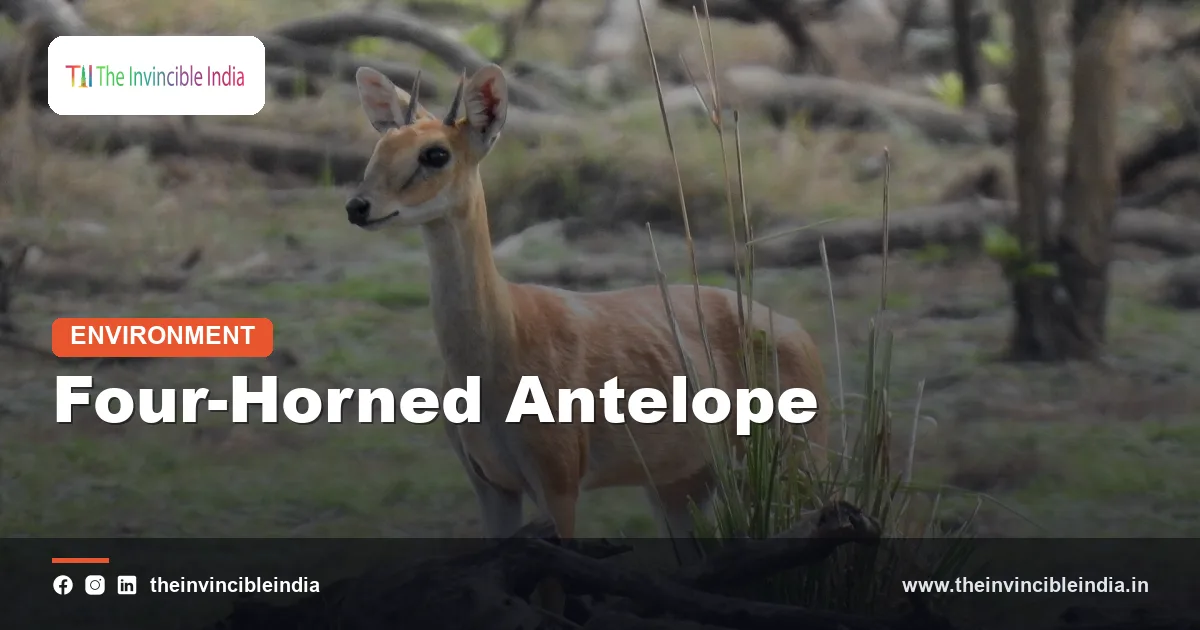
The four-horned antelope (Tetracerus quadricornis), known in Hindi as the chousingha, is a small, shy, solitary antelope of India’s dry forests, and it is the only wild bovid in the world in which males normally carry two pairs of horns. The species is found almost entirely in peninsular and central India, with a small presence in lowland Nepal, and it is protected under the Wildlife (Protection) Act, 1972.
Though common in old shikar records, the four-horned antelope is now considered a Vulnerable species by the IUCN because its range is patchy and its habitat is shrinking. This explainer covers what the four-horned antelope is, why it has four horns, where it lives, how it behaves, what threatens it and how it is protected.
Quick Facts: Four-Horned Antelope
| Common names | Four-horned antelope; chousingha (Hindi, meaning roughly “four horns”) |
|---|---|
| Scientific name | Tetracerus quadricornis (the only species in the genus Tetracerus) |
| Family and tribe | Bovidae, in the tribe Boselaphini, whose only other living member is the nilgai |
| Size | About 55 to 65 centimetres at the shoulder; typically around 17 to 25 kilograms |
| Horns | Males usually have a short front pair and a longer rear pair; females are hornless |
| Habitat | Dry deciduous forest, open woodland and grass-scrub, close to water |
| Range | Peninsular and central India, with a small population in Nepal’s lowlands |
| Social behaviour | Largely solitary; mothers with young, and occasional small groups |
| Conservation status | IUCN: Vulnerable; protected in India under the Wildlife (Protection) Act, 1972 |
Key Takeaways
- The four-horned antelope (Tetracerus quadricornis) is the only wild bovid in which adult males regularly carry four horns.
- The four-horned antelope is endemic to the Indian subcontinent, with almost all of its population in India and only a small presence in Nepal.
- The four-horned antelope prefers dry deciduous forests with hilly terrain, tall grass and a permanent water source, and it avoids open plains and dense evergreen forest.
- The four-horned antelope is the smallest of the Asian bovids and is usually solitary, which makes it difficult to see and to count.
- The IUCN classifies the four-horned antelope as Vulnerable, and habitat loss, grazing pressure and hunting are the main reasons for its decline.
- The four-horned antelope is protected under India’s Wildlife (Protection) Act, 1972, and survives mainly inside tiger reserves, national parks and sanctuaries.
What is the four-horned antelope?
The four-horned antelope is a small antelope-like hoofed mammal native to India and Nepal, scientifically named Tetracerus quadricornis, in which the male normally has four horns. The name chousingha comes from Hindi, where char means four and singh means horn.
Despite being called an antelope, the four-horned antelope is not related to the gazelles and the true antelopes of the savanna. It belongs to the bovid family, in the tribe Boselaphini, and its nearest living relative is the nilgai, the large blue bull of India’s plains. Zoologists regard both as survivors of an ancient lineage that was once more widespread in Asia.
The species is monotypic at the genus level, meaning Tetracerus has only one living species. Some authors recognise subspecies on the basis of colour and horn pattern, but the subspecies question is not settled.
Why does the four-horned antelope have four horns?
The four-horned antelope has four horns because males grow a second, shorter pair in front of the main pair, but biologists do not know the exact evolutionary reason for the extra pair. The rear horns are longer, usually around eight to ten centimetres, and the front horns are small, often only a few centimetres, and can look like little spikes or knobs.
How the horns develop
- Only males have horns; females are hornless.
- Young males usually grow the rear pair first, and the smaller front pair often appears later, sometimes only after the animal is about a year old.
- In some individuals and regions the front pair is very small or absent, so a two-horned male is not necessarily a different species.
- The horns are permanent, made of a bony core with a keratin sheath, and are not shed each year like antler.
The horns have a role in territorial and dominance displays between males, and in defence, though the antelope’s main defence is concealment and flight rather than fighting.
What does a four-horned antelope look like?
A four-horned antelope is a slim, long-legged animal with a yellowish-brown to reddish-brown coat, a pale belly and a dark line down the front of each leg. It stands roughly 55 to 65 centimetres tall at the shoulder and weighs about 17 to 25 kilograms, making it the smallest bovid in Asia.
Several features help to identify the species in the field:
- A slender body that is high at the rump and slightly hunched when the animal is alarmed.
- A short, tufted tail.
- Small, rounded ears and a noticeable dark patch near the eye gland.
- Dark stripes on the lower front legs, which are more pronounced in some animals than in others.
The animal’s colour blends with dry grass and leaf litter. When disturbed, it often freezes, then bounds away in a series of quick, jerky leaps, usually making a low, whistling or snorting alarm sound.
Where does the four-horned antelope live in India?
The four-horned antelope lives in scattered pockets of dry forest across peninsular and central India, including parts of Madhya Pradesh, Chhattisgarh, Maharashtra, Gujarat, Rajasthan, Odisha, Jharkhand, Karnataka, Andhra Pradesh, Telangana and Tamil Nadu, with some animals along the Himalayan foothills. Its distribution is patchy rather than continuous, and many sub-populations are small and isolated.
The species needs undulating, hilly or broken ground, open forest with grassy undergrowth, and a source of drinking water within a short distance. It rarely strays far from water and tends to avoid both heavily cultivated land and very dense forest.
Protected areas where the four-horned antelope has been reported
- Gir National Park and Sanctuary in Gujarat.
- Kanha, Pench and Satpura tiger reserves in Madhya Pradesh, and other central Indian forests.
- Simlipal in Odisha.
- Parts of the Western Ghats and the peninsular forests of Karnataka, such as Bandipur and Nagarhole.
- Other dry-forest reserves of Maharashtra, Rajasthan and Telangana.
Outside India, small numbers have been reported in the Terai lowlands of Nepal. Records from other countries are unconfirmed or historic. Because sightings are infrequent, the exact distribution of the species is still being refined by camera-trap surveys.
How does the four-horned antelope live?
The four-horned antelope lives mostly alone, browses on leaves and grasses, and uses fixed dung heaps to mark its range. Males occupy home ranges that overlap those of several females, while females and their young may stay together for a time.
Diet
The four-horned antelope feeds on grasses, herbs, leaves, shoots, flowers and fallen fruits, and it needs to drink regularly. It is a mixed feeder, taking grass in the monsoon when it is fresh and relying more on browse in the dry season. Its habit of eating fruit makes it a minor seed disperser in dry forests.
Behaviour and middens
The four-horned antelope defecates in the same spots repeatedly, creating dung piles known as middens. These piles are thought to act as scent and territory signals, and they are one of the best clues that the species is present in a forest.
Breeding
Females usually give birth to one or two young after a gestation of about eight months. The mother hides the newborn in tall grass or brush for several days and visits it to nurse. Breeding is not strictly tied to one season, though births often cluster around the monsoon, when forage is plentiful.
Which predators and ecological roles are linked to the four-horned antelope?
The four-horned antelope is prey for leopards, tigers, dholes (Asiatic wild dogs) and striped hyenas, and young animals can also be taken by jackals and large birds of prey. The species is small enough that it forms a modest part of the diet of large carnivores, but in some forests it is a regular prey item.
As a browser-grazer and fruit eater, the four-horned antelope contributes to seed dispersal and vegetation structure in dry forests. Its presence is also treated by forest managers as an indicator of healthy, water-rich dry deciduous woodland, since the species disappears quickly when forests are degraded.
What threatens the four-horned antelope?
The main threats to the four-horned antelope are habitat loss and fragmentation, grazing pressure from domestic livestock, forest fires, hunting for meat and, locally, disturbance from human settlement. Because its populations are small and scattered, local extinctions are a real risk.
- Habitat loss: Conversion of dry forest to farmland, mining, plantations, roads and townships has removed or divided much of its range.
- Livestock grazing: Cattle and goat grazing degrades ground cover and drives out the antelope, which depends on dense grass for fawn-hiding and cover.
- Hunting: The species has long been hunted for meat and sometimes for its horns. Illegal hunting using snares and dogs persists in some areas.
- Water scarcity: Drying of seasonal streams and waterholes forces animals to travel further, exposing them to predators and people.
- Fire and fuelwood extraction: Repeated forest fires and the collection of firewood and non-timber forest produce can degrade the undergrowth.
- Isolation: Small, cut-off sub-populations are more vulnerable to chance events and loss of genetic diversity.
How is the four-horned antelope protected in India?
The four-horned antelope is protected in India under the Wildlife (Protection) Act, 1972, which bans hunting and trade in protected species, and it lives mainly inside tiger reserves, national parks and wildlife sanctuaries. The species is generally understood to sit in the highest protection tier of the Act, but because Schedules are revised by amendment, readers needing an exact listing should check the current text.
Conservation actions
- Legal protection: Enforced by state forest departments under the oversight of the Ministry of Environment, Forest and Climate Change (MoEFCC).
- Habitat management: Managing water sources, controlling fires and removing invasive plants help to maintain suitable dry-forest habitat.
- Surveys and monitoring: Camera-trap studies and midden surveys help to estimate presence and abundance in reserves.
- Community involvement: Reducing grazing pressure and supporting village-level forest protection helps to keep core habitat intact.
- Red List assessment: The IUCN Red List classifies the species as Vulnerable, which keeps it on the international conservation priority list.
Estimates of the total population are rough and vary between assessments, typically running to a few thousand animals and probably under ten thousand, with a declining trend. Any single number should therefore be read with caution.
How does the four-horned antelope differ from other Indian antelopes?
The four-horned antelope differs from other Indian antelopes in size, horn number, habitat and social behaviour. The table below compares it with the other well-known antelope species found in India.
| Species | Scientific name | Size | Horns | Habitat |
|---|---|---|---|---|
| Four-horned antelope | Tetracerus quadricornis | Small, about 17 to 25 kg | Two pairs in males, none in females | Dry deciduous forest |
| Nilgai | Boselaphus tragocamelus | Large, often over 150 kg | Short, single pair in males | Scrub, farmland and open woodland |
| Blackbuck | Antilope cervicapra | Medium | Long spiral horns in males | Open grassland and semi-arid plains |
| Chinkara | Gazella bennettii | Small gazelle | Ringed, lyre-shaped; present in both sexes | Arid scrub and desert edge |
| Tibetan antelope (chiru) | Pantholops hodgsonii | Medium | Long, straight, slim horns in males | High-altitude plateau of Ladakh |
The four-horned antelope is also easy to separate from deer, since deer such as the chital and sambar shed branching antlers, while the antelope’s horns are permanent and unbranched.
Why is the four-horned antelope hard to see and count?
The four-horned antelope is hard to see and count because it is small, solitary, wary and well camouflaged, and it often stays in thick grass or on rocky slopes. Visitors to Indian forests frequently mistake it for a young chital or for a muntjac, and many guides rarely see it.
Researchers therefore rely on indirect methods. Dung middens, camera traps and walking transects are the most common survey tools. As camera-trap networks in tiger reserves have grown, they have added many new records of the species, which has helped clarify its distribution even in places where it was assumed to be absent.
How can visitors spot a four-horned antelope responsibly?
Visitors can spot a four-horned antelope by going on early-morning or late-afternoon safaris in dry deciduous forests, scanning waterholes and open slopes, and staying quiet and patient. The best chances are in reserves with good populations, such as those in central India and Gir.
- Visit waterholes and forest-edge grass during the cooler hours.
- Look for dung middens beside trails as a sign of presence.
- Keep voices low and remain inside the vehicle where the park rules require it.
- Never chase or approach animals, particularly mothers with fawns hidden in grass.
- Choose licensed guides and park-approved safaris, which support the reserve’s management.
Bottom Line
The four-horned antelope is a small, quiet species whose decline is easy to overlook because it is rarely seen, yet it is one of India’s distinctive native mammals. Protecting its dry-forest habitat, limiting grazing and fire, keeping waterholes functioning and maintaining legal protection are the practical steps that will keep the chousingha on India’s forest map.
Frequently Asked Questions
What is a four-horned antelope?
A four-horned antelope is a small Indian antelope, scientifically named Tetracerus quadricornis, in which the male usually has four horns. It is also called the chousingha. It is found mainly in dry deciduous forests of India and in a small area of Nepal.
Why does the four-horned antelope have four horns?
Males of the four-horned antelope grow two pairs of horns, a longer rear pair and a shorter front pair. Scientists do not know the exact evolutionary reason for the extra pair. The horns are thought to be used in displays and contests between males.
Where is the four-horned antelope found in India?
The four-horned antelope is found in scattered dry-forest areas of peninsular and central India, including Madhya Pradesh, Maharashtra, Gujarat, Odisha and Karnataka. It is reported from reserves such as Gir, Kanha, Pench, Satpura and Simlipal. Its distribution is patchy and many populations are small.
Is the four-horned antelope endangered?
The four-horned antelope is classed as Vulnerable by the IUCN, which is one step below Endangered. Its numbers are believed to be declining because of habitat loss, grazing pressure and hunting. In India it is protected under the Wildlife (Protection) Act, 1972.
Do female four-horned antelopes have horns?
No, female four-horned antelopes do not have horns. Only males carry horns, and the number can vary from two to four depending on age and the individual. Females can be recognised by their smooth heads and slightly smaller size.
What does the four-horned antelope eat?
The four-horned antelope eats grasses, herbs, leaves, shoots, flowers and fallen fruits. It browses on shrubs in the dry season and grazes more in the monsoon. It also needs regular access to water, so it generally lives near streams or waterholes.
{“@context”:”https://schema.org”,”@graph”:[{“@type”:”FAQPage”,”mainEntity”:[{“@type”:”Question”,”name”:”What is a four-horned antelope?”,”acceptedAnswer”:{“@type”:”Answer”,”text”:”A four-horned antelope is a small Indian antelope, scientifically named Tetracerus quadricornis, in which the male usually has four horns. It is also called the chousingha. It is found mainly in dry deciduous forests of India and in a small area of Nepal.”}},{“@type”:”Question”,”name”:”Why does the four-horned antelope have four horns?”,”acceptedAnswer”:{“@type”:”Answer”,”text”:”Males of the four-horned antelope grow two pairs of horns, a longer rear pair and a shorter front pair. Scientists do not know the exact evolutionary reason for the extra pair. The horns are thought to be used in displays and contests between males.”}},{“@type”:”Question”,”name”:”Where is the four-horned antelope found in India?”,”acceptedAnswer”:{“@type”:”Answer”,”text”:”The four-horned antelope is found in scattered dry-forest areas of peninsular and central India, including Madhya Pradesh, Maharashtra, Gujarat, Odisha and Karnataka. It is reported from reserves such as Gir, Kanha, Pench, Satpura and Simlipal. Its distribution is patchy and many populations are small.”}},{“@type”:”Question”,”name”:”Is the four-horned antelope endangered?”,”acceptedAnswer”:{“@type”:”Answer”,”text”:”The four-horned antelope is classed as Vulnerable by the IUCN, which is one step below Endangered. Its numbers are believed to be declining because of habitat loss, grazing pressure and hunting. In India it is protected under the Wildlife (Protection) Act, 1972.”}},{“@type”:”Question”,”name”:”Do female four-horned antelopes have horns?”,”acceptedAnswer”:{“@type”:”Answer”,”text”:”No, female four-horned antelopes do not have horns. Only males carry horns, and the number can vary from two to four depending on age and the individual. Females can be recognised by their smooth heads and slightly smaller size.”}},{“@type”:”Question”,”name”:”What does the four-horned antelope eat?”,”acceptedAnswer”:{“@type”:”Answer”,”text”:”The four-horned antelope eats grasses, herbs, leaves, shoots, flowers and fallen fruits. It browses on shrubs in the dry season and grazes more in the monsoon. It also needs regular access to water, so it generally lives near streams or waterholes.”}}]}]}


