

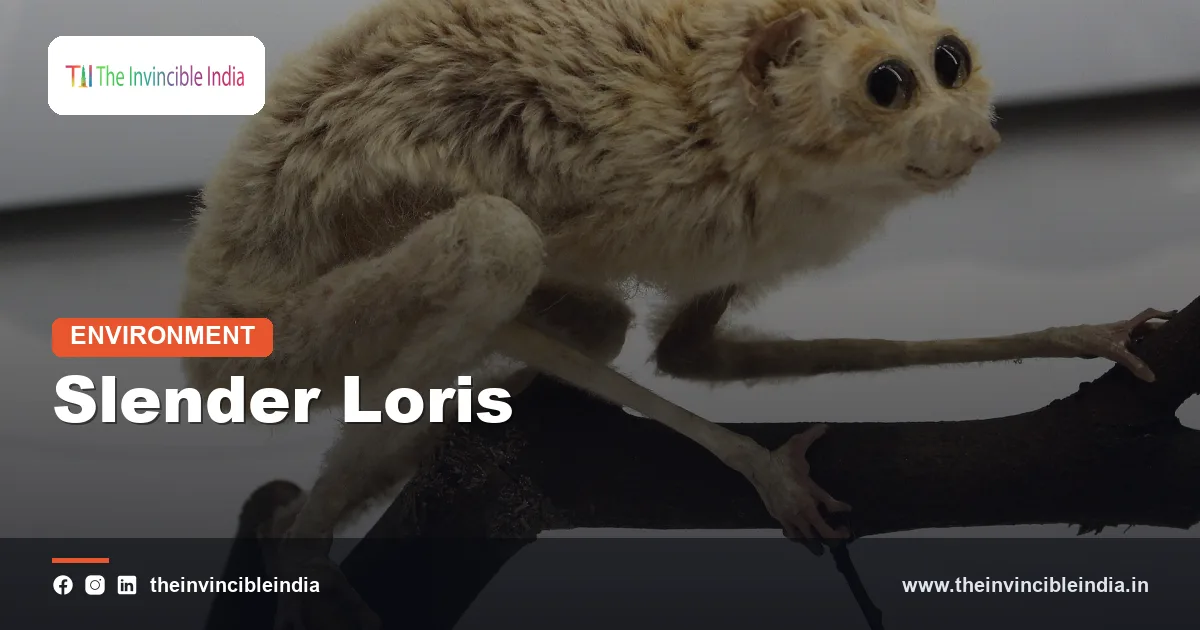
The slender loris is a small, nocturnal, large-eyed primate with thin limbs and a slow, deliberate way of moving, and in India it is represented by the grey slender loris (Loris lydekkerianus), which lives in the scrub and forests of the southern peninsula. Active only at night and almost invisible by day, the slender loris is one of India’s least known primates, and it is protected under the Wildlife (Protection) Act, 1972.
The animal feeds mainly on insects, which makes it a quiet ally of farmers, yet it is threatened by habitat loss, road traffic, power lines and, in particular, myths that lead people to capture and kill it. This explainer covers what the slender loris is, how it lives, where it is found in India, what threatens it and how it is protected.
Quick Facts: Slender Loris in India
| Common names | Grey slender loris; kaadu papa (“forest baby”) in Kannada; thevangu in Tamil |
|---|---|
| Scientific name | Loris lydekkerianus (India and Sri Lanka); a second species, Loris tardigradus, lives only in Sri Lanka |
| Group | Primates, family Lorisidae (the lorises and their relatives) |
| Size | Body about 20 to 26 centimetres, no visible tail, typically a few hundred grams at most |
| Activity | Strictly nocturnal; sleeps by day in dense vegetation |
| Diet | Mostly insects, plus some fruit, buds, small vertebrates and eggs |
| Indian range | Southern India, mainly Karnataka, Tamil Nadu, Andhra Pradesh and Kerala, in dry scrub and forest |
| Main threats | Habitat loss, traditional-medicine and superstition-driven capture, the pet trade, road kills and electrocution |
| Legal protection | Protected in India under the Wildlife (Protection) Act, 1972; included in international trade controls under CITES |
Key Takeaways
- The slender loris (Loris lydekkerianus) is a small, tailless, nocturnal primate found in southern India and Sri Lanka, and the grey slender loris is the form that lives in India.
- The slender loris moves slowly and deliberately along branches, with at least one limb gripping at all times, and this cautious style helps it avoid detection by predators.
- The slender loris eats mainly insects, including pests such as caterpillars, beetles and grasshoppers, and therefore gives natural pest control in scrub, farms and orchards.
- The slender loris is persecuted in parts of southern India because of folk beliefs in its supposed medicinal and magical powers, which drives illegal capture, trade and killing.
- The slender loris is legally protected in India under the Wildlife (Protection) Act, 1972, and Tamil Nadu notified the Kadavur Slender Loris Sanctuary in 2022 to protect the animal in its habitat.
- The slender loris is easily confused with the slow loris of north-east India, but the two are different genera, and the slender loris has no venom.
What is the slender loris?
The slender loris is a small primate belonging to the genus Loris, characterised by big forward-facing eyes, a pointed face, long thin limbs and a lack of any visible tail. It is a relative of monkeys and apes only in the wide sense that all are primates, and it belongs to a more ancient branch that includes the lorises and pottos of Asia and Africa.
The genus Loris contains two species. The red slender loris (Loris tardigradus) occurs only in the wet zone of Sri Lanka. The grey slender loris (Loris lydekkerianus) occurs in southern India and in drier parts of Sri Lanka. Within the grey slender loris, scientists recognise several subspecies, including the Mysore slender loris of the dry scrub of Karnataka and Tamil Nadu and the Malabar slender loris of the Western Ghats, and they continue to revise the classification.
What does a slender loris look like, and why are its eyes so large?
A slender loris looks like a tiny, long-limbed teddy bear with huge dark eyes, and its large eyes are an adaptation to hunting insects in near-total darkness. The animal’s body is only about 20 to 26 centimetres long, and its weight is typically in the range of a few hundred grams, much lighter than a domestic cat.
- Eyes: The eyes are large, set close together and face forward, giving good depth perception. Dark patches around the eyes give the face a distinctive “spectacled” look. As in many nocturnal mammals, a reflective layer behind the retina improves vision in dim light.
- Fur: The fur is short, soft and grey to brown above and whitish to buff underneath.
- Limbs: The arms and legs are very thin, which is the origin of the name “slender”. The hands and feet have strong gripping digits that can hold a branch for hours.
- Ears: The ears are rounded and can be folded back.
- Tail: The tail is absent or vestigial.
Where does the slender loris live in India?
The slender loris lives in the dry thorn scrub, deciduous forests, plantations and the edges of the Western Ghats in southern India, mainly in Karnataka, Tamil Nadu, Andhra Pradesh, Telangana and Kerala. It is more common in dry scrub and open forest than in dense evergreen forest.
The animal needs a continuous network of branches because it seldom comes down to the ground and does not leap across wide gaps. Hedges, live fences of thorny shrubs, tamarind and neem trees, and cashew and mango orchards can all provide habitat as long as they stay linked.
Notable habitats
- The Kadavur forests of Karur and Dindigul districts in Tamil Nadu, protected as the Kadavur Slender Loris Sanctuary.
- Scrub and dry deciduous forests of Karnataka, including parts of the Mysuru and Chamarajanagar landscapes.
- Foothill forests and scrub of the Eastern Ghats and the Tirupati region of Andhra Pradesh.
- Forest edges and plantations along the Western Ghats, where the Malabar slender loris is reported.
Because the species is nocturnal and cryptic, exact population figures for India are not available. Surveys have generally found the animal at low to moderate densities, and any quoted national number should be read as an informed estimate rather than a count.
How does the slender loris move, hunt and live?
The slender loris moves slowly and quietly through the branches at night, hunting insects by sight and smell, and rests by day in dense foliage. It climbs hand over hand, always keeping at least three limbs on the branch, a style that reduces noise and makes sudden detection less likely.
Hunting and diet
The diet of the slender loris is dominated by insects such as beetles, grasshoppers, crickets, moths, caterpillars and ants. The animal also eats some fruits, buds, flowers and gum, and occasionally small lizards, bird eggs and nestlings. It creeps up on prey and then grabs it with a swift, accurate movement of one hand, a contrast to its normally unhurried manner.
Social life and communication
Slender lorises forage alone at night but are not strictly solitary. Individuals may share sleeping sites in small groups by day, usually of related animals. They communicate by scent, by trills and whistles, and by washing their hands and feet in urine as they move, leaving scent marks on branches.
Breeding
Females usually give birth to one or two young, after a pregnancy of about five to six months, and in good conditions may breed more than once a year. The infant clings to its mother’s belly at first and later is “parked” on a branch while she feeds. Young animals reach adult size within the first year or two.
How is the slender loris different from the slow loris?
The slender loris differs from the slow loris in its build, habitat, geographic range and chemistry: slender lorises are leaner, live in southern India, and have no venom, while slow lorises are stockier, live in the north-eastern states, and have a venomous gland in the elbow. Both are nocturnal primates in the same family, and both are protected.
| Feature | Slender loris | Slow loris (Bengal slow loris) |
|---|---|---|
| Scientific name | Loris lydekkerianus | Nycticebus bengalensis |
| Region in India | Southern India | North-eastern India |
| Habitat | Dry scrub, deciduous and thin forest | Evergreen and semi-evergreen forest |
| Build | Slim with very thin limbs | Stocky and round-headed |
| Ears | Large and visible | Small, mostly hidden in fur |
| Venom | Absent | Present, produced by an elbow gland |
| Typical weight | Under about 300 grams | Roughly one to two kilograms |
Because the two animals look superficially alike, they are sometimes confused in the media, but they never overlap in their natural Indian range.
Why does the slender loris matter to people and to the ecosystem?
The slender loris matters because it controls insect populations, forms part of the food chain for owls and snakes, and serves as an indicator of well-connected scrub and forest. A single animal may eat large numbers of insects every night, including species that damage crops and trees.
The slender loris also helps farmers. Studies in southern India have documented that lorises eat agricultural pests, which is a reason to treat the animal as a beneficial neighbour. Where hedges and tree lines connect farmland and forest, the loris can persist alongside people, provided that it is not harmed.
What threatens the slender loris in India?
The main threats to the slender loris in India are habitat loss and fragmentation, capture and killing driven by superstition and folk medicine, the illegal pet trade, road accidents and electrocution on power lines. Several of these threats are caused directly by people and can be reduced through awareness and enforcement.
- Superstition and folk practice: In parts of southern India, various body parts, especially the eyes, are wrongly believed to cure eye problems or bring luck, and the animal is sometimes thought to have charm or magical powers. This has led to capture, sale and killing, even though such beliefs have no scientific basis.
- Pet trade and tourism: Lorises are taken from the wild and sold as exotic pets or used as photo props. They fare badly in captivity, and removing them from the wild harms local populations.
- Habitat loss: Clearing of scrub for agriculture, quarrying, roads and urban expansion removes the connected canopy that the animal needs. Removal of live fences and hedgerows breaks the links between patches.
- Roads and traffic: Because lorises cannot cross wide gaps easily and move slowly, they are often killed when they try to cross a road at night.
- Power lines and fencing: Electrocution on low power lines and injuries from barbed-wire fencing are recorded.
- Fire and pesticides: Forest fires and heavy pesticide use reduce the insects on which the animal depends.
- Stray animals: Free-ranging cats and dogs can attack lorises that come to the ground.
How is the slender loris protected in India?
The slender loris is protected in India under the Wildlife (Protection) Act, 1972, which prohibits hunting, capture, possession and trade, and it is also covered by international trade restrictions under CITES. The species is understood to be placed in the Act’s highest protection category, but because Schedules are revised by amendment, readers who need the exact current listing should consult the latest official text.
Conservation actions
- Kadavur Slender Loris Sanctuary: Tamil Nadu notified this sanctuary in 2022 in the Karur and Dindigul districts, covering an area of roughly 11,800 hectares. It was widely described as the first sanctuary in India set up specifically for the slender loris.
- Canopy bridges: Rope and pipe bridges across roads allow lorises to cross safely, and forest departments and conservation groups have trialled them in Tamil Nadu and Karnataka.
- Awareness campaigns: Conservation groups run programmes to counter the myths that lead to capture, often working with traditional healers, schools and local communities.
- Rescue and release: Forest departments confiscate captured lorises and release them, after veterinary checks, in suitable habitat.
- Research: Universities and research institutions are studying population density, ecology and genetics to refine subspecies boundaries and priorities.
Because the species is largely outside the main national parks and lives on private and community land, its long-term survival depends heavily on local cooperation.
What should you do if you find a slender loris?
If you find a slender loris, you should not capture or handle it, keep a respectful distance, and inform the local forest department or a wildlife rescue helpline. The animal is wild, easily stressed and legally protected, and possession of one is an offence under the Wildlife (Protection) Act, 1972.
- Do not use a flash or bright light at close range, since this can disorient a nocturnal animal.
- Do not feed it or attempt to keep it as a pet.
- If the animal is injured on a road or caught in wire, contact the forest department or a trained wildlife rescuer and wait for guidance.
- Report anyone offering lorises or loris parts for sale to the authorities.
- Share accurate information; the idea that loris body parts have healing or magical properties is false.
Bottom Line
The slender loris is a harmless, insect-eating primate whose survival in southern India depends less on large reserves than on connected trees, safe roads and the end of harmful myths. Habitat links, canopy bridges, strict enforcement and sustained community education are the most direct ways to keep this gentle night animal in India’s scrub and forests.
Frequently Asked Questions
What is a slender loris?
A slender loris is a small, nocturnal primate with large eyes, thin limbs and no visible tail. In India, it is the grey slender loris (Loris lydekkerianus) of the southern states. It eats mainly insects and moves slowly through trees at night.
Where is the slender loris found in India?
The slender loris is found in southern India, mainly in Karnataka, Tamil Nadu, Andhra Pradesh and Kerala. It prefers dry scrub, deciduous forest and forest edges. The Kadavur forests in Tamil Nadu were notified as a dedicated slender loris sanctuary in 2022.
Is the slender loris poisonous?
No, the slender loris is not venomous or poisonous. Venom is found in the slow lorises (genus Nycticebus) of north-eastern India, not in the slender loris. Like any wild animal, a slender loris may bite if it is handled, so it should be left alone.
Why is the slender loris endangered or threatened in India?
The slender loris is threatened mainly by habitat loss, road accidents, electrocution and illegal capture. Superstition about its supposed medicinal or magical value drives some of this capture. Its legal status in India is protected, and trade or possession is an offence.
Can a slender loris be kept as a pet?
No, a slender loris cannot legally be kept as a pet in India. It is protected under the Wildlife (Protection) Act, 1972, and keeping, selling or capturing one is a punishable offence. Captive lorises also suffer from poor diet and stress, and rarely survive well.
What does the slender loris eat?
The slender loris eats mostly insects such as beetles, grasshoppers, ants and caterpillars. It also takes fruit, buds, gum, small lizards and bird eggs. By eating crop pests, it benefits farmers and forests.
{“@context”:”https://schema.org”,”@graph”:[{“@type”:”FAQPage”,”mainEntity”:[{“@type”:”Question”,”name”:”What is a slender loris?”,”acceptedAnswer”:{“@type”:”Answer”,”text”:”A slender loris is a small, nocturnal primate with large eyes, thin limbs and no visible tail. In India, it is the grey slender loris (Loris lydekkerianus) of the southern states. It eats mainly insects and moves slowly through trees at night.”}},{“@type”:”Question”,”name”:”Where is the slender loris found in India?”,”acceptedAnswer”:{“@type”:”Answer”,”text”:”The slender loris is found in southern India, mainly in Karnataka, Tamil Nadu, Andhra Pradesh and Kerala. It prefers dry scrub, deciduous forest and forest edges. The Kadavur forests in Tamil Nadu were notified as a dedicated slender loris sanctuary in 2022.”}},{“@type”:”Question”,”name”:”Is the slender loris poisonous?”,”acceptedAnswer”:{“@type”:”Answer”,”text”:”No, the slender loris is not venomous or poisonous. Venom is found in the slow lorises (genus Nycticebus) of north-eastern India, not in the slender loris. Like any wild animal, a slender loris may bite if it is handled, so it should be left alone.”}},{“@type”:”Question”,”name”:”Why is the slender loris endangered or threatened in India?”,”acceptedAnswer”:{“@type”:”Answer”,”text”:”The slender loris is threatened mainly by habitat loss, road accidents, electrocution and illegal capture. Superstition about its supposed medicinal or magical value drives some of this capture. Its legal status in India is protected, and trade or possession is an offence.”}},{“@type”:”Question”,”name”:”Can a slender loris be kept as a pet?”,”acceptedAnswer”:{“@type”:”Answer”,”text”:”No, a slender loris cannot legally be kept as a pet in India. It is protected under the Wildlife (Protection) Act, 1972, and keeping, selling or capturing one is a punishable offence. Captive lorises also suffer from poor diet and stress, and rarely survive well.”}},{“@type”:”Question”,”name”:”What does the slender loris eat?”,”acceptedAnswer”:{“@type”:”Answer”,”text”:”The slender loris eats mostly insects such as beetles, grasshoppers, ants and caterpillars. It also takes fruit, buds, gum, small lizards and bird eggs. By eating crop pests, it benefits farmers and forests.”}}]}]}


