

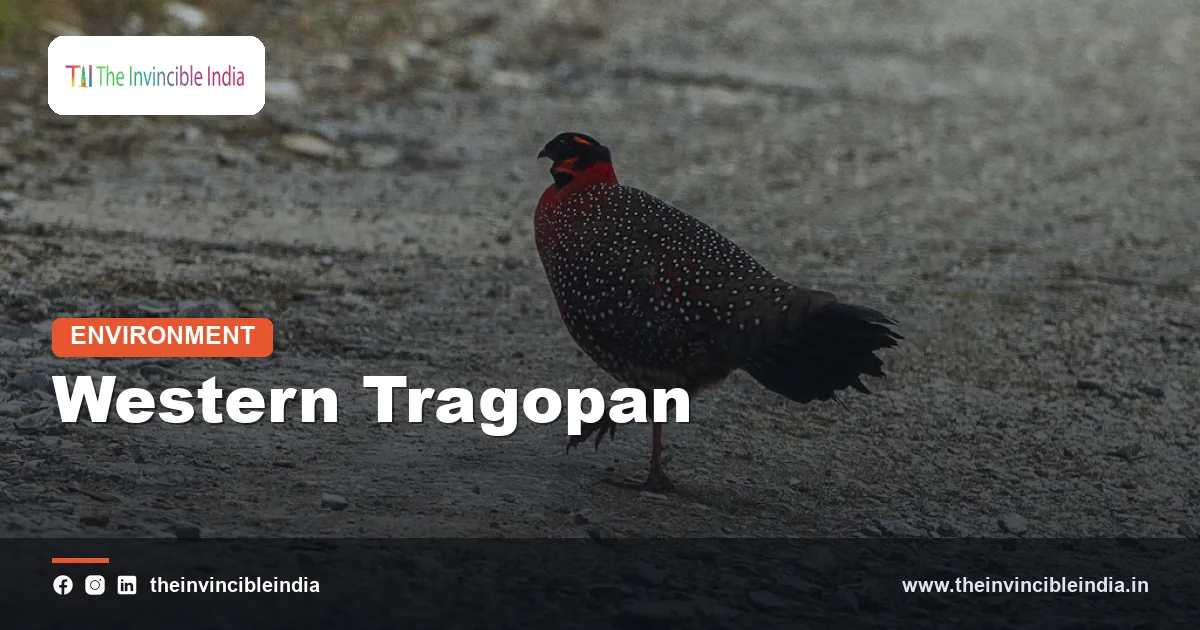
The western tragopan (Tragopan melanocephalus) is a rare, shy Himalayan pheasant and the state bird of Himachal Pradesh, and western tragopan conservation in India focuses on protecting the dense temperate forests with thick undergrowth where this vulnerable species survives. Its population is small and scattered across the western Himalaya of Pakistan and India, and it is considered one of the rarest pheasants in the world.
The male is a handsome bird with a black head, crimson-and-black body spotted with white, and a pair of blue horns and a bright blue throat bib that he inflates during courtship. In Himachal Pradesh the bird is known locally as the jujurana, meaning “king of birds”. Because it lives in dense forest and is rarely seen, much of what is known about it comes from call surveys, careful field studies and captive breeding work.
| Scientific name | Tragopan melanocephalus |
|---|---|
| Common names | Western tragopan, horned pheasant; jujurana in Himachal Pradesh |
| Family | Phasianidae (pheasants and partridges) |
| State bird | Himachal Pradesh |
| IUCN status | Vulnerable |
| Typical altitude | Roughly 1,800 to 3,600 metres, moving down in winter |
| Habitat | Temperate and subalpine forest with dense understorey of ringal bamboo, rhododendron and shrubs |
| Range | Western Himalaya in Pakistan and northern India, including Jammu and Kashmir, Himachal Pradesh and a small part of Uttarakhand |
| Legal protection in India | Protected under the Wildlife (Protection) Act, 1972 (understood to be placed in Schedule I) and listed in CITES Appendix I |
Key Takeaways
- The western tragopan is the state bird of Himachal Pradesh and is classed as Vulnerable by the International Union for Conservation of Nature (IUCN).
- The western tragopan lives in dense temperate and subalpine forests of the western Himalaya, where thick undergrowth gives it cover and food.
- The male western tragopan inflates a pair of blue horns and a blue throat bib during courtship, and calls loudly at dawn in spring, which is how surveyors usually detect the species.
- The main threats to the western tragopan are habitat loss, hunting and egg collection, livestock grazing and disturbance during collection of forest products.
- The Sarahan Pheasantry in Himachal Pradesh is the best-known captive breeding centre for the western tragopan in India.
- Protecting the western tragopan also protects the Himalayan forests that shelter musk deer, black bear, leopard and many other species.
What is the western tragopan?
The western tragopan is a medium-large, forest-dwelling pheasant of the western Himalaya, about the size of a domestic hen but heavier, with a stocky body and short legs. Its genus, Tragopan, includes five species of similarly spectacular pheasants found along the Himalaya and in China, and the western tragopan is the westernmost of the group.
The male has a black head with a short crest, a bright red-and-orange neck, and a deep chestnut-red or crimson breast and underparts covered in white spots with black borders. The upperparts are dark with fine white dots. The female is a much plainer brown bird, mottled and streaked to blend into leaf litter. During display the male’s blue skin comes alive as it swells into a pair of horns and a bib patterned with bright colours.
The name “tragopan” is built from Greek words meaning goat and Pan, a nod to an ancient story of a horned bird, and the inflatable horns of the male give the group its popular name of horned pheasants.
Where does the western tragopan live?
The western tragopan lives in a narrow strip of the western Himalaya, from the Kohistan and Azad Kashmir areas of Pakistan eastward into Jammu and Kashmir, Himachal Pradesh and parts of Uttarakhand in India. The bird’s range is patchy and many of its populations are small and cut off from one another.
In India it is associated with protected areas such as the Great Himalayan National Park, Daranghati Wildlife Sanctuary, Khokhan, Sainj, Tirthan and Kais areas in Himachal Pradesh, and with some forest blocks in Jammu and Kashmir and Uttarakhand. The Great Himalayan National Park in Kullu district is often cited as the most important stronghold in India.
The bird prefers moist forest of oak, deodar, spruce, fir and rhododendron, with a dense understorey of ringal bamboo and shrubs. In summer it moves upward toward the subalpine zone close to the treeline, and in winter it drops down into lower forest to avoid deep snow.
How does the western tragopan behave?
The western tragopan is a shy, mostly solitary or paired bird that spends much of its time under thick cover and is very hard to see. It forages on the ground and often roosts in trees at night, flying up with a heavy flapping and then gliding down the slope.
The bird feeds on leaves, buds, shoots, seeds, berries and insects, and it picks food from the forest floor and from low shrubs. In the breeding season, males call loudly at dawn from a high perch, in a repeated, wailing cry that echoes across a valley. Surveyors use this call to estimate how many males live in an area.
Unlike many pheasants, tragopans nest above the ground. The female typically uses an old nest of another bird or squirrel’s drey in a tree, lining it with leaves and moss, and lays about two to four eggs. She incubates for about a month and tends the chicks, which leave the nest soon after hatching and follow her on the forest floor.
How does the male western tragopan court a female?
The male western tragopan courts a female by inflating a pair of bright blue horns on the head and a large blue and red bib on the throat, spreading his wings and bowing in front of her. The display is shown at close range in dense forest, and only a few researchers and wildlife photographers have ever recorded it in the wild.
How many western tragopans are there?
The global population of the western tragopan is estimated to be only a few thousand mature birds, and the number is believed to be declining, but there is no precise count because the bird is so hard to survey. India is thought to hold a significant share of the world population, mostly in Himachal Pradesh.
Most estimates rely on call counts at dawn, repeated in the same areas each year. Because calling depends on weather, season and the age of the males, such counts give only an index of abundance. Population figures should therefore be treated as approximate and as subject to change as methods improve.
The IUCN lists the species as Vulnerable because the population is small, the range is fragmented and continued habitat loss and hunting are driving a decline.
Why is the western tragopan threatened?
The western tragopan is threatened because the dense mid-altitude forests it relies on are shrinking and being disturbed, and because hunting and egg collection continue in some areas. Its small and fragmented populations are slow to recover.
- Habitat loss and fragmentation: Forests have been cleared for agriculture, apple orchards, roads, hydropower projects, tourism infrastructure and settlements, which breaks the range into smaller patches.
- Overgrazing: Livestock grazing, particularly by migratory flocks of sheep and goats, strips the understorey that the bird needs for cover and food.
- Collection of forest products: The seasonal gathering of firewood, fodder, mushrooms, medicinal herbs and other products puts people in the forest during the nesting period.
- Hunting and egg collection: Snares, guns and egg collection reduce local populations, especially in the winter when birds come down to lower altitudes near villages.
- Forest fires: Fires, whether accidental or set to promote grass growth, destroy understorey and nests.
- Climate change: Warmer temperatures and altered snowfall may push vegetation zones upward and shrink the area of suitable forest.
- Small population effects: In isolated forest patches, a few poor breeding years or the loss of a few birds can lead to local extinction.
How is the western tragopan protected in India?
The western tragopan is protected in India through the Wildlife (Protection) Act, 1972, which places it in the highest category of protection, through protected areas in the Himalaya, and through its listing in Appendix I of CITES, which prohibits international commercial trade. The law makes hunting, capture and trade in the species a serious offence.
Within Himachal Pradesh, the Great Himalayan National Park, Daranghati, Kais and several other sanctuaries protect the bird’s main habitat, and the state forest department runs surveys and monitoring. Local people have been involved in conservation through eco-development committees, nature guiding and homestay tourism in the buffer zones of the national park.
Because of its cultural significance as the state bird, the western tragopan features in public awareness campaigns, and the jujurana is a familiar name in Himachali folklore and tourism.
What is the role of captive breeding in western tragopan conservation?
Captive breeding plays a supporting role in western tragopan conservation by maintaining a safety-net population, providing birds for research and offering the chance of future reintroduction. The Sarahan Pheasantry in Himachal Pradesh, near the Bhimakali temple in Shimla district, has been a key centre for breeding the western tragopan in India.
Captive breeding of tragopans is challenging because the birds are sensitive to disturbance, need large aviaries with natural cover and have specialised dietary and behavioural needs. Early efforts had mixed success, and managers learned that the survival of eggs and chicks improved when birds were kept in quiet, planted enclosures with minimal human contact.
Releasing captive-bred birds into the wild is more complicated than breeding them. Released birds must learn to find food, avoid predators and survive winters, and the sites chosen must be free of the threats that caused the original decline. For this reason, experts generally say that habitat protection is more important than captive breeding for the long-term future of the species.
How does the western tragopan compare with other tragopan species?
The western tragopan differs from the other four tragopan species in range, colour and conservation status, and it is the one most closely tied to the dry-temperate forests of the far west of the Himalaya. The table below summarises the Indian tragopans.
| Species | Range in India | Male appearance | IUCN status |
|---|---|---|---|
| Western tragopan | Jammu and Kashmir, Himachal Pradesh, Uttarakhand | Black head, crimson body with white spots | Vulnerable |
| Satyr tragopan | Uttarakhand, Sikkim, the hills of West Bengal and Arunachal Pradesh | Orange-red body with white spots and a blue lappet | Near Threatened |
| Temminck’s tragopan | Arunachal Pradesh and nearby eastern Himalaya | Crimson body with grey-bordered spots | Least Concern |
| Blyth’s tragopan | Arunachal Pradesh, Nagaland, Manipur and other north-eastern hill areas | Reddish body with dark facial skin | Vulnerable |
Why does western tragopan conservation matter?
Western tragopan conservation matters because the species is an umbrella and flagship for the Himalayan mid-altitude forest, one of the most heavily used and least protected parts of the mountain landscape. Saving the tragopan means keeping forest cover, understorey and water sources intact.
- The tragopan’s forests are home to other threatened animals such as the Himalayan musk deer, Himalayan black bear, leopard, serow and the cheer pheasant.
- These forests control erosion and landslides on steep slopes and supply clean water to rivers such as the Beas, Sutlej and Parvati.
- Bird tourism in places like the Great Himalayan National Park provides jobs and income to mountain communities.
- The bird carries cultural meaning in Himachal Pradesh, which can make the case for conservation easier to understand for local people.
How can people help the western tragopan?
People can help the western tragopan by respecting forest rules during the nesting season, avoiding disturbance to dense understorey, supporting community-based conservation and choosing tourism operators who follow wildlife guidelines. Visitors who are lucky enough to hear a male calling at dawn should keep distance and silence.
Local residents can help by managing grazing, avoiding forest fires and not collecting eggs or setting snares. Researchers and nature groups can contribute by running call surveys, restoring the understorey in degraded forests and supporting village-level monitoring programmes.
Bottom Line
The western tragopan is a vulnerable and elusive pheasant whose survival depends on the protection of dense Himalayan forest in Himachal Pradesh and neighbouring regions. Habitat conservation, anti-poaching work and careful use of captive breeding give the state bird the best chance of remaining a living part of the mountains rather than only a name in folklore.
Frequently Asked Questions
Which state has the western tragopan as its state bird?
The western tragopan is the state bird of Himachal Pradesh, where it is called the jujurana. The name means “king of birds” in the local language. The Himalayan monal, which is a different pheasant, is the state bird of the neighbouring state of Uttarakhand.
Is the western tragopan endangered?
The western tragopan is classed as Vulnerable by the IUCN, which means it faces a high risk of extinction in the wild unless threats are reduced. Its population is small, scattered and believed to be declining. In India it is also protected under the Wildlife (Protection) Act, 1972.
Where can I see the western tragopan in India?
The western tragopan lives mainly in the Himalayan forests of Himachal Pradesh, including the Great Himalayan National Park and nearby sanctuaries, and in smaller areas of Jammu and Kashmir and Uttarakhand. It is very shy and hard to see, so most people only hear it calling at dawn in spring. Captive birds can sometimes be viewed at the Sarahan Pheasantry in Himachal Pradesh.
What does the western tragopan eat?
The western tragopan eats leaves, buds, shoots, seeds, berries and insects, which it picks from the forest floor and from low plants. In summer it feeds on fresh green vegetation at higher altitudes, and in winter it moves lower and eats more buds and seeds. Chicks eat many insects during their first weeks.
Why does the male western tragopan have blue horns?
The male western tragopan has inflatable blue horns and a throat bib that he puffs out during courtship to impress females. The structures are fleshy and mostly hidden at rest, so the bird looks plain until he displays. The show is seen only at close range in dense forest, which is part of why the species is so rarely photographed.
How can the western tragopan be saved?
The western tragopan can best be saved by protecting its forest habitat, controlling hunting and egg collection, managing grazing and supporting community involvement in conservation. Captive breeding at centres such as the Sarahan Pheasantry offers a backup population, but experts agree that safe forest habitat is the most important requirement. Regular monitoring helps managers see whether the measures are working.
{“@context”:”https://schema.org”,”@graph”:[{“@type”:”FAQPage”,”mainEntity”:[{“@type”:”Question”,”name”:”Which state has the western tragopan as its state bird?”,”acceptedAnswer”:{“@type”:”Answer”,”text”:”The western tragopan is the state bird of Himachal Pradesh, where it is called the jujurana. The name means “king of birds” in the local language. The Himalayan monal, which is a different pheasant, is the state bird of the neighbouring state of Uttarakhand.”}},{“@type”:”Question”,”name”:”Is the western tragopan endangered?”,”acceptedAnswer”:{“@type”:”Answer”,”text”:”The western tragopan is classed as Vulnerable by the IUCN, which means it faces a high risk of extinction in the wild unless threats are reduced. Its population is small, scattered and believed to be declining. In India it is also protected under the Wildlife (Protection) Act, 1972.”}},{“@type”:”Question”,”name”:”Where can I see the western tragopan in India?”,”acceptedAnswer”:{“@type”:”Answer”,”text”:”The western tragopan lives mainly in the Himalayan forests of Himachal Pradesh, including the Great Himalayan National Park and nearby sanctuaries, and in smaller areas of Jammu and Kashmir and Uttarakhand. It is very shy and hard to see, so most people only hear it calling at dawn in spring. Captive birds can sometimes be viewed at the Sarahan Pheasantry in Himachal Pradesh.”}},{“@type”:”Question”,”name”:”What does the western tragopan eat?”,”acceptedAnswer”:{“@type”:”Answer”,”text”:”The western tragopan eats leaves, buds, shoots, seeds, berries and insects, which it picks from the forest floor and from low plants. In summer it feeds on fresh green vegetation at higher altitudes, and in winter it moves lower and eats more buds and seeds. Chicks eat many insects during their first weeks.”}},{“@type”:”Question”,”name”:”Why does the male western tragopan have blue horns?”,”acceptedAnswer”:{“@type”:”Answer”,”text”:”The male western tragopan has inflatable blue horns and a throat bib that he puffs out during courtship to impress females. The structures are fleshy and mostly hidden at rest, so the bird looks plain until he displays. The show is seen only at close range in dense forest, which is part of why the species is so rarely photographed.”}},{“@type”:”Question”,”name”:”How can the western tragopan be saved?”,”acceptedAnswer”:{“@type”:”Answer”,”text”:”The western tragopan can best be saved by protecting its forest habitat, controlling hunting and egg collection, managing grazing and supporting community involvement in conservation. Captive breeding at centres such as the Sarahan Pheasantry offers a backup population, but experts agree that safe forest habitat is the most important requirement. Regular monitoring helps managers see whether the measures are working.”}}]}]}


