

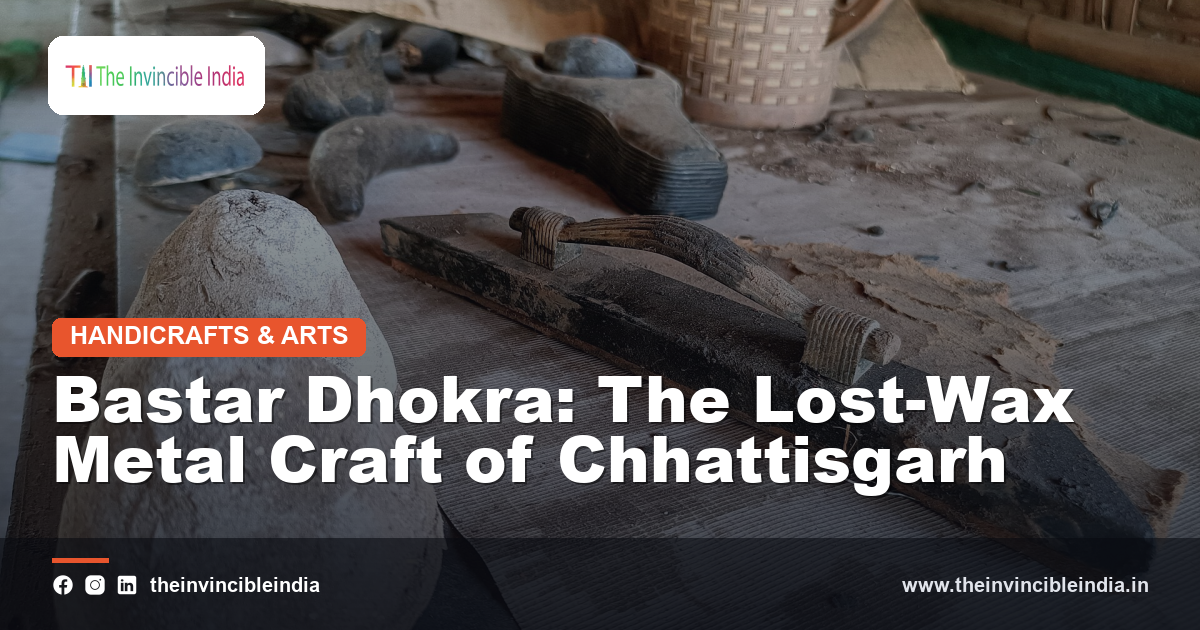
Bastar Dhokra, also spelled Dokra, is a tribal metal craft from the Bastar region of southern Chhattisgarh, in which figurines and objects are cast from a non-ferrous metal using the ancient lost-wax technique known as cire perdue. The craft is famous for its earthy, textured surface, its slightly irregular handmade character and its subjects drawn from tribal life, village deities, animals and everyday scenes. Each piece is cast only once, because the mould must be broken to release the metal, so no two works are ever exactly alike. The craft is practised chiefly by artisans of the Ghadwa community. Readers who enjoy the broad sweep of the traditional handicrafts of Rajasthan will find in Bastar Dhokra one of India”s oldest and most distinctive living metal traditions. This guide describes the place, the history, the materials, the technique, the motifs and the legacy of Bastar Dhokra.
Quick answer: Bastar Dhokra is a tribal lost-wax metal craft from the Bastar region of Chhattisgarh, India, in which brass and other non-ferrous metal objects are cast using the cire perdue technique. It is known for figurines of tribal life, deities and animals with a distinctive textured surface, each piece cast only once. The craft is made chiefly by Ghadwa community artisans and has been recognised with a Geographical Indication tag.
Key Takeaways
- Bastar Dhokra is a tribal metal craft from the Bastar region of southern Chhattisgarh, India.
- It uses the lost-wax (cire perdue) technique, in which a wax model is encased in clay, melted out and replaced by molten metal.
- Each piece is cast only once because the clay mould must be broken to release the metal, so no two are identical.
- The craft is practised chiefly by artisans of the Ghadwa (Gadhwa) community.
- Typical subjects include tribal figures, village deities, animals, lamps, measuring bowls and ritual objects.
- The craft uses non-ferrous metal and has been recognised with a Geographical Indication tag.
The sections below explain where Bastar is, how the craft is made, what it depicts, who makes it and why it still matters.
Quick Facts
| Detail | Information |
|---|---|
| Craft type | Tribal non-ferrous metal casting |
| Region of origin | Bastar region, southern Chhattisgarh |
| Also known as | Dokra, Dhokra |
| Materials | Brass and other non-ferrous metal, beeswax, clay |
| Technique | Lost-wax casting (cire perdue) |
| Known for | Textured figurines of tribal life and animals |
| GI status | Recognised with a Geographical Indication tag |
| Community | Ghadwa (Gadhwa) artisans |
What Is Bastar Dhokra?
Bastar Dhokra is a tribal metal craft in which figurines and objects are cast from non-ferrous metal using the ancient lost-wax technique. A model is first built in wax over a clay core, encased in more clay to form a mould, and then the wax is melted out and replaced by molten metal. Because the clay mould must be broken to free the finished casting, every piece is unique and cannot be reproduced exactly. The craft is known for its warm, earthy surface, often patterned with fine thread-like lines left by the wax threads used in modelling. Subjects range from tribal figures and deities to animals, lamps and ritual vessels. Bastar Dhokra is named after the Bastar region of Chhattisgarh, where it is a living tradition. It is one of India”s oldest continuous metalworking crafts.
Where Is Bastar and Why Is It Known for Dhokra?
Bastar is a forested, largely tribal region in the south of Chhattisgarh, in central India, long known for its rich adivasi culture, folk deities and crafts. It is known for Dhokra because communities of hereditary metal casters have lived and worked across its villages for generations, serving local needs for ritual objects, lamps, ornaments and figures. The region”s strong tradition of tribal worship created steady demand for cast images of village gods and guardian spirits. The surrounding forests and village economy supported the craft over centuries. Over time, the name of Bastar became closely associated with this metalwork, alongside the region”s wood carving and iron craft. Bastar is therefore both a place and a byword for a distinctive school of Dhokra. The region and the craft are deeply intertwined.
How Old Is the Dhokra Tradition?
The Dhokra tradition is very old, and the lost-wax method it uses is among the most ancient metal-casting techniques known. The famous bronze figure commonly called the Dancing Girl of Mohenjo-daro, from the Indus Valley civilisation, is often cited as an early example of lost-wax casting in the subcontinent, which points to the great antiquity of the method. It is important to treat such comparisons as commonly cited context rather than as a direct line of descent, since the precise history of the craft in Bastar is not documented in detail. What is clear is that the technique has been practised in India for a very long time and has survived in tribal regions such as Bastar. The craft therefore links present-day artisans to a deep metalworking past. Its age is part of its cultural value.
What Materials Are Used in Bastar Dhokra?
Bastar Dhokra uses non-ferrous metal, chiefly brass and scrap metal, together with beeswax, resin, clay and firewood or charcoal for melting. The core of each object is shaped from a mixture of clay, and the fine surface detail is built up in wax, often drawn out into thin threads that give the craft its characteristic ribbed texture. A natural resin may be mixed with the wax to make it workable. The outer mould is formed from layers of clay, and channels are left for the wax to escape and the metal to enter. Metal is melted in a crucible using a simple furnace. Because the craft relies on locally available and recycled materials, it is both economical and rooted in the village economy. These humble materials yield durable, finely detailed objects.
How Is a Dhokra Piece Made Step by Step?
A Dhokra piece is made through the lost-wax, or cire perdue, process carried out entirely by hand. The artisan first shapes a core of clay in the rough form of the object and lets it dry. Over this core, a detailed model is built up in beeswax, often using thin wax threads to create the surface pattern. The wax model is then covered with fine clay to capture the detail, followed by coarser clay to make a strong mould, leaving channels for pouring. When the mould is heated, the wax melts and runs out, leaving a hollow cavity. Molten metal is then poured in to fill the space left by the wax. After cooling, the clay mould is broken away, and the casting is cleaned and finished. Each piece is thus cast only once.
What Does Cire Perdue or Lost-Wax Casting Mean?
Cire perdue, a French term meaning lost wax, is the casting method in which a wax model is lost from the mould and replaced by metal. In this technique the artisan creates the object in wax, encases it in a clay mould, and then melts and drains the wax, so that the empty space exactly matches the intended shape. Molten metal poured into that space takes the form of the original wax model. Because the wax is destroyed and the mould is broken to extract the casting, each object is a one-off original. This ancient method allows fine, flowing detail that would be hard to achieve by other means. It is used in metal traditions around the world, and Bastar Dhokra applies it in a distinctly tribal style. The lost wax gives the craft its name and character.
What Motifs and Themes Appear in Bastar Dhokra?
Bastar Dhokra depicts subjects drawn from tribal life, religion and the natural world. Common themes include figures of village deities and guardian spirits, tribal men and women at work or dance, and scenes of daily and festival life. Animals such as elephants, horses, bulls, tortoises, peacocks and birds are popular, as are mythical and totemic creatures. Useful and ritual objects are also cast, including oil lamps, incense holders, measuring bowls and small boxes. The figures are stylised rather than realistic, with elongated limbs and simplified forms that give them a lively, folk character. The ribbed surface texture adds further life. These motifs reflect the beliefs, environment and daily rhythms of Bastar”s tribal communities. They make each piece a small window into adivasi culture.
What Makes Bastar Dhokra Distinctive?
Bastar Dhokra is distinctive for its textured surface, its one-of-a-kind castings and its earthy, tribal character. The fine thread-like lines left by the wax modelling give the metal a woven or ribbed look that is unlike smooth, moulded brassware. Because each piece is cast by breaking its mould, no two works are identical, and small irregularities are valued as signs of genuine handwork. The stylised, folk forms of the figures, with their simplified shapes and expressive gestures, set the craft apart from classical or ornamental metalwork. The warm golden tone of the metal and the matte finish add to its rustic appeal. These qualities together make Bastar Dhokra easy to recognise. Its honesty of material and method is central to its charm.
Who Are the Ghadwa Artisans?
The Ghadwa, also written Gadhwa, are the traditional metal-casting community most associated with Bastar Dhokra. The name is linked to the act of casting or shaping metal, and the community has practised the craft across the villages of Bastar for generations. Work is usually organised around the household, with skills and knowledge passed from elders to the young through long practice rather than formal schooling. Family members often share the different stages, from preparing clay and wax to casting and finishing. Craft cooperatives and government bodies have supported the artisans with training, materials and access to wider markets. Like many traditional crafts, Dhokra faces pressures that can draw young people toward other work. The Ghadwa artisans are the living carriers of the tradition. Their skill keeps the craft alive.
Does Bastar Dhokra Have a Geographical Indication?
Bastar Dhokra has been recognised with a Geographical Indication tag, which ties the craft name to the Bastar region of Chhattisgarh and its traditional artisans. A Geographical Indication protects a product whose qualities and reputation are linked to its place of origin, helping to guard genuine work against imitation. For the Ghadwa artisans, the tag affirms that authentic Bastar Dhokra comes from their region and is made by their traditional lost-wax method. Because sources can differ on the exact registration details, the precise date is best confirmed with the official Geographical Indications Registry. The recognition supports the craft”s reputation and the livelihoods of its makers. It also helps buyers identify genuine pieces made in Bastar. The GI status underlines the strong bond between the craft and its home region.
How Does Bastar Dhokra Compare with Other Dhokra Traditions?
Bastar Dhokra is one of several regional Dhokra traditions in India, and it differs from others in style and surface. Dhokra casting is also practised in parts of West Bengal, Odisha, Jharkhand and Madhya Pradesh, each with its own character. Bastar work is known for its strongly tribal, folk forms and its pronounced thread-like surface texture, reflecting the adivasi culture of the region. Some other schools produce smoother or more decorative pieces aimed at wider markets. All share the core lost-wax method and the use of non-ferrous metal. Comparing these traditions shows how a single ancient technique takes on local colour across India. Bastar contributes a rustic, deeply tribal voice to the family of Dhokra crafts. Each regional style has its own admirers and identity.
What Objects Are Made in Bastar Dhokra?
Bastar Dhokra produces a wide range of decorative, ritual and useful objects. Figurines of deities, tribal figures and animals are the most familiar products, serving both as objects of worship and as decorative pieces. Lamps, including standing oil lamps and hanging lamps, are a traditional speciality, as are incense holders and ritual vessels. Measuring bowls, small boxes, ornaments, jewellery and wall hangings are also cast. Larger showpieces and panels are made for display in homes and public spaces. Contemporary artisans adapt the craft to make items suited to modern interiors while keeping the traditional technique. Whatever the object, the hallmark remains the textured, hand-cast surface. This range of products shows the craft”s versatility. It allows Dhokra to serve both the shrine and the modern home.
What Challenges Does the Craft Face Today?
Bastar Dhokra faces challenges common to many traditional crafts, including rising costs, competition from imitations and the difficulty of keeping young artisans in the trade. The lost-wax method is slow and labour-intensive, so genuine pieces cost more than mass-produced lookalikes, which can mislead buyers. The price of metal and fuel can squeeze artisan incomes. Younger members of craft families sometimes seek other work, which threatens the passing on of skills. Reaching fair markets and avoiding exploitative middlemen are also concerns. At the same time, growing interest in authentic tribal crafts, Geographical Indication protection and support from craft bodies offer encouragement. Fair pricing and honest labelling help genuine artisans. The tradition”s survival depends on steady demand for real handmade work. Meeting these challenges is essential for its future.
How Can You Buy Authentic Bastar Dhokra?
Authentic Bastar Dhokra can be bought from state handicraft emporiums, recognised artisan cooperatives, craft fairs and trusted stores that name Bastar and its artisans as the source. A genuine piece shows the fine thread-like surface texture, small natural irregularities and the warm matte tone of hand-cast metal, and because each is cast only once, no two are identical. Machine-moulded or mass-produced imitations tend to look perfectly uniform, smoother and repeated in identical copies. Buyers can ask about the village and workshop and look for GI labelling where available. Buying directly from artisan societies helps income reach the makers. A gentle wipe and dry storage keep the metal looking its best. Careful buying rewards genuine craftsmanship and supports the tribal artisans. It also ensures a true example of the craft.
Bastar Dhokra Today
Bastar Dhokra today remains one of India”s most admired tribal crafts and a proud emblem of Chhattisgarh”s adivasi heritage. Ghadwa artisans continue to cast figurines, lamps and ritual objects by the ancient lost-wax method, while adapting designs for new buyers at home and abroad. Geographical Indication recognition, craft promotion and growing interest in handmade tribal art have brought the craft renewed attention. At the same time, it faces real challenges of cost, imitation and the need to attract young artisans. Readers can support Bastar Dhokra by learning its technique, visiting craft outlets and choosing authentic handmade pieces. The craft endures as a living link to one of the world”s oldest metalworking methods. Bastar Dhokra remains a warm, earthy expression of tribal creativity. It continues to carry the name of its region with quiet pride.
Sources & Further Reading
- Development Commissioner (Handicrafts), Ministry of Textiles, Government of India (handicrafts.nic.in).
- Geographical Indications Registry, Government of India (ipindia.gov.in).
Frequently Asked Questions
What is Bastar Dhokra?
Bastar Dhokra is a tribal lost-wax metal craft from the Bastar region of Chhattisgarh, India, in which brass and other non-ferrous metal objects are cast using the cire perdue technique. It is known for textured figurines of tribal life, deities and animals. Each piece is cast only once, so no two are identical.
What is the lost-wax or cire perdue technique?
The lost-wax, or cire perdue, technique is a casting method in which a wax model is encased in clay, then melted out so that molten metal can take its place. Because the clay mould must be broken to release the finished casting, every piece is a unique original. It is one of the oldest metal-casting methods known.
Who makes Bastar Dhokra?
Bastar Dhokra is made chiefly by artisans of the Ghadwa, also written Gadhwa, community, a traditional metal-casting group in the Bastar region. Skills are passed down within families through long practice. The whole household often shares the stages of casting and finishing.
What is Bastar Dhokra known for?
Bastar Dhokra is known for its earthy, textured surface, its stylised figures of tribal life, deities and animals, and its one-of-a-kind castings. The fine thread-like lines left by wax modelling give the metal a woven look. Lamps, figurines and ritual objects are typical products.
Does Bastar Dhokra have a GI tag?
Yes, Bastar Dhokra has been recognised with a Geographical Indication tag that links the craft to the Bastar region of Chhattisgarh. The tag helps protect genuine work against imitation. The exact registration details are best confirmed with the official Geographical Indications Registry.
How can I identify authentic Bastar Dhokra?
Authentic Bastar Dhokra shows fine thread-like surface texture, small natural irregularities and a warm matte metal tone, and because each piece is cast only once, no two are identical. Machine-made imitations look uniform and are produced in identical copies. Buying from recognised cooperatives or emporiums helps ensure authenticity.


