

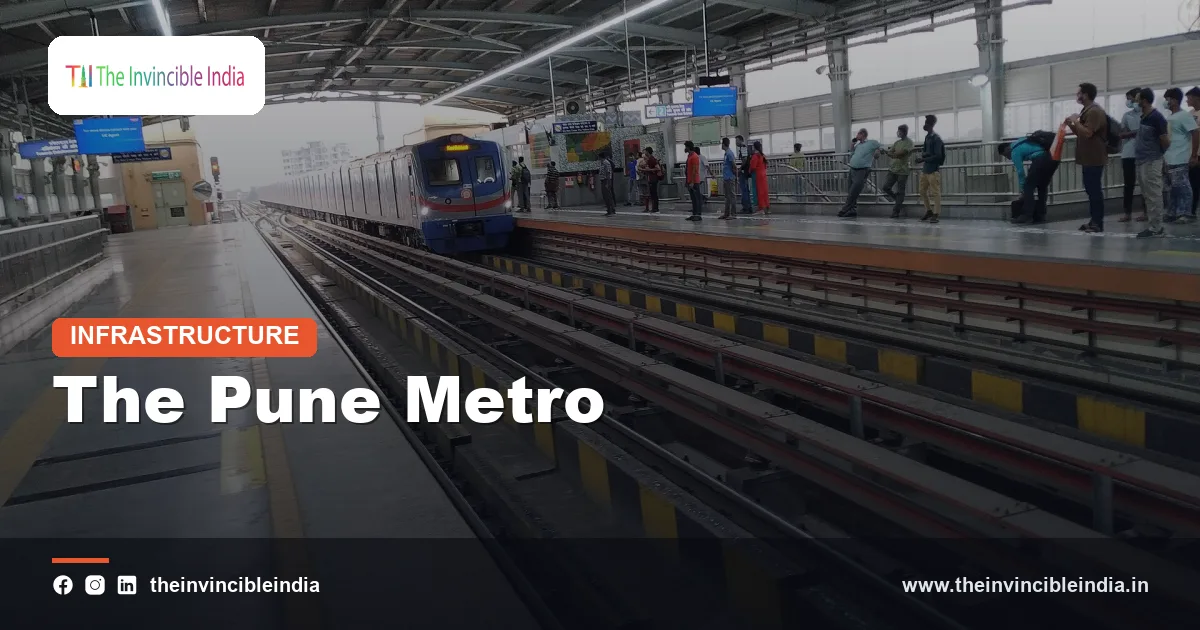
The Pune Metro is the rapid-transit rail system serving Pune and Pimpri-Chinchwad in Maharashtra, built and operated by the Maharashtra Metro Rail Corporation Limited (Maha Metro), a joint venture of the Government of India and the Government of Maharashtra. Its first sections opened in March 2022, and the network is organised around two main corridors, the Purple Line between Pimpri-Chinchwad and Swargate and the Aqua Line between Vanaz and Ramwadi.
Pune Metro mixes elevated and underground sections, including an underground stretch through the old city that passes beneath the Mula-Mutha river. It is designed to ease congestion in one of India’s fastest growing urban regions, where two-wheelers and buses have long dominated travel. This explainer covers the corridors, the engineering, the stations near heritage areas, the fares and ridership picture and the planned expansion. Lengths, dates and figures are approximate and should be verified against the latest official updates.
| Attribute | Detail |
|---|---|
| City and region | Pune and Pimpri-Chinchwad, Maharashtra |
| Operator and builder | Maharashtra Metro Rail Corporation Limited (Maha Metro) |
| Ownership | Equal joint venture of the Government of India and the Government of Maharashtra |
| Project approved and launched | Approved in late 2016; foundation stone laid in December 2016 |
| First opening | March 2022, with initial sections of the Purple and Aqua lines |
| Main corridors | Purple Line (Line 1) and Aqua Line (Line 2) |
| Combined length of phase 1 | Roughly 33 kilometres, with a mix of elevated and underground sections |
| Track gauge | Standard gauge (1,435 mm) |
| Train formation | Typically three-coach electric trains |
Key Takeaways
- The Pune Metro is built and run by Maha Metro, the Maharashtra Metro Rail Corporation Limited, which is owned equally by the Government of India and the Government of Maharashtra.
- The Pune Metro has two main corridors, the Purple Line from Pimpri-Chinchwad to Swargate and the Aqua Line from Vanaz to Ramwadi, which cross at the Civil Court interchange.
- The Pune Metro opened its first sections in March 2022 and later added the underground stretch to Swargate, which opened in 2024.
- The Pune Metro runs underground through the old city and beneath the Mula-Mutha river, serving areas such as Budhwar Peth and Mandai.
- The Pune Metro uses standard gauge track and three-coach electric trains, and its stations are designed for accessibility, with lifts and tactile paths for passengers with disabilities.
- The Pune Metro has approved and proposed extensions, including towards Katraj and other suburbs, while a separate Hinjewadi-Shivajinagar line is being developed under a public-private partnership.
What is the Pune Metro?
The Pune Metro is a mass rapid transit system that serves Pune and the adjoining industrial city of Pimpri-Chinchwad through electric trains running on dedicated tracks. It is managed by Maha Metro, which was created to build metro rail systems in Maharashtra outside Mumbai, and which also built the Nagpur Metro.
Pune is a large city with a long-standing traffic problem. The population of the urban region has grown sharply, and private vehicles, especially two-wheelers, make up most of the traffic. A metro was proposed for many years, and the project was finally approved in 2016 after earlier ideas of a mixed bus and rail plan were reworked.
The system is designed to complement the existing bus network run by Pune Mahanagar Parivahan Mahamandal Limited (PMPML), the city’s public bus operator, and the suburban railway services of Indian Railways. Integration of fares, feeders and stations remains a continuing task.
Who runs the Pune Metro?
The Pune Metro is run by Maha Metro, formally the Maharashtra Metro Rail Corporation Limited, a special purpose company set up as a 50:50 joint venture between the Government of India and the Government of Maharashtra. Maha Metro is responsible for construction, train operation and maintenance of the two main corridors.
The funding model follows the central Metro Rail Policy, which allows for a combination of central and state equity and loans from multilateral and bilateral lenders. Metro projects in India are also guided by the Metro Railways (Operation and Maintenance) Act, 2002, and are subject to safety inspection by the Commissioner of Metro Rail Safety before opening to passengers.
A separate line, often called Line 3, connects the Hinjewadi IT hub with Shivajinagar. This one is being built under a public-private partnership, with the Pune Metropolitan Region Development Authority (PMRDA) as the project authority and a private consortium as the builder and operator. It is therefore not part of the Maha Metro network, although it is planned to connect with it.
What are the corridors of the Pune Metro?
The Pune Metro has two main corridors, the Purple Line (Line 1) running north-west to south through Pimpri-Chinchwad, Shivajinagar and the old city to Swargate, and the Aqua Line (Line 2) running from Vanaz in the west to Ramwadi in the east. The two lines meet at the Civil Court interchange, which is the main transfer point in the network.
The Purple Line is about 17 kilometres long and combines elevated stations in the north with an underground section running from the Shivajinagar area through Civil Court to Swargate. The Aqua Line is roughly 16 kilometres and is mostly elevated, passing through Deccan, the Mutha river bank and Pune’s eastern suburbs.
| Corridor | Colour | Termini | Nature |
|---|---|---|---|
| Line 1 | Purple | PCMC Bhavan (Pimpri-Chinchwad) to Swargate | Elevated and underground |
| Line 2 | Aqua | Vanaz to Ramwadi | Mostly elevated, with the interchange at Civil Court |
| Line 3 | Under PPP | Hinjewadi to Shivajinagar | Elevated, built by a private consortium for PMRDA |
Key stations on the Purple Line include PCMC Bhavan, Bhosari, Dapodi, Khadki, Range Hill, Shivajinagar, Civil Court, Budhwar Peth, Mandai and Swargate. On the Aqua Line, they include Vanaz, Anand Nagar, Nal Stop, Garware College, Deccan Gymkhana, Chhatrapati Sambhaji Udyan, PMC, Civil Court, Ruby Hall Clinic, Bund Garden, Yerwada, Kalyani Nagar and Ramwadi. Station names and numbers may change with extensions, so the official map is the safest guide.
When did the Pune Metro open?
The Pune Metro opened to passengers in March 2022, when the first stretches of the Purple Line and the Aqua Line were inaugurated, and more sections were added over the following two years. The Prime Minister inaugurated the initial services, which covered the elevated parts of the network.
Later openings extended the lines towards the centre of the city and then through the underground section. The stretch from Civil Court to Swargate, which includes the deep underground stations, opened in 2024 and connected the heart of the old city to the network. By then both main corridors were operating over most of their planned length.
Timeline of the Pune Metro
- 2016: The central and state governments approve the project and the foundation stone is laid.
- 2017 to 2021: Construction proceeds, with viaducts, stations and tunnelling in the old city.
- March 2022: The first sections of the Purple and Aqua lines open.
- 2023 to 2024: Further sections open, bringing the lines into the city centre.
- 2024: The underground stretch between Civil Court and Swargate begins service.
How does the Pune Metro run underground and under the river?
The Pune Metro runs underground through the old city from the Shivajinagar area to Swargate, using tunnels bored beneath densely built localities and under the Mula-Mutha river. Underground stations were chosen for this section because the area has narrow streets, heritage structures and very high building density, which leaves little space for elevated viaducts.
Tunnelling in Pune had to deal with the basalt rock of the Deccan Plateau, which is hard and different from the soft soil found in many other cities, as well as with the need to protect old buildings above. Tunnel boring machines were used for much of the work, and the tunnels cross below the river bed at a depth designed to protect both the river and the structures nearby.
The underground stations on the Purple Line include Shivajinagar, Civil Court, Budhwar Peth, Mandai and Swargate, and the interchange at Civil Court is among the deepest stations in the network. Underground metro stations in India, such as those in Kolkata and Mumbai, have faced similar rock and groundwater challenges, though each city has unique geology.
Which Pune Metro stations are near heritage areas?
Several Pune Metro stations lie near the historic core of the city, including Shivajinagar, Civil Court, Budhwar Peth and Mandai, which serve neighbourhoods known for old markets, temples and wadas, the traditional courtyard mansions of Pune. These stations bring the metro close to the oldest parts of the city, known as the peths.
The old city around Shaniwar Wada, Tulshibaug and the markets of Mandai has many historic buildings, and metro planners chose underground alignments partly to limit surface disruption in this area. Station designs in the city centre have drawn on local architectural references, such as stone patterns and traditional motifs, though the extent differs from station to station.
Shivajinagar station is a key transport hub where the metro meets the main bus station and the railway station at Shivajinagar. It is also the planned connection point with the Hinjewadi line, which makes it one of the most important interchange locations in the network. Civil Court, the interchange between the Purple and Aqua lines, serves the nearby district courts and government offices.
Why heritage mattered in planning
- The old city has very narrow streets and many historic buildings that cannot easily bear surface construction.
- Underground alignment limits visible changes to heritage precincts.
- Construction needed monitoring of vibration and settlement near old structures.
- Station entrances were placed to avoid damaging protected monuments.
How many people ride the Pune Metro?
The Pune Metro carries tens of thousands of passengers on an average day, with ridership rising as more stretches opened and as the network reached the city centre. Weekend and festival days, especially during the Ganeshotsav period, have produced much higher peaks than normal weekdays.
Ridership numbers change frequently, so exact daily or monthly figures are best taken from Maha Metro announcements. In general, early ridership on partly completed metros in India tends to be lower than the figures forecast in the planning stage, and it increases as the network becomes continuous and feeder services improve.
Fares are distance based, and the system accepts tickets on mobile apps, QR codes and smart cards, including the National Common Mobility Card (NCMC), which allows a single card to be used across metros and other transport in several cities. Fares are revised periodically, so travellers should check the current fare chart.
What shapes ridership
- Network length and connectivity between key destinations.
- Quality of feeder buses, shared autos and last-mile links.
- Availability of parking and cycle facilities at stations.
- Fare levels compared with buses and two-wheeler costs.
What are the technical features of the Pune Metro?
The Pune Metro uses standard gauge track of 1,435 millimetres and electric multiple units with three coaches, running with automatic train protection and signalling designed for frequent services. Standard gauge is used by most Indian metros built in the last decade, and it makes it easier to buy rolling stock from international suppliers.
The coaches are air-conditioned, built from lightweight material and have wide doors and space for standing passengers and wheelchairs. Stations are designed for accessibility, with lifts, escalators, tactile paving for the visually impaired and reserved spaces. Several elevated stations carry rooftop solar panels, and the system has stated goals to source a growing share of its electricity from renewables.
The trains run on electric traction, and the signalling follows modern automatic train protection practice, which allows for short intervals between trains. The elevated sections rest on concrete viaducts supported by piers, and the underground sections use cut-and-cover for stations and bored tunnels for the running lines.
What is the future expansion of the Pune Metro?
The Pune Metro is planned to expand through extensions of the Purple and Aqua lines and new corridors, including links towards Katraj in the south, Nigdi in the north-west and Wagholi or Kharadi in the east. Several extensions have received approval in principle, while others remain proposals awaiting funding and clearances.
Planners also propose connecting Hadapsar and other growing suburbs to the metro, and strengthening links with the Pune airport and railway stations. The Hinjewadi to Shivajinagar line is important for the IT sector, because it will serve a large employment area on the western side of the city that currently suffers from heavy road traffic.
| Proposed or approved link | Direction | Main purpose |
|---|---|---|
| Swargate to Katraj extension | South | Connect the southern suburbs and the Katraj area |
| PCMC to Nigdi extension | North-west | Extend the Purple Line within Pimpri-Chinchwad |
| Ramwadi to Wagholi extension | East | Serve the eastern IT and residential belt |
| Hinjewadi to Shivajinagar (Line 3) | West | Serve the Rajiv Gandhi Infotech Park |
The timing of these projects depends on approvals, funding and land acquisition, and readers should check the latest statements from Maha Metro and the government.
Why does the Pune Metro matter?
The Pune Metro matters because it offers a high-capacity alternative to road transport in a city where traffic congestion and air pollution have grown steadily. A single metro train can carry hundreds of passengers, and the system takes load off roads that were designed for a much smaller population.
The metro is also an example of the Indian push for urban rail. Dozens of cities now have or are building metros, and the Pune system is one of the newer ones, benefiting from experience in Delhi, Mumbai and Nagpur. It shows the technical choices of the present generation, such as standard gauge, accessibility features and the use of solar power.
The wider challenge is making the metro work as part of a connected system, with good bus feeders, walkable streets and integrated ticketing. Without these, the benefit of the rail line is limited. The Pune example shows that the building of a metro is only the first step toward changing how a city moves.
Bottom Line
The Pune Metro is a two-line rapid-transit system run by Maha Metro that links Pimpri-Chinchwad, Shivajinagar, the old city and the east of Pune, with underground sections beneath heritage areas and the Mula-Mutha river. It opened in 2022 and continues to grow through extensions and a separate public-private line. For current timings, fares and ridership, the official Maha Metro sources are the best reference.
Frequently Asked Questions
Who operates the Pune Metro?
The Pune Metro is operated by the Maharashtra Metro Rail Corporation Limited, known as Maha Metro. It is a 50:50 joint venture of the Government of India and the Government of Maharashtra. The Hinjewadi to Shivajinagar line is a separate public-private partnership project.
How many lines does the Pune Metro have?
The Pune Metro has two main operating corridors, the Purple Line and the Aqua Line. The Purple Line runs from Pimpri-Chinchwad to Swargate, and the Aqua Line runs from Vanaz to Ramwadi. A third line from Hinjewadi to Shivajinagar is being developed separately.
Where do the Pune Metro lines intersect?
The Purple and Aqua lines of the Pune Metro intersect at the Civil Court station, which serves as the main interchange. Passengers can change between the two lines there. The station is in the central part of the city, near the district courts.
Is the Pune Metro underground?
The Pune Metro is partly underground and partly elevated. The underground section lies in the old city, running from the Shivajinagar area to Swargate, and it passes beneath the Mula-Mutha river. The remaining stations on both lines are elevated.
When did the Pune Metro start running?
The Pune Metro started running in March 2022 with the first sections of the Purple and Aqua lines. More stations were added in the following years, and the underground stretch to Swargate opened in 2024. Operating hours and frequency can change, so the official schedule should be checked.
Will the Pune Metro be extended?
The Pune Metro is expected to expand through several extensions and new corridors, such as links towards Katraj, Nigdi and the eastern suburbs. Some of these have been approved while others are still proposals. Timelines depend on funding, land and regulatory clearances.
{“@context”:”https://schema.org”,”@graph”:[{“@type”:”FAQPage”,”mainEntity”:[{“@type”:”Question”,”name”:”Who operates the Pune Metro?”,”acceptedAnswer”:{“@type”:”Answer”,”text”:”The Pune Metro is operated by the Maharashtra Metro Rail Corporation Limited, known as Maha Metro. It is a 50:50 joint venture of the Government of India and the Government of Maharashtra. The Hinjewadi to Shivajinagar line is a separate public-private partnership project.”}},{“@type”:”Question”,”name”:”How many lines does the Pune Metro have?”,”acceptedAnswer”:{“@type”:”Answer”,”text”:”The Pune Metro has two main operating corridors, the Purple Line and the Aqua Line. The Purple Line runs from Pimpri-Chinchwad to Swargate, and the Aqua Line runs from Vanaz to Ramwadi. A third line from Hinjewadi to Shivajinagar is being developed separately.”}},{“@type”:”Question”,”name”:”Where do the Pune Metro lines intersect?”,”acceptedAnswer”:{“@type”:”Answer”,”text”:”The Purple and Aqua lines of the Pune Metro intersect at the Civil Court station, which serves as the main interchange. Passengers can change between the two lines there. The station is in the central part of the city, near the district courts.”}},{“@type”:”Question”,”name”:”Is the Pune Metro underground?”,”acceptedAnswer”:{“@type”:”Answer”,”text”:”The Pune Metro is partly underground and partly elevated. The underground section lies in the old city, running from the Shivajinagar area to Swargate, and it passes beneath the Mula-Mutha river. The remaining stations on both lines are elevated.”}},{“@type”:”Question”,”name”:”When did the Pune Metro start running?”,”acceptedAnswer”:{“@type”:”Answer”,”text”:”The Pune Metro started running in March 2022 with the first sections of the Purple and Aqua lines. More stations were added in the following years, and the underground stretch to Swargate opened in 2024. Operating hours and frequency can change, so the official schedule should be checked.”}},{“@type”:”Question”,”name”:”Will the Pune Metro be extended?”,”acceptedAnswer”:{“@type”:”Answer”,”text”:”The Pune Metro is expected to expand through several extensions and new corridors, such as links towards Katraj, Nigdi and the eastern suburbs. Some of these have been approved while others are still proposals. Timelines depend on funding, land and regulatory clearances.”}}]}]}


