

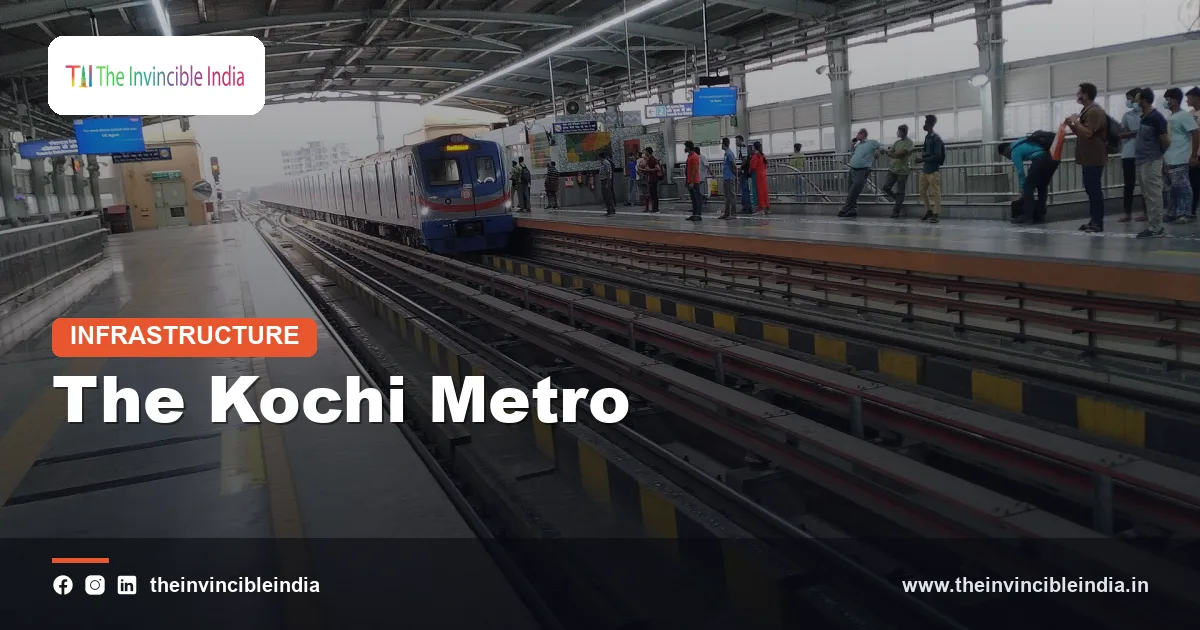
The Kochi Metro is the rapid-transit rail system of Kochi (Cochin) in Kerala, operated by Kochi Metro Rail Limited (KMRL) and the first metro railway in the state of Kerala. It opened to the public in June 2017 and is widely noted in India for connecting trains with buses, feeder services, bicycles and ferries, for relying heavily on solar power, and for its inclusive staffing policy that brought Kudumbashree women and transgender persons into regular jobs.
The Kochi Metro is a smaller system than the metros of Delhi, Mumbai or Bengaluru, but it is frequently studied as a model for medium-sized Indian cities. It runs on an elevated viaduct through the Ernakulam side of the city, and it has been extended step by step from its first stretch towards Tripunithura, with a further line planned to Kakkanad. This explainer covers its history, lines, technology, ridership, special features and the linked Kochi Water Metro, with 17 October 2026 as the reference date.
| Attribute | Detail |
|---|---|
| System name | Kochi Metro (Kochi Metro Rail) |
| Operator | Kochi Metro Rail Limited (KMRL) |
| Ownership | Joint venture of the Government of India and the Government of Kerala, with equal shares |
| City and state | Kochi (Cochin), Kerala |
| First commercial service | June 2017, on the Aluva to Palarivattom stretch |
| Type | Elevated rapid-transit metro on a standard-gauge track |
| Current core line | Aluva to Tripunithura, roughly 25 to 28 km with about 25 stations |
| Notable firsts | First metro in Kerala; Kudumbashree women and transgender staff; linked water metro |
| Linked services | Kochi Water Metro, feeder buses, feeder autos, bicycles |
Key Takeaways
- The Kochi Metro is Kerala’s first metro rail system and has been operated by Kochi Metro Rail Limited (KMRL) since its opening in June 2017.
- Kochi Metro Rail Limited is owned in equal parts by the Government of India and the Government of Kerala.
- The Kochi Metro is built as an elevated line and runs from Aluva in the north towards Tripunithura in the south-east of the Kochi urban area.
- The Kochi Metro became widely known for employing women from the Kudumbashree self-help network and for hiring transgender persons as regular staff.
- The Kochi Metro uses solar panels on its stations and depot to meet a substantial part of its electricity needs.
- The Kochi Water Metro, run by KMRL, is a separate ferry-style electric boat network that links the mainland with the islands around Kochi.
What is the Kochi Metro?
The Kochi Metro is an urban mass rapid transit railway serving the city of Kochi and its neighbouring suburbs in the Ernakulam district of Kerala. It was planned to relieve road congestion on the narrow, heavily used corridor that links Aluva, the northern gateway of the city, with the commercial centre around Ernakulam.
The system runs on an elevated viaduct rather than underground, which kept construction costs lower and was suited to the soft, water-rich soil of the region. Trains are electric, air-conditioned and operate over a standard-gauge track. The network is managed by KMRL, a special-purpose company, rather than by a municipal body.
Kochi is Kerala’s commercial and port city, with a high density of vehicles, a large floating population and a long waterfront. These conditions made a metro attractive for the city, even though its population is far smaller than that of the largest metropolitan areas in India.
Who runs the Kochi Metro?
Kochi Metro Rail Limited (KMRL) runs the Kochi Metro and was incorporated as a joint venture of the Government of India and the Government of Kerala, each holding an equal share of the equity. The company is registered under the Companies Act and is governed by a board that includes officials of both governments.
KMRL handles construction, train operations, ticketing, station management and commercial activities such as advertising and real estate near stations. It also operates the Kochi Water Metro, which gives the company an unusual role as both a rail operator and a waterway operator.
E. Sreedharan, the engineer widely credited with the Delhi Metro and the Konkan Railway, served as the principal adviser in the early years. His involvement is often cited as a reason for the project’s emphasis on delivery discipline and on building to tight schedules.
When did the Kochi Metro start and how was it built?
The Kochi Metro began commercial service in June 2017 after several years of planning, land acquisition and construction that started in the early 2010s. The first stretch ran from Aluva to Palarivattom, and it was opened by the Prime Minister before commercial services began a couple of days later.
The line was then lengthened in stages. Extensions towards Maharaja’s College, Thykoodam and Petta followed, and a further stretch to SN Junction was opened. The final section of the first line, up to the Tripunithura terminus, followed in the early 2020s as part of what the project describes as Phase 1B. Exact opening dates for each stretch are recorded in KMRL’s own announcements.
Key milestones
- Early 2010s: Project approval, creation of KMRL and start of civil work.
- 2017: First commercial service from Aluva towards Palarivattom, followed by an extension to Maharaja’s College.
- 2019 to 2020: Extensions towards Thykoodam and Petta.
- 2022: Extension to SN Junction.
- 2023: Launch of the Kochi Water Metro service.
- 2024: Extension to Tripunithura, completing the original Aluva to Tripunithura line.
What are the lines and stations of the Kochi Metro?
The Kochi Metro currently functions as a single north-south line from Aluva to Tripunithura, with roughly two dozen stations along a corridor of about 25 to 28 km. Most stations are named after local landmarks, such as Edapally, Kaloor, MG Road, Maharaja’s College, Ernakulam South and Vyttila.
The corridor passes through the Aluva suburb, the CUSAT university area, the Edapally junction, the Palarivattom crossing, the busy Kaloor stretch, the commercial heart of Ernakulam and then south towards Vyttila and Tripunithura. Vyttila is an important multimodal hub because it is also connected with long-distance and city bus facilities.
A second corridor is planned from Kaloor towards Kakkanad, the part of Kochi where Infopark and other IT campuses are located. This line is intended to relieve the heavily congested road to the IT hub and is under development in stages. Dates for its opening should be checked against official KMRL announcements.
Planned extensions
- Kakkanad (Infopark) corridor from Kaloor, often called Phase 2.
- Proposals to improve links with the airport area at Nedumbassery.
- Further connectivity studies for the western and southern parts of the metropolitan region.
How does the Kochi Metro run technically?
The Kochi Metro runs air-conditioned electric trains of three coaches on a standard-gauge elevated track, powered by a 750 volt direct-current third rail system. Trains are built by Alstom at its plant in Sri City, Andhra Pradesh, and use communication-based train control (CBTC) signalling that allows frequent, closely spaced services.
A train can carry more than nine hundred passengers at crush loads according to project descriptions, though exact figures vary with the configuration. Trains can be extended to more coaches if demand rises, since the stations were designed with the possibility of lengthening in mind.
The depot at Muttom, near Aluva, serves as the maintenance and stabling base. The depot is also one of the places where solar panels are installed. The system uses automatic fare collection through gates, with tickets that can be bought as paper-based tokens, through the mobile app or on stored-value cards.
How many people ride the Kochi Metro?
The Kochi Metro carries on the order of one lakh passengers on an average working day in recent years, with higher numbers on festival days and special occasions. Ridership grew after the extension towards Petta, SN Junction and Tripunithura, since the line now reaches more residential areas.
Daily figures are published by KMRL and change from month to month, so a precise number is best taken from the latest official release. Observers often point out that the system has not yet reached the ridership forecasts made at the planning stage, which is a common experience for new metros in India, and that integration with feeder services is meant to close this gap.
Fares are set to be competitive with bus and auto rides on the same corridor, and discounted fares and passes are available for frequent travellers and for students in some schemes.
What makes the Kochi Metro unique?
The Kochi Metro is distinctive for its inclusive hiring, its attention to multimodal connections and its use of renewable energy. These choices are often highlighted in India as examples of a metro that serves more than just a transport function.
Kudumbashree women
Kudumbashree is the Kerala government’s poverty-eradication and women-empowerment network. When the Kochi Metro opened, KMRL employed several hundred Kudumbashree women in roles such as station housekeeping, ticketing, customer relations and maintenance support. The arrangement gave a large number of women stable work in a public project.
Transgender employees
KMRL was among the first public agencies in India to hire transgender persons in regular jobs. Around two dozen people from the transgender community were employed at the time of the opening, in roles such as customer care and ticketing. The programme drew national attention, although KMRL has reported challenges, such as housing and retention, that other employers also face.
Solar power
The Kochi Metro has installed solar panels on station roofs and on the depot, which feed a share of the electricity used by stations and the depot into the grid. The project has often been described as among the more solar-oriented metros in the country. The exact share of energy supplied by solar depends on the year, and KMRL reports it periodically.
How does the Kochi Metro connect with other transport?
The Kochi Metro is designed around integrated multimodal transport, which means that trains, buses, autos, bicycles and boats are meant to be used through a common system. The concept is called a last-mile connectivity approach, since the metro itself covers only a corridor and passengers need good links to reach it.
KMRL runs feeder buses that link stations to residential areas and employment centres. It has introduced feeder auto-rickshaws, which can be booked through an app, and a public bicycle-sharing scheme at many stations. The Kochi 1 smart card allows payment across the metro and some partner services, and the Kochi 1 app supports ticketing and trip planning.
Governance integration is also pursued through the Unified Metropolitan Transport Authority (UMTA), a body envisaged to coordinate planning of roads, buses, rail and waterways in the metropolitan region.
| Mode | Role in the Kochi network |
|---|---|
| Metro rail | North-south trunk line from Aluva to Tripunithura |
| Feeder buses | Link residential areas and offices to metro stations |
| Feeder autos | Short app-booked rides to and from stations |
| Bicycles | Shared cycles at selected stations for short trips |
| Water Metro boats | Electric hybrid ferries linking islands and terminals |
| Buses and trains | Interchange at Vyttila, Ernakulam Junction and Ernakulam Town |
What is the Kochi Water Metro?
The Kochi Water Metro is a network of electric hybrid ferry boats that connects the mainland of Kochi with the many islands in the backwaters around the city, and it is run by Kochi Metro Rail Limited. It began service in April 2023 on a route connecting the High Court area with Vypin Island.
The project was designed for the island communities around Kochi, who have long relied on slow ferries and long road detours to reach the city. It plans a network of terminals and routes across the backwaters, with air-conditioned, battery-powered boats of modest size and boarding at purpose-built terminals.
The Water Metro uses a ticketing system that is linked with the metro, so that passengers can use the same card or app across both. Observers have described it as a unique innovation in Indian urban transport, since few Indian cities have used their waterways as a regular commuter network. Exact numbers of boats, terminals and routes are being expanded, so the latest figures should be taken from KMRL.
What are the benefits and challenges of the Kochi Metro?
The Kochi Metro has brought a clean, punctual, air-conditioned alternative to the congested roads along the Aluva to Ernakulam corridor and has supported property development near stations. It has also contributed to employment for women and marginalised groups, and it has encouraged cooperation among transport agencies.
Challenges include ridership that has taken time to grow, high capital costs, and the need for good access to stations in a city with narrow roads. Critics have also pointed to the cost of land acquisition and to the difficulty of recovering operating costs from fares alone.
KMRL has responded by developing non-fare revenue, such as advertising, leasing of commercial space and consultancy, and by extending the line to areas with larger populations.
Bottom Line
The Kochi Metro is a compact but influential urban rail system, notable for integrating transport modes, employing women and transgender persons, using solar energy and spawning the Kochi Water Metro. Its growth depends on further extensions, such as the Kakkanad line, and on strong feeder services.
Frequently Asked Questions
When did the Kochi Metro open?
The Kochi Metro opened to the public in June 2017 on the Aluva to Palarivattom stretch. It was later extended in stages towards Maharaja’s College, Thykoodam, Petta, SN Junction and Tripunithura.
Who owns the Kochi Metro?
The Kochi Metro is owned by Kochi Metro Rail Limited (KMRL), a company in which the Government of India and the Government of Kerala hold equal shares. KMRL also runs the Kochi Water Metro.
How long is the Kochi Metro line?
The main Kochi Metro line from Aluva to Tripunithura is roughly 25 to 28 km long, with about two dozen stations. A second line towards Kakkanad is planned, and exact lengths should be checked with KMRL.
Why is the Kochi Metro famous for Kudumbashree women and transgender staff?
The Kochi Metro is famous because KMRL employed several hundred Kudumbashree women and about two dozen transgender persons in regular jobs when it opened. This made it one of the best-known examples of inclusive hiring in an Indian public transport project.
What is the Kochi Water Metro?
The Kochi Water Metro is a network of electric hybrid ferry boats linking the mainland of Kochi with nearby islands. KMRL launched it in April 2023, and its ticketing is designed to work together with the metro.
How many people use the Kochi Metro daily?
The Kochi Metro has carried roughly one lakh passengers on an average working day in recent years, according to published figures. The number varies by month and rises after route extensions and on festival days.
{“@context”:”https://schema.org”,”@graph”:[{“@type”:”FAQPage”,”mainEntity”:[{“@type”:”Question”,”name”:”When did the Kochi Metro open?”,”acceptedAnswer”:{“@type”:”Answer”,”text”:”The Kochi Metro opened to the public in June 2017 on the Aluva to Palarivattom stretch. It was later extended in stages towards Maharaja’s College, Thykoodam, Petta, SN Junction and Tripunithura.”}},{“@type”:”Question”,”name”:”Who owns the Kochi Metro?”,”acceptedAnswer”:{“@type”:”Answer”,”text”:”The Kochi Metro is owned by Kochi Metro Rail Limited (KMRL), a company in which the Government of India and the Government of Kerala hold equal shares. KMRL also runs the Kochi Water Metro.”}},{“@type”:”Question”,”name”:”How long is the Kochi Metro line?”,”acceptedAnswer”:{“@type”:”Answer”,”text”:”The main Kochi Metro line from Aluva to Tripunithura is roughly 25 to 28 km long, with about two dozen stations. A second line towards Kakkanad is planned, and exact lengths should be checked with KMRL.”}},{“@type”:”Question”,”name”:”Why is the Kochi Metro famous for Kudumbashree women and transgender staff?”,”acceptedAnswer”:{“@type”:”Answer”,”text”:”The Kochi Metro is famous because KMRL employed several hundred Kudumbashree women and about two dozen transgender persons in regular jobs when it opened. This made it one of the best-known examples of inclusive hiring in an Indian public transport project.”}},{“@type”:”Question”,”name”:”What is the Kochi Water Metro?”,”acceptedAnswer”:{“@type”:”Answer”,”text”:”The Kochi Water Metro is a network of electric hybrid ferry boats linking the mainland of Kochi with nearby islands. KMRL launched it in April 2023, and its ticketing is designed to work together with the metro.”}},{“@type”:”Question”,”name”:”How many people use the Kochi Metro daily?”,”acceptedAnswer”:{“@type”:”Answer”,”text”:”The Kochi Metro has carried roughly one lakh passengers on an average working day in recent years, according to published figures. The number varies by month and rises after route extensions and on festival days.”}}]}]}


