

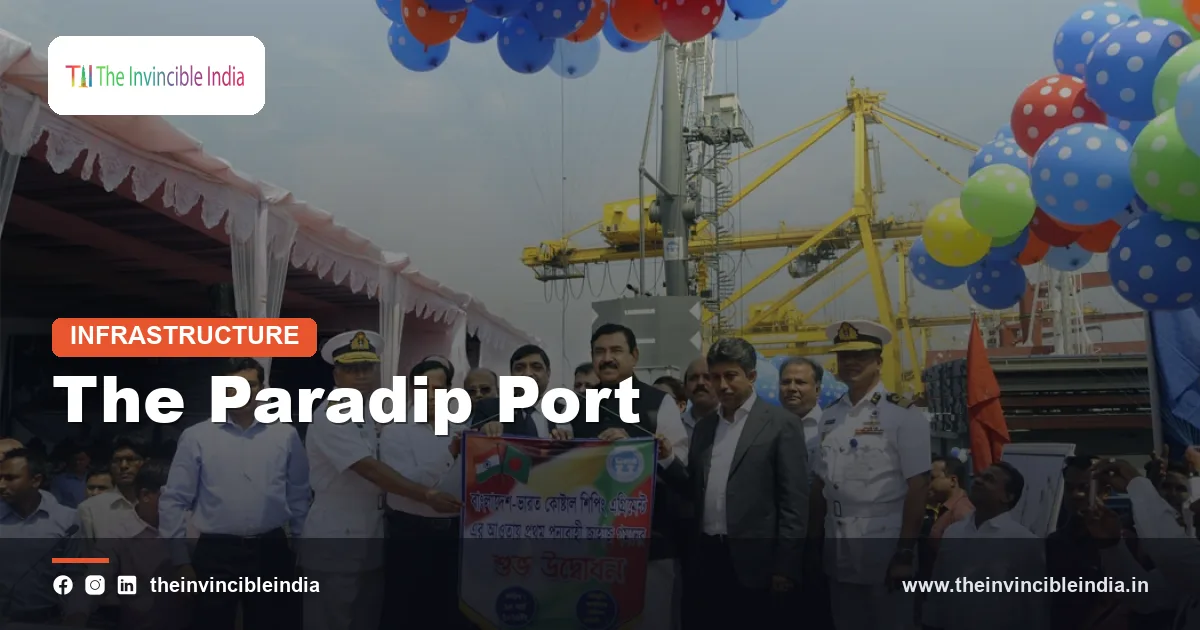
Paradip Port is a major deepwater seaport on the Odisha coast, in Jagatsinghpur district near the point where the Mahanadi river meets the Bay of Bengal, and it is one of the highest-tonnage ports in India. Opened in 1966 as a government-owned major port, Paradip Port handles bulk cargoes such as thermal and coking coal, iron ore, crude oil, petroleum products and fertiliser raw materials, and it serves the mineral-rich hinterland of Odisha, Jharkhand and Chhattisgarh.
The port sits on the eastern seaboard, which makes it a natural gateway for coal imports and ore exports on the Bay of Bengal trade routes. This explainer covers the history, location, infrastructure, cargo profile, administration and future plans of Paradip Port, with figures qualified where they change from year to year. Last updated: 17 October 2026.
| Attribute | Detail |
|---|---|
| Name | Paradip Port (administered by the Paradip Port Authority) |
| Location | Near Paradip town, Jagatsinghpur district, Odisha, at the Mahanadi mouth on the Bay of Bengal |
| Opened | 1966, as a major port of India |
| Type | Deepwater, all-weather, artificial lagoon-type harbour with an outer harbour |
| Ownership | Central Government of India, one of the major ports under the Ministry of Ports, Shipping and Waterways |
| Main cargoes | Thermal coal, coking coal, iron ore, crude oil, petroleum products, fertilisers and their raw materials |
| Notable role | One of the highest-tonnage ports in India; main east-coast outlet for Odisha’s minerals |
| Governing law | Major Port Trusts Act, 1963, later replaced by the Major Port Authorities Act, 2021 |
Key Takeaways
- Paradip Port is a major port of India on the Odisha coast, opened in 1966 near the mouth of the Mahanadi river.
- Paradip Port is owned by the Government of India and managed by the Paradip Port Authority under the Ministry of Ports, Shipping and Waterways.
- Paradip Port handles mostly dry and liquid bulk cargo, with coal, iron ore and crude oil forming the largest shares of its traffic.
- Paradip Port has deep draft berths and an outer harbour that allow it to receive very large bulk carriers that many Indian ports cannot take.
- Paradip Port serves a large hinterland of mineral and industrial regions in Odisha, Jharkhand, Chhattisgarh and neighbouring states through rail and road links.
- Paradip Port is a key node in the Sagarmala port-led development programme and has undergone several phases of capacity expansion.
What is Paradip Port?
Paradip Port is a government-owned major seaport on the coast of Odisha that serves as the state’s principal gateway for bulk trade. It is one of the 12 or so major ports of India administered by the central government, as opposed to the many non-major ports run by state maritime boards or private operators.
The port was conceived mainly to export iron ore from the mineral belt of eastern India and to give Odisha a deepwater outlet on the Bay of Bengal. Over the decades its role widened to include coal, petroleum, fertiliser and containerised or general cargo. The town of Paradip, often spelled Paradeep in industrial and company names, grew around the port and now hosts a refinery, a fertiliser complex and other industries.
Because the port is a central-government entity, its tariffs, land and major projects are overseen by national authorities rather than by the state government alone, although Odisha is a key stakeholder in its development.
Where is Paradip Port located?
Paradip Port is located on the east coast of India in Jagatsinghpur district, Odisha, roughly 100 km from the state capital Bhubaneswar by road, in the delta of the Mahanadi. The exact distances vary by route, so they are best treated as approximate.
The location is on a low coastal plain where the Mahanadi and its distributaries drain into the Bay of Bengal. The port is built on the sea face rather than inside the river, which is why it can offer deeper water than river ports such as Kolkata.
- Sea approach: Direct access to the open Bay of Bengal, with a dredged approach channel.
- Nearby ports: Haldia and Kolkata lie to the north, while Dhamra, Gopalpur and Visakhapatnam lie along the coast in other directions.
- Climate exposure: The Odisha coast is cyclone-prone, so the port plans for storm surges and has storm-preparedness procedures.
When was Paradip Port built and how did it develop?
Paradip Port was developed in the early 1960s and formally opened as a major port in 1966, after planning that began in the years following Independence. The idea was to create a deepwater harbour on the Odisha coast that could export iron ore and relieve pressure on the older eastern ports of Kolkata and Visakhapatnam.
The earliest port was a modest lagoon-type harbour carved out of the coastal landscape, with a protected basin and a few berths. Its first major cargo was iron ore bound for export markets, and for many years the port was closely tied to the fortunes of that single commodity.
From the 1980s onwards the port added new cargo streams and facilities. Further growth followed the opening of the Indian economy in the 1990s, the arrival of coastal industries, and later the Paradip refinery. The table below summarises the broad stages of development.
| Period | Development stage |
|---|---|
| Early 1960s | Construction of the lagoon harbour and first berths |
| 1966 | Port opened as a major port of India |
| 1970s to 1980s | Growth in iron ore exports; additional general cargo and fertiliser-related traffic |
| 1990s | Modernisation, mechanisation and coastal industrial growth after economic liberalisation |
| 2000s | Outer harbour and deeper berths; entry into crude oil and coal handling at scale |
| 2010s | Refinery-linked oil traffic, coal mechanisation, a Western Dock project and private terminals under public-private partnership |
| 2020s | Further capacity additions, rail and road connectivity, and Sagarmala-linked projects |
Dates in this table are approximate groupings of well-known phases rather than exact commissioning dates for each facility.
What cargo does Paradip Port handle?
Paradip Port primarily handles dry bulk and liquid bulk cargo, with thermal coal, coking coal, iron ore, crude oil and petroleum products among its biggest traffic categories. Fertilisers and fertiliser raw materials such as rock phosphate and phosphoric acid are also important, along with limestone, steel products and other general cargo.
Coal
Paradip Port is among India’s leading ports for coal handling. It receives imported thermal and coking coal for power plants and steel mills, and it also handles domestic coal moved by rail and loaded onto ships for coastal movement to other Indian ports. Mechanised coal terminals reduce vessel waiting time and manual handling.
Iron ore and other minerals
Iron ore was the original driver of the port and remains a major export. Iron ore, along with pellets and some other minerals, is transported by rail from mining areas in Odisha and neighbouring states. Exports depend heavily on policy, prices and demand abroad, so volumes swing from year to year.
Crude oil and petroleum products
Paradip Port receives crude oil for the large refinery built nearby, using offshore mooring facilities that allow very large crude carriers to discharge without entering the harbour. The port also handles petroleum products and other liquid cargo.
Fertiliser and general cargo
A fertiliser complex at Paradip imports raw materials through the port and sends finished products inland. The port also handles steel, project cargo and some containerised goods, although containers form a small share compared with bulk.
What infrastructure does Paradip Port have?
Paradip Port has a lagoon-type enclosed harbour, an outer harbour, multiple dedicated bulk and liquid berths, offshore crude oil mooring facilities and mechanised cargo-handling systems. These are supported by storage yards, conveyor systems, rail sidings and road connections.
- Deep draft berths: The port can receive large bulk carriers of the Capesize class, which need deeper water than most Indian ports provide.
- Single point mooring: Offshore buoys allow supertankers to unload crude through pipelines.
- Mechanised terminals: Dedicated coal and ore terminals use conveyor belts and loaders to speed up operations.
- Western Dock and PPP terminals: Newer docks and terminals developed with private operators on a design, build, finance, operate and transfer basis.
- Dredging: Regular maintenance dredging keeps the channel and basin at the required depth despite river sediments and currents.
The exact depths, berth counts and handling capacities are updated regularly, so readers needing current numbers should check the latest figures published by the port authority.
Who runs Paradip Port?
Paradip Port is run by the Paradip Port Authority, a statutory body of the Government of India that operates under the Ministry of Ports, Shipping and Waterways. Before 2021 the same body was known as the Paradip Port Trust and was governed by the Major Port Trusts Act, 1963.
The Major Port Authorities Act, 2021 replaced the older law and changed the governance model. Under this Act, each major port has a Board of Authority with a smaller, more professional membership, and the board has more freedom to set tariffs for private terminals and to plan development.
- Board of Authority: Headed by a chairperson, with members representing the government, railways, defence, customs, labour and independent experts.
- Landlord port model: The authority owns land and basic infrastructure, while private operators often build and run terminals under concession.
- Tariff Authority: Rate-setting for major ports has been reorganised under the new Act, giving ports more flexibility.
Why is Paradip Port important to India?
Paradip Port is important because it provides the eastern mineral belt with a deepwater outlet, supports energy security through crude and coal imports, and anchors industrial growth in Odisha. A port close to the source of raw materials reduces inland transport cost and makes domestic industries more competitive.
- Energy: Coal and crude oil flowing through the port feed power plants, steel mills and a major refinery.
- Industry: The refinery, fertiliser plant and related industries create employment and attract downstream investment.
- Trade: The port links eastern India with East Asia, Southeast Asia and other Bay of Bengal markets.
- Coastal shipping: Paradip is a hub for coal and other cargo moved between Indian ports by sea, which is cheaper and cleaner than long road hauls.
How is Paradip Port connected to the hinterland?
Paradip Port is connected to its hinterland by railway lines, national highways and pipelines, which together carry bulk cargo to and from the interior. The rail link joins the port to the main eastern trunk network, which carries coal from the Talcher and Ib valley fields and ore from mining areas.
Roads link Paradip to Cuttack, Bhubaneswar and the national highway network. For crude oil, a pipeline system carries product from the port area toward inland refining and distribution points. Improving these corridors is a continuing priority because evacuation capacity often limits how much cargo a port can effectively handle.
Policy initiatives such as dedicated freight corridors, port-rail connectivity projects and industrial corridors aim to shorten transit times. The development of inland waterways and coastal shipping can also supplement these routes over time.
What are the challenges and future plans for Paradip Port?
Paradip Port faces challenges such as cyclone risk, siltation, competition from nearby private ports and the need to diversify beyond bulk cargo, while its future plans centre on capacity expansion and better connectivity. The Odisha coast has experienced severe cyclones in past decades, which means the port must invest in resilient design and disaster response.
Key challenges
- Dependence on a few commodities, particularly coal and iron ore, exposes the port to market swings.
- Maintaining channel depth requires continuous dredging.
- Nearby ports such as Dhamra compete for the same hinterland cargo.
- Container traffic remains small compared with bulk traffic.
Future directions
- Adding berths and deepening channels to handle larger ships and more cargo.
- Strengthening rail and road evacuation under the Sagarmala programme.
- Developing port-led industrial and logistics zones around Paradip.
- Adopting greener practices, including shore power, dust control and renewable energy.
How does Paradip Port compare with other east-coast ports?
Paradip Port is one of the larger east-coast ports by tonnage and is distinguished by its deep draft and bulk focus, while other ports differ in cargo mix and ownership. The table below places it beside several neighbours at a broad, qualitative level.
| Port | State | Type | Broad character |
|---|---|---|---|
| Paradip | Odisha | Major port | Deepwater bulk port: coal, ore, crude, fertiliser |
| Haldia and Kolkata | West Bengal | Major river ports | River-based ports with tidal and draft limits; mixed cargo and containers |
| Visakhapatnam | Andhra Pradesh | Major port | Diversified port with a naturally deep harbour |
| Dhamra | Odisha | Private port | Deepwater private port focused on dry bulk |
| Chennai and Ennore | Tamil Nadu | Major ports | Container, vehicle and coal handling on the southern coast |
Bottom Line
Paradip Port is a central-government major port that turned a stretch of the Odisha coast into one of India’s busiest bulk gateways. Its deep berths, rail links and nearby refinery and fertiliser plants make it vital to eastern India’s energy and industrial supply chains.
Frequently Asked Questions
Where is Paradip Port located?
Paradip Port is located on the Odisha coast in Jagatsinghpur district, at the mouth of the Mahanadi river on the Bay of Bengal. It lies roughly 100 km from Bhubaneswar by road, although exact distances depend on the route. The port town of Paradip is also spelled Paradeep in several company names.
When was Paradip Port opened?
Paradip Port was opened in 1966 as a major port of India. Construction and planning took place in the early 1960s. Since then the port has grown through several phases of expansion into one of the country’s highest-tonnage ports.
What does Paradip Port mainly handle?
Paradip Port mainly handles bulk cargo, especially thermal and coking coal, iron ore, crude oil, petroleum products and fertiliser raw materials. Containers and general cargo form a smaller share. The cargo mix changes with market conditions and policy.
Who owns and manages Paradip Port?
Paradip Port is owned by the Government of India and managed by the Paradip Port Authority under the Ministry of Ports, Shipping and Waterways. It was earlier called the Paradip Port Trust. The Major Port Authorities Act, 2021 now governs how it is run.
Is Paradip Port a deepwater port?
Yes, Paradip Port is a deepwater port that can receive very large bulk carriers and use offshore moorings for crude tankers. Its outer harbour and dredged channel give it a greater draft than many other Indian ports. Depths are maintained by regular dredging and may be updated over time.
Why is Paradip Port important for Odisha?
Paradip Port is important for Odisha because it gives the state’s mineral and industrial regions a direct sea outlet and supports a refinery, a fertiliser complex and other industries. It also lowers inland transport costs for exporters and importers. The port is a major driver of coastal economic activity in the state.
{“@context”:”https://schema.org”,”@graph”:[{“@type”:”FAQPage”,”mainEntity”:[{“@type”:”Question”,”name”:”Where is Paradip Port located?”,”acceptedAnswer”:{“@type”:”Answer”,”text”:”Paradip Port is located on the Odisha coast in Jagatsinghpur district, at the mouth of the Mahanadi river on the Bay of Bengal. It lies roughly 100 km from Bhubaneswar by road, although exact distances depend on the route. The port town of Paradip is also spelled Paradeep in several company names.”}},{“@type”:”Question”,”name”:”When was Paradip Port opened?”,”acceptedAnswer”:{“@type”:”Answer”,”text”:”Paradip Port was opened in 1966 as a major port of India. Construction and planning took place in the early 1960s. Since then the port has grown through several phases of expansion into one of the country’s highest-tonnage ports.”}},{“@type”:”Question”,”name”:”What does Paradip Port mainly handle?”,”acceptedAnswer”:{“@type”:”Answer”,”text”:”Paradip Port mainly handles bulk cargo, especially thermal and coking coal, iron ore, crude oil, petroleum products and fertiliser raw materials. Containers and general cargo form a smaller share. The cargo mix changes with market conditions and policy.”}},{“@type”:”Question”,”name”:”Who owns and manages Paradip Port?”,”acceptedAnswer”:{“@type”:”Answer”,”text”:”Paradip Port is owned by the Government of India and managed by the Paradip Port Authority under the Ministry of Ports, Shipping and Waterways. It was earlier called the Paradip Port Trust. The Major Port Authorities Act, 2021 now governs how it is run.”}},{“@type”:”Question”,”name”:”Is Paradip Port a deepwater port?”,”acceptedAnswer”:{“@type”:”Answer”,”text”:”Yes, Paradip Port is a deepwater port that can receive very large bulk carriers and use offshore moorings for crude tankers. Its outer harbour and dredged channel give it a greater draft than many other Indian ports. Depths are maintained by regular dredging and may be updated over time.”}},{“@type”:”Question”,”name”:”Why is Paradip Port important for Odisha?”,”acceptedAnswer”:{“@type”:”Answer”,”text”:”Paradip Port is important for Odisha because it gives the state’s mineral and industrial regions a direct sea outlet and supports a refinery, a fertiliser complex and other industries. It also lowers inland transport costs for exporters and importers. The port is a major driver of coastal economic activity in the state.”}}]}]}


