

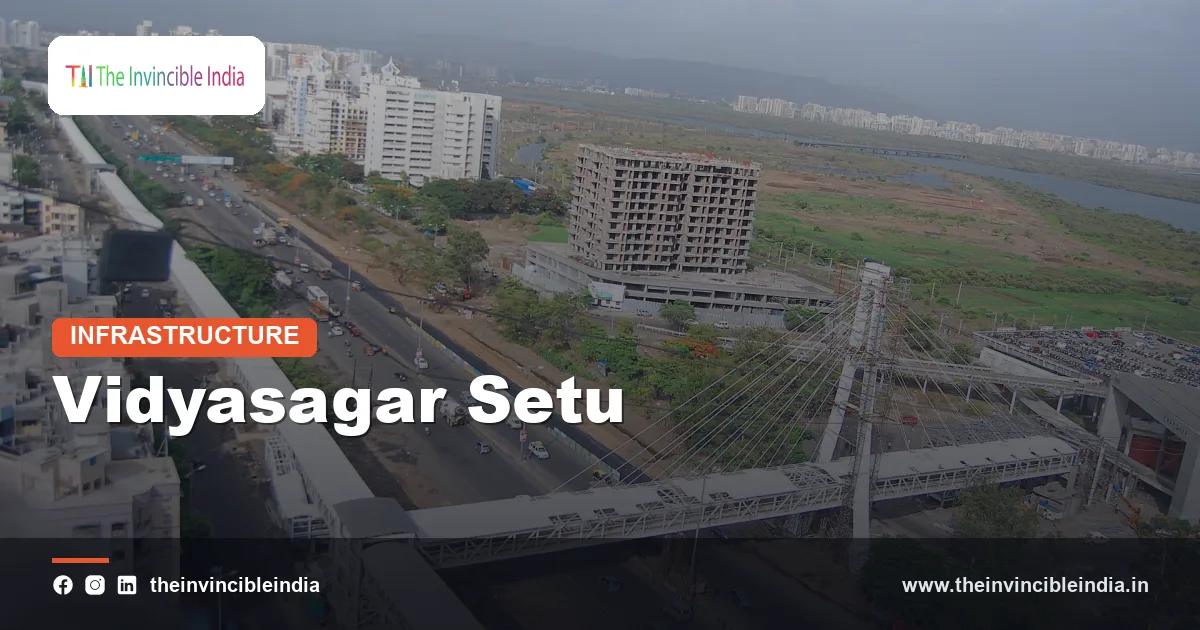
Vidyasagar Setu is a cable-stayed road bridge across the Hooghly river that links Kolkata and Howrah in West Bengal, opened in 1992 and long regarded as one of India’s longest cable-stayed bridges. Also known as the Second Hooghly Bridge, Vidyasagar Setu was built to relieve the heavy traffic on the century-old Howrah Bridge and is named after the nineteenth-century social reformer Ishwar Chandra Vidyasagar.
The bridge carries a multi-lane road over the tidal river on a deck hung from two towers by sloping steel cables. This explainer covers the bridge’s history, location, structure, how cable-stayed design works, its role in Kolkata’s traffic and its place beside the other Hooghly crossings. Last updated: 17 October 2026.
| Attribute | Detail |
|---|---|
| Official name | Vidyasagar Setu (Second Hooghly Bridge) |
| Location | Over the Hooghly river, connecting Kolkata (Khidirpur side) and Howrah, West Bengal |
| Opened | 1992 |
| Type | Cable-stayed road bridge |
| Named after | Ishwar Chandra Vidyasagar (1820 to 1891), educator and social reformer |
| Built and managed by | Hooghly River Bridge Commissioners (HRBC) |
| Total length | Roughly 820 m, with a main cable-stayed span of about 457 m |
| Carriageway | Multi-lane road deck for motor traffic, tolled |
| Notable role | Second road bridge at Kolkata; eased pressure on the older Howrah Bridge |
Key Takeaways
- Vidyasagar Setu is a cable-stayed road bridge over the Hooghly river connecting Kolkata and Howrah, opened in 1992.
- Vidyasagar Setu is also called the Second Hooghly Bridge because it was built as the second major road crossing of the Hooghly at Kolkata, after the Howrah Bridge.
- Vidyasagar Setu is named after Ishwar Chandra Vidyasagar, the Bengali educator and reformer associated with the Hindu Widows’ Remarriage Act of 1856.
- Vidyasagar Setu has a main span of roughly 457 m and a total length of about 820 m, and its deck hangs from cables fixed to two tall towers.
- Vidyasagar Setu is managed by the Hooghly River Bridge Commissioners, the body that also built it, and it is commonly described as one of the longest cable-stayed bridges in the country.
- Vidyasagar Setu took well over a decade to build and became a vital link for goods and passenger traffic on the Kolkata and Howrah corridor.
What is Vidyasagar Setu?
Vidyasagar Setu is a major road bridge across the Hooghly river in West Bengal that connects the city of Kolkata with Howrah on the western bank. Its name, in Bengali and Hindi, means the bridge of Vidyasagar, honouring Ishwar Chandra Vidyasagar.
The bridge was opened in 1992 as the second road crossing built at Kolkata. At the time of its construction it was a technological landmark in India, because it used a cable-stayed design that was relatively new in the country, and it is still among the best-known engineering structures of eastern India.
The bridge is a toll facility and is maintained by the Hooghly River Bridge Commissioners, a statutory body created by the Government of West Bengal to build and manage bridges across the Hooghly.
Where is Vidyasagar Setu located?
Vidyasagar Setu is located over the Hooghly river on the southern side of central Kolkata, joining the Kidderpore and Khidirpur area of Kolkata on the eastern bank with the Howrah side on the western bank. It lies downstream, meaning south, of the Howrah Bridge.
The Hooghly is a distributary of the Ganga, which flows through West Bengal and is tidal at Kolkata. Placing a bridge there meant dealing with strong currents, soft alluvial soil and the need to keep the navigation channel open for ships going to and from Kolkata port.
- Kolkata side: The approach connects to roads serving the Kidderpore dock area, the Maidan, Alipore and central Kolkata.
- Howrah side: The approach connects to roads that lead toward Howrah, the national highways and industrial areas.
- Corridor role: The bridge is a link between roads leading to the southern part of the city and the highways on the western bank.
Why was Vidyasagar Setu built?
Vidyasagar Setu was built to relieve the heavy congestion on Howrah Bridge, which had been the only major road link between Kolkata and Howrah for decades. By the 1960s and 1970s traffic had far outgrown the capacity of that single crossing, causing long delays and slowing movement of goods and people between the two cities.
Planners therefore sought a second bridge, located downstream, that could carry through traffic and let heavy vehicles avoid the congested city centre. The project formed part of a wider plan to improve connectivity around the Kolkata metropolitan area.
- Traffic growth: Rising vehicle numbers overwhelmed the older crossing.
- Port and industry: Kolkata port, Howrah’s industries and the road network all depended on reliable river crossings.
- Navigation needs: A cable-stayed structure allowed a wide main span without piers in the middle of the shipping channel.
When was Vidyasagar Setu built?
Vidyasagar Setu was built over a long period that began in the 1970s and ended with the opening of the bridge in 1992. Construction took many years because of funding constraints, the complexity of the design and the difficulty of working in a tidal river.
| Stage | Approximate timing |
|---|---|
| Planning and design of a second Hooghly bridge | 1960s to early 1970s |
| Establishment of the Hooghly River Bridge Commissioners | 1969 |
| Start of construction | 1970s |
| Main structure and deck completed in stages | 1980s |
| Opening to traffic | 1992 |
| Later years | Maintenance, cable and deck inspections, and traffic management upgrades |
The dates for early stages are approximate, as accounts of the project differ on exactly when the foundation and tower work began. The opening in 1992 is the widely accepted completion date.
How is Vidyasagar Setu designed?
Vidyasagar Setu is designed as a cable-stayed bridge, in which the road deck is supported by straight inclined cables that run directly from the deck to tall towers, rather than by a main draped cable as in a suspension bridge. The cables carry the deck’s weight as tension, and the towers pass the load down to the foundations.
Towers
The bridge has two tall towers, one on each side of the main span, and these are visible from a long distance. The cables fan out from the towers to support the deck at regular intervals, and the towers are the most recognisable feature of the structure.
Deck
The deck is a continuous roadway that carries several lanes of traffic. It is built so that it can flex slightly under load, wind and temperature changes, and it includes expansion joints, drainage and lighting.
Foundations
Working in the Hooghly required deep foundations in soft river-bed soil. Foundations for the towers and approach piers were sunk deep into the alluvium so that they could resist the weight of the structure and the force of the river current and tides.
Approach spans
On each side of the main cable-stayed span, approach viaducts carry the road from ground level up to the deck height needed for river clearance. These approaches make up a significant part of the total length of the structure.
Figures for tower height, number of cables and the exact span lengths vary slightly between sources, so the commonly quoted values of about 457 m for the main span and about 820 m for the total length should be treated as approximate.
How does a cable-stayed bridge work?
A cable-stayed bridge works by using inclined steel cables that connect the deck directly to one or more towers, so that the towers take the load through the cables and carry it to the ground. This differs from a suspension bridge, which hangs the deck from vertical hangers attached to a large main cable draped between anchorages.
| Feature | Cable-stayed bridge | Suspension bridge | Cantilever truss bridge |
|---|---|---|---|
| Main support | Cables straight from deck to tower | Large draped main cables with vertical hangers | Rigid steel framework projecting from piers |
| Typical span range | Medium to long spans | Very long spans | Medium spans |
| Anchorage need | Anchored to the deck itself | Needs massive end anchorages | Not applicable |
| Example at Kolkata | Vidyasagar Setu | None at Kolkata on the Hooghly | Howrah Bridge |
The advantage of the cable-stayed design is that it allows a long, unobstructed main span with relatively less material than a girder bridge. It is therefore well suited to a busy river such as the Hooghly, where the shipping channel must stay clear.
Who is Vidyasagar Setu named after?
Vidyasagar Setu is named after Ishwar Chandra Vidyasagar, a nineteenth-century Bengali scholar, educator and social reformer who lived from 1820 to 1891. He is remembered for his campaigns on women’s education and for his role in the movement that led to the Hindu Widows’ Remarriage Act of 1856.
Vidyasagar was a key figure of the Bengal Renaissance. He worked to simplify Bengali prose and printing, wrote primers still associated with his name, and served as an administrator of the Sanskrit College in Calcutta. Naming a prominent public structure after him reflects the high regard in which he is held in West Bengal.
How does Vidyasagar Setu compare with other Hooghly bridges?
Vidyasagar Setu is one of several bridges that cross the Hooghly in the Kolkata region, and it differs from the others in age, type and purpose. The best-known crossings are summarised below, with dates as widely reported.
| Bridge | Type | Opened | Notes |
|---|---|---|---|
| Howrah Bridge (Rabindra Setu) | Cantilever truss | 1943 | Replaced an earlier pontoon bridge; one of the busiest bridges in the world by pedestrian traffic |
| Vidyasagar Setu (Second Hooghly Bridge) | Cable-stayed | 1992 | Relieved congestion on the Howrah Bridge; tolled |
| Vivekananda Setu (Bally Bridge) | Steel girder | 1932 | Older upstream crossing that carries both road and rail at Bally, north of Kolkata |
| Nivedita Setu (Second Vivekananda Setu) | Cable-stayed | 2007 | Built alongside the older Bally Bridge to add capacity |
The Howrah Bridge, officially renamed Rabindra Setu in the 1960s, remains iconic, but Vidyasagar Setu handles much of the heavier road traffic that would otherwise crowd the city centre.
What is the significance of Vidyasagar Setu for Kolkata?
Vidyasagar Setu is significant for Kolkata because it provides a high-capacity road link that supports the movement of people and freight between the city and the western bank of the Hooghly. It improved connectivity between Kolkata and Howrah, reduced pressure on the Howrah Bridge and became a route for vehicles heading to the national highways.
- Traffic relief: It diverts through traffic away from the congested Howrah Bridge and central city streets.
- Freight movement: It supports trucks serving Kolkata port, industrial Howrah and the highway network.
- Urban landmark: The towers and cables form a recognisable part of the Kolkata skyline, and the bridge is a popular spot for photographs.
- Engineering milestone: It helped introduce cable-stayed technology to Indian bridge building, a design later used in other large Indian bridges.
Heavy use also means that the bridge needs continuous inspection and maintenance of its cables, bearings, expansion joints and wearing surface, and authorities have carried out repairs and upgrades over the years to keep it safe.
Who manages and maintains Vidyasagar Setu?
Vidyasagar Setu is managed and maintained by the Hooghly River Bridge Commissioners, a statutory body of the Government of West Bengal that was set up to construct and operate the bridge. The commissioners collect tolls, which fund maintenance, and they handle inspection, traffic regulation and repairs.
Maintenance of a cable-stayed bridge involves regular checks of the cables and their anchorages, protection against corrosion in the humid river environment, monitoring of the towers and foundations, and renewal of the road surface. Because the Hooghly is tidal and the region experiences monsoon rainfall and occasional cyclonic winds, the structure is designed to withstand these conditions.
Bottom Line
Vidyasagar Setu, the Second Hooghly Bridge, is a cable-stayed landmark that has shaped Kolkata’s traffic for more than three decades. It eased the burden on the Howrah Bridge, honoured a major Bengali reformer by name and brought a modern bridge-building technique to India.
Frequently Asked Questions
What is Vidyasagar Setu?
Vidyasagar Setu is a cable-stayed road bridge over the Hooghly river that connects Kolkata and Howrah in West Bengal. It opened in 1992 and is also called the Second Hooghly Bridge. It is managed by the Hooghly River Bridge Commissioners.
Why is it called Vidyasagar Setu?
The bridge is named after Ishwar Chandra Vidyasagar, a Bengali educator and social reformer who lived from 1820 to 1891. He is remembered for promoting education and for supporting widow remarriage. The word setu means bridge.
How long is Vidyasagar Setu?
Vidyasagar Setu is roughly 820 m long in total, with a main cable-stayed span of about 457 m. Sources differ slightly on exact measurements. It is commonly described as one of the longest cable-stayed bridges in India.
When was Vidyasagar Setu opened?
Vidyasagar Setu was opened to traffic in 1992. Construction had begun in the 1970s, and the project took many years to complete. The bridge was designed to relieve the older Howrah Bridge.
What is the difference between Vidyasagar Setu and Howrah Bridge?
Vidyasagar Setu is a cable-stayed bridge opened in 1992, while the Howrah Bridge is a cantilever truss bridge opened in 1943. The Howrah Bridge is also known as Rabindra Setu and is located upstream, closer to the city centre. Vidyasagar Setu lies downstream and handles a large share of through road traffic.
Is there a toll on Vidyasagar Setu?
Yes, Vidyasagar Setu is a tolled bridge, and the toll is collected by the Hooghly River Bridge Commissioners. Rates differ by vehicle type and are revised from time to time. Current rates should be checked with the commissioners.
{“@context”:”https://schema.org”,”@graph”:[{“@type”:”FAQPage”,”mainEntity”:[{“@type”:”Question”,”name”:”What is Vidyasagar Setu?”,”acceptedAnswer”:{“@type”:”Answer”,”text”:”Vidyasagar Setu is a cable-stayed road bridge over the Hooghly river that connects Kolkata and Howrah in West Bengal. It opened in 1992 and is also called the Second Hooghly Bridge. It is managed by the Hooghly River Bridge Commissioners.”}},{“@type”:”Question”,”name”:”Why is it called Vidyasagar Setu?”,”acceptedAnswer”:{“@type”:”Answer”,”text”:”The bridge is named after Ishwar Chandra Vidyasagar, a Bengali educator and social reformer who lived from 1820 to 1891. He is remembered for promoting education and for supporting widow remarriage. The word setu means bridge.”}},{“@type”:”Question”,”name”:”How long is Vidyasagar Setu?”,”acceptedAnswer”:{“@type”:”Answer”,”text”:”Vidyasagar Setu is roughly 820 m long in total, with a main cable-stayed span of about 457 m. Sources differ slightly on exact measurements. It is commonly described as one of the longest cable-stayed bridges in India.”}},{“@type”:”Question”,”name”:”When was Vidyasagar Setu opened?”,”acceptedAnswer”:{“@type”:”Answer”,”text”:”Vidyasagar Setu was opened to traffic in 1992. Construction had begun in the 1970s, and the project took many years to complete. The bridge was designed to relieve the older Howrah Bridge.”}},{“@type”:”Question”,”name”:”What is the difference between Vidyasagar Setu and Howrah Bridge?”,”acceptedAnswer”:{“@type”:”Answer”,”text”:”Vidyasagar Setu is a cable-stayed bridge opened in 1992, while the Howrah Bridge is a cantilever truss bridge opened in 1943. The Howrah Bridge is also known as Rabindra Setu and is located upstream, closer to the city centre. Vidyasagar Setu lies downstream and handles a large share of through road traffic.”}},{“@type”:”Question”,”name”:”Is there a toll on Vidyasagar Setu?”,”acceptedAnswer”:{“@type”:”Answer”,”text”:”Yes, Vidyasagar Setu is a tolled bridge, and the toll is collected by the Hooghly River Bridge Commissioners. Rates differ by vehicle type and are revised from time to time. Current rates should be checked with the commissioners.”}}]}]}


