

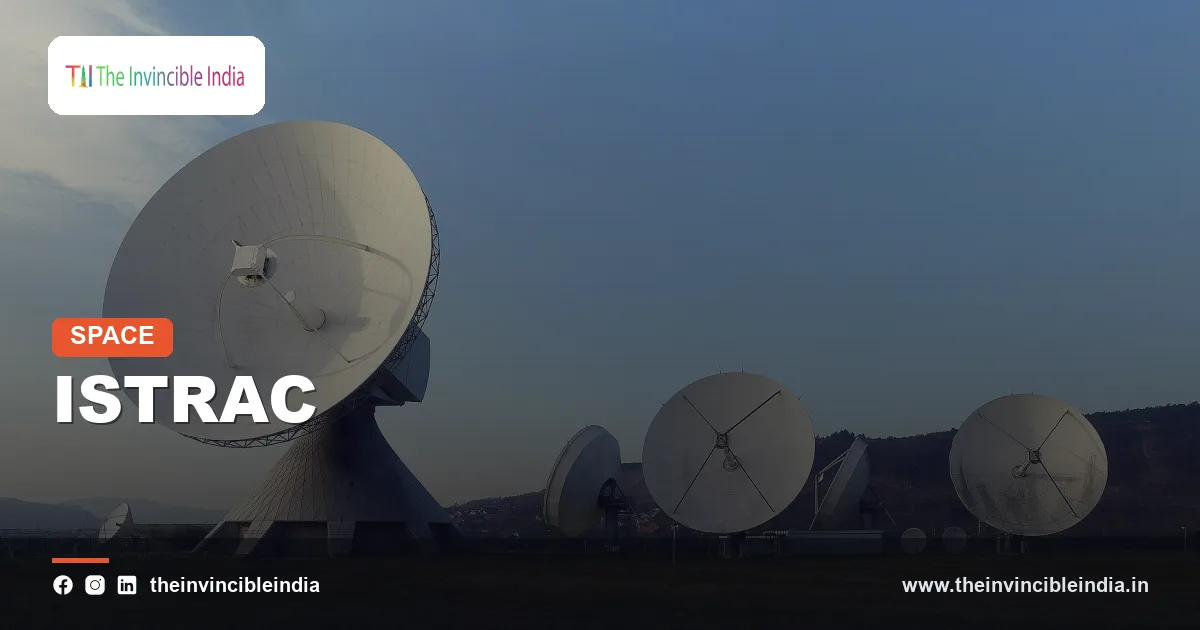
ISTRAC, the ISRO Telemetry, Tracking and Command Network, is the Indian Space Research Organisation (ISRO) unit headquartered in Bengaluru that tracks launch vehicles, monitors and controls satellites through a network of ground stations, and supports deep-space missions such as Chandrayaan and the Mars Orbiter Mission. It provides the radio link between spacecraft and the people who operate them, and without that link a satellite would be an uncontrollable object in orbit.
ISTRAC operates tracking stations across India and at overseas locations, runs the Mission Operations Complex that controls many of India’s low-Earth-orbit satellites, and manages the Indian Deep Space Network at Byalalu near Bengaluru. This explainer describes what the organisation does, how its network is laid out and why it matters to every Indian space mission.
Quick Facts: ISTRAC
| Full name | ISRO Telemetry, Tracking and Command Network (ISTRAC) |
|---|---|
| Parent organisation | Indian Space Research Organisation (ISRO), Department of Space, Government of India |
| Headquarters | Peenya, Bengaluru, Karnataka |
| Established | 1976, growing from tracking arrangements made in the early 1970s |
| Core functions | Telemetry, tracking and command; mission operations; navigation and data reception |
| Ground stations | Bengaluru, Sriharikota, Lucknow, Port Blair, Thiruvananthapuram and others in India; overseas stations such as Mauritius, Brunei and Biak (Indonesia) |
| Deep space facility | Indian Deep Space Network (IDSN), Byalalu, near Bengaluru, with large dish antennas |
| Missions supported | Launch vehicles, Earth observation satellites, Chandrayaan, Mangalyaan (Mars Orbiter Mission), AstroSat |
Key Takeaways
- ISTRAC, headquartered in Bengaluru, is the ISRO network responsible for telemetry, tracking and command of Indian launch vehicles and satellites.
- The Mission Operations Complex of ISTRAC operates a large part of India’s low-Earth-orbit satellite fleet, including many Earth observation missions.
- The Indian Deep Space Network at Byalalu, near Bengaluru, uses large dish antennas to communicate with spacecraft travelling to the Moon and Mars.
- ISTRAC stations outside India, in places such as Mauritius, Brunei and Indonesia, allow tracking of launches and satellites when they pass over areas far from the Indian mainland.
- Control of satellites in geostationary orbit is handled mainly by a different ISRO facility, the Master Control Facility at Hassan in Karnataka.
- ISTRAC played a central role in the Chandrayaan-1, Mars Orbiter Mission and Chandrayaan-3 operations.
What is ISTRAC?
ISTRAC is the ISRO unit that provides tracking, telemetry and command support for launch vehicles and satellites. Its full name, the ISRO Telemetry, Tracking and Command Network, describes the three services it performs.
- Telemetry: receiving data from a spacecraft that report its health, such as temperatures, voltages and fuel pressure.
- Tracking: measuring the position and velocity of a spacecraft, normally by recording radio signal ranges and Doppler shifts, so that its orbit can be calculated.
- Command: sending radio instructions to a spacecraft to change its orientation, fire thrusters, switch instruments on or off or alter its orbit.
Together these functions are sometimes grouped as TT&C. ISTRAC also receives data from remote-sensing satellites, and it has developed software used for flight dynamics, mission planning and orbit determination.
Where is ISTRAC headquartered and how is it organised?
ISTRAC is headquartered in Peenya, a locality in the north of Bengaluru, and its operations are spread across a network of stations and control centres. The headquarters houses the Mission Operations Complex, usually shortened to MOX, which is the nerve centre for the satellites that ISTRAC controls.
The organisation is made up of several functional parts.
- Mission Operations Complex (MOX): where operations teams plan activities and send commands during satellite passes.
- Ground stations: antennas and receivers at fixed sites that track and communicate with passing satellites.
- Indian Deep Space Network: large antennas used for the Moon, Mars and beyond.
- Flight dynamics and software groups: specialists who compute orbits, predict passes and plan manoeuvres.
The unit reports to ISRO and provides services to the other centres that build the vehicles and satellites.
How did ISTRAC begin?
ISTRAC began in the 1970s as India’s first satellites required a dedicated tracking network, and it was formally established in 1976. At first, ISRO relied on foreign facilities and a few improvised stations. India’s first satellite, Aryabhata, launched in April 1975 on a Soviet rocket, was tracked with the help of stations in India and abroad.
As the Indian space programme matured, ISRO needed its own continuing network, particularly for the Indian Remote Sensing satellites of the late 1980s and for the PSLV, which began flying in the 1990s. Over several decades the network has expanded in step with Indian space ambitions.
| Period | Development |
|---|---|
| 1975 | Aryabhata, India’s first satellite, supported by early tracking arrangements |
| 1976 | ISTRAC formally set up in Bengaluru |
| 1980s to 1990s | Network expanded for Indian Remote Sensing satellites and the PSLV |
| 2008 | Indian Deep Space Network commissioned for Chandrayaan-1 |
| 2013 to 2014 | Mars Orbiter Mission launched and placed in orbit around Mars |
| 2019 and 2023 | Chandrayaan-2 and Chandrayaan-3 mission operations |
How does satellite tracking work?
Satellite tracking works by using radio signals exchanged between a ground antenna and a spacecraft to measure the spacecraft’s distance and velocity, from which its orbit is calculated. This is the basic principle behind the work of ISTRAC.
A ground station sends a signal to the satellite, which returns it through a transponder. The time the signal takes gives the range, and the shift in its frequency, the Doppler effect, gives the speed along the line of sight. Combining several measurements over a pass allows flight dynamics software to determine where the satellite is and where it will be.
A satellite in low Earth orbit passes over a given ground station for only a few minutes at a time, and some passes are out of range altogether. This is why a network of stations is needed, rather than a single dish. Operators plan each pass in advance, uplinking commands and downlinking stored data within the brief contact window.
Which ground stations does ISTRAC operate?
ISTRAC operates ground stations within India and at overseas locations that extend the network’s reach. Placing stations at different longitudes and latitudes increases the amount of time that a satellite or rocket is in view.
Stations in India
- Bengaluru, which hosts the headquarters and the main control complex.
- Sriharikota, near the launch site, which tracks launch vehicles in the first minutes of flight.
- Lucknow in Uttar Pradesh, Port Blair in the Andaman and Nicobar Islands and Thiruvananthapuram in Kerala, among other sites.
Stations abroad
Overseas stations have included sites in Mauritius, Brunei and Biak in Indonesia, and ISTRAC has also used facilities in other countries through cooperation agreements. These stations are valuable during launches because a rocket often travels beyond the horizon of Indian stations soon after lift-off. Ships fitted with tracking equipment have additionally been used at times to cover gaps in the ground network. Exact station lists change from time to time as equipment is upgraded and agreements evolve.
What is the Indian Deep Space Network?
The Indian Deep Space Network (IDSN) is ISRO’s set of large antennas at Byalalu, about 40 kilometres from Bengaluru, used to communicate with spacecraft far beyond Earth orbit. It was set up in 2008 to support Chandrayaan-1, India’s first lunar mission, and it is operated by ISTRAC.
Deep-space communication is demanding because signals weaken rapidly with distance. A spacecraft near Mars is tens of millions of kilometres away, and the radio signal takes several minutes to cross that distance. To receive such faint signals, the network uses very large dish antennas of 18 metres and 32 metres in diameter, with sensitive receivers and powerful transmitters.
The Byalalu site, whose official name is the Indian Deep Space Network complex, has served as the principal facility for the Indian lunar and Mars missions. It also hosts a navigation control centre for the Indian regional satellite navigation system, NavIC. For distant phases of missions, ISRO has also arranged to use partner networks, including NASA’s Deep Space Network and the European Space Agency’s tracking stations, as backup.
How did ISTRAC support Chandrayaan and Mangalyaan?
ISTRAC supported the Chandrayaan and Mangalyaan missions by tracking the spacecraft, controlling their orbit changes and receiving their scientific data. In each mission, the Mission Operations Complex in Bengaluru was the main control room.
- Chandrayaan-1 (2008): India’s first lunar orbiter, tracked through the newly commissioned deep space antenna at Byalalu.
- Mars Orbiter Mission or Mangalyaan (launched November 2013): India’s first interplanetary probe. Controllers conducted a series of engine burns to move it away from Earth, and it entered Martian orbit on 24 September 2014, making India the first Asian country to reach Mars orbit and the first in the world to do so on its first attempt.
- Chandrayaan-2 (2019): an orbiter, lander and rover; the orbiter continues to operate while the lander lost contact during descent.
- Chandrayaan-3 (2023): the lander Vikram soft-landed near the lunar south pole on 23 August 2023. ISTRAC handled the tracking of the spacecraft through its journey and landing.
The long communication delays in deep space mean that spacecraft must carry out critical manoeuvres, such as lunar landing, by following sequences programmed in advance, with ground staff monitoring and ready to intervene where the delay permits.
What is the difference between ISTRAC and the Master Control Facility?
ISTRAC mainly controls low-Earth-orbit satellites, launch vehicles and deep-space probes, whereas the Master Control Facility (MCF) at Hassan in Karnataka controls ISRO’s geostationary satellites. Both belong to ISRO but serve different orbit regimes.
| Feature | ISTRAC | Master Control Facility (MCF) |
|---|---|---|
| Location | Bengaluru, with stations nationwide and abroad | Hassan, Karnataka (with a second site at Bhopal) |
| Main orbit types | Low Earth orbit, launch phase, deep space | Geostationary orbit |
| Typical satellites | Remote-sensing satellites, scientific missions | INSAT and GSAT communication satellites |
| Contact with spacecraft | Short passes, several per day | Near-continuous, since satellite stays over one place |
The difference reflects physics: a geostationary satellite stays fixed over one longitude, so one control site can contact it continuously, while a low-orbit satellite is visible to any given station for only a few minutes per pass.
Why is ISTRAC important for Indian space missions?
ISTRAC is important because every launch and every satellite depends on a reliable communication link with the ground. It forms the operational backbone of the Indian space programme, in the same way that air traffic control is the backbone of aviation.
- Launch safety: during a launch, tracking data tells range safety officers and mission controllers whether the rocket is following its planned path.
- Satellite health: telemetry allows engineers to detect and correct problems early, extending satellite lifetimes.
- Data delivery: remote-sensing images are received by stations and passed on to users in agriculture, disaster management and mapping.
- Exploration: the deep space network makes interplanetary missions possible.
- Future programmes: the Gaganyaan human spaceflight programme and a planned Indian space station will need continuous, highly reliable tracking and communication.
How does ISTRAC handle a launch day?
On a launch day, ISTRAC provides continuous tracking of the rocket from lift-off until the satellite is injected into its orbit and has begun to transmit its own signals. The work begins hours before the countdown ends, when stations are configured and tested.
- Pre-launch checks: the stations at Sriharikota and elsewhere confirm that antennas, receivers and data links are working.
- Lift-off and ascent: radars and telemetry receivers at the launch site follow the rocket as it climbs, relaying position and health data to the control room.
- Downrange tracking: as the rocket moves away from India, overseas stations and sometimes ship-borne terminals take over the tracking.
- Satellite separation: the satellite is released into its planned orbit and its own transmitter is switched on.
- Acquisition of signal: a ground station picks up the satellite’s signal and the Mission Operations Complex confirms that the satellite is alive and stable.
In the days that follow, controllers deploy solar panels and antennas, test the instruments and, for satellites that need to reach a higher orbit, carry out a series of engine burns. After this commissioning phase, the satellite settles into a routine of daily passes, and the network continues to monitor and command it for the rest of its working life, which may last many years.
What is the future of ISTRAC?
The future of ISTRAC lies in expanding its capacity for deep-space, human spaceflight and space-safety operations. Several developments are under way or under discussion.
- Additional and larger antennas for deep-space communication, to support more distant missions.
- Network upgrades to support Gaganyaan, which needs tracking over the entire flight of a crew vehicle.
- Greater use of data relay satellites, which relay signals from low-orbit spacecraft to the ground without a need for many stations.
- Growth in commercial and private sector satellite services as the space sector opens to private companies through the Indian National Space Promotion and Authorization Centre (IN-SPACe).
- Monitoring of space debris and collisions risks through ISRO’s space situational awareness efforts.
Bottom Line
ISTRAC is the quiet enabler of Indian space missions: the network that listens to rockets and satellites and sends them commands. From Aryabhata to Chandrayaan-3, its stations and control centre have been the link between Indian engineers and their spacecraft. Last reviewed: 17 October 2026.
Frequently Asked Questions
What is ISTRAC?
ISTRAC, the ISRO Telemetry, Tracking and Command Network, is the ISRO unit that tracks launch vehicles and controls satellites from ground stations. It is headquartered in Bengaluru and was formally set up in 1976. It also runs the Indian Deep Space Network at Byalalu.
Where is ISTRAC headquartered?
ISTRAC is headquartered at Peenya in Bengaluru, Karnataka. The headquarters hosts the Mission Operations Complex, from which many satellites are controlled. Its ground stations are spread across India and overseas.
What is the Indian Deep Space Network?
The Indian Deep Space Network (IDSN) is a facility of large dish antennas at Byalalu near Bengaluru that communicates with spacecraft far from Earth. It was commissioned in 2008 for Chandrayaan-1 and also supported the Mars Orbiter Mission and later lunar missions. ISTRAC operates it.
Which missions has ISTRAC supported?
ISTRAC has supported launch vehicle flights, Earth observation satellites and scientific missions such as AstroSat. It was also central to the deep-space missions Chandrayaan-1, the Mars Orbiter Mission, Chandrayaan-2 and Chandrayaan-3. Mission operations for these were run from Bengaluru.
Does ISTRAC have ground stations outside India?
Yes, ISTRAC operates or uses ground stations overseas, including sites in Mauritius, Brunei and Biak in Indonesia. These stations track launches and satellites when they are beyond the range of Indian stations. Exact arrangements may change over time.
How is ISTRAC different from the Master Control Facility?
ISTRAC mainly handles low-Earth-orbit satellites, launch vehicles and deep-space missions, while the Master Control Facility in Hassan controls geostationary communication satellites. A geostationary satellite stays over one location and can be contacted continuously. A low-orbit satellite is visible to a station for only minutes per pass.
{“@context”:”https://schema.org”,”@graph”:[{“@type”:”FAQPage”,”mainEntity”:[{“@type”:”Question”,”name”:”What is ISTRAC?”,”acceptedAnswer”:{“@type”:”Answer”,”text”:”ISTRAC, the ISRO Telemetry, Tracking and Command Network, is the ISRO unit that tracks launch vehicles and controls satellites from ground stations. It is headquartered in Bengaluru and was formally set up in 1976. It also runs the Indian Deep Space Network at Byalalu.”}},{“@type”:”Question”,”name”:”Where is ISTRAC headquartered?”,”acceptedAnswer”:{“@type”:”Answer”,”text”:”ISTRAC is headquartered at Peenya in Bengaluru, Karnataka. The headquarters hosts the Mission Operations Complex, from which many satellites are controlled. Its ground stations are spread across India and overseas.”}},{“@type”:”Question”,”name”:”What is the Indian Deep Space Network?”,”acceptedAnswer”:{“@type”:”Answer”,”text”:”The Indian Deep Space Network (IDSN) is a facility of large dish antennas at Byalalu near Bengaluru that communicates with spacecraft far from Earth. It was commissioned in 2008 for Chandrayaan-1 and also supported the Mars Orbiter Mission and later lunar missions. ISTRAC operates it.”}},{“@type”:”Question”,”name”:”Which missions has ISTRAC supported?”,”acceptedAnswer”:{“@type”:”Answer”,”text”:”ISTRAC has supported launch vehicle flights, Earth observation satellites and scientific missions such as AstroSat. It was also central to the deep-space missions Chandrayaan-1, the Mars Orbiter Mission, Chandrayaan-2 and Chandrayaan-3. Mission operations for these were run from Bengaluru.”}},{“@type”:”Question”,”name”:”Does ISTRAC have ground stations outside India?”,”acceptedAnswer”:{“@type”:”Answer”,”text”:”Yes, ISTRAC operates or uses ground stations overseas, including sites in Mauritius, Brunei and Biak in Indonesia. These stations track launches and satellites when they are beyond the range of Indian stations. Exact arrangements may change over time.”}},{“@type”:”Question”,”name”:”How is ISTRAC different from the Master Control Facility?”,”acceptedAnswer”:{“@type”:”Answer”,”text”:”ISTRAC mainly handles low-Earth-orbit satellites, launch vehicles and deep-space missions, while the Master Control Facility in Hassan controls geostationary communication satellites. A geostationary satellite stays over one location and can be contacted continuously. A low-orbit satellite is visible to a station for only minutes per pass.”}}]}]}


