

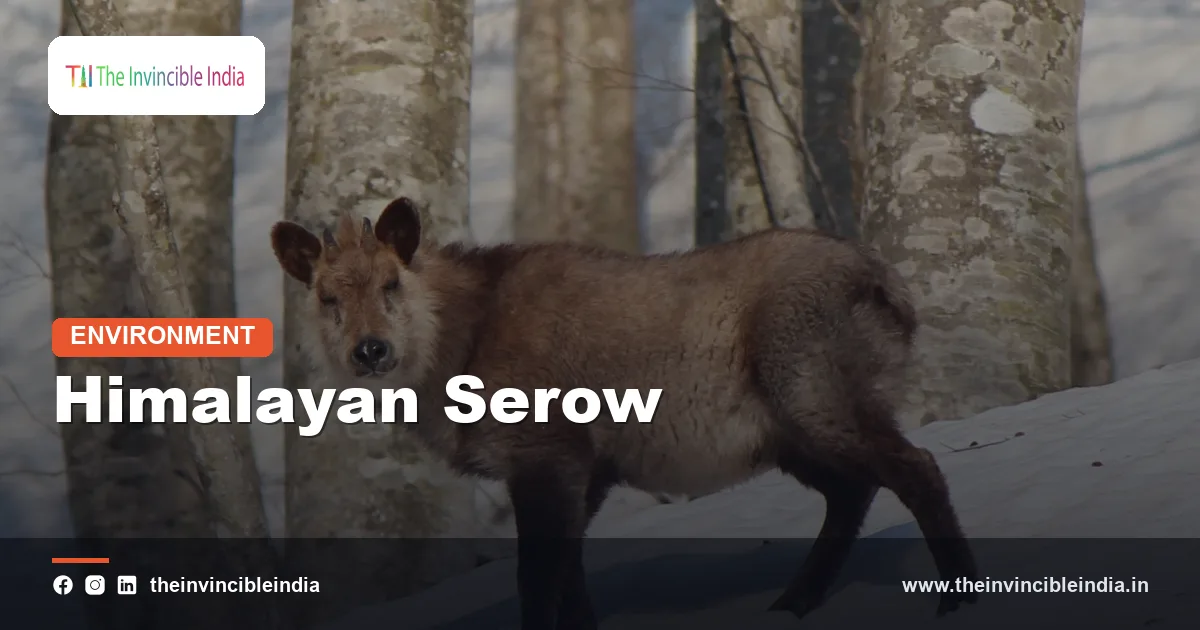
The Himalayan serow (Capricornis thar) is a heavily built, mostly solitary goat-antelope that lives in steep, forested and rocky terrain across the Himalayan mountains, from Himachal Pradesh in India eastwards through Nepal and Bhutan to Arunachal Pradesh. With its dark coat, shaggy mane, long donkey-like ears and short, pointed horns, the serow looks like a cross between a goat, a deer and a mule, and it is one of the most elusive large mammals of the Himalayan middle hills.
This explainer covers how to identify the Himalayan serow, where it is found, how it lives, why it is sometimes confused with the Mishmi takin and other mountain ungulates, the threats it faces, and the legal and practical protection it receives in India. Last updated: 17 October 2026.
| Attribute | Detail |
|---|---|
| Common names | Himalayan serow, Himalayan thar (the term “thar” is also used for unrelated animals, which can cause confusion) |
| Scientific name | Capricornis thar (earlier treated as a subspecies of the mainland serow, Capricornis sumatraensis) |
| Group | Goat-antelope in the family Bovidae, related to the gorals, the takin and the wild goats and sheep |
| Size | A large goat-antelope, often reaching about 90 to 100 centimetres at the shoulder and weighing around 100 kilograms or more |
| Horns | Short, slightly curved, pointed horns in both sexes |
| Habitat | Steep forested slopes, ravines and rocky outcrops, commonly in the temperate and subtropical hill zone |
| Range | Himalayan belt from Himachal Pradesh and Uttarakhand through Nepal, Sikkim and Bhutan to Arunachal Pradesh; also reported in neighbouring countries |
| Social habits | Mostly solitary; occasionally seen in pairs or a mother with a young one |
| Conservation concern | Serows are treated as a group of conservation concern by the IUCN (the mainland serow complex is listed as Vulnerable); check the latest IUCN entry for the Himalayan serow |
| Legal protection in India | Protected under the Wildlife (Protection) Act, 1972 in a high protection schedule; hunting is prohibited |
Key Takeaways
- The Himalayan serow (Capricornis thar) is a large, solitary goat-antelope with a dark coat, a shaggy neck mane, long ears and short pointed horns.
- The Himalayan serow lives on steep forested and rocky Himalayan slopes and uses regular trails and sheltered overhangs for resting.
- The Himalayan serow is much heavier than the Himalayan goral, and it differs from the Mishmi takin of Arunachal Pradesh, which is a larger, herd-forming goat-antelope with a different build.
- Hunting for meat and for body parts used in traditional remedies, along with forest loss and snaring, are the principal threats to the Himalayan serow.
- The Himalayan serow is protected by the Wildlife (Protection) Act, 1972 in India, and its population size is not well known, so any figures should be treated as estimates.
- The Himalayan serow is secretive and active at dawn, dusk and night, which is why camera traps have become a key tool for recording its presence.
What is the Himalayan serow?
The Himalayan serow is a medium-large, goat-like mammal in the subfamily of the goat-antelopes that is adapted to rugged forested mountains. The word serow is believed to derive from a local Lepcha term, and the generic name Capricornis combines Latin words for goat and horn.
The animal has a stocky body, a thick neck and relatively short, strong legs. The coat is coarse and mostly black to dark grey, with a paler, reddish or whitish tinge on the lower legs and sometimes on the throat. A short mane of longer hair runs from the head along the neck and back. The ears are long and pointed, and there are large pits in front of the eyes, which are scent glands that may open when the animal is excited or marking territory. Both sexes have short, curved horns that rise from the head.
Scientists have debated how many serow species exist. Several forms once grouped within the mainland serow are now treated as separate species by many authorities, and the Himalayan form is often called Capricornis thar. Readers should note that the exact classification can differ between sources.
Where does the Himalayan serow live?
The Himalayan serow lives in the Himalayan hills of northern and north-eastern India, in steep, forested terrain that is often too rugged for farming. It has been recorded in states such as Himachal Pradesh, Uttarakhand, Sikkim, West Bengal’s northern hills and Arunachal Pradesh, and it also occurs in Nepal and Bhutan.
Within India, the animal is reported from protected areas such as Great Himalayan National Park in Himachal Pradesh, sections of the Kedarnath and Nanda Devi landscapes in Uttarakhand, and forests in Sikkim and Arunachal Pradesh. It typically uses mid-elevation broadleaf and mixed forest, bamboo thickets and ravines, and moves higher in summer and lower in winter in some areas.
The serow depends on a mix of dense cover and rocky outcrops. It prefers forest on steep slopes with overhanging rocks, boulders or caves where it can shelter from rain and snow. Because such sites occur in small patches, serow density is usually low, and the species is rarely seen by casual visitors.
How does the Himalayan serow behave?
The Himalayan serow is a shy, mostly solitary animal that moves along established trails, is active at dawn and dusk, and often rests during the day in sheltered spots. Males and females generally live apart, meeting mainly during the breeding season.
Serows use regular routes between feeding areas and shelter, which leave visible tracks on steep slopes. They also keep to defined home ranges, marking them with secretions from the glands in front of the eyes and with dung piles. The animals can be bold when cornered and may defend themselves with their horns, but they usually flee along cliffs and through dense vegetation.
The alarm call is a loud snort or whistle, similar to that of other goat-antelopes. Serows are known to stay motionless when disturbed, relying on their dark coat and thick cover to remain unseen. Observers on steep forest trails often hear the call before they see the animal, if they see it at all.
What does the Himalayan serow eat?
The Himalayan serow eats leaves, shoots, twigs, shrubs, ferns, grasses and fruits, so it is mainly a browser. It feeds on a wide range of plants, depending on what is available in each season and on each slope.
During the monsoon, when vegetation is abundant, the serow takes tender leaves and herbs, and in winter it relies more on woody browse and dry material. The animal chews cud, as all ruminants do, and it commonly feeds near cover so that it can retreat quickly. By browsing, the serow influences the growth of shrubs and saplings in the forest understorey, although its effects are small because of low density.
Seasonal movements to follow food and avoid deep snow are reported in some regions, although the detail is not well documented. Studies that rely on camera traps and dung surveys continue to add information on the diet and habitat use of the animal.
How does the Himalayan serow breed?
The Himalayan serow breeds once a year, usually mating in autumn, and a single kid is typically born after a gestation of roughly seven to eight months. The timing of births in spring or early summer allows the young to benefit from new vegetation.
The young animal stays with its mother for several months and learns the routes and shelters in her home range. Serows in captivity have been recorded living for around a decade or longer, while the lifespan in the wild is not well documented and is shortened by hunting and predation. The slow reproductive rate, with one young per year, means that populations recover slowly when numbers are depleted by hunting.
Natural predators include the leopard, the dhole and, in some areas, the tiger or the snow leopard, although adult serows are formidable prey because of their size and their ability to use steep ground. Young animals are more vulnerable.
How is the Himalayan serow different from the Mishmi takin and other mountain ungulates?
The Himalayan serow is different from the Mishmi takin because the serow is a solitary, dark, mane-bearing animal of about 100 kilograms, while the Mishmi takin (a subspecies of the takin, Budorcas taxicolor) is a much larger, heavier goat-antelope that lives in herds in the high forests and bamboo of Arunachal Pradesh. People sometimes confuse them because both are heavy, dark Himalayan goat-antelopes that live in the same eastern ranges.
| Feature | Himalayan serow | Mishmi takin | Himalayan goral |
|---|---|---|---|
| Size | Large, around 100 kg or more | Very large and thickset, usually heavier than the serow | Small, around 20 to 35 kg |
| Social behaviour | Mostly solitary | Often in herds, especially in summer | Small family groups |
| Horns | Short, slightly curved, pointed | Thick, with a distinct outward and upward hooked shape | Short and backward-curving |
| Distinctive look | Long ears, shaggy mane, dark coat | Heavy-bodied, humped muzzle, dark coat in the Mishmi form | Grey-brown coat and pale throat |
| Typical habitat | Steep forest and rocky outcrops at mid-elevations | High-altitude forest, bamboo and rhododendron scrub | Open, rocky grassy slopes |
The takin is not a close relative of the serow in everyday terms, although both belong to the goat-antelope group. For anyone reading field reports, the key rule is that the Mishmi takin is mostly an Arunachal Pradesh animal at higher elevation, while the Himalayan serow has a wider distribution along the hills and can be encountered at lower elevations.
What threatens the Himalayan serow?
The Himalayan serow is threatened mainly by hunting, snaring, habitat loss and fragmentation, and the loss of forest cover on steep slopes. Because the animal is solitary and has a low birth rate, localised hunting can reduce its numbers quickly.
- Hunting for meat: The serow is large and yields a lot of meat, making it a target in areas where subsistence hunting continues.
- Use of body parts: In parts of Asia, serow parts are used in traditional remedies, creating a market for illegal trade.
- Snares and traps: Wire snares set for other animals can injure or kill serows, which follow predictable trails.
- Forest loss: Logging, road construction, landslides, hydropower and farmland expansion reduce and fragment steep forest habitat.
- Dogs and disturbance: Free-ranging dogs and human activity near forest edges can drive animals out of their ranges.
The numbers of the Himalayan serow are not precisely known. Because the animal is shy and lives at low density in difficult terrain, survey results vary, and reports of the animal’s status in particular valleys should be considered local snapshots instead of national totals.
Is the Himalayan serow protected in India?
Yes, the Himalayan serow is protected in India by the Wildlife (Protection) Act, 1972, which prohibits hunting and trade in the species, with penalties for violations. The serow has been placed in a high protection schedule of the Act, though the schedules were reorganised by later amendments, and readers should check the current text for the exact listing.
Serows are also covered by international wildlife controls. They are included in listings under the Convention on International Trade in Endangered Species of Wild Fauna and Flora (CITES), and the IUCN treats the serow group as one of conservation concern, with the mainland serow complex classed as Vulnerable. The precise status of the Himalayan serow as a distinct species should be checked on the IUCN Red List and the CITES website.
In practice, protection depends on state forest departments, national parks and sanctuaries, and community vigilance. Many serow records come from within protected areas, which suggests that these reserves act as important refuges for the species.
How can the Himalayan serow be conserved?
The Himalayan serow can be conserved by protecting steep forest habitat, removing snares, reducing hunting and improving monitoring with camera traps and community reporting. Since the animal is elusive, long-term field data are the foundation of effective management.
- Protect forest and rock habitat: Maintain intact slopes with cover and overhangs, and keep corridors between protected areas.
- Snare removal and patrolling: Regular patrols, often with community participation, to find and remove traps.
- Camera-trap monitoring: Use of remote cameras to estimate occupancy and detect trends, which is more reliable than direct sightings.
- Community engagement: Awareness and livelihood programmes in hill villages so that residents have a reason to support wildlife protection.
- Research on genetics and taxonomy: Studies to clarify how many distinct serow species exist, so that conservation plans target the right populations.
Institutions such as the Wildlife Institute of India and state forest departments have contributed to surveys of Himalayan ungulates. Greater coverage of the middle-elevation forests, which lie outside the main protected areas, would help determine where the serow is declining and where it remains stable.
Why does the Himalayan serow matter?
The Himalayan serow matters because it is a large herbivore and a prey species that helps maintain healthy forest ecosystems on steep Himalayan slopes. Its presence indicates relatively undisturbed forest and rocky habitat.
As a large prey animal, the serow supports predators such as the leopard and the dhole, and its browsing contributes to the structure of the understorey. Its status is also a measure of how well middle-hill forests are being managed, since these slopes are often lost to development before they receive formal protection. The animal’s elusive nature has also made it a symbol of the hidden biodiversity of the Himalaya.
Bottom Line
The Himalayan serow is a large, shy goat-antelope of steep Himalayan forests, easily told apart from the smaller goral and the herd-forming Mishmi takin. It is legally protected in India but still faces hunting, snaring and forest loss, and better monitoring is needed to understand how many remain.
Frequently Asked Questions
What is a Himalayan serow?
A Himalayan serow is a large, mostly solitary goat-antelope (Capricornis thar) that lives in steep forests of the Himalaya. It has a dark coat, a shaggy mane, long ears and short, pointed horns in both sexes. It is a browser that feeds on leaves, shoots and shrubs.
Where does the Himalayan serow live in India?
The Himalayan serow lives in the Himalayan hills of states such as Himachal Pradesh, Uttarakhand, Sikkim and Arunachal Pradesh. It prefers steep, forested slopes with rocky outcrops at mid-elevations. Because it is shy and lives at low density, it is rarely seen by visitors.
Is the Himalayan serow the same as the Mishmi takin?
No, the Himalayan serow and the Mishmi takin are different animals. The serow is a solitary, dark, mane-bearing animal of about 100 kilograms, while the Mishmi takin is a larger, heavier, herd-forming goat-antelope of high forests in Arunachal Pradesh. Both are goat-antelopes, which is why they are sometimes confused.
Is the Himalayan serow endangered?
The Himalayan serow is regarded as a species of conservation concern, and the broader serow group is listed by the IUCN as Vulnerable. Exact population numbers are not known. Readers should check the latest IUCN Red List entry for the Himalayan serow specifically.
What do Himalayan serows eat?
Himalayan serows eat leaves, shoots, twigs, ferns, grasses and fruits, making them mainly browsers. They change their diet with the seasons, relying on fresh growth in the monsoon and woody browse in winter. They feed mostly at dawn and dusk and stay close to cover.
Is hunting the Himalayan serow illegal in India?
Yes, hunting the Himalayan serow is illegal in India under the Wildlife (Protection) Act, 1972, except under narrow legal exemptions. The animal is placed in a high protection schedule, and trade in its parts is prohibited. Suspected poaching should be reported to the state forest or wildlife department.
{“@context”:”https://schema.org”,”@graph”:[{“@type”:”FAQPage”,”mainEntity”:[{“@type”:”Question”,”name”:”What is a Himalayan serow?”,”acceptedAnswer”:{“@type”:”Answer”,”text”:”A Himalayan serow is a large, mostly solitary goat-antelope (Capricornis thar) that lives in steep forests of the Himalaya. It has a dark coat, a shaggy mane, long ears and short, pointed horns in both sexes. It is a browser that feeds on leaves, shoots and shrubs.”}},{“@type”:”Question”,”name”:”Where does the Himalayan serow live in India?”,”acceptedAnswer”:{“@type”:”Answer”,”text”:”The Himalayan serow lives in the Himalayan hills of states such as Himachal Pradesh, Uttarakhand, Sikkim and Arunachal Pradesh. It prefers steep, forested slopes with rocky outcrops at mid-elevations. Because it is shy and lives at low density, it is rarely seen by visitors.”}},{“@type”:”Question”,”name”:”Is the Himalayan serow the same as the Mishmi takin?”,”acceptedAnswer”:{“@type”:”Answer”,”text”:”No, the Himalayan serow and the Mishmi takin are different animals. The serow is a solitary, dark, mane-bearing animal of about 100 kilograms, while the Mishmi takin is a larger, heavier, herd-forming goat-antelope of high forests in Arunachal Pradesh. Both are goat-antelopes, which is why they are sometimes confused.”}},{“@type”:”Question”,”name”:”Is the Himalayan serow endangered?”,”acceptedAnswer”:{“@type”:”Answer”,”text”:”The Himalayan serow is regarded as a species of conservation concern, and the broader serow group is listed by the IUCN as Vulnerable. Exact population numbers are not known. Readers should check the latest IUCN Red List entry for the Himalayan serow specifically.”}},{“@type”:”Question”,”name”:”What do Himalayan serows eat?”,”acceptedAnswer”:{“@type”:”Answer”,”text”:”Himalayan serows eat leaves, shoots, twigs, ferns, grasses and fruits, making them mainly browsers. They change their diet with the seasons, relying on fresh growth in the monsoon and woody browse in winter. They feed mostly at dawn and dusk and stay close to cover.”}},{“@type”:”Question”,”name”:”Is hunting the Himalayan serow illegal in India?”,”acceptedAnswer”:{“@type”:”Answer”,”text”:”Yes, hunting the Himalayan serow is illegal in India under the Wildlife (Protection) Act, 1972, except under narrow legal exemptions. The animal is placed in a high protection schedule, and trade in its parts is prohibited. Suspected poaching should be reported to the state forest or wildlife department.”}}]}]}


