

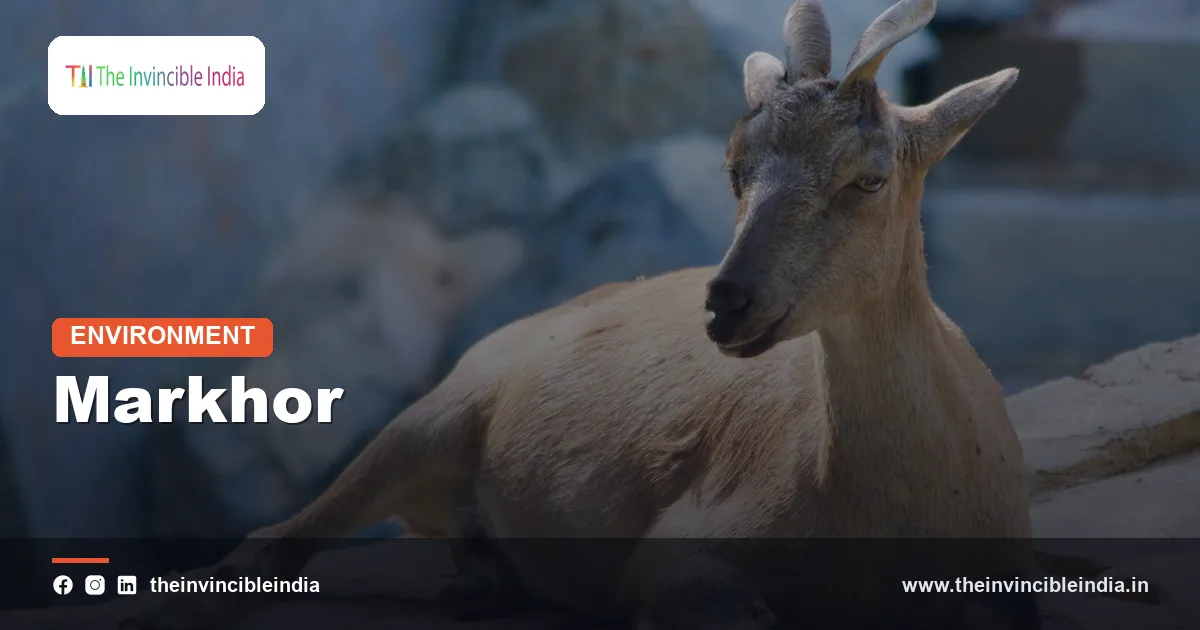
The markhor (Capra falconeri) is a large wild goat with spectacular corkscrew horns that lives on rugged mountain cliffs of Central and South Asia, and in India it survives only in small, scattered populations in the Pir Panjal range of Jammu and Kashmir, including Kazinag National Park and Hirapora Wildlife Sanctuary. Because the Indian markhor is the eastern fringe of a mainly Pakistani and Afghan distribution, India’s few animals are of high conservation importance.
This explainer covers what the markhor is, how its spiral horns and cliff habit make it distinctive, where it lives in Jammu and Kashmir, how many are believed to remain, what threatens it, how the Indian and international legal framework protects it, and what conservation approaches are being used. Last updated: 17 October 2026.
| Attribute | Detail |
|---|---|
| Common name | Markhor; in Kashmir, the Pir Panjal form is called the Kashmir markhor |
| Scientific name | Capra falconeri; the Pir Panjal form is usually assigned to the subspecies Capra falconeri cashmiriensis |
| Group | Wild goat in the family Bovidae, genus Capra (the genus that includes ibexes and domestic goats) |
| Size | Large; males may stand about 90 to 115 centimetres at the shoulder and weigh around 80 to 110 kilograms, with females much smaller |
| Horns | Spiralling, corkscrew-shaped horns in both sexes, much longer in males, which may exceed a metre in length |
| Indian range | Pir Panjal range of Jammu and Kashmir, including Kazinag National Park, Hirapora Wildlife Sanctuary and adjoining forests |
| Habitat | Rocky cliffs, scrub forest and alpine slopes, moving between lower winter ranges and high summer pastures |
| IUCN status | Near Threatened in recent assessments after earlier listings as Endangered (check the latest IUCN Red List) |
| Legal protection in India | Protected under the Wildlife (Protection) Act, 1972 in a high protection schedule; listed in CITES Appendix I |
Key Takeaways
- The markhor (Capra falconeri) is a large wild goat with spiral, corkscrew-shaped horns that lives on steep, rocky mountainsides in Central and South Asia.
- In India, the markhor survives only in small populations in the Pir Panjal range of Jammu and Kashmir, including Kazinag National Park and Hirapora Wildlife Sanctuary.
- The markhor is protected in India under the Wildlife (Protection) Act, 1972 and is listed in Appendix I of CITES, which restricts international trade.
- Hunting for horns and meat, competition and disease from domestic livestock, and habitat disturbance are the chief threats to the markhor in India.
- Exact numbers of the Indian markhor are uncertain and are generally described as small, so population figures in news reports should be treated as approximate.
- The markhor is the national animal of Pakistan, where community-based conservation schemes have helped some populations to grow, offering lessons for India.
What is the markhor?
The markhor is a large, sturdy wild goat of dry, rocky mountains, known for the corkscrew twist of its horns and the shaggy mane and beard of adult males. The common name is often explained as coming from Persian words for “snake” and “eater”, a folk interpretation linked to stories that the animal kills snakes, although the true origin is uncertain.
The coat changes with the seasons. In summer it is short and fawn to reddish-grey, and in winter it grows thick, long and pale grey. Adult males have long hair hanging from the throat, chest and shoulders, giving a heavy-maned look. Females and young are smaller, with short, tightly twisted horns and a shorter beard.
Scientists recognise several forms of the markhor, which are variously treated as subspecies. They are named after regions in Pakistan, Afghanistan, Tajikistan and Uzbekistan, and after the Pir Panjal and Kashmir hills. The horns of the Kashmir form tend to be more open and flaring than the tight spirals seen in some others, but these differences are not always easy to apply in the field.
Why are the markhor’s horns so distinctive?
The markhor’s horns are distinctive because they twist like a corkscrew as they grow, forming a long spiral that can be well over a metre in adult males. Both males and females have horns, but those of males are far larger and are used in contests during the breeding season.
The horns grow continuously through the animal’s life and are never shed. Their spiral shape is a hallmark of the species, and it is the reason the markhor has long been prized by trophy hunters and, sadly, by illegal traders. During the rut, males rear up and clash horns, push against one another, and compete for access to females. The strongest males, with the biggest horns, usually succeed in mating.
The markhor is the national animal of Pakistan, and its horn has become a cultural symbol in the region. In India, the species is far less well known to the public, which is partly why it receives less attention than animals such as the snow leopard or the Kashmir stag (hangul).
Where does the markhor live in India?
The markhor lives in India only in the Pir Panjal range of Jammu and Kashmir, in a few forested and rocky pockets where it is present in small numbers. The best-known sites are Kazinag National Park in the Baramulla area and Hirapora Wildlife Sanctuary in the Shopian area, and it is also reported in forests and high slopes on the southern and western sides of the range.
Kazinag National Park protects steep conifer and mixed forest, cliffs and alpine pasture near the Line of Control, a landscape that also shelters the Himalayan musk deer, the Himalayan black bear, the Himalayan brown bear, the leopard and the Himalayan monal pheasant. Hirapora is part of the Pir Panjal landscape known for its markhor and for other wildlife including the Himalayan black bear.
These areas are geographically contiguous with the markhor’s range in neighbouring Pakistan-administered territory, which means the Indian population is part of a larger transboundary system. The security situation along the border has influenced access for surveys and field monitoring, and this is one reason why information about the animal in India is limited.
How does the markhor use its habitat through the year?
The markhor uses its habitat through seasonal movements, spending summer on high alpine and subalpine slopes and descending to lower forests and rocky ledges in winter. This altitudinal migration allows the animal to follow food and avoid deep snow.
Summer
In summer, the markhor grazes on grasses, herbs and flowering plants on high slopes, often above 3,000 metres. It rests on shaded ledges during the heat of the day and is most active in the early morning and evening.
Winter
In winter, it moves lower, to about 2,000 metres or below, where snow is thinner. It browses on shrubs, twigs, leaves and bark and sometimes takes oak and pine needles. The lower slopes overlap with areas used by people, so winter is also a time of greater risk from hunting and livestock.
Cliffs as refuge
The markhor depends on cliffs and steep ground as refuge from predators such as the leopard, the snow leopard and the wolf. Its hooves, like those of other wild goats, have a hard rim and a soft inner pad that give a strong grip on rock.
How many markhor are there in India?
Only a small number of markhor remain in India, with estimates for the Pir Panjal population generally described as being in the low hundreds at most and fewer at individual sites, although figures vary by survey and should be treated as approximate. Reliable counts are difficult because the animals live on remote cliffs and in border zones.
By contrast, the species as a whole has a much larger population in Pakistan and Afghanistan, and the global figure has risen in recent decades, prompting the IUCN to move the species from Endangered to Near Threatened. The Indian population remains vulnerable to local extinction because of its small size and isolation.
| Aspect | Situation in India | Situation in the wider range |
|---|---|---|
| Population size | Small and scattered; estimates uncertain | Larger, with growth reported in some community-managed areas in Pakistan |
| Main sites | Kazinag National Park, Hirapora Wildlife Sanctuary, Pir Panjal forests | Hills of Gilgit-Baltistan, Khyber Pakhtunkhwa, Balochistan, Afghanistan and Central Asia |
| Main management model | State-managed protected areas and forest department patrols | Mix of protected areas and, in Pakistan, community-based hunting-conservation schemes |
| Chief risk | Small size, poaching, livestock pressure | Poaching, habitat loss and conflict in some regions |
What threatens the markhor?
The markhor is threatened by hunting and poaching, competition and disease from domestic livestock, habitat disturbance and the small size of its populations. In India, each of these pressures is amplified because only a few groups remain.
- Poaching: The markhor is hunted for its horns, which are prized as trophies, and for its meat. Even a small number of animals killed can set back a small population.
- Livestock grazing: Large numbers of sheep, goats and cattle, many of them moved seasonally by herding communities such as the Bakarwals and Gujjars, compete with wild goats for pasture.
- Disease: Wild goats can contract infections from domestic sheep and goats, which has caused die-offs in some mountain regions.
- Habitat disturbance: Roads, tunnels, construction, military activity and forest degradation fragment habitat and disturb animals.
- Small population size: Isolated groups are susceptible to chance events, low genetic diversity and local extinction.
Conflict and border tension in the Pir Panjal region have, at various times, added further pressure by limiting patrols and monitoring. At the same time, restricted access in some areas has unintentionally given the animals a degree of protection from casual disturbance.
Is the markhor legally protected in India?
Yes, the markhor is legally protected in India under the Wildlife (Protection) Act, 1972, which places it in a high protection schedule and prohibits hunting and trade. As the Act has been amended, readers should check the current schedules for the exact listing, but the species has long been covered by the strictest protection.
The markhor is also listed in Appendix I of the Convention on International Trade in Endangered Species of Wild Fauna and Flora (CITES), which generally bans commercial international trade in the species and its parts. Some Pakistani populations are subject to specific quota arrangements for regulated trophy hunting, which is an exception to the usual Appendix I restrictions and is applied only under strict controls.
Enforcement in India is carried out by the Jammu and Kashmir Department of Wildlife Protection, with support from other agencies. Protected areas such as Kazinag National Park and Hirapora Wildlife Sanctuary provide the legal and administrative framework for patrolling and habitat management.
What conservation efforts support the markhor?
Conservation efforts for the markhor in India include protection of habitat in national parks and sanctuaries, patrolling against poaching, surveys and monitoring, and engagement with local communities. The aim is to stabilise the small population and then allow it to grow.
- Protected areas: Kazinag National Park and Hirapora Wildlife Sanctuary protect core habitat from clearing, hunting and some grazing.
- Surveys and monitoring: Field surveys, camera traps and population counts by the wildlife department and research bodies such as the Wildlife Institute of India help establish baselines.
- Livestock management: Regulating the movement of herds into core habitat and encouraging veterinary care for livestock to reduce disease risk.
- Community outreach: Working with villagers and pastoral communities, who are key to long-term success, through awareness and livelihood support.
- Transboundary learning: Studying approaches used in Pakistan, where community-based programmes such as those in Torghar and parts of Gilgit-Baltistan have been credited with helping some populations recover.
The Pakistani experience is debated, because it involves regulated trophy hunting whose proceeds are shared with local people. Supporters argue that it gives communities a reason to protect the animals, while critics worry about oversight and ethics. India has not adopted such a model, and its approach remains firmly based on strict protection.
Why does the markhor matter to India?
The markhor matters to India because it is a rare species at the edge of its range, an indicator of healthy cliff and forest ecosystems in the Pir Panjal, and a link between Indian and Central Asian mountain biodiversity. Losing it would remove a species that is found nowhere else in the country.
The animal also shares its landscape with other threatened Kashmiri wildlife, including the Himalayan musk deer, the Himalayan brown bear and the leopard, so efforts to protect the markhor tend to benefit the broader community of species. For local people, protecting the animals can go hand in hand with managing grazing, water and forest resources more sustainably.
Bottom Line
The markhor is a rare, cliff-dwelling wild goat whose Indian population is limited to a few small groups in the Pir Panjal of Jammu and Kashmir. It is protected by Indian law and by CITES, but poaching, livestock pressure and small population size continue to threaten it, so careful monitoring and community cooperation are essential.
Frequently Asked Questions
What is a markhor?
A markhor is a large wild goat (Capra falconeri) with corkscrew-shaped horns that lives on rocky mountain slopes in Central and South Asia. Males have a heavy beard and mane and horns that may exceed a metre in length. In India, it is found only in the Pir Panjal region of Jammu and Kashmir.
Where is the markhor found in India?
The markhor is found in India in the Pir Panjal range of Jammu and Kashmir, notably in Kazinag National Park and Hirapora Wildlife Sanctuary. It lives on steep, rocky, forested slopes and alpine pastures. The Indian population is small and is connected to a larger range across the border.
How many markhor are left in India?
Only a small number of markhor remain in India, with estimates generally described as being in the low hundreds at most and fewer at individual sites. Counts are difficult because the animals live on remote cliffs and near the border. Figures vary between surveys and should be treated as approximate.
Is the markhor endangered?
The markhor is currently assessed by the IUCN as Near Threatened globally, after earlier being classed as Endangered. The status reflects population growth in parts of its range, particularly Pakistan. The Indian population is small and isolated, so it remains at greater local risk than the global figure suggests.
Why is the markhor important to Pakistan and India?
The markhor is the national animal of Pakistan and is a symbol of the mountain regions of that country. In India, it is important as a rare species at the edge of its range, found only in the Pir Panjal of Jammu and Kashmir. Protecting it helps conserve a shared cliff and forest ecosystem across the border.
Is hunting the markhor illegal in India?
Yes, hunting the markhor is illegal in India under the Wildlife (Protection) Act, 1972, and the species is also covered by CITES Appendix I. Trade in its horns, skin or meat is prohibited. Suspected poaching should be reported to the Jammu and Kashmir Department of Wildlife Protection.
{“@context”:”https://schema.org”,”@graph”:[{“@type”:”FAQPage”,”mainEntity”:[{“@type”:”Question”,”name”:”What is a markhor?”,”acceptedAnswer”:{“@type”:”Answer”,”text”:”A markhor is a large wild goat (Capra falconeri) with corkscrew-shaped horns that lives on rocky mountain slopes in Central and South Asia. Males have a heavy beard and mane and horns that may exceed a metre in length. In India, it is found only in the Pir Panjal region of Jammu and Kashmir.”}},{“@type”:”Question”,”name”:”Where is the markhor found in India?”,”acceptedAnswer”:{“@type”:”Answer”,”text”:”The markhor is found in India in the Pir Panjal range of Jammu and Kashmir, notably in Kazinag National Park and Hirapora Wildlife Sanctuary. It lives on steep, rocky, forested slopes and alpine pastures. The Indian population is small and is connected to a larger range across the border.”}},{“@type”:”Question”,”name”:”How many markhor are left in India?”,”acceptedAnswer”:{“@type”:”Answer”,”text”:”Only a small number of markhor remain in India, with estimates generally described as being in the low hundreds at most and fewer at individual sites. Counts are difficult because the animals live on remote cliffs and near the border. Figures vary between surveys and should be treated as approximate.”}},{“@type”:”Question”,”name”:”Is the markhor endangered?”,”acceptedAnswer”:{“@type”:”Answer”,”text”:”The markhor is currently assessed by the IUCN as Near Threatened globally, after earlier being classed as Endangered. The status reflects population growth in parts of its range, particularly Pakistan. The Indian population is small and isolated, so it remains at greater local risk than the global figure suggests.”}},{“@type”:”Question”,”name”:”Why is the markhor important to Pakistan and India?”,”acceptedAnswer”:{“@type”:”Answer”,”text”:”The markhor is the national animal of Pakistan and is a symbol of the mountain regions of that country. In India, it is important as a rare species at the edge of its range, found only in the Pir Panjal of Jammu and Kashmir. Protecting it helps conserve a shared cliff and forest ecosystem across the border.”}},{“@type”:”Question”,”name”:”Is hunting the markhor illegal in India?”,”acceptedAnswer”:{“@type”:”Answer”,”text”:”Yes, hunting the markhor is illegal in India under the Wildlife (Protection) Act, 1972, and the species is also covered by CITES Appendix I. Trade in its horns, skin or meat is prohibited. Suspected poaching should be reported to the Jammu and Kashmir Department of Wildlife Protection.”}}]}]}


