

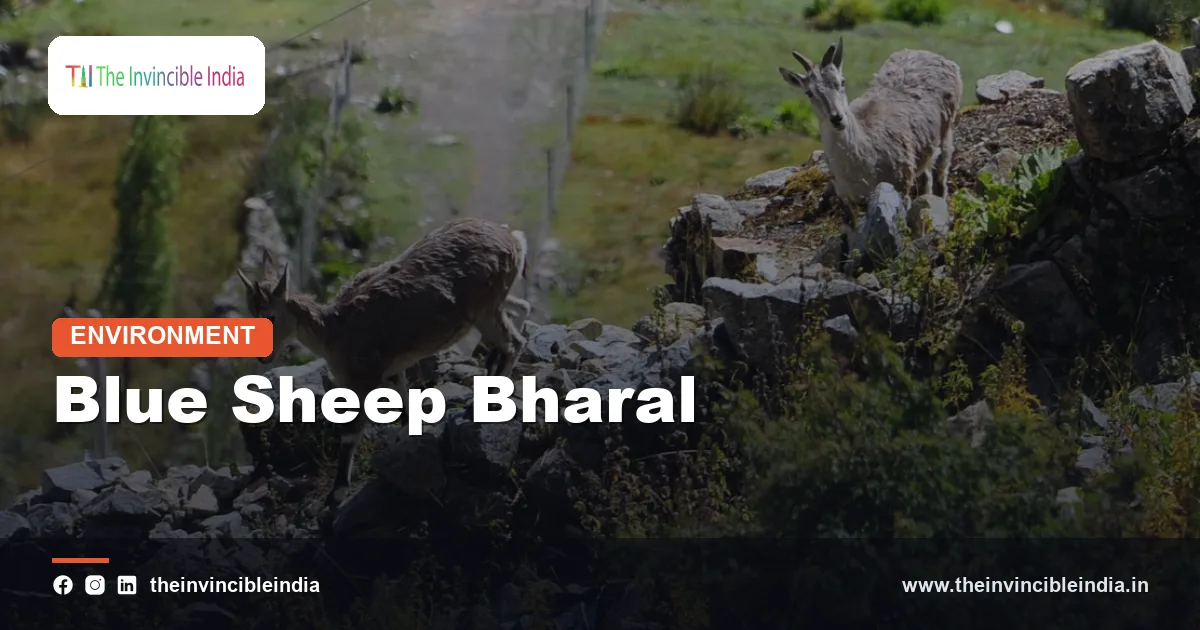
The bharal (Pseudois nayaur), widely known as the blue sheep, is a stocky, slate-grey wild caprine of the high Himalayas and the Tibetan plateau, and it is the single most important prey animal of the snow leopard in much of India’s mountain country. Despite its common name, the blue sheep is neither a true sheep nor a true goat, but a distinct animal placed in its own genus, Pseudois, within the subfamily Caprinae.
In India, the blue sheep occurs in the cold, dry, treeless uplands of Ladakh, Lahaul and Spiti in Himachal Pradesh, parts of Uttarakhand, and the high valleys of Sikkim, and it is protected under the Wildlife (Protection) Act, 1972. This explainer covers what the blue sheep is, how it survives at extreme altitude, where it lives, why it matters to the wider mountain ecosystem, what threatens it and how it is protected.
Quick Facts: Blue Sheep (Bharal)
| Common names | Blue sheep, bharal; known as naur in Nepali and in several Himalayan languages |
|---|---|
| Scientific name | Pseudois nayaur |
| Family and subfamily | Bovidae, subfamily Caprinae (the goat-antelopes) |
| Typical altitude | Roughly 2,500 to 5,500 metres above sea level |
| Habitat | Alpine meadows, steppe and barren rocky slopes above the tree line |
| Indian range | Ladakh, Lahaul and Spiti, parts of Uttarakhand, Sikkim and the high Himalayan belt of the north-east |
| Diet | Grasses, sedges, herbs, mosses and lichens |
| Main natural predators | Snow leopard, Himalayan wolf, and occasionally leopard and golden eagle (for young animals) |
| Conservation status | Listed by the IUCN as Least Concern at global level; protected in India under the Wildlife (Protection) Act, 1972 |
Key Takeaways
- The blue sheep (bharal, Pseudois nayaur) is a wild caprine that is genetically and anatomically intermediate between sheep and goats and belongs to its own genus, Pseudois.
- The blue sheep’s slate-grey, faintly bluish coat and rock-coloured outline make it almost invisible against Himalayan scree, which is its main defence against predators.
- The blue sheep is considered the principal prey species of the snow leopard across most of the Indian trans-Himalaya, so the health of bharal herds directly shapes snow leopard survival.
- Competition with domestic livestock for scarce high-altitude pasture is widely regarded as one of the main pressures on blue sheep populations in India.
- The blue sheep has a large global range and is classed by the IUCN as Least Concern, but local numbers in India vary widely and are monitored rather than assumed to be secure.
- Blue sheep in India are covered by the Wildlife (Protection) Act, 1972, and live inside several high-altitude national parks and wildlife sanctuaries.
What is the blue sheep (bharal)?
The blue sheep, or bharal, is a medium-sized, mountain-dwelling hoofed mammal native to the Himalayas and the Tibetan plateau, scientifically named Pseudois nayaur. The word bharal is the name used in Hindi and several north Indian languages, and the species is also called naur in Nepal.
A bharal is a herbivore that spends its life on open, high-altitude terrain where few other large mammals can find enough to eat. Adult males are considerably larger than females and carry thick, backward-curving horns, while females have shorter, thinner and straighter horns. The species was first described to Western science in the early nineteenth century from specimens collected in Nepal, which is why its species name, nayaur, is derived from a local word.
Two forms are usually recognised by zoologists. The Himalayan blue sheep (Pseudois nayaur) is the one found in India. A smaller relative, the dwarf blue sheep (Pseudois schaeferi), lives in a limited part of western China and does not occur in India. Some authorities have treated the two as a single species, so readers may see both treatments in older literature.
What does a blue sheep look like, and why is it called “blue”?
The blue sheep is called “blue” because its short, dense coat has a slate-grey colour with a bluish tinge, especially visible in winter and on the flanks of adult males. In reality the colour is a grey-brown that reads as bluish in the cold, bright light of the high mountains, and it blends with weathered rock and shale.
An adult blue sheep stands roughly 70 to 90 centimetres at the shoulder. Males usually weigh somewhere between 55 and 75 kilograms, with females noticeably lighter. The body is stocky and deep-chested, with short, strong legs ending in hooves that are well adapted to steep, broken ground.
Distinctive markings
- A dark stripe runs along the front of the chest and down the front of the legs, and a dark line separates the grey flank from the paler belly.
- The face is greyish, and in males the front of the face and chest turns darker during the breeding season.
- The underparts and inner legs are white or very pale.
- The tail is short.
The horns
The horns of the blue sheep grow upward and then sweep outward and backward in a smooth curve, rather than forming the spiral of a true sheep or the scimitar of an ibex. Male horns can reach well over half a metre in length. They are used in ritualised clashes between males, which usually involve rearing, charging and head-butting, particularly in the winter breeding season.
Is the bharal a sheep or a goat?
The bharal is neither a true sheep nor a true goat, because it combines features of both groups and is placed in its own genus, Pseudois, a name that literally means “false sheep”. Like sheep, the bharal has no beard and no strong odour; like goats, it has a short tail, a stocky build suited to cliffs, and horns that lack the tight spiral of a sheep’s.
Genetic studies have repeatedly suggested that the blue sheep sits somewhere between the two lineages, sometimes closer to sheep and sometimes closer to goats depending on the method used. For general readers, the key point is that the bharal is a separate evolutionary line adapted to open alpine steppe. It is one of several Himalayan caprines that can be confused with each other, which is why a comparison is given later in this article.
Where do blue sheep live in India?
In India, blue sheep live across the high Himalayan and trans-Himalayan belt, with the strongest presence in Ladakh, Lahaul and Spiti in Himachal Pradesh, the upper valleys of Uttarakhand and the higher reaches of Sikkim. Within these regions the species prefers open, treeless country between roughly 3,000 and 5,500 metres in the driest ranges, close enough to cliffs and rock faces to flee quickly from danger.
Blue sheep do not usually enter dense forest. They graze on alpine meadows and dry steppe in summer and move to lower slopes, or to south-facing slopes that lose their snow early, in winter. The seasonal shift is usually modest in distance but significant in terms of food and safety.
Protected areas where blue sheep are found
- Hemis National Park and the wider Changthang and Zanskar landscapes in Ladakh.
- Spiti Valley in Himachal Pradesh, including the Pin Valley National Park and the Kibber Wildlife Sanctuary, which are well known for bharal and snow leopard sightings.
- High-altitude protected areas in Uttarakhand, such as Gangotri National Park and Nanda Devi National Park.
- Khangchendzonga National Park and the northern plateau areas of Sikkim.
Outside India, the species occurs in Nepal, Bhutan, Pakistan’s far north-east and across the Tibetan plateau in China. Blue sheep are therefore a transboundary species, and their movements and populations are influenced by land use on both sides of several mountain borders.
How do blue sheep live: herds, food and breeding?
Blue sheep live in herds, feed on high-altitude grasses and herbs, and breed once a year in a cycle timed to the short Himalayan summer. Herd size varies with season and with the quality of the pasture: groups can number a few animals or several dozen, and larger aggregations are recorded in some areas, particularly in winter.
Social structure
Adult males and females generally live apart for much of the year. Female groups, with their young and sub-adult animals, form the core herds, while males gather in bachelor groups. The sexes come together for the rut, which usually takes place in the cold months of late autumn and winter.
Diet
The diet of the blue sheep consists of grasses and sedges, supplemented by herbs, shrubs, mosses and lichens, especially when snow covers the better forage. Because the blue sheep grazes rather than browses, its food overlaps strongly with that of domestic sheep, goats and yaks that are grazed in the same valleys.
Breeding
Females usually give birth to a single lamb in early summer, around June or July, after a gestation of roughly five to six months. Newborn lambs can follow the herd within hours, an essential skill on steep ground. Young animals face high mortality in their first winter, which is a key factor in how quickly a population can recover from losses.
Why is the blue sheep important to the snow leopard?
The blue sheep is important to the snow leopard because it is the snow leopard’s most widely available large prey animal across the Indian Himalaya, and a shortage of bharal pushes snow leopards towards livestock. A snow leopard typically needs to make a large kill, such as a bharal, every one to two weeks, and the cat’s survival in a given valley often tracks the local wild prey base.
Along with the Himalayan ibex, the blue sheep forms the backbone of the wild ungulate community in the trans-Himalaya. When wild prey is abundant, snow leopards take mostly wild animals; when it is depleted, losses of domestic sheep, goats and horses to snow leopards rise, which in turn increases the chance of retaliatory killing by herders. Protecting blue sheep is therefore both a prey-conservation measure and a human-wildlife conflict measure.
The blue sheep also supports other wildlife. Wolves take bharal where the two overlap, and young animals are vulnerable to eagles. Carcass remains feed smaller scavengers, and grazing by wild herds shapes the plant community on alpine slopes.
What threatens blue sheep in India?
The main threats to blue sheep in India are competition with domestic livestock for pasture, habitat degradation, hunting and disturbance, disease and the longer-term effects of climate change. These pressures vary from valley to valley, which is why careful local monitoring matters more than any single national figure.
- Livestock competition: Herders graze sheep, goats, yaks and ponies on the same high pastures. Heavy grazing reduces the forage available to wild herbivores and can push blue sheep into poorer or more exposed ground.
- Poaching and opportunistic hunting: Although hunting is illegal, bharal meat has historically been valued, and illegal hunting has been reported in some remote areas. Free-ranging dogs can also harass and kill blue sheep, especially young animals.
- Disease: Diseases carried by domestic small ruminants can spill over to wild populations. Outbreaks of respiratory and viral diseases in wild caprines are a recognised concern across mountain Asia.
- Climate and land-use change: A warming climate is altering snowlines, vegetation zones and the timing of plant growth. Roads, army and tourism infrastructure, and expanding settlements add disturbance and fragmentation at high altitude.
- Predator and conflict dynamics: Where blue sheep numbers are low, snow leopards raid livestock, which can lead to retaliatory killings of the cats and to reduced tolerance for wildlife generally.
Estimating blue sheep numbers is difficult, because the animals live in rugged, remote terrain and are best counted by trained observers using spotting scopes and standardised survey methods. Published density estimates in India vary considerably between sites, and any single population figure should be treated as approximate.
How is the blue sheep protected in India?
The blue sheep is protected in India principally through the Wildlife (Protection) Act, 1972, which prohibits hunting and trade in listed wild animals, and through a network of high-altitude national parks, sanctuaries and community conservation initiatives. The exact Schedule placement of species is revised from time to time by amendments to the Act, so readers who need the current legal listing should consult the latest text of the Act.
Legal and institutional protection
- The Wildlife (Protection) Act, 1972 is the central law, and the blue sheep is among the Himalayan ungulates that receive high statutory protection under it.
- The Ministry of Environment, Forest and Climate Change (MoEFCC) and state forest and wildlife departments are responsible for implementation.
- The Wildlife Institute of India (WII), based in Dehradun, carries out surveys and research on Himalayan wildlife.
Landscape and community conservation
The blue sheep benefits indirectly from snow leopard conservation programmes. The Government of India’s Project Snow Leopard, launched in 2009, promotes a landscape approach that involves local communities. The Global Snow Leopard and Ecosystem Protection (GSLEP) Programme, a 12-country initiative, also emphasises prey recovery. Conservation groups in Spiti and Ladakh have supported community-managed grazing rules, livestock insurance and predator-proof corrals, all of which reduce pressure on both predators and wild prey.
Homestay-based wildlife tourism has given some villages a direct income from healthy bharal and snow leopard populations, and has strengthened local interest in protecting them.
How does the blue sheep compare with the Himalayan ibex and other mountain ungulates?
The blue sheep differs from the Himalayan ibex and other Himalayan mountain ungulates in its colour, horn shape, preferred terrain and social behaviour. The table below summarises the main differences that help observers tell them apart in the field.
| Feature | Blue sheep (bharal) | Himalayan ibex | Himalayan tahr |
|---|---|---|---|
| Scientific name | Pseudois nayaur | Capra sibirica | Hemitragus jemlahicus |
| Colour | Slate-grey with a bluish tinge | Sandy-brown to dark brown, paler in winter | Reddish-brown to dark brown with a heavy mane in males |
| Horns | Smooth upward-and-backward curve, no heavy ridges | Long, scimitar-shaped with strong transverse ridges in males | Short, curved backward and flattened |
| Beard | None | Present in males | None, but a thick mane |
| Typical habitat | Open alpine meadows and steppe near cliffs | Steep, rocky, craggy slopes and high ridges | Steep forested and grassy slopes at lower to middle altitudes |
| Main Indian region | Ladakh, Spiti, Uttarakhand, Sikkim | Ladakh, Himachal Pradesh, Jammu and Kashmir | Himachal Pradesh, Uttarakhand, Sikkim |
In practice, the bharal is often seen in the open on grassy slopes, while the ibex is more closely tied to jagged rock faces. Both are important snow leopard prey, and in some valleys they share the same slopes.
How can visitors see blue sheep responsibly?
Visitors can see blue sheep responsibly by travelling with local guides or homestay operators, keeping a safe distance, avoiding disturbance during winter and lambing seasons, and staying on established routes inside protected areas. Spiti and Ladakh are the best-known destinations, with winter being the preferred season for animal-watching because the herds descend to lower and more visible slopes.
- Use binoculars or a spotting scope, because bharal are hard to see until they move.
- Keep dogs out of wildlife areas, since free dogs are a threat to wild herbivores.
- Carry back all waste, because high-altitude ecosystems decompose waste very slowly.
- Choose locally owned homestays, which links the visitor’s spending directly to the village’s tolerance for wildlife.
- Be prepared for the altitude and the cold; acclimatise properly before trekking.
Anyone who photographs wildlife should avoid approaching animals for a closer image. Blue sheep that are repeatedly flushed from feeding lose energy that they need to survive the winter.
Bottom Line
The blue sheep is not globally threatened, but in India it is a keystone prey animal whose condition shapes the fate of the snow leopard and the livelihoods of mountain herders. Protecting its pastures, controlling livestock disease and dogs, and supporting community-led conservation are the most practical ways to keep bharal herds healthy on India’s high mountain slopes.
Frequently Asked Questions
What is a blue sheep?
A blue sheep, also called a bharal, is a wild mountain caprine found in the Himalayas and Tibetan plateau. Its scientific name is Pseudois nayaur. It is not a true sheep or goat but a separate animal with a slate-grey coat and backward-curving horns.
Is the blue sheep really blue?
No, the blue sheep is not truly blue. Its coat is a slate-grey or grey-brown with a bluish sheen in some light. The colour helps the animal blend into rock and scree, which protects it from predators such as the snow leopard.
Where can I see blue sheep in India?
Blue sheep can be seen in the high mountain regions of Ladakh, Spiti in Himachal Pradesh, Uttarakhand and Sikkim. Spiti Valley, including the Kibber and Pin Valley area, and Hemis National Park in Ladakh are popular places. Winter is generally the better season for sightings, because the herds come down to lower slopes.
Is the blue sheep an endangered animal?
The blue sheep is not classed as endangered at global level; the IUCN lists it as Least Concern. In India, however, it is a legally protected species and its local populations face pressures from grazing competition, disease and disturbance. Numbers differ between regions and should be treated as approximate.
Why is the blue sheep important for the snow leopard?
The blue sheep is one of the snow leopard’s main natural prey species in the Indian Himalaya. When blue sheep are plentiful, snow leopards are less likely to attack domestic livestock. Healthy bharal herds therefore support both predator survival and peaceful coexistence with herders.
What does the blue sheep eat?
The blue sheep eats grasses, sedges, herbs, mosses and lichens. In summer it grazes on alpine meadows, and in winter it moves to slopes with less snow. Its diet overlaps with that of domestic sheep and goats, which is why shared pastures can lead to competition.
{“@context”:”https://schema.org”,”@graph”:[{“@type”:”FAQPage”,”mainEntity”:[{“@type”:”Question”,”name”:”What is a blue sheep?”,”acceptedAnswer”:{“@type”:”Answer”,”text”:”A blue sheep, also called a bharal, is a wild mountain caprine found in the Himalayas and Tibetan plateau. Its scientific name is Pseudois nayaur. It is not a true sheep or goat but a separate animal with a slate-grey coat and backward-curving horns.”}},{“@type”:”Question”,”name”:”Is the blue sheep really blue?”,”acceptedAnswer”:{“@type”:”Answer”,”text”:”No, the blue sheep is not truly blue. Its coat is a slate-grey or grey-brown with a bluish sheen in some light. The colour helps the animal blend into rock and scree, which protects it from predators such as the snow leopard.”}},{“@type”:”Question”,”name”:”Where can I see blue sheep in India?”,”acceptedAnswer”:{“@type”:”Answer”,”text”:”Blue sheep can be seen in the high mountain regions of Ladakh, Spiti in Himachal Pradesh, Uttarakhand and Sikkim. Spiti Valley, including the Kibber and Pin Valley area, and Hemis National Park in Ladakh are popular places. Winter is generally the better season for sightings, because the herds come down to lower slopes.”}},{“@type”:”Question”,”name”:”Is the blue sheep an endangered animal?”,”acceptedAnswer”:{“@type”:”Answer”,”text”:”The blue sheep is not classed as endangered at global level; the IUCN lists it as Least Concern. In India, however, it is a legally protected species and its local populations face pressures from grazing competition, disease and disturbance. Numbers differ between regions and should be treated as approximate.”}},{“@type”:”Question”,”name”:”Why is the blue sheep important for the snow leopard?”,”acceptedAnswer”:{“@type”:”Answer”,”text”:”The blue sheep is one of the snow leopard’s main natural prey species in the Indian Himalaya. When blue sheep are plentiful, snow leopards are less likely to attack domestic livestock. Healthy bharal herds therefore support both predator survival and peaceful coexistence with herders.”}},{“@type”:”Question”,”name”:”What does the blue sheep eat?”,”acceptedAnswer”:{“@type”:”Answer”,”text”:”The blue sheep eats grasses, sedges, herbs, mosses and lichens. In summer it grazes on alpine meadows, and in winter it moves to slopes with less snow. Its diet overlaps with that of domestic sheep and goats, which is why shared pastures can lead to competition.”}}]}]}


