

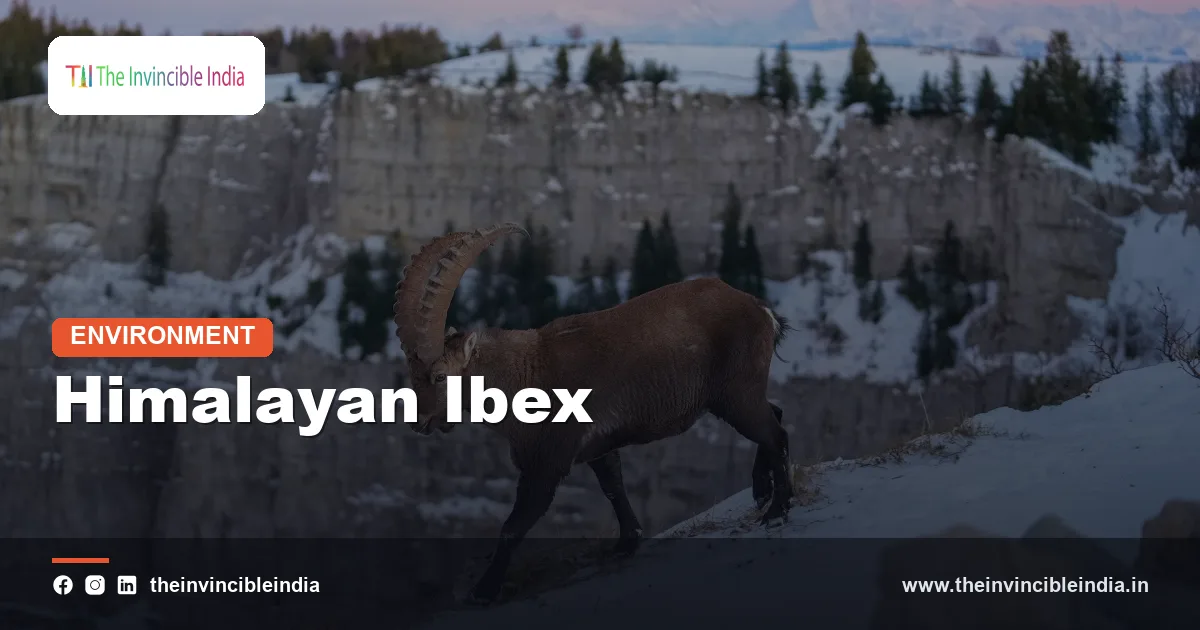
The Himalayan ibex (Capra sibirica) is a large, sure-footed wild goat of the cold, dry mountains of northern India, recognisable by the long, ridged, scimitar-shaped horns of the males, and it is one of the two most important prey animals of the snow leopard. In India, the Himalayan ibex lives on steep, rocky slopes in Ladakh, Himachal Pradesh and Jammu and Kashmir, usually above 3,500 metres, and it is protected under the Wildlife (Protection) Act, 1972.
The animal is the western Himalayan form of the wider Siberian ibex group, which ranges across Central Asia. This explainer covers what the Himalayan ibex is, how it lives and breeds on near-vertical ground, where it is found in India, why it matters to the mountain food chain, what threatens it and how it is protected.
Quick Facts: Himalayan Ibex
| Common names | Himalayan ibex; also called the Siberian ibex in the wider sense; known locally as skin (or skyin) in Ladakh |
|---|---|
| Scientific name | Capra sibirica |
| Family and subfamily | Bovidae, subfamily Caprinae (the goat-antelopes) |
| Typical altitude | Roughly 3,500 to 5,500 metres above sea level, descending in severe winters |
| Habitat | Rocky cliffs, scree slopes, craggy ridges and adjoining alpine meadows |
| Indian range | Ladakh, Himachal Pradesh (including Lahaul and Spiti), Jammu and Kashmir, and the upper reaches of Uttarakhand |
| Male horn length | Can exceed one metre along the curve, with prominent cross ridges |
| Main natural predators | Snow leopard, Himalayan wolf, and golden eagle (for kids) |
| Conservation status | Protected in India under the Wildlife (Protection) Act, 1972; global IUCN assessments place the species outside the threatened categories, with local declines reported |
Key Takeaways
- The Himalayan ibex (Capra sibirica) is a wild goat whose males carry some of the longest and most heavily ridged horns of any mountain ungulate in India.
- The Himalayan ibex lives on steep cliffs and scree above roughly 3,500 metres in Ladakh, Himachal Pradesh and Jammu and Kashmir, and uses vertical terrain as its first line of defence against predators.
- The Himalayan ibex, together with the blue sheep (bharal), forms the main wild prey base of the snow leopard in the Indian trans-Himalaya.
- Competition with domestic livestock, disease spill-over from sheep and goats, illegal hunting and a changing climate are the main pressures on Himalayan ibex populations.
- Himalayan ibex numbers in India are not precisely known, because the animals live in remote terrain, and any published population figure should be read as an approximate estimate.
- The Himalayan ibex has been part of Ladakh’s cultural landscape for thousands of years, appearing in ancient rock engravings and in the horn offerings placed on religious structures.
What is the Himalayan ibex?
The Himalayan ibex is a large wild goat, scientifically named Capra sibirica, that lives in the high mountains of the western Himalaya and the wider Central Asian ranges. It belongs to the genus Capra, which also includes the domestic goat, the Alpine ibex of Europe, the Nubian ibex of north-east Africa and Arabia, and the markhor of Central and South Asia.
Taxonomists continue to debate how many species and subspecies the group contains. The animals of the Indian Himalaya are generally treated as a regional form of the Siberian ibex, and some authors have used separate names for them. For general readers, the practical point is that the Himalayan ibex is the large, brown, curve-horned wild goat of Ladakh, Spiti and Kashmir, and is easily told apart from the grey blue sheep that often shares its mountains.
What does a Himalayan ibex look like?
A Himalayan ibex is a heavily built, thick-necked wild goat with a coat that ranges from sandy brown to dark brown, a pale saddle patch in older males, and a short dark beard. Adult males stand roughly 90 to 105 centimetres at the shoulder and commonly weigh somewhere between about 60 and 100 kilograms, while females are distinctly smaller and slimmer.
The horns
The horns of the Himalayan ibex are the defining feature of the species. In adult males they sweep back in a long, curved arc, are flattened at the front, and carry bold transverse ridges that mark each year of growth. They can exceed a metre along the curve. Females have short, slender horns, usually under about thirty centimetres, that curve gently backward.
Coat and seasonal change
The winter coat is long, dense and paler, with a thick woolly undercoat that provides insulation at temperatures well below freezing. The coat is shed in spring and the summer coat is shorter and darker. The overall colouring is a good match for dry rock and dead grass, and a motionless ibex on a cliff can be easy to overlook.
Where does the Himalayan ibex live in India?
In India, the Himalayan ibex lives in the high, dry mountains of Ladakh, Lahaul and Spiti in Himachal Pradesh, and parts of Jammu and Kashmir, with smaller populations reported from the upper valleys of Uttarakhand. It prefers steep, rocky ground close to cliffs, with alpine pasture nearby for feeding.
Protected areas with Himalayan ibex
- Hemis National Park in Ladakh and the neighbouring Changthang, Nubra and Zanskar valleys.
- Pin Valley National Park and the Kibber Wildlife Sanctuary in Spiti, Himachal Pradesh.
- Great Himalayan National Park and other high reserves in Himachal Pradesh.
- Kishtwar High Altitude National Park and other high-altitude reserves in Jammu and Kashmir.
- Gangotri National Park in Uttarakhand, where ibex have been reported in the higher reaches.
Outside India, the wider Siberian ibex group occurs across Pakistan’s northern mountains, Afghanistan, Central Asia, Mongolia and southern Siberia. Because the range crosses borders, the Himalayan ibex is a transboundary conservation concern.
How does the Himalayan ibex live: herds, food and breeding?
The Himalayan ibex lives in sex-segregated herds for most of the year, feeds on grasses and herbs of the alpine zone, and breeds once annually in winter, with a single kid born in late spring. Female groups include their kids and young animals and may number a few individuals to several dozen, while older males live alone or in small bachelor parties.
Daily rhythm and movement
Ibex feed mainly in the early morning and late afternoon and rest on ledges or sunny slopes in the middle of the day. In summer, the animals move to higher meadows to graze on fresh growth. In severe winters, they move to lower south-facing slopes where wind and sun have cleared the snow. The movement is short in distance, but crucial for survival.
Diet
The Himalayan ibex eats grasses, sedges, herbs and low shrubs, and relies on dry stems and woody plants when snow covers the pasture. Because it is a grazer and a browser, its diet overlaps with that of domestic goats, sheep and yaks.
Rut and birth
Mating takes place in the depths of winter, usually around December and January. Males become more aggressive and test each other with rearing clashes and horn-to-horn contact. After a gestation of around five to six months, females give birth in May or June to a single kid, which can climb and follow its mother within hours.
How can an ibex climb such steep cliffs?
An ibex can climb steep cliffs because its hooves have a hard outer rim and a soft, flexible inner pad, giving grip on both rough and polished rock, and because its low centre of gravity and strong muscles allow precise jumps and balance. The hooves spread slightly to grip, and the dewclaws help on loose ground.
The ability to flee uphill onto cliffs where most predators cannot follow is the Himalayan ibex’s main defence. Snow leopards hunt ibex by stalking close, using rock cover, and attacking from above or from the side before the prey reaches safer terrain. Many ambushes fail, which is one reason a snow leopard may have to hunt repeatedly before it makes a kill.
Why is the Himalayan ibex important to the snow leopard and the mountain ecosystem?
The Himalayan ibex is important because it is a primary wild prey species of the snow leopard, and the availability of ibex and blue sheep influences how often snow leopards turn to domestic livestock. An adult snow leopard needs a large prey animal every week or two, and in many Indian valleys the ibex is the most common such animal.
When wild prey is abundant, the proportion of livestock in the snow leopard’s diet is typically lower. When ibex and bharal decline, predation on herders’ sheep, goats and horses rises, and with it the risk of retaliatory killing. For this reason, wildlife biologists treat prey recovery as one of the central pillars of snow leopard conservation.
The ibex also supports wolves and scavengers such as the lammergeier and Himalayan griffon, which feed on carcasses. Its grazing helps shape alpine plant communities.
What threatens the Himalayan ibex?
The main threats to the Himalayan ibex are competition with domestic livestock, disease transmission from domestic animals, illegal hunting, disturbance from infrastructure and tourism, and long-term climate change. The relative importance of each threat differs from one valley to another.
- Grazing competition: Large numbers of sheep, goats and pashmina goats on the same high pastures reduce the forage available to wild herbivores, particularly in winter ranges.
- Disease: Diseases carried by domestic small ruminants, such as peste des petits ruminants and mange-causing mites, are recognised risks for wild goats and sheep in mountain Asia.
- Illegal hunting: Ibex have long been hunted for meat and for their horns. Although hunting is banned, poaching remains a concern in remote or poorly patrolled areas.
- Dogs: Free-ranging dogs near settlements and roadside camps can chase and kill ibex, especially kids and weakened animals.
- Infrastructure and disturbance: New roads, military and tourism construction, and mining can fragment habitat and push animals off preferred ranges.
- Climate change: Shifting snowlines, changes in plant growth, and more extreme weather such as heavy snow or avalanche seasons can affect both food supply and survival.
How is the Himalayan ibex protected in India?
The Himalayan ibex is protected in India mainly by the Wildlife (Protection) Act, 1972, which prohibits hunting and trade in protected wild animals, and by a series of high-altitude national parks and wildlife sanctuaries. The species is generally understood to be placed among the highly protected Himalayan ungulates under the Act’s Schedules, although readers who need the exact current listing should check the latest official text, since Schedules are revised by amendment.
Key institutions and programmes
- The Ministry of Environment, Forest and Climate Change (MoEFCC) and the state wildlife departments of Ladakh, Himachal Pradesh and Jammu and Kashmir enforce the law.
- The Wildlife Institute of India (WII), Dehradun, conducts research and surveys on Himalayan wildlife.
- Project Snow Leopard, launched in India in 2009, takes a landscape and community-based approach to conserving snow leopards and their prey.
- The Global Snow Leopard and Ecosystem Protection (GSLEP) Programme, a multi-country initiative, also promotes recovery of wild prey.
Community-based measures
Local initiatives in Spiti and Ladakh have focused on predator-proof livestock corrals, grazing management that protects some pastures for wild herbivores, livestock insurance schemes that lower the cost of predation, and homestay tourism that rewards communities for protecting wildlife. These measures reduce pressure on both the ibex and the snow leopard.
How does the Himalayan ibex differ from similar wild goats and sheep?
The Himalayan ibex differs from other Himalayan and Asian wild caprines in horn shape, colour and habitat. The comparison below shows how it can be separated from animals that are sometimes confused with it.
| Animal | Scientific name | Horn shape | Typical habitat | Main Indian region |
|---|---|---|---|---|
| Himalayan ibex | Capra sibirica | Long, scimitar-like, strongly ridged in males | Cliffs and craggy slopes above 3,500 metres | Ladakh, Himachal Pradesh, Jammu and Kashmir |
| Blue sheep (bharal) | Pseudois nayaur | Smooth, upward then backward curve | Open alpine meadows and steppe | Ladakh, Spiti, Uttarakhand, Sikkim |
| Himalayan tahr | Hemitragus jemlahicus | Short, flattened, curved back | Steep forested and grassy slopes at middle altitudes | Himachal Pradesh, Uttarakhand, Sikkim |
| Markhor | Capra falconeri | Spiralled corkscrew horns | Rocky slopes with scrub | Pir Panjal range in Jammu and Kashmir (small numbers) |
| Ladakh urial | Ovis vignei | Heavy, curling sheep-type horns | Low, arid river valleys | Ladakh |
The easiest field cue is the horn: a long, ridged scimitar suggests ibex, a smooth curve on a grey animal suggests bharal, and a tight corkscrew indicates a markhor.
What role does the ibex play in Ladakhi culture?
The ibex plays a long-standing role in Ladakhi culture as a symbol of the high mountains, and its image appears in ancient rock engravings, while its horns are traditionally placed on stone walls and shrines in some Himalayan villages. Rock art sites across Ladakh show ibex among the most frequently depicted animals, a sign of how important mountain game was to early communities.
Today the cultural attachment can be used to support conservation. Village-level festivals, wildlife homestays and local conservation clubs link pride in the ibex to responsible tourism.
Bottom Line
The Himalayan ibex is not widely classed as globally endangered, but in India it is a keystone prey species whose abundance shapes snow leopard survival and herder tolerance. Keeping its pastures free of overgrazing, preventing disease spill-over and poaching, and rewarding communities for living with wildlife are the most realistic ways to keep the ibex on India’s cliffs.
Frequently Asked Questions
What is a Himalayan ibex?
A Himalayan ibex is a large wild goat of the high mountains of northern India, scientifically named Capra sibirica. Males have long, ridged, scimitar-shaped horns. It lives on steep cliffs above roughly 3,500 metres in Ladakh, Himachal Pradesh and Jammu and Kashmir.
Where can I see the Himalayan ibex in India?
The Himalayan ibex can be seen in Ladakh, in Spiti Valley in Himachal Pradesh, and in high protected areas of Jammu and Kashmir. Hemis National Park, Pin Valley National Park and Kibber are well-known places. Winter is often the best time, because animals move to lower and more visible slopes.
Is the Himalayan ibex endangered?
The Himalayan ibex is not generally listed in the threatened categories on a global scale, but local populations have declined in some regions. In India, it is a legally protected species. Estimates of numbers are approximate, so conservation depends on regular local monitoring.
How long are the horns of a Himalayan ibex?
The horns of an adult male Himalayan ibex can exceed one metre along their curve. They are heavily ridged and sweep backward in a long arc. Females have much shorter and thinner horns, usually well under half a metre.
What is the difference between an ibex and a blue sheep?
The ibex is a wild goat with long, ridged, scimitar-shaped horns and a brown coat, while the blue sheep is a grey animal with smooth, curved horns. The ibex stays closer to cliffs, whereas the blue sheep prefers open alpine meadows. Both are major prey of the snow leopard.
Why is the ibex important for snow leopards?
The ibex is one of the two main wild prey animals of the snow leopard in the Indian Himalaya. When ibex are plentiful, snow leopards are less likely to attack livestock. This reduces conflict with herders and supports the survival of both species.
{“@context”:”https://schema.org”,”@graph”:[{“@type”:”FAQPage”,”mainEntity”:[{“@type”:”Question”,”name”:”What is a Himalayan ibex?”,”acceptedAnswer”:{“@type”:”Answer”,”text”:”A Himalayan ibex is a large wild goat of the high mountains of northern India, scientifically named Capra sibirica. Males have long, ridged, scimitar-shaped horns. It lives on steep cliffs above roughly 3,500 metres in Ladakh, Himachal Pradesh and Jammu and Kashmir.”}},{“@type”:”Question”,”name”:”Where can I see the Himalayan ibex in India?”,”acceptedAnswer”:{“@type”:”Answer”,”text”:”The Himalayan ibex can be seen in Ladakh, in Spiti Valley in Himachal Pradesh, and in high protected areas of Jammu and Kashmir. Hemis National Park, Pin Valley National Park and Kibber are well-known places. Winter is often the best time, because animals move to lower and more visible slopes.”}},{“@type”:”Question”,”name”:”Is the Himalayan ibex endangered?”,”acceptedAnswer”:{“@type”:”Answer”,”text”:”The Himalayan ibex is not generally listed in the threatened categories on a global scale, but local populations have declined in some regions. In India, it is a legally protected species. Estimates of numbers are approximate, so conservation depends on regular local monitoring.”}},{“@type”:”Question”,”name”:”How long are the horns of a Himalayan ibex?”,”acceptedAnswer”:{“@type”:”Answer”,”text”:”The horns of an adult male Himalayan ibex can exceed one metre along their curve. They are heavily ridged and sweep backward in a long arc. Females have much shorter and thinner horns, usually well under half a metre.”}},{“@type”:”Question”,”name”:”What is the difference between an ibex and a blue sheep?”,”acceptedAnswer”:{“@type”:”Answer”,”text”:”The ibex is a wild goat with long, ridged, scimitar-shaped horns and a brown coat, while the blue sheep is a grey animal with smooth, curved horns. The ibex stays closer to cliffs, whereas the blue sheep prefers open alpine meadows. Both are major prey of the snow leopard.”}},{“@type”:”Question”,”name”:”Why is the ibex important for snow leopards?”,”acceptedAnswer”:{“@type”:”Answer”,”text”:”The ibex is one of the two main wild prey animals of the snow leopard in the Indian Himalaya. When ibex are plentiful, snow leopards are less likely to attack livestock. This reduces conflict with herders and supports the survival of both species.”}}]}]}


