

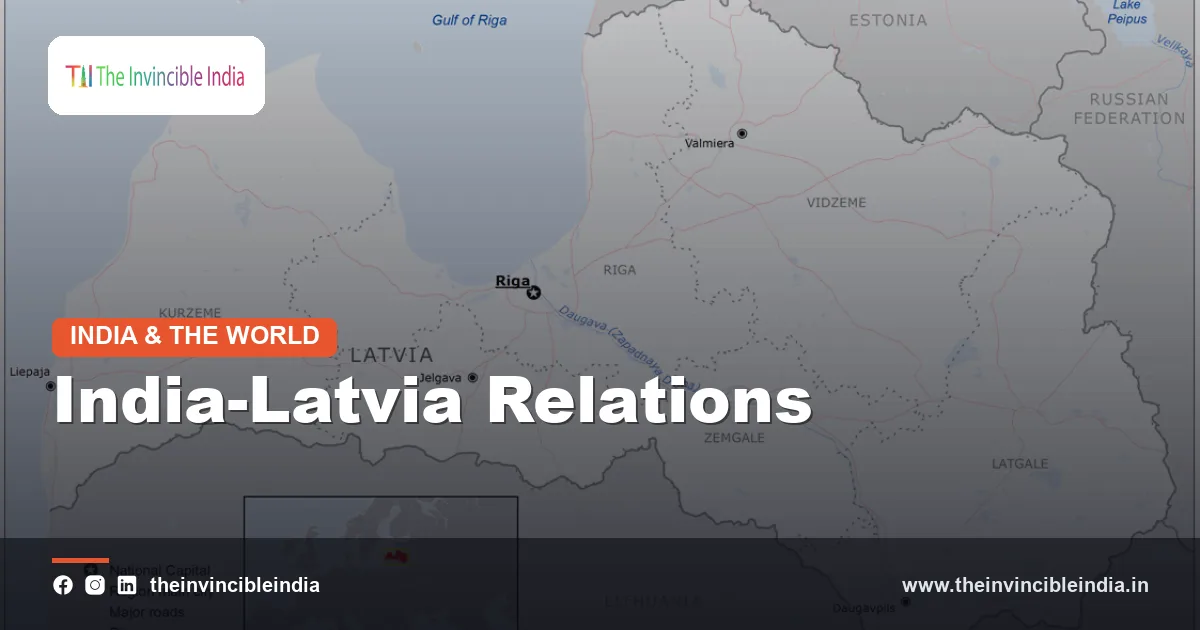
India-Latvia relations are the bilateral ties between the Republic of India and the Republic of Latvia, a Baltic member of the European Union and NATO, built on diplomatic recognition in 1991, steady political dialogue, modest but diversified trade, and a shared interest in using Latvian ports and rail links as a transit gateway between Asia and the European Union. The partnership is small in scale compared with India’s ties with Germany or France, but it is stable, free of major disputes and rich in niche opportunities.
Latvia sits on the eastern shore of the Baltic Sea and has about 1.9 million people, while India is the world’s most populous country. That asymmetry shapes the relationship: India-Latvia relations are less about large volumes and more about specific sectors such as information technology, pharmaceuticals, logistics, education and cooperation inside multilateral bodies. This explainer, last reviewed 17 October 2026, sets out how the relationship works and where it may go.
| Attribute | Detail |
|---|---|
| Countries | Republic of India and Republic of Latvia |
| Diplomatic relations | Established in 1991, after Latvia restored its independence |
| Latvian capital and gateway | Riga, with major ports at Riga, Ventspils and Liepaja |
| Latvia’s bloc memberships | European Union and NATO (both 2004), Schengen Area (2007), eurozone (2014) |
| Indian nodal ministry | Ministry of External Affairs (MEA), through the Embassy of India in Riga |
| Key sectors | Transit and logistics, information technology, pharmaceuticals, timber, fertilisers, education |
| Trade scale | Modest, generally counted in the low hundreds of millions of US dollars a year (figures vary by year and source) |
| Wider frame | India-EU relations, including the long-running India-EU trade and investment negotiations |
Key Takeaways
- India-Latvia relations began formally in 1991, when India recognised Latvia after its restoration of independence from the Soviet Union.
- Latvia has been a member of the European Union since 2004, so many India-Latvia trade and visa questions are decided at the EU level rather than bilaterally.
- The ports of Riga, Ventspils and Liepaja, together with Latvian Railways, give Latvia a ready-made logistics role as a gateway to the EU single market and to the wider Baltic region.
- India’s exports to Latvia are led by pharmaceuticals, textiles, machinery and engineering goods, while its imports from Latvia have historically centred on timber, fertilisers and metals.
- Indian students, especially in medicine, are one of the most visible people-to-people links between India and Latvia.
- Both countries support a rules-based international order, and Latvia was elected to the United Nations Security Council for 2026-27, a body in which India also seeks a larger role.
What are India-Latvia relations based on?
India-Latvia relations are based on mutual recognition of sovereignty, a commitment to democracy and international law, and complementary economic strengths. India offers scale, skills and a large consumer market, while Latvia offers EU access, a favourable geography on the Baltic Sea and a compact, digitally capable economy.
Unlike partnerships built on a dominant strategic bargain, the India-Latvia relationship rests on many small pillars. These include periodic political consultations between the foreign ministries, cooperation through the European Union, trade in specific product lines, education exchanges and cultural contact. Neither country has a dispute with the other, which keeps the agenda practical and positive.
Latvia is also one of three Baltic states, alongside Estonia and Lithuania. India often engages the three together, and developments in the broader Baltic and Nordic region influence how New Delhi approaches Riga.
How did India-Latvia relations develop after 1991?
India-Latvia relations developed from formal recognition in 1991 into a working partnership through embassy-level contact, ministerial visits and Latvia’s entry into the European Union in 2004. India had maintained sympathetic ties with the Soviet Union during the Cold War, but it moved quickly to recognise the restored Baltic states once they regained independence.
In the 1990s the focus was on establishing missions and basic agreements. Latvia’s 2004 accession to the EU and NATO changed the context, because Riga now spoke on trade, migration and sanctions policy through Brussels. The 2010s brought a more regular rhythm of visits by senior Indian and Latvian officials, and both sides spoke of diversifying beyond traditional commodities. The Russia-Ukraine war from 2022 reshaped Baltic trade and security priorities and prompted Latvia to look for new partners and markets, a shift that has made India more relevant in Riga’s thinking.
Why does the Riga port matter to India-Latvia relations?
The Port of Riga matters because it is one of the largest Baltic ports and, with Ventspils and Liepaja, offers a gateway to the European Union and to the Eurasian rail network. Latvia’s ice-free ports and its wide-gauge rail system, operated by the state company Latvian Railways, have long served as a transit route for bulk cargo, containers and timber.
The transit-corridor idea
For India, which is always looking for resilient trade routes, Latvia’s logistics sector is attractive in principle. Indian exporters typically ship to northern Europe through large hubs such as Rotterdam, Hamburg or Gdansk, and feeder services then reach Baltic ports. A direct, high-frequency India-Riga container link has not been a regular feature, so most India-Latvia cargo moves through transshipment. Latvian officials have promoted their ports to Asian shippers and have discussed connecting to wider corridors, including those that link South Asia and Europe via Iran and Central Asia, such as the International North-South Transport Corridor (INSTC).
Rail Baltica and future connectivity
Rail Baltica, a European-gauge railway project linking Tallinn, Riga, Kaunas and Warsaw, is under development and could improve Latvia’s connection to the EU rail grid over time. If completed as planned, it would strengthen Riga’s value as a gateway, although timelines for large infrastructure projects frequently shift, and any benefit for Indian cargo would depend on commercial services and pricing.
How big is India-Latvia trade and what is traded?
India-Latvia trade is small but varied, usually reported in the low hundreds of millions of US dollars annually, with figures varying from year to year and by the source used. India usually runs a modest surplus or near-balance depending on commodity prices.
The table below summarises the commonly traded categories. It is indicative rather than exact, because the mix changes with prices, sanctions and shipping routes.
| Direction | Typical product categories |
|---|---|
| India to Latvia | Pharmaceuticals and generic medicines, textiles and garments, machinery and engineering goods, chemicals, agricultural products, tea and spices |
| Latvia to India | Timber and wood products, fertiliser inputs, ferrous metals, machinery parts, food-processing items and some chemicals |
| Services | Information technology, logistics services, education and tourism, with smaller flows in financial technology |
Because Latvia is in the EU customs union, goods entering Latvia are subject to the common external tariff, and Indian exporters must meet EU product and safety standards. That makes the pace of the India-EU trade agreement negotiations a central variable for the future size of India-Latvia trade.
What is the role of IT and pharma in India-Latvia cooperation?
Information technology and pharmaceuticals are the two sectors most often named as growth areas in India-Latvia cooperation because each country has distinct strengths that fit together. India has a global IT services industry and the largest generic-medicine manufacturing base among developing countries, while Latvia has an active technology start-up scene and a long-established pharmaceutical tradition.
Information technology
Riga has a growing technology and fintech ecosystem, and Latvia has invested in digital public services and broadband infrastructure. Indian IT firms can use Latvia as an EU-based location for nearshore work, while Latvian companies can draw on Indian engineering talent and outsourcing capacity. Cooperation has often taken the form of company-to-company partnerships, business delegations and exchanges between technology institutes, rather than large government-led projects.
Pharmaceuticals
Latvia hosts pharmaceutical producers such as Grindeks, which makes active pharmaceutical ingredients and finished medicines. India supplies generic medicines to many markets and has a strong interest in the EU, where regulatory compliance with Good Manufacturing Practice (GMP) is required. Latvia’s regulator, the State Agency of Medicines, and Indian companies interact within the wider EU framework. Opportunities include contract manufacturing, joint development and distribution into the Baltic and neighbouring markets.
How does the European Union shape India-Latvia relations?
The European Union shapes India-Latvia relations by setting the rules for trade, visas, investment screening and sanctions that apply in Latvia, so a large part of the bilateral agenda is effectively decided in Brussels. India and the EU are strategic partners, and their relationship covers trade, technology, climate and connectivity.
India and the EU relaunched negotiations on a free trade agreement and related investment and geographical-indications agreements in 2022, after a pause of several years. Reports in early 2026 indicated that the main trade negotiations had been concluded, though legal vetting, ratification and entry into force are separate steps, and readers should check official sources for the current status. If the agreement takes effect, Latvian importers and Indian exporters would gain from lower tariffs and clearer rules, and Latvia’s ports could benefit from additional volumes.
The EU also runs a Global Gateway connectivity initiative and the India-EU Trade and Technology Council, both of which touch themes that matter to Latvia, including digital infrastructure and supply-chain resilience. As a small member state, Latvia tends to support closer EU engagement with India, since it sees India as a large, democratic partner outside the traditional focus on the United States and China.
What are the people-to-people and education links?
The most visible people-to-people links are Indian students who study in Latvia, particularly in medicine, together with cultural events, yoga and tourism. Latvian medical universities, such as those in Riga, enrol international students in English-language programmes, and a number of Indian students choose them as a lower-cost route to a European medical degree.
Cultural contact is smaller but real. International Day of Yoga has been marked in Riga, Indian dance and music groups perform at festivals, and Indian cuisine has a modest presence in the capital. The Indian community in Latvia is small, made up mainly of students, professionals and business people. Latvia is also part of the Schengen Area, so Indian visitors can combine a trip to Riga with travel across much of Europe.
Both sides have expressed interest in expanding scholarships, university tie-ups and research exchanges. Mobility between India and the EU is a policy topic in its own right, and any migration and mobility partnership at EU level would affect how easily students and skilled workers move between the two countries.
How do India and Latvia cooperate in multilateral forums?
India and Latvia cooperate in multilateral forums by consulting at the United Nations and by sharing broad positions on international law, sovereignty and a rules-based order. Latvia has generally been supportive of India’s larger role in global governance, and the two sides have talked about reform of the UN Security Council.
Latvia was elected as a non-permanent member of the UN Security Council for the 2026-27 term, which gives the two countries more reason to consult on peace and security issues. India has served on the Council multiple times and has campaigned for a permanent seat. Their views do not always align, because Latvia is a NATO member with a strong focus on the security of the Baltic region and on Russia’s war in Ukraine, while India follows a policy of strategic autonomy and maintains ties with Moscow. Both sides have managed these differences through dialogue rather than public disagreement, and they find more common ground on climate action, digital governance, counter-terrorism and maritime security.
What challenges limit India-Latvia relations?
The main challenges limiting India-Latvia relations are small trade volumes, limited direct shipping and flight links, and differing security perspectives on Russia. Distance and the scale mismatch also mean that business communities know little about one another.
- Limited connectivity: Direct shipping services and flights are scarce, so goods and travellers usually pass through other European hubs.
- Small market awareness: Many Indian firms prioritise larger EU markets, and many Latvian firms have limited experience of India’s regulatory environment.
- EU regulation: Standards on medicines, food safety and chemicals can be demanding for exporters.
- Geopolitical divergence: Latvia’s security outlook, shaped by its location near Russia, differs from India’s policy of balancing relationships.
- Thin institutional frameworks: A broader framework, such as an EU-level trade agreement, is often needed to unlock larger flows.
What is the outlook for India-Latvia relations?
The outlook for India-Latvia relations is cautiously positive, with growth most likely in logistics, technology, pharmaceuticals, education and green energy rather than in headline-grabbing deals. The most important driver is the India-EU relationship, because progress there would lower barriers for Latvian and Indian businesses at the same time.
Several practical steps would strengthen the relationship: regular business forums linking chambers of commerce, better shipping and air connectivity, university partnerships, and cooperation between digital public-service providers. Latvia’s need to diversify its transit economy after changes in regional trade, and India’s need for reliable European partners, give both countries a reason to deepen contact. Analysts generally treat the relationship as a steady, low-risk partnership with room to grow rather than a fast-changing one.
Bottom Line
India-Latvia relations are friendly, uncontroversial and modest in size, resting on 1991 recognition, EU membership, Baltic port access and niche sectors such as IT, pharma and education. Their future depends less on bilateral announcements than on how quickly India-EU economic ties, shipping links and business contacts mature.
Frequently Asked Questions
When did India and Latvia establish diplomatic relations?
India and Latvia established diplomatic relations in 1991, after Latvia restored its independence from the Soviet Union. India was among the countries that recognised the restored Baltic states quickly. The two countries have since maintained resident embassies and regular political contact.
What does India export to and import from Latvia?
India mainly exports pharmaceuticals, textiles, machinery, engineering goods and chemicals to Latvia, and imports timber, fertilisers, metals and some machinery parts. The exact mix changes with prices and trade routes. Total two-way trade is modest, generally in the low hundreds of millions of US dollars a year.
Why is Riga important for India’s trade with Europe?
Riga is important because its port, along with Ventspils and Liepaja and the Latvian rail network, offers a gateway to the European Union and the Baltic region. Indian cargo currently reaches it mostly by transshipment through larger European hubs. Its value could grow if direct shipping services and wider transit corridors develop.
How does the India-EU relationship affect India-Latvia ties?
The India-EU relationship affects India-Latvia ties because Latvia is an EU member and follows common EU trade, customs and visa rules. A completed India-EU trade agreement would lower tariffs and give clearer rules to Latvian and Indian firms. Its practical effect depends on ratification and implementation, which readers should check against official sources.
Are there Indian students in Latvia?
Yes, Indian students study in Latvia, especially in English-taught medical programmes at universities in Riga. They form one of the most visible parts of the India-Latvia people-to-people link. Numbers vary by year, so current figures should be checked with the universities or the Indian embassy.
Do India and Latvia have any major disagreements?
No, India and Latvia have no major bilateral dispute, though their security perspectives differ on Russia and the war in Ukraine. Latvia is a NATO member in a region directly affected by the conflict, while India pursues strategic autonomy. The two countries manage this difference through dialogue and focus on areas of shared interest.
{“@context”:”https://schema.org”,”@graph”:[{“@type”:”FAQPage”,”mainEntity”:[{“@type”:”Question”,”name”:”When did India and Latvia establish diplomatic relations?”,”acceptedAnswer”:{“@type”:”Answer”,”text”:”India and Latvia established diplomatic relations in 1991, after Latvia restored its independence from the Soviet Union. India was among the countries that recognised the restored Baltic states quickly. The two countries have since maintained resident embassies and regular political contact.”}},{“@type”:”Question”,”name”:”What does India export to and import from Latvia?”,”acceptedAnswer”:{“@type”:”Answer”,”text”:”India mainly exports pharmaceuticals, textiles, machinery, engineering goods and chemicals to Latvia, and imports timber, fertilisers, metals and some machinery parts. The exact mix changes with prices and trade routes. Total two-way trade is modest, generally in the low hundreds of millions of US dollars a year.”}},{“@type”:”Question”,”name”:”Why is Riga important for India’s trade with Europe?”,”acceptedAnswer”:{“@type”:”Answer”,”text”:”Riga is important because its port, along with Ventspils and Liepaja and the Latvian rail network, offers a gateway to the European Union and the Baltic region. Indian cargo currently reaches it mostly by transshipment through larger European hubs. Its value could grow if direct shipping services and wider transit corridors develop.”}},{“@type”:”Question”,”name”:”How does the India-EU relationship affect India-Latvia ties?”,”acceptedAnswer”:{“@type”:”Answer”,”text”:”The India-EU relationship affects India-Latvia ties because Latvia is an EU member and follows common EU trade, customs and visa rules. A completed India-EU trade agreement would lower tariffs and give clearer rules to Latvian and Indian firms. Its practical effect depends on ratification and implementation, which readers should check against official sources.”}},{“@type”:”Question”,”name”:”Are there Indian students in Latvia?”,”acceptedAnswer”:{“@type”:”Answer”,”text”:”Yes, Indian students study in Latvia, especially in English-taught medical programmes at universities in Riga. They form one of the most visible parts of the India-Latvia people-to-people link. Numbers vary by year, so current figures should be checked with the universities or the Indian embassy.”}},{“@type”:”Question”,”name”:”Do India and Latvia have any major disagreements?”,”acceptedAnswer”:{“@type”:”Answer”,”text”:”No, India and Latvia have no major bilateral dispute, though their security perspectives differ on Russia and the war in Ukraine. Latvia is a NATO member in a region directly affected by the conflict, while India pursues strategic autonomy. The two countries manage this difference through dialogue and focus on areas of shared interest.”}}]}]}


