

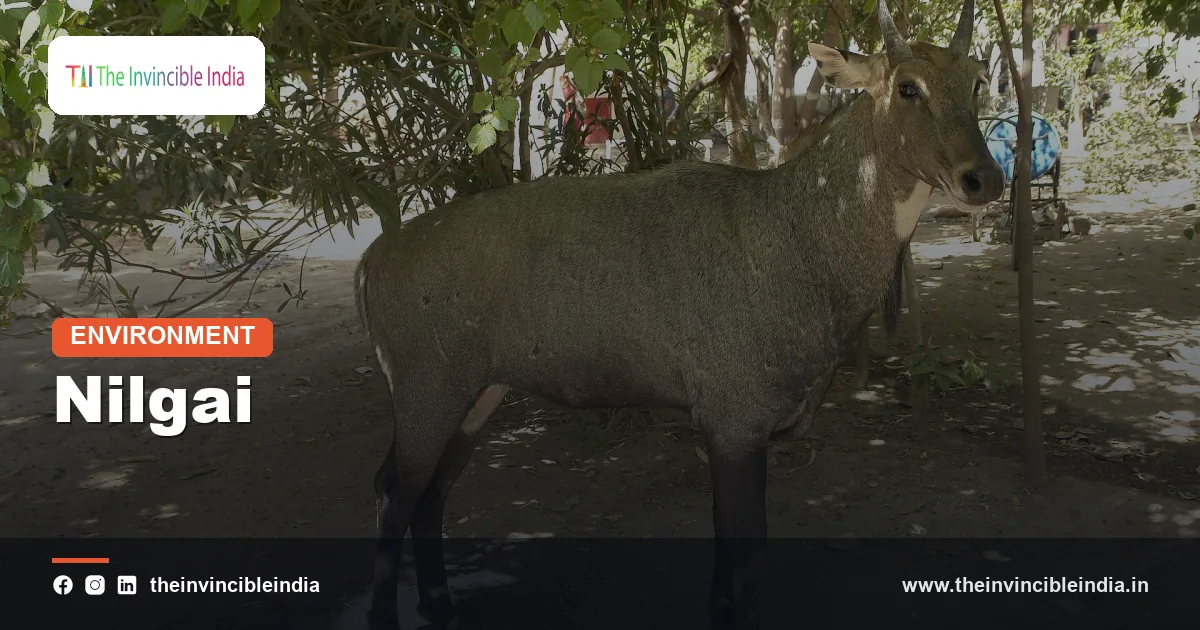
The nilgai (Boselaphus tragocamelus), or blue bull, is India’s largest antelope, and nilgai conservation in India is a balancing act between protecting a native wild herbivore and reducing the crop damage it causes to farmers. The animal is common across the northern and central plains, thrives in scrub and farmland, and is not considered globally threatened, yet it is at the centre of one of the country’s most visible human-wildlife conflicts.
Although its name contains “gai”, meaning cow, the nilgai is an antelope and not a bovine. In many regions, however, the cow association gives it a degree of social protection that makes culling politically and culturally sensitive. This explainer covers the biology, range, legal position, conflict and management of the nilgai in plain terms. It was last reviewed on 17 October 2026.
Quick Facts
| Common names | Nilgai, blue bull, blue cow; also called roz or rojh in parts of North India |
|---|---|
| Scientific name | Boselaphus tragocamelus |
| Family | Bovidae, the only species in the genus Boselaphus |
| Size | India’s largest antelope; adult males commonly stand about 1.2 to 1.5 metres at the shoulder and weigh well over 100 kilograms |
| Range in India | Open scrub, grassland and farmland across the northern, central and western plains, including the Terai |
| IUCN category | Least Concern, according to IUCN assessments |
| Main conflict | Crop raiding in farming states such as Uttar Pradesh, Bihar, Rajasthan, Madhya Pradesh, Haryana and Gujarat |
| Legal framework | Wildlife (Protection) Act, 1972; vermin declaration possible under Section 62 |
| Cultural sensitivity | The word “gai” links the animal to cow protection in many communities |
Key Takeaways
- The nilgai (Boselaphus tragocamelus) is India’s largest antelope and is native to the Indian subcontinent.
- Nilgai is assessed as Least Concern by the IUCN, so conservation efforts focus on coexistence and conflict management and not on preventing extinction.
- Nilgai raids crops such as wheat, mustard, pulses and vegetables, and its damage is a major livelihood concern for farmers in northern and central India.
- Nilgai is an antelope and not a cow, but its Hindi name carries a cow association that makes culling culturally sensitive in many regions.
- Section 62 of the Wildlife (Protection) Act, 1972 allows the Central Government to declare certain wild animals vermin for a limited area and period, a tool that has been applied to nilgai in some states.
- Lasting management of nilgai conflict is likely to need a mix of fencing, crop protection, community action and, where legally approved, regulated population control.
What Is the Nilgai?
The nilgai is a large, long-legged antelope of the Indian subcontinent, and it is the only member of the genus Boselaphus. The name combines the Hindi words “nil”, meaning blue, and “gai”, meaning cow, and it refers to the bluish-grey colour of adult males.
Adult males have a slate-blue coat, short pointed horns, white patches on the cheeks and throat, white leg bands and a tuft of dark hair hanging from the throat. Females and young animals are tawny brown and hornless. The body slopes from high shoulders toward lower hindquarters, giving the animal a distinctive profile. The nilgai belongs to the same tribe of antelopes as the four-horned antelope or chousingha, a smaller Indian species.
Because nilgai are relatively tolerant of heat and dry conditions, they are among the few large wild herbivores that survive comfortably in landscapes heavily used by people.
Where Is the Nilgai Found?
The nilgai is found across large parts of the Indian subcontinent, mainly in open scrub, grassland, thin woodland and agricultural land in India, Nepal and Pakistan. In India it is common in the northern, central and western plains, including the Terai region and the drier states of Rajasthan, Gujarat, Haryana, Madhya Pradesh and Uttar Pradesh.
The animal is largely absent from the dense wet forests of the Western Ghats and from much of the far Northeast. Outside its native range, a feral population descended from animals introduced in the early twentieth century lives in southern Texas in the United States.
Nilgai prefer a mix of open ground for feeding and bushy cover for resting. Field edges, ravines, canal banks and fallow land give them exactly that, which helps explain why they have done well in farming landscapes while many other large mammals have declined.
How Does the Nilgai Live and Behave?
The nilgai lives in small herds, feeds on grass, leaves and crops, and uses communal dung heaps called middens to mark territory. Herds are often loose groups of females and young, while adult males form separate bachelor groups or live alone.
Breeding can occur through much of the year. After a gestation of roughly eight months, a female typically gives birth to one or two calves, with twins quite common. Nilgai are fast runners and can leap moderate fences, though they often prefer to push through or go under rather than jump high barriers.
Adult males sometimes spar by pushing against each other’s necks while kneeling, a behaviour that is often seen in the breeding season. Nilgai are mainly active in the morning and evening, resting in the shade of shrubs and trees during the heat of the day.
Diet
The nilgai is a mixed feeder, eating grasses, herbs, leaves, shoots, fruits and, where available, cultivated crops. It can go for long periods without water, a trait that suits dry regions.
Predators
Natural predators of adult nilgai include the tiger, lion, leopard and dhole, while calves are vulnerable to smaller carnivores. In regions where large predators have disappeared, nilgai numbers can grow with little natural check.
Why Is the Nilgai Considered a Pest by Farmers?
The nilgai is considered a pest by many farmers because herds feed on standing crops, trample fields and can destroy a season’s harvest in a short time. The damage is greatest in regions where farms sit next to scrub, ravines and patches of natural cover.
Crops commonly affected include wheat, mustard, gram, lentils, maize, sugarcane and a wide range of vegetables. Small and marginal farmers suffer the most, because they have limited ability to guard fields at night or to afford fencing. Many families keep night-time watch on their fields, a practice that is exhausting and sometimes dangerous.
The conflict also extends to roads. Nilgai crossing highways are involved in traffic accidents in several states, and such collisions can injure or kill both people and animals. Rising complaints from farmers have pushed several state governments to ask for stronger control measures.
Why the conflict has grown
- Loss of large predators in many farm-adjoining landscapes.
- Expansion of irrigated crops that attract herbivores through the dry months.
- Scrub, ravine and plantation cover that gives shelter close to fields.
- Reduced traditional hunting and, in some areas, a strong social taboo against harming the animal.
Why Does the Word “Gai” Matter for Nilgai Conservation?
The word “gai” matters because it links the nilgai to cow protection in the minds of many people, so any proposal to kill or cull the animal can meet strong cultural and religious objections. Although zoologists classify the animal as an antelope, the common name leads many communities to treat it with the reverence they give to cattle.
This association explains why in some villages farmers who suffer crop losses are still reluctant to harm the animal, and why proposals for culling have drawn protests and legal challenges. At the same time, other farmers and local governments argue that livelihoods must come first and that the animal is a wild antelope, not a sacred cow.
For managers, this tension means that policy has to be explained carefully to local people. Approaches that rely on humane, non-lethal methods are often easier to accept socially, while regulated culling usually needs transparent rules, official oversight and a clear legal basis.
What Is the Legal Status of the Nilgai in India?
The nilgai is a wild animal covered by the Wildlife (Protection) Act, 1972, and it is placed in a lower schedule than species such as the tiger, so it receives a lower level of statutory protection. Schedule listings were reorganised by the 2022 amendment to the Act, so readers should check the current Schedule position in the latest notified text.
A key provision is Section 62, which allows the Central Government to declare specified wild animals, other than those in the highest-protection category, to be vermin for a given area and period. Once an animal is declared vermin, killing it within that area and time may be permitted without the usual offence. Several states have requested and, in some cases, obtained such declarations for nilgai or other crop-damaging species such as the wild boar and the rhesus macaque.
State governments can also authorise action under other provisions, such as permits by the Chief Wildlife Warden in specific circumstances. Culling operations, where permitted, have typically been carried out by authorised shooters under official supervision, and they have been debated in courts and in public.
What Are the Main Ways to Manage Nilgai Conflict?
The main ways to manage nilgai conflict are physical barriers, crop-protection methods, community-based measures, habitat management, compensation and, in limited cases, regulated population control. No single method works everywhere, and the most successful programmes combine several.
Comparison of management options
| Approach | How it works | Main strengths | Main limitations |
|---|---|---|---|
| Fencing | Chain-link, solar-powered or high mesh fences around fields | Direct protection of crops | High cost; hard for small farmers; may hinder other wildlife |
| Bio-fencing and deterrent crops | Thorny hedges or crops that nilgai avoid on field edges | Low cost; ecological benefits | Slow to establish; partial effect |
| Scare devices | Noise makers, lights, scarecrows, watch teams | Cheap and quick | Animals often get used to them |
| Community watch | Shared night guarding and early-warning groups | Uses local knowledge | Labour intensive; safety risks |
| Compensation and insurance | Payments or cover for crop loss | Reduces economic burden | Slow claims; verification problems |
| Fertility control | Experimental contraception | Non-lethal; socially acceptable | Not yet proven at large scale in India |
| Regulated culling | Permitted removal of animals under legal orders | Can quickly reduce local numbers | Cultural opposition; legal disputes; needs strong oversight |
Translocation, or capturing and moving animals, is sometimes proposed, but experience in India and elsewhere suggests that it is costly, stressful for the animals and often only moves the problem, since nilgai are abundant and suitable release sites are limited.
Does the Nilgai Play a Positive Ecological Role?
Yes, the nilgai plays a positive ecological role as a prey species for large carnivores and as a grazer and seed disperser in dry grassland and scrub ecosystems. In protected areas that still hold tigers, leopards or lions, nilgai form a useful part of the prey base, especially in drier parks.
The animal’s dung middens also move nutrients and seeds around the landscape, and its feeding can keep scrub and grasses in a patchy, varied condition that supports other species. These benefits explain why wildlife biologists caution against treating the nilgai only as a pest.
The ecological picture is therefore mixed. In well-managed reserves the nilgai is a natural part of the ecosystem, while at the boundary of farmland, high numbers can cause serious conflict. Local solutions need to reflect that difference.
How Can India Move Toward Coexistence?
India can move toward nilgai coexistence by combining targeted crop protection, community engagement, clear legal procedures and monitoring of nilgai numbers. The aim is to protect farmers’ livelihoods without treating a native species as an enemy.
- Know the numbers: carry out regular population surveys so that decisions are based on evidence and not on assumptions.
- Protect high-risk fields first: prioritise fencing and support for small farmers on the edges of scrub and ravines.
- Use mixed tools: combine fences, deterrents, watch groups and, where justified, regulated control.
- Speed up compensation: simplify claims for crop and road-accident losses.
- Involve local people: explain decisions openly and include panchayats and farmer groups.
- Restore natural checks: where possible, maintain predators and wild habitats so that herbivore numbers do not rise unchecked.
Bottom Line
The nilgai is a widespread, native Indian antelope that is not threatened globally, but its crop damage and its cultural association with the cow make it a difficult species to manage. Effective nilgai conservation in India relies on evidence, a mix of non-lethal and, where lawful, regulated measures, and respect for both farmers and wildlife.
Frequently Asked Questions
Is a nilgai a cow or an antelope?
A nilgai is an antelope and not a cow. It belongs to the family Bovidae and is the only species in the genus Boselaphus. The word “gai” in its name has led many people to link it with cattle, which is why the animal has a protective cultural aura in some regions.
Why are nilgai called blue bulls?
Nilgai are called blue bulls because adult males have a bluish-grey coat. The Hindi name combines “nil” for blue and “gai” for cow. Females and young animals are tawny brown, so the blue colour is a mark of mature males.
Is the nilgai endangered?
No, the nilgai is not endangered. The IUCN assesses it as Least Concern, and it is common across much of northern and central India. Its conservation issues are mainly about managing conflict with farmers and not about preventing extinction.
Why do nilgai damage crops?
Nilgai damage crops because they graze on wheat, mustard, pulses and vegetables that grow close to scrub and ravine cover. Herds can eat and trample large areas quickly. Fewer large predators and expanding irrigated farmland have made the problem worse in many areas.
Can nilgai be legally culled in India?
Nilgai can be culled only where the law allows it, such as under a vermin declaration under Section 62 of the Wildlife (Protection) Act, 1972, or specific permits from wildlife authorities. These actions are carried out under official supervision and are often debated publicly. Readers should check the latest notifications for any specific state.
What non-lethal methods can protect crops from nilgai?
Non-lethal methods include fencing, bio-fencing with thorny hedges, scare devices, community night watches and faster compensation for losses. Researchers are also exploring fertility control. Most experts recommend combining methods because no single approach works in every landscape.
{“@context”:”https://schema.org”,”@graph”:[{“@type”:”FAQPage”,”mainEntity”:[{“@type”:”Question”,”name”:”Is a nilgai a cow or an antelope?”,”acceptedAnswer”:{“@type”:”Answer”,”text”:”A nilgai is an antelope and not a cow. It belongs to the family Bovidae and is the only species in the genus Boselaphus. The word “gai” in its name has led many people to link it with cattle, which is why the animal has a protective cultural aura in some regions.”}},{“@type”:”Question”,”name”:”Why are nilgai called blue bulls?”,”acceptedAnswer”:{“@type”:”Answer”,”text”:”Nilgai are called blue bulls because adult males have a bluish-grey coat. The Hindi name combines “nil” for blue and “gai” for cow. Females and young animals are tawny brown, so the blue colour is a mark of mature males.”}},{“@type”:”Question”,”name”:”Is the nilgai endangered?”,”acceptedAnswer”:{“@type”:”Answer”,”text”:”No, the nilgai is not endangered. The IUCN assesses it as Least Concern, and it is common across much of northern and central India. Its conservation issues are mainly about managing conflict with farmers and not about preventing extinction.”}},{“@type”:”Question”,”name”:”Why do nilgai damage crops?”,”acceptedAnswer”:{“@type”:”Answer”,”text”:”Nilgai damage crops because they graze on wheat, mustard, pulses and vegetables that grow close to scrub and ravine cover. Herds can eat and trample large areas quickly. Fewer large predators and expanding irrigated farmland have made the problem worse in many areas.”}},{“@type”:”Question”,”name”:”Can nilgai be legally culled in India?”,”acceptedAnswer”:{“@type”:”Answer”,”text”:”Nilgai can be culled only where the law allows it, such as under a vermin declaration under Section 62 of the Wildlife (Protection) Act, 1972, or specific permits from wildlife authorities. These actions are carried out under official supervision and are often debated publicly. Readers should check the latest notifications for any specific state.”}},{“@type”:”Question”,”name”:”What non-lethal methods can protect crops from nilgai?”,”acceptedAnswer”:{“@type”:”Answer”,”text”:”Non-lethal methods include fencing, bio-fencing with thorny hedges, scare devices, community night watches and faster compensation for losses. Researchers are also exploring fertility control. Most experts recommend combining methods because no single approach works in every landscape.”}}]}]}


