

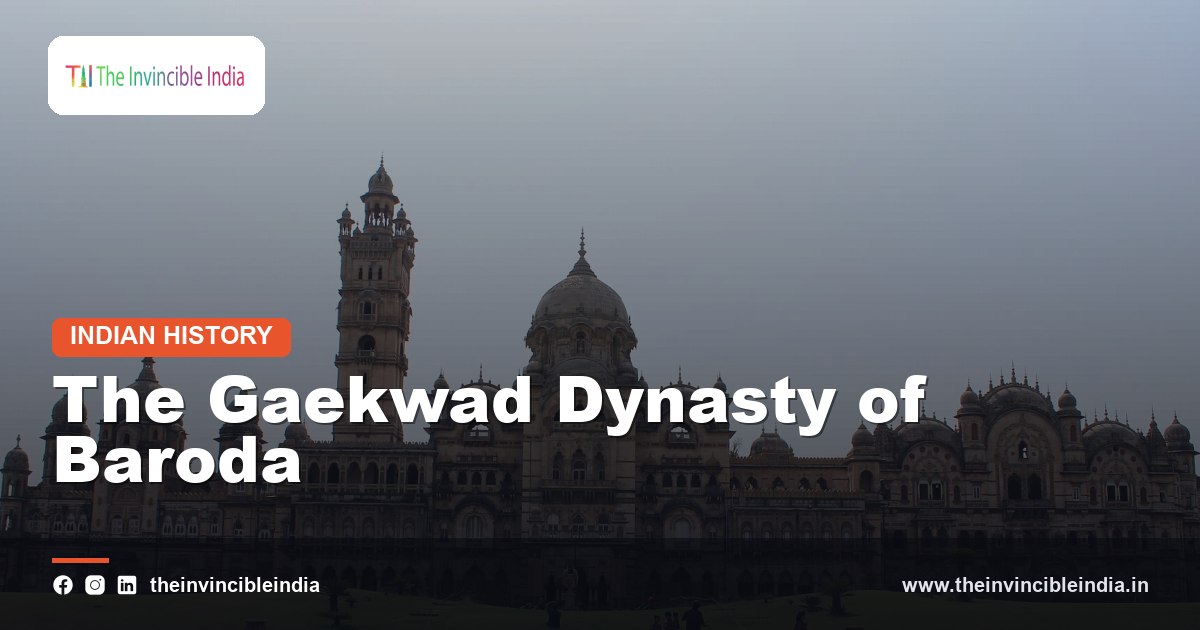
The Gaekwad dynasty, also spelled Gaikwad, was a Maratha ruling house that governed the state of Baroda, centred on the city now known as Vadodara in Gujarat, from the eighteenth century until the integration of the princely states into independent India. Rising to prominence in the early eighteenth century under Pilaji Gaekwad during the great expansion of Maratha power, the Gaekwads established one of the most important princely states of western India. The dynasty is especially remembered for the reforming ruler Sayajirao Gaekwad III and for the magnificent Laxmi Vilas Palace in Vadodara. Emerging from the wider Maratha movement described in our guide to the Maratha Empire, the Gaekwads became a leading dynasty of modern Indian history, and this account keeps to broadly established facts where details are uncertain.
Quick answer: The Gaekwad dynasty, also spelled Gaikwad, was a Maratha ruling house that governed the state of Baroda, centred on present-day Vadodara in Gujarat, from the eighteenth century until the integration of the princely states into independent India. The dynasty rose under Pilaji Gaekwad during the expansion of Maratha power and became one of the leading princely states of western India. It is especially remembered for the reformer Sayajirao Gaekwad III and for the Laxmi Vilas Palace at Vadodara.
Key Takeaways
- The Gaekwads, also spelled Gaikwad, were a Maratha ruling house that governed the state of Baroda in present-day Gujarat.
- The dynasty rose to prominence in the early eighteenth century under Pilaji Gaekwad during the expansion of Maratha power.
- Their capital was the city of Baroda, now known as Vadodara.
- Baroda became one of the leading and most progressive princely states of western India.
- Sayajirao Gaekwad III, of the late nineteenth and early twentieth centuries, is remembered as a notable reformer.
- The magnificent Laxmi Vilas Palace in Vadodara is the dynasty’s most celebrated monument.
Read on for the history, culture, and legacy in detail.
Quick Facts
| Detail | Information |
|---|---|
| Dynasty | Gaekwad dynasty (also spelled Gaikwad) |
| Origin | Maratha ruling house |
| State | Baroda, centred on present-day Vadodara, Gujarat |
| Rose Under | Pilaji Gaekwad in the early eighteenth century |
| Period | Eighteenth century to integration with India in 1947 |
| Notable Ruler | Sayajirao Gaekwad III, a noted reformer |
| Famous Palace | Laxmi Vilas Palace, Vadodara |
| Status | One of the leading princely states of western India |
Who Were the Gaekwads?
The Gaekwads, also spelled Gaikwad, were a Maratha ruling house that governed the state of Baroda in present-day Gujarat from the eighteenth century until the mid-twentieth century. They emerged as one of the great families associated with the expansion of Maratha power across western India and beyond, establishing a durable dynasty in Gujarat. Ruling from the city of Baroda, now known as Vadodara, the Gaekwads built one of the most important princely states of the subcontinent. The dynasty is remembered both for its political prominence and for the cultural and administrative achievements of its rulers, particularly in the modern era. The Gaekwad name became closely tied to the identity of Baroda and its heritage. As a Maratha house that rose to rule a major state in Gujarat, the Gaekwads represent an important strand in the history of the Maratha movement and of the princely states of India.
How Did the Gaekwad Dynasty Rise?
The Gaekwad dynasty rose to prominence in the early eighteenth century, during the period when Maratha power was expanding across western India from its base in the Deccan. The family came to the fore under Pilaji Gaekwad, who established the dynasty’s authority in the Gujarat region as Maratha influence extended into those lands. In this era of dynamic expansion, able commanders and families carved out spheres of authority, and the Gaekwads secured control of the Baroda region. Their rise was tied to the wider growth of Maratha power and the opportunities it created for ambitious leaders. Over succeeding generations the dynasty consolidated its position and established Baroda as its seat. The details of these early campaigns are known from the records of the period. The rise of the Gaekwads illustrates how the Maratha expansion gave birth to several enduring ruling houses across western and central India.
Who Was Pilaji Gaekwad?
Pilaji Gaekwad is remembered as the founder of the fortunes of the Gaekwad dynasty in Gujarat, the leader under whom the family rose to prominence in the early eighteenth century. As Maratha power extended into the Gujarat region, Pilaji established the dynasty’s authority there and laid the foundations on which his successors would build the state of Baroda. He is regarded as the progenitor of the ruling line, and his efforts secured the family a lasting territorial base. The details of his career belong to the turbulent and expansive period of early-eighteenth-century Maratha history. His work in establishing the dynasty in Gujarat was decisive for all that followed. Pilaji Gaekwad therefore occupies the honoured place of founder in the dynasty’s history. The state he helped establish would endure for more than two centuries, making him a pivotal figure in the story of the Gaekwads and of Baroda.
Where Was the State of Baroda?
The state of Baroda was centred on the city now known as Vadodara in the Gujarat region of western India, and it comprised territories in and around that part of the subcontinent. Gujarat, with its fertile plains, trading cities and access to the sea, was a prosperous and strategically significant region, and Baroda became one of its most important states. The city of Baroda served as the capital and the centre of the dynasty’s political, cultural and administrative life. The state’s territories made it one of the larger and wealthier princely states of western India. Its location gave it a prominent place in the economy and culture of the region. The prosperity of Gujarat provided the resources that supported the dynasty’s achievements. The state of Baroda, with its capital at Vadodara, was thus the heartland of Gaekwad power and the stage for the dynasty’s notable contributions to modern Indian history.
What Was the Gaekwads' Relationship with the Marathas?
The Gaekwads’ relationship with the wider Maratha polity was central to their origin and identity, as the dynasty arose from the great expansion of Maratha power across India. The Gaekwads were one of several prominent Maratha families who established states in different regions during the eighteenth century, operating within the broader framework of the Maratha confederacy. Their rule in Gujarat formed part of the extension of Maratha authority into western India. Over time, as the political landscape of the subcontinent changed, the relationship between the Gaekwads and the other Maratha powers evolved. The dynasty eventually came to rule Baroda as a distinct state with its own standing. This Maratha heritage remained a defining feature of the Gaekwad identity. The dynasty’s place within the Maratha movement connects its history to one of the most important political developments of early modern India.
How Did Baroda Become a Princely State?
Baroda became a princely state as the political order of the subcontinent took shape in the period of growing British paramountcy during the eighteenth and nineteenth centuries. As British power expanded across India, many ruling houses, including the Gaekwads, entered into arrangements that recognised their rule over their territories while acknowledging the overarching authority of the colonial power. Under this system Baroda was counted among the princely states, retaining its own ruler, administration and internal governance. It became one of the leading and most prominent of these states in western India. This status allowed the Gaekwads to continue governing Baroda and to pursue their own programmes of development. The princely-state framework shaped the later history of the dynasty until the integration of the states into independent India. Baroda’s standing as a major princely state is an important part of the Gaekwad story in the modern era.
Who Was Sayajirao Gaekwad III?
Sayajirao Gaekwad III is the most celebrated ruler of the Gaekwad dynasty, remembered as a progressive reformer who governed Baroda in the late nineteenth and early twentieth centuries. Under his long rule, Baroda became known as one of the most forward-looking and well-administered of the princely states, associated with notable efforts in education, social reform and public welfare. He is remembered for promoting schooling and learning, for encouraging reforms aimed at improving the lives of his people, and for fostering institutions that advanced the development of the state. His reign gave Baroda a reputation for enlightened governance that endured well beyond his lifetime. The specific measures and achievements attributed to him belong to the broadly recorded history of the modern princely states. Sayajirao Gaekwad III stands as the figure who most defines the dynasty’s modern legacy. His rule is central to the memory of the Gaekwads and of Baroda.
What Reforms Is Baroda Remembered For?
Baroda under the Gaekwads, and especially under Sayajirao Gaekwad III, is remembered for a reputation as one of the most progressive and reform-minded of the princely states. The state became associated with efforts to promote education, including the encouragement of schooling and the establishment of institutions of learning that served its people. It is also remembered for measures aimed at social improvement and public welfare, reflecting a commitment to the modernisation of the state. These reforms gave Baroda a distinctive standing among the princely states of India. The emphasis on education and development became a hallmark of the dynasty’s modern rule. While the specific details belong to the broadly recorded history of the period, the general reputation of Baroda as a centre of reform is well established. This legacy of progressive governance remains one of the most admired aspects of the Gaekwad dynasty’s contribution to modern Indian history.
What Is the Laxmi Vilas Palace?
The Laxmi Vilas Palace in Vadodara is the most celebrated monument of the Gaekwad dynasty, a grand and expansive royal residence built in the period of the dynasty’s modern prominence. Renowned for its vast scale and its richly decorated architecture, the palace blends various styles in a manner characteristic of the great palace-building of the princely states. It served as the residence of the Gaekwad rulers and as a centre of the court’s ceremonial and cultural life. The palace is admired for its grandeur, its artistic detail and its extensive grounds, and it stands as a symbol of the wealth and status of the dynasty. Today it remains one of the most famous landmarks of Vadodara and a major heritage attraction. The Laxmi Vilas Palace embodies the splendour of the Gaekwads at the height of their power. It is the enduring architectural emblem of the dynasty and its capital.
How Did the Gaekwads Patronise Culture and Education?
The Gaekwads were notable patrons of culture and education, and this patronage forms an important part of their legacy, especially in the modern era. The dynasty, particularly under Sayajirao Gaekwad III, is remembered for its encouragement of learning, the support of schools and institutions, and the promotion of the arts and scholarship in Baroda. The court supported cultural life and helped make the city a centre of education and the arts in the region. This patronage reflected the progressive outlook for which the state became known. The investment in education and culture gave Baroda a lasting reputation as a hub of learning in western India. The institutions and traditions fostered under the dynasty contributed to the cultural vitality of the city and region. Through this support for culture and education, the Gaekwads left a legacy that extended well beyond their political role and continues to be valued today.
What Was the Gaekwad Administration Like?
The Gaekwad administration of Baroda combined the authority of the ruler with a developed system of governance that managed the affairs of a substantial state. At the head stood the Gaekwad ruler, supported by ministers, officials and departments responsible for revenue, justice, public works and other functions of government. In the modern era, and particularly under reforming rulers, the administration became known for its relatively progressive and well-organised character. The prosperity of the Gujarat region provided the resources that sustained the state and its programmes. The administration oversaw the development of infrastructure, education and public institutions that gave Baroda its reputation. This system of governance allowed the dynasty to pursue its ambitions for the modernisation of the state. The administrative achievements of the Gaekwads, especially their efforts at reform and development, are an important dimension of their standing as one of the leading princely states of India.
How Did Baroda Join Independent India?
Baroda, like the other princely states, joined the Indian Union in the period following the independence of India in 1947, when the states were integrated into the new nation. With the end of British paramountcy, the rulers of the princely states acceded to India, and their territories were merged into the republic through the process of integration that reshaped the political map of the subcontinent. Baroda became part of independent India, and its territories were absorbed into the administrative structure of the nation. This transition brought to a close the era of the Gaekwads as ruling princes, though the family retained its historical standing and heritage. The integration of the states was one of the great achievements of the early years of independent India. For the Gaekwads, it marked the end of their role as sovereign rulers of a princely state. Baroda thus became part of the modern Indian nation.
What Is the Cultural Legacy of the Gaekwads?
The cultural legacy of the Gaekwads is rich and visible, embracing architecture, education, the arts and the heritage of the city of Vadodara. The magnificent Laxmi Vilas Palace stands as the most striking monument of the dynasty, a symbol of its wealth and status. The institutions of learning and culture fostered under the dynasty, especially in the era of reform, gave Baroda a lasting reputation as a centre of education in western India. The city of Vadodara retains much of the heritage shaped by the Gaekwads, including buildings, institutions and traditions associated with their rule. The dynasty’s reputation for progressive governance and cultural patronage remains an important part of its memory. This legacy makes the Gaekwads one of the more celebrated of the modern ruling houses of India. Their cultural inheritance continues to define the identity and heritage of Vadodara today.
Why Are the Gaekwads Significant?
The Gaekwads are significant as one of the leading Maratha ruling houses and as the dynasty that made Baroda one of the most important and progressive princely states of modern India. Their rise from the eighteenth-century expansion of Maratha power illustrates the dynamism of that great movement and its lasting influence across the subcontinent. Their rule in the modern era, particularly under Sayajirao Gaekwad III, gave Baroda a reputation for enlightened governance, educational advancement and social reform that distinguished it among the princely states. The architectural and cultural heritage they left, embodied in the Laxmi Vilas Palace and the institutions of Vadodara, remains a treasured part of the region. For students of Indian history, the Gaekwads bridge the world of the Marathas and the modern princely states. Their significance rests on this combination of Maratha origins, progressive rule and enduring cultural legacy.
The Gaekwad Dynasty Today
The Gaekwad dynasty is remembered today chiefly through the heritage of Vadodara, above all the magnificent Laxmi Vilas Palace, and through the enduring reputation of Baroda as a centre of education and culture. The palace remains one of the most famous landmarks of the city and a major heritage attraction, drawing visitors interested in the splendour of the princely states. The institutions of learning and the cultural traditions fostered under the dynasty continue to shape the identity of Vadodara as a vibrant city of western India. The family retains its historical standing and its association with the heritage of Baroda. For readers of Indian history, the Gaekwads offer a vivid example of a Maratha house that became a leading and progressive princely state. Their legacy endures in the palaces, institutions and cultural life of Vadodara and in the memory of modern Indian history.
Sources & Further Reading
- Archaeological Survey of India (asi.nic.in).
- Ministry of Culture, Government of India (indiaculture.gov.in).
- Tourism Corporation of Gujarat (gujarattourism.com).
Frequently Asked Questions
Who were the Gaekwads?
The Gaekwads, also spelled Gaikwad, were a Maratha ruling house that governed the state of Baroda, centred on present-day Vadodara in Gujarat, from the eighteenth century until the integration of the princely states into independent India. They became one of the leading princely states of western India.
How did the Gaekwad dynasty rise?
The Gaekwad dynasty rose to prominence in the early eighteenth century under Pilaji Gaekwad, during the expansion of Maratha power into the Gujarat region. The family established its authority in and around Baroda and built one of western India’s major states.
Who was Sayajirao Gaekwad III?
Sayajirao Gaekwad III was the most celebrated Gaekwad ruler, who governed Baroda in the late nineteenth and early twentieth centuries and is remembered as a progressive reformer. Under him Baroda became known for its efforts in education and social reform.
What is the Laxmi Vilas Palace?
The Laxmi Vilas Palace in Vadodara is the most famous monument of the Gaekwad dynasty, a grand royal residence admired for its scale and richly decorated architecture. It served as the residence of the Gaekwad rulers and remains a major heritage landmark.
Where was the state of Baroda?
The state of Baroda was centred on the city now known as Vadodara in the Gujarat region of western India. It was one of the larger and wealthier princely states, and its capital was the heart of Gaekwad power.
What happened to Baroda after independence?
Baroda, like the other princely states, was integrated into the Indian Union following independence in 1947, ending the Gaekwads’ role as ruling princes. Its territories were merged into independent India during the process of integration of the states.


