

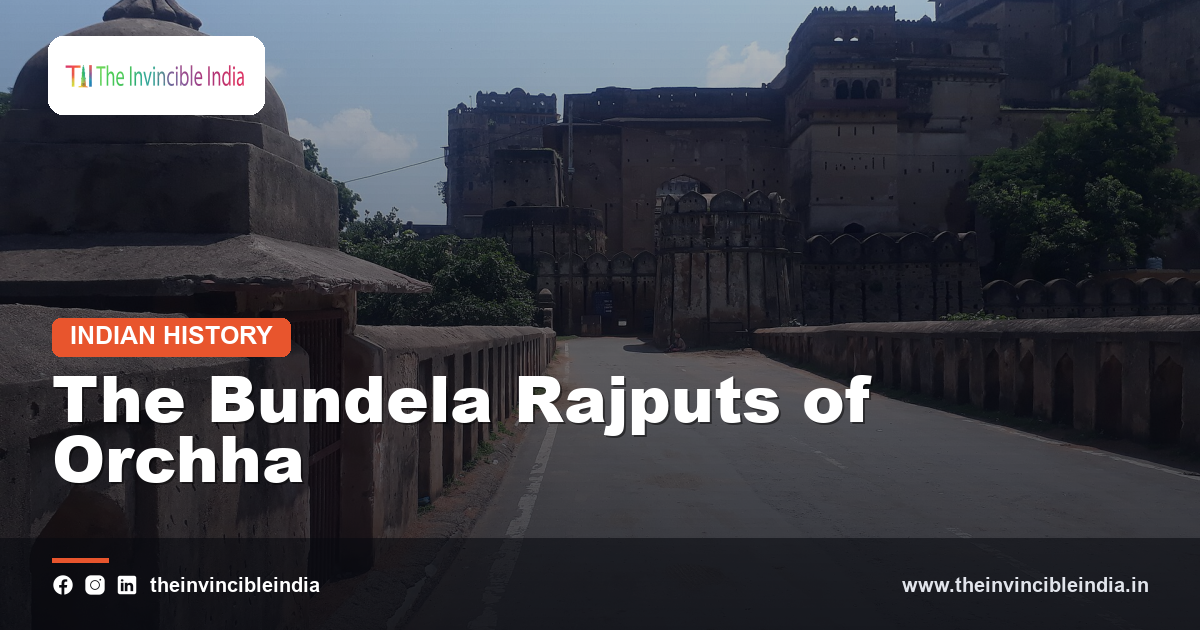
The Bundela Rajputs were a Rajput clan who rose to rule the region of Bundelkhand in central India, establishing their most famous seat at Orchha on the Betwa river in present-day Madhya Pradesh. Founding Orchha in the early sixteenth century under Rudra Pratap Singh, the Bundelas created a kingdom known for its striking palaces, temples and royal cenotaphs, and for figures such as Bir Singh Deo, who built the great Jahangir Mahal, and the later warrior Chhatrasal, who carved out Bundela power in Bundelkhand. As a Rajput house, their story belongs to the wider world of the clans described in our guide to the Rajputs, and this account keeps to broadly established history where particular dates and details are uncertain.
Quick answer: The Bundela Rajputs were a Rajput clan who ruled the region of Bundelkhand in central India and established their most famous seat at Orchha on the Betwa river in present-day Madhya Pradesh. Orchha was founded in the early sixteenth century under Rudra Pratap Singh, and the dynasty is remembered for rulers such as Bir Singh Deo, who built the Jahangir Mahal, and the later warrior Chhatrasal. The Bundelas left a rich legacy of palaces, temples and royal cenotaphs along the Betwa.
Key Takeaways
- The Bundelas were a Rajput clan who ruled the region of Bundelkhand in central India.
- Their most famous seat was Orchha, on the Betwa river in present-day Madhya Pradesh.
- Orchha was founded in the early sixteenth century under the ruler Rudra Pratap Singh.
- Bir Singh Deo is remembered for building the Jahangir Mahal and other monuments at Orchha.
- The later warrior Chhatrasal rose to establish Bundela power across Bundelkhand.
- The Bundelas left a rich heritage of palaces, temples and royal cenotaphs, known as chhatris.
Read on for the history, culture, and legacy in detail.
Quick Facts
| Detail | Information |
|---|---|
| Dynasty | Bundela Rajputs (Bundela clan) |
| Region | Bundelkhand, central India |
| Chief Seat | Orchha, on the Betwa river, present-day Madhya Pradesh |
| Orchha Founded | Early sixteenth century, under Rudra Pratap Singh |
| Notable Ruler | Bir Singh Deo, builder of the Jahangir Mahal |
| Later Hero | Chhatrasal, who rose in Bundelkhand |
| Monuments | Palaces, temples and royal cenotaphs (chhatris) |
| River | The Betwa, which flows by Orchha |
Who Were the Bundelas?
The Bundelas were a Rajput clan who rose to rule the region of Bundelkhand in central India, giving their name to that historic land. Like other Rajput houses, they claimed a prestigious lineage and upheld the martial traditions and values associated with the Rajputs. From their strongholds in the rugged country of central India, the Bundelas established kingdoms and principalities, the most famous centred on Orchha. Their history is marked by the building of impressive palaces and temples, by relations with the great empires of their time, and by episodes of resistance and warfare. The clan produced notable rulers and warriors whose deeds are remembered in the traditions of Bundelkhand. As a Rajput dynasty of central India, the Bundelas occupy an important place in the regional history of the subcontinent. Their legacy survives vividly in the monuments and traditions of the land that bears their name.
Where Is Bundelkhand?
Bundelkhand is a historic region of central India, spread across parts of present-day Madhya Pradesh and Uttar Pradesh, that takes its name from the Bundela Rajputs. It is a land of rocky hills, plateaus, forests and rivers, including the Betwa, which flows through the heart of the region. This rugged and varied terrain shaped the history of the region, favouring the rise of forts and strongholds and the martial traditions of its ruling clans. Bundelkhand lay between the great centres of power in northern and central India, giving it a strategic and sometimes contested position. The region developed a distinctive culture, architecture and identity under the Bundelas and other local powers. Its landscape of hills and rivers remains dotted with the forts, palaces and temples of its history. Bundelkhand is thus both a geographical region and a cultural identity closely bound to the Bundela dynasty that gave it its name.
When Was Orchha Founded?
Orchha, the most famous seat of the Bundelas, was founded in the early sixteenth century under the ruler Rudra Pratap Singh, who is remembered as the founder of the city and the one who established it as the dynasty’s capital. Set on the banks of the Betwa river, Orchha was chosen for its favourable position and became the centre of Bundela power in the region. From this seat the dynasty developed a kingdom and adorned the city with the palaces, temples and monuments for which it is celebrated. The founding of Orchha marked the beginning of the most brilliant phase of Bundela history. Rudra Pratap Singh is therefore honoured as the founder of the capital and the builder of the dynasty’s fortunes at Orchha. The city he established would grow into one of the most remarkable heritage centres of central India, embodying the achievements of the Bundela Rajputs.
Why Is Orchha Famous?
Orchha is famous as one of the most remarkable heritage towns of central India, renowned for its concentration of palaces, temples and royal cenotaphs set on and around the Betwa river. The town preserves a striking ensemble of Bundela architecture, including grand palaces built on a fortified island, important temples, and the distinctive cenotaphs that line the riverbank. The scale and beauty of these monuments make Orchha a celebrated destination for those interested in history, architecture and heritage. The setting on the Betwa, with its forts, domes and towers rising above the water and the surrounding country, adds to the town’s distinctive atmosphere. Orchha reflects the wealth, ambition and artistic patronage of the Bundela rulers at the height of their power. It stands today as a living museum of Bundela architecture and remains the most famous and evocative symbol of the dynasty’s achievements.
Who Was Rudra Pratap Singh?
Rudra Pratap Singh is remembered as the founder of Orchha and an early leader who established the Bundelas firmly in the region during the early sixteenth century. Under his leadership the dynasty founded its famous capital on the Betwa and laid the foundations of the kingdom that his successors would develop and adorn. He is honoured in the traditions of the Bundelas as the figure who established the seat from which the dynasty rose to prominence. His founding of Orchha was a decisive moment in the clan’s history, giving the Bundelas a centre worthy of their ambitions. The details of his career belong to the early history of the dynasty in the region. Rudra Pratap Singh occupies the honoured place of founder in the memory of the Bundelas. The capital he established would become one of the great heritage centres of central India, a lasting monument to his legacy.
Who Was Bir Singh Deo?
Bir Singh Deo is among the most celebrated rulers of the Bundelas of Orchha, remembered above all as a great builder who adorned the kingdom with magnificent architecture. He is especially associated with the construction of the Jahangir Mahal, a grand palace at Orchha built to commemorate a visit by the Mughal emperor Jahangir, with whom he maintained close relations. His reign is regarded as a high point of Bundela power and artistic patronage, during which Orchha was enriched with palaces and monuments. Bir Singh Deo’s relationship with the Mughal court reflects the ways in which Rajput rulers engaged with the dominant imperial power of the age. His building projects left an enduring architectural legacy that remains central to the fame of Orchha. Bir Singh Deo therefore stands as one of the dynasty’s most important figures, remembered for both his political prominence and his patronage of architecture.
What Is the Jahangir Mahal?
The Jahangir Mahal is one of the most celebrated monuments of Orchha, a grand palace built under Bir Singh Deo and named in honour of the Mughal emperor Jahangir. Renowned for its impressive architecture, the palace combines strong fortified forms with richly decorated detail, domes, balconies and ornamental features characteristic of the Bundela style. It was built to commemorate the emperor’s visit and stands as a symbol of the relationship between the Bundelas and the Mughal court. The palace is admired for its harmonious design and its blend of architectural influences, reflecting the cultural exchanges of the age. Rising among the other monuments of Orchha, it forms a central part of the town’s remarkable heritage ensemble. The Jahangir Mahal remains one of the most striking and famous examples of Bundela architecture. It embodies both the artistic achievement and the political connections of the dynasty at its height.
How Did the Bundelas Relate to the Mughals?
The Bundelas related to the Mughal Empire through a complex and shifting pattern of alliance, service, accommodation and, at times, resistance, as was common among the Rajput houses of the era. During certain periods, Bundela rulers maintained close relations with the Mughal court, as reflected in the career of Bir Singh Deo and the building of the Jahangir Mahal in honour of the emperor Jahangir. At other times, tensions and conflict arose between the Bundelas and the imperial power. These relations were shaped by the wider politics of the age, in which the great Mughal Empire interacted with the many Rajput and regional powers of the subcontinent. The Bundelas navigated this relationship to preserve their authority and advance their interests. Their engagement with the Mughals is an important dimension of their history and illustrates the layered political world of early modern India in which Rajput kingdoms operated.
Who Was Chhatrasal?
Chhatrasal is one of the most renowned figures associated with the Bundelas, a later warrior who rose to establish and extend Bundela power across Bundelkhand. He is remembered in tradition as a brave and determined leader who carved out a substantial realm in the region through his military prowess and leadership. His career unfolded in a period of shifting fortunes for the great powers of the subcontinent, and he is celebrated in the traditions of Bundelkhand as a hero of the Bundela cause. Chhatrasal is also associated with connections to the rising Maratha power of his time. His deeds and his establishment of Bundela authority made him a legendary figure in regional memory. The details of his campaigns belong to the broadly recorded history of the period and to the traditions of Bundelkhand. Chhatrasal stands as a celebrated warrior whose name is closely tied to the later glory of the Bundelas.
What Are the Cenotaphs of Orchha?
The cenotaphs of Orchha, known as chhatris, are among the most distinctive and evocative monuments associated with the Bundelas, a row of memorial structures built in honour of the dynasty’s rulers along the banks of the Betwa river. These elegant domed and towered structures served as commemorative monuments to the kings of Orchha and form a striking group set beside the flowing river. Their graceful forms, rising above the water and the surrounding landscape, create one of the most memorable scenes of the town. The chhatris reflect the Bundela tradition of honouring departed rulers with fine architecture. They are admired for their beauty and their harmonious setting, and they contribute greatly to the heritage character of Orchha. The royal cenotaphs stand as a lasting tribute to the Bundela rulers and as a cherished part of the architectural legacy of the dynasty along the Betwa.
What Was Bundela Architecture Like?
Bundela architecture, seen at its finest in Orchha and other centres of the region, is renowned for its grand palaces, temples and cenotaphs that blend strength with ornamental beauty. The style combines fortified forms with richly decorated detail, including domes, arches, balconies, towers and carved ornament, creating buildings that are both imposing and elegant. Bundela palaces, built in prominent and defensible positions, express the power and wealth of the ruling clan, while the temples reflect the devotional life of the region. The cenotaphs along the Betwa show the tradition of commemorative architecture. The style reflects both the martial character of the Bundelas and the cultural exchanges of the age, including influences from the wider architectural traditions of the subcontinent. Bundela architecture forms one of the most distinctive regional styles of central India. Its monuments remain the most visible and celebrated legacy of the dynasty’s artistic patronage.
How Did the Bundelas Patronise Religion and Culture?
The Bundelas were patrons of religion and culture, and their support for temples, devotion and the arts forms an important part of their legacy. Across their territories, and especially at Orchha, the dynasty built and endowed temples and supported the religious life of the region in keeping with their Rajput traditions. Orchha is known for important temples associated with the devotion of the Bundelas and the people of the region. The court also fostered cultural life, and the region developed distinctive traditions of architecture, art and local culture under the dynasty. This patronage tied the Bundelas to the sacred landscape and cultural identity of Bundelkhand. The religious and cultural achievements of the dynasty complemented its political power and architectural grandeur. Through such patronage the Bundelas left a rich inheritance that continues to shape the devotional and cultural heritage of the region, visible in its temples, festivals and traditions.
How Did Bundela Power Change Over Time?
Bundela power changed considerably over time, rising to great heights, experiencing periods of conflict and division, and adapting to the shifting balance of power in central India. From the founding of Orchha and the brilliant era of rulers such as Bir Singh Deo, the dynasty established itself as a leading power of Bundelkhand. Later, figures such as Chhatrasal extended Bundela authority across the region in a period of changing fortunes for the great empires. Over the centuries the Bundela territories were divided among different branches and principalities, and the clan navigated relations with the Mughals, the Marathas and later the British. As the political order of the subcontinent transformed, Bundela principalities were drawn into the framework of the princely states. The history of Bundela power thus reflects the broader currents of early modern and modern Indian history, in which Rajput houses continually adapted to survive.
Why Are the Bundelas Significant?
The Bundelas are significant as the Rajput clan that gave its name to Bundelkhand and left an extraordinary architectural and cultural legacy in central India. Their capital of Orchha, with its palaces, temples and royal cenotaphs, ranks among the most remarkable heritage ensembles in the country and embodies the wealth and artistry of the dynasty. Figures such as Bir Singh Deo, builder of the Jahangir Mahal, and the warrior Chhatrasal are celebrated in the history and traditions of the region. The Bundelas’ engagement with the great empires of their time illustrates the layered political world of early modern India. Their distinctive style of architecture forms an important chapter in the artistic heritage of the subcontinent. For students of Indian history, the Bundelas offer a vivid example of a Rajput house of central India. Their significance rests on this blend of regional power and enduring cultural achievement.
The Bundela Rajputs Today
The Bundela Rajputs are remembered today above all through the magnificent heritage of Orchha and the broader cultural identity of Bundelkhand. The palaces, temples and riverside cenotaphs of Orchha draw visitors, historians and admirers of architecture from across the country and beyond, standing as a living monument to the dynasty’s achievements. The region of Bundelkhand retains the traditions, architecture and cultural character shaped by the Bundelas and preserves the memory of rulers and warriors such as Bir Singh Deo and Chhatrasal. Efforts to conserve and present these heritage sites help sustain the legacy of the dynasty. For readers of Indian history, the Bundelas offer a vivid picture of a Rajput kingdom of central India and its brilliant artistic patronage. Their legacy endures in the stone palaces and temples of Orchha, in the monuments along the Betwa, and in the identity of Bundelkhand.
Sources & Further Reading
- Archaeological Survey of India (asi.nic.in).
- Ministry of Culture, Government of India (indiaculture.gov.in).
- Madhya Pradesh Tourism Board (mptourism.com).
Frequently Asked Questions
Who were the Bundelas?
The Bundelas were a Rajput clan who ruled the region of Bundelkhand in central India and established their most famous seat at Orchha on the Betwa river. They are remembered for their striking palaces, temples and royal cenotaphs and for figures such as Bir Singh Deo and Chhatrasal.
When was Orchha founded?
Orchha was founded in the early sixteenth century under the ruler Rudra Pratap Singh, who established it as the capital of the Bundelas on the banks of the Betwa river. It became the centre of Bundela power and heritage in the region.
Who built the Jahangir Mahal?
The Jahangir Mahal at Orchha is associated with the ruler Bir Singh Deo, who built it in honour of the Mughal emperor Jahangir. It is one of the most celebrated examples of Bundela palace architecture.
Who was Chhatrasal?
Chhatrasal was a later warrior associated with the Bundelas who rose to establish and extend Bundela power across Bundelkhand. He is celebrated in regional tradition as a brave leader and is also linked with connections to the rising Maratha power of his time.
What are the cenotaphs of Orchha?
The cenotaphs of Orchha, known as chhatris, are elegant domed memorial structures built in honour of the Bundela rulers along the banks of the Betwa river. They form one of the most distinctive and memorable features of the town’s heritage.
Where is Bundelkhand?
Bundelkhand is a historic region of central India spread across parts of present-day Madhya Pradesh and Uttar Pradesh, named after the Bundela Rajputs. It is a land of hills, plateaus, forests and rivers, including the Betwa.


