

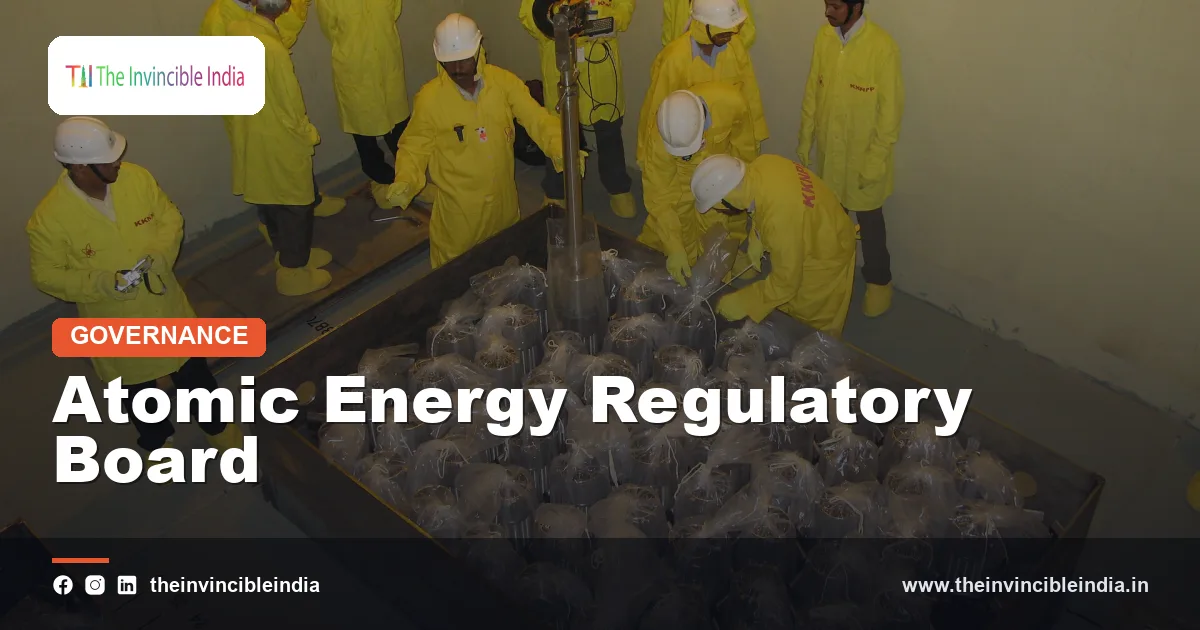
The Atomic Energy Regulatory Board (AERB) is India’s national regulator for nuclear and radiation safety, constituted in 1983 and reporting to the Atomic Energy Commission (AEC). The Atomic Energy Regulatory Board frames safety standards, grants licences and authorisations, and inspects nuclear power plants, research reactors, fuel-cycle facilities and the many medical and industrial uses of radiation across the country.
Headquartered at Niyamak Bhavan in Anushaktinagar, Mumbai, the Atomic Energy Regulatory Board does not build or run reactors itself; that job belongs to operators such as the Nuclear Power Corporation of India Limited (NPCIL). Because the regulator was set up under the Atomic Energy Act, 1962 by executive order rather than by its own statute, questions about its independence have been a recurring theme in India’s nuclear policy debate.
| Attribute | Details |
|---|---|
| Full name | Atomic Energy Regulatory Board (AERB) |
| Constituted | 15 November 1983 |
| Legal basis | Established under Sections 16, 17 and 23 of the Atomic Energy Act, 1962 and the Environment (Protection) Act, 1986 |
| Reports to | The Atomic Energy Commission (AEC), chaired by the Secretary, Department of Atomic Energy |
| Headquarters | Niyamak Bhavan, Anushaktinagar, Mumbai, Maharashtra |
| Mandate | Nuclear safety, radiation safety and regulation of radioactive waste |
| Regulated entities | Nuclear power plants, research reactors, fuel-cycle facilities, hospitals, industries and research institutions using radiation |
| Predecessor | Safety Review Committee and radiological safety arrangements within the Department of Atomic Energy |
| Key debate | Operational and statutory independence from the Department of Atomic Energy |
Key Takeaways
- The Atomic Energy Regulatory Board (AERB) was constituted on 15 November 1983 as India’s regulator for nuclear and radiation safety.
- The Atomic Energy Regulatory Board derives its authority from the Atomic Energy Act, 1962 and the Environment (Protection) Act, 1986, and it reports to the Atomic Energy Commission.
- The AERB grants licences and authorisations at each stage of a nuclear facility’s life: siting, construction, commissioning, operation and decommissioning.
- The Atomic Energy Regulatory Board also regulates thousands of medical, industrial and research uses of radiation, including diagnostic X-ray units, radiotherapy machines and industrial radiography sources.
- The AERB follows international norms of the International Atomic Energy Agency (IAEA) and the International Commission on Radiological Protection (ICRP) when setting dose limits and safety codes.
- The independence of the Atomic Energy Regulatory Board has been questioned because it was created by executive order and is linked administratively to the Department of Atomic Energy it oversees.
What is the Atomic Energy Regulatory Board (AERB)?
The Atomic Energy Regulatory Board is the government regulatory body that ensures the use of ionising radiation and nuclear energy in India does not cause undue risk to workers, the public or the environment. It sets the rules, reviews the safety case of each facility, grants permission to proceed and enforces compliance through inspections.
The AERB’s role is distinct from that of the promoters and operators of nuclear technology. The Department of Atomic Energy (DAE), NPCIL, the Bhabha Atomic Research Centre (BARC) and the Indira Gandhi Centre for Atomic Research (IGCAR) design, build and operate facilities. The Atomic Energy Regulatory Board stands apart and decides whether those facilities meet the safety requirements to be built or kept running.
Its remit covers not only reactors but also uranium mining and milling, fuel fabrication, heavy-water plants, spent-fuel reprocessing, radioactive waste management, radiation sources used in hospitals and industry, and the transport of radioactive materials.
When and why was the AERB set up?
The Atomic Energy Regulatory Board was set up on 15 November 1983, when the President of India constituted it under powers in the Atomic Energy Act, 1962. Before then, safety review in India’s nuclear programme was handled by committees and units inside the Department of Atomic Energy, including a Safety Review Committee created in the 1970s.
As the programme grew beyond research reactors into commercial power stations, there was a felt need for a body with a clearer regulatory identity. The goal was to separate safety oversight from the operational pressures of building and running plants, while staying within the government structure of the DAE.
Milestones in the regulator’s evolution
- 1962: The Atomic Energy Act, 1962 provides the legal foundation for development and control of atomic energy.
- 1969: The Tarapur Atomic Power Station, India’s first nuclear power station, begins operation, creating the first major regulatory challenge.
- 1983: The Atomic Energy Regulatory Board is constituted.
- 1986: The Environment (Protection) Act, 1986 gives the AERB additional authority over radioactive waste disposal as a designated authority.
- 2004: The Atomic Energy (Radiation Protection) Rules, 2004 modernise the licensing framework for radiation sources.
- 2011 onwards: The Fukushima Daiichi accident in Japan prompts safety reviews of Indian plants and renewed discussion of regulatory independence.
Who runs the AERB and how is it organised?
The Atomic Energy Regulatory Board is led by a Chairman, who works with a small board of members and a Secretary, and it reports to the Atomic Energy Commission. Board members are drawn from fields such as nuclear engineering, radiation physics, medicine and safety, and some are ex-officio.
The regulator carries out its work through a secretariat of technical officers and through a network of expert committees. Many safety reviews are carried out by specialist committees staffed by experts from within and outside the nuclear establishment.
Major review committees
- Advisory Committees for Project Safety Review (ACPSRs): examine the safety of new nuclear facilities at the siting, design and construction stages.
- Safety Review Committee for Operating Plants (SARCOP): oversees safety performance of operating nuclear power stations and other fuel-cycle facilities.
- Safety Review Committee for Applications of Radiation (SARCAR): reviews the safety of radiation applications in medicine, industry and research.
- Specialised advisory committees: handle subjects such as nuclear safety codes, radiological protection, emergency preparedness and radioactive waste.
The arrangement allows the regulator to draw on deep technical expertise, though critics note that many experts also come from the same institutions being regulated.
What does the AERB regulate?
The Atomic Energy Regulatory Board regulates all facilities and activities in India that involve nuclear material or ionising radiation, from power reactors to hospital X-ray machines. Its coverage can be understood through two broad categories: nuclear facilities and radiation facilities.
Nuclear facilities
- Nuclear power plants run by NPCIL and the Bharatiya Nabhikiya Vidyut Nigam Limited (BHAVINI), such as those at Tarapur, Rawatbhata, Kalpakkam, Narora, Kakrapar, Kaiga and Kudankulam.
- Research reactors and associated facilities of BARC and IGCAR.
- Front-end and back-end fuel-cycle facilities, including uranium mining, the Nuclear Fuel Complex in Hyderabad, spent-fuel reprocessing plants and heavy-water plants.
- Radioactive waste storage and disposal facilities.
Radiation facilities
- Medical uses such as diagnostic X-ray units, computed tomography (CT) scanners, nuclear medicine and radiotherapy equipment.
- Industrial radiography, well logging and nuclear gauges used in manufacturing, construction and oil exploration.
- Research institutions using radioactive isotopes and accelerators.
- Radiation-processing plants, including those for sterilisation and food irradiation.
- Transport of radioactive materials by road, rail, sea and air.
The number of radiation facilities across India runs into several tens of thousands, which makes the regulator’s licensing and inspection system a significant administrative task.
How does the AERB license a nuclear power plant?
The Atomic Energy Regulatory Board licenses a nuclear power plant through a staged authorisation process that spans siting, construction, commissioning, operation and eventual decommissioning. The operator cannot move from one stage to the next without written clearance from the regulator.
| Stage | What the AERB examines |
|---|---|
| Siting | Seismic and geological conditions, flooding risk, population density, meteorology and the ability to manage emergencies |
| Construction | Design safety, quality of materials and construction, and compliance with codes and standards |
| Commissioning | Pre-operational tests, fuel loading, first criticality and gradual power rise, with hold points at each step |
| Operation | Periodic safety reviews, inspections, staff qualification, maintenance and event reporting |
| Decommissioning | Plans for safe shutdown, dismantling, waste management and site release |
The regulator also requires operators to submit safety analysis reports, maintain emergency plans and report significant events. Operating licences for plants are issued for a limited period and need renewal, which gives the regulator regular opportunities to review safety performance and ageing.
What safety standards and radiation limits does the AERB follow?
The Atomic Energy Regulatory Board follows the principle of defence in depth and bases its radiation limits on recommendations of the International Commission on Radiological Protection (ICRP) and safety standards of the International Atomic Energy Agency (IAEA). The overarching idea is that exposure should be kept as low as reasonably achievable (the ALARA principle).
Dose limits in brief
- Occupational exposure for radiation workers is commonly limited to 20 millisievert per year averaged over five consecutive years, with an additional cap for any single year.
- Exposure of members of the public from regulated practices is generally limited to 1 millisievert per year.
- Special limits apply to the lens of the eye, skin, extremities and pregnant workers.
Safety principles in nuclear plants
- Defence in depth: multiple, independent layers of protection so that failure of one barrier does not lead to release of radioactivity.
- Redundancy and diversity: backup systems of different design, so a single cause cannot disable all safety functions.
- Emergency preparedness: on-site and off-site plans, drills and evacuation planning around nuclear sites.
- Safety culture: an organisational attitude that gives safety priority over production and schedules.
Actual dose limits and codes are published as regulations and safety guides by the regulator, and readers should consult current documents for exact figures.
How does the AERB oversee medical and industrial radiation?
The Atomic Energy Regulatory Board oversees medical and industrial radiation by requiring licences, registrations or authorisations for each radiation source, and by checking that users, equipment and premises meet safety criteria. Large numbers of small users make this work different from the oversight of a handful of reactors.
Hospitals and clinics that use diagnostic X-ray or radiotherapy equipment must register with the regulator and appoint a qualified radiological safety officer. The AERB has built an online system known as e-LORA (electronic Licensing of Radiation Applications) to process such applications, track licences and streamline renewals.
Typical responsibilities of users
- Employ trained personnel and a designated radiological safety officer.
- Monitor staff exposure using personal dosimeters.
- Keep sealed sources secure and account for them in inventory.
- Report loss, theft or abnormal exposure to the regulator.
- Dispose of or return spent sources through approved routes.
The importance of this system was underlined by the 2010 incident in Mayapuri, Delhi, where an orphaned cobalt-60 source from a university research irradiator ended up in a scrap market and caused serious radiation exposure. The case led to tighter attention to disused sources.
How does the AERB handle radioactive waste and emergencies?
The Atomic Energy Regulatory Board handles radioactive waste by prescribing how it must be classified, treated, stored and disposed of, and it handles emergencies by requiring each nuclear site to maintain tested response plans. Under the Environment (Protection) Act, the AERB is also the designated authority for authorising waste disposal.
Operators must limit discharges to levels set in their authorisations and monitor the environment around plants. Low- and intermediate-level waste is generally conditioned and stored in engineered facilities, while high-level waste from reprocessing is vitrified and stored pending long-term arrangements.
For emergencies, the regulator expects site, off-site and national-level arrangements, including coordination with the National Disaster Management Authority and state authorities. Incidents are reported and classified; India uses the International Nuclear and Radiological Event Scale (INES) to communicate the significance of events.
Is the AERB independent of the government?
The Atomic Energy Regulatory Board has regulatory authority over facilities of the Department of Atomic Energy, but it has historically not been a fully independent statutory body, because it was created by executive order and reports to the Atomic Energy Commission. This arrangement has led to long-running debate about possible conflicts of interest.
Arguments raised by critics
- The Chairman and members are appointed by the government, and the AEC, to which the regulator reports, is also responsible for promoting nuclear energy.
- The regulator’s budget and staff have traditionally been linked to the Department of Atomic Energy.
- International safety norms, including those encouraged by the IAEA, stress effective independence of the regulator from promotional functions.
- The Comptroller and Auditor General (CAG) of India, in a 2012 performance audit of the AERB, noted the absence of statutory backing and called for a more independent body.
Arguments made in the regulator’s defence
- The AERB takes safety decisions through technical review processes and has shut down or restricted operations when concerns arose.
- Nuclear expertise in India is concentrated in a small community, so reviewers inevitably come from related institutions.
- International peer reviews have examined the system and suggested improvements rather than finding it unworkable.
What reforms have been proposed to strengthen the AERB?
Reform proposals for the Atomic Energy Regulatory Board have centred on giving it a clear statutory identity and greater autonomy. The best-known earlier attempt was the Nuclear Safety Regulatory Authority Bill, 2011, which sought to create an independent authority but lapsed when the Lok Sabha was dissolved in 2014.
The Civil Liability for Nuclear Damage Act, 2010 addressed compensation after nuclear accidents rather than regulator independence, but it formed part of the same public conversation after Fukushima. In late 2025, Parliament took up fresh nuclear-sector legislation, reported under the name Sustainable Harnessing and Advancement of Nuclear Energy for Transforming India (SHANTI), which was described as consolidating nuclear law and giving the regulator a statutory footing. Readers should verify the current text and its implementation with official sources.
- Statutory status: establishing the regulator by an Act of Parliament rather than by executive order.
- Financial and administrative autonomy: a separate budget and staffing powers.
- Transparent appointments: selection of members through an open and qualification-based process.
- Public disclosure: regular publication of inspection findings, event reports and decisions.
Why does the Atomic Energy Regulatory Board matter for India?
The Atomic Energy Regulatory Board matters because nuclear power is a growing part of India’s low-carbon energy plans, and public trust in that expansion depends on credible safety regulation. A competent, visible regulator also supports international cooperation, fuel supply arrangements and the export of nuclear technology.
India has set long-term ambitions to expand nuclear generation substantially, including through larger indigenous pressurised heavy water reactors and fast breeder technology. Each new plant adds to the regulator’s workload, and each radiation source in a hospital or factory brings its own safeguards. The quality of oversight therefore affects both the energy transition and everyday public health.
Bottom Line
The Atomic Energy Regulatory Board is India’s nuclear and radiation safety regulator, responsible for licensing and inspecting everything from power reactors to hospital X-ray machines. Its technical role is well established, while its institutional independence remains a topic of debate and reform. This explainer was last reviewed on 17 October 2026, and readers should rely on AERB notifications for current rules.
Frequently Asked Questions
What is the Atomic Energy Regulatory Board (AERB)?
The Atomic Energy Regulatory Board is India’s regulator for nuclear and radiation safety. It was constituted in 1983 and reports to the Atomic Energy Commission. It licenses and inspects nuclear power plants, research reactors, fuel-cycle facilities and radiation sources in medicine and industry.
When was the AERB established and where is it headquartered?
The AERB was established on 15 November 1983. Its headquarters, Niyamak Bhavan, is located in Anushaktinagar, Mumbai. The regulator operates under powers conferred by the Atomic Energy Act, 1962.
Does the AERB build or run nuclear power plants?
No, the AERB does not build or operate nuclear plants. Operators such as the Nuclear Power Corporation of India Limited (NPCIL) and research bodies like BARC and IGCAR do that work. The regulator reviews and authorises their activities and checks compliance through inspections.
Is the AERB an independent body?
The AERB has regulatory powers but has historically lacked full statutory independence. It was created by executive order and reports to the Atomic Energy Commission, which also promotes nuclear energy. The CAG and others have urged a more independent statutory regulator, and legislative reforms have been proposed over the years.
What radiation limits does the AERB prescribe?
The AERB follows ICRP-based limits, generally 20 millisievert per year averaged over five years for radiation workers and 1 millisievert per year for members of the public. Special limits apply to specific body parts and to pregnant workers. Exact limits are published in the regulator’s rules and safety codes.
How does the AERB regulate hospitals and industries using radiation?
The AERB regulates hospitals and industries by requiring them to register or obtain licences for radiation equipment and sources. Users must appoint qualified safety officers, monitor worker doses and report incidents. Applications and renewals are processed largely through the online e-LORA system.
{“@context”:”https://schema.org”,”@graph”:[{“@type”:”FAQPage”,”mainEntity”:[{“@type”:”Question”,”name”:”What is the Atomic Energy Regulatory Board (AERB)?”,”acceptedAnswer”:{“@type”:”Answer”,”text”:”The Atomic Energy Regulatory Board is India’s regulator for nuclear and radiation safety. It was constituted in 1983 and reports to the Atomic Energy Commission. It licenses and inspects nuclear power plants, research reactors, fuel-cycle facilities and radiation sources in medicine and industry.”}},{“@type”:”Question”,”name”:”When was the AERB established and where is it headquartered?”,”acceptedAnswer”:{“@type”:”Answer”,”text”:”The AERB was established on 15 November 1983. Its headquarters, Niyamak Bhavan, is located in Anushaktinagar, Mumbai. The regulator operates under powers conferred by the Atomic Energy Act, 1962.”}},{“@type”:”Question”,”name”:”Does the AERB build or run nuclear power plants?”,”acceptedAnswer”:{“@type”:”Answer”,”text”:”No, the AERB does not build or operate nuclear plants. Operators such as the Nuclear Power Corporation of India Limited (NPCIL) and research bodies like BARC and IGCAR do that work. The regulator reviews and authorises their activities and checks compliance through inspections.”}},{“@type”:”Question”,”name”:”Is the AERB an independent body?”,”acceptedAnswer”:{“@type”:”Answer”,”text”:”The AERB has regulatory powers but has historically lacked full statutory independence. It was created by executive order and reports to the Atomic Energy Commission, which also promotes nuclear energy. The CAG and others have urged a more independent statutory regulator, and legislative reforms have been proposed over the years.”}},{“@type”:”Question”,”name”:”What radiation limits does the AERB prescribe?”,”acceptedAnswer”:{“@type”:”Answer”,”text”:”The AERB follows ICRP-based limits, generally 20 millisievert per year averaged over five years for radiation workers and 1 millisievert per year for members of the public. Special limits apply to specific body parts and to pregnant workers. Exact limits are published in the regulator’s rules and safety codes.”}},{“@type”:”Question”,”name”:”How does the AERB regulate hospitals and industries using radiation?”,”acceptedAnswer”:{“@type”:”Answer”,”text”:”The AERB regulates hospitals and industries by requiring them to register or obtain licences for radiation equipment and sources. Users must appoint qualified safety officers, monitor worker doses and report incidents. Applications and renewals are processed largely through the online e-LORA system.”}}]}]}


