

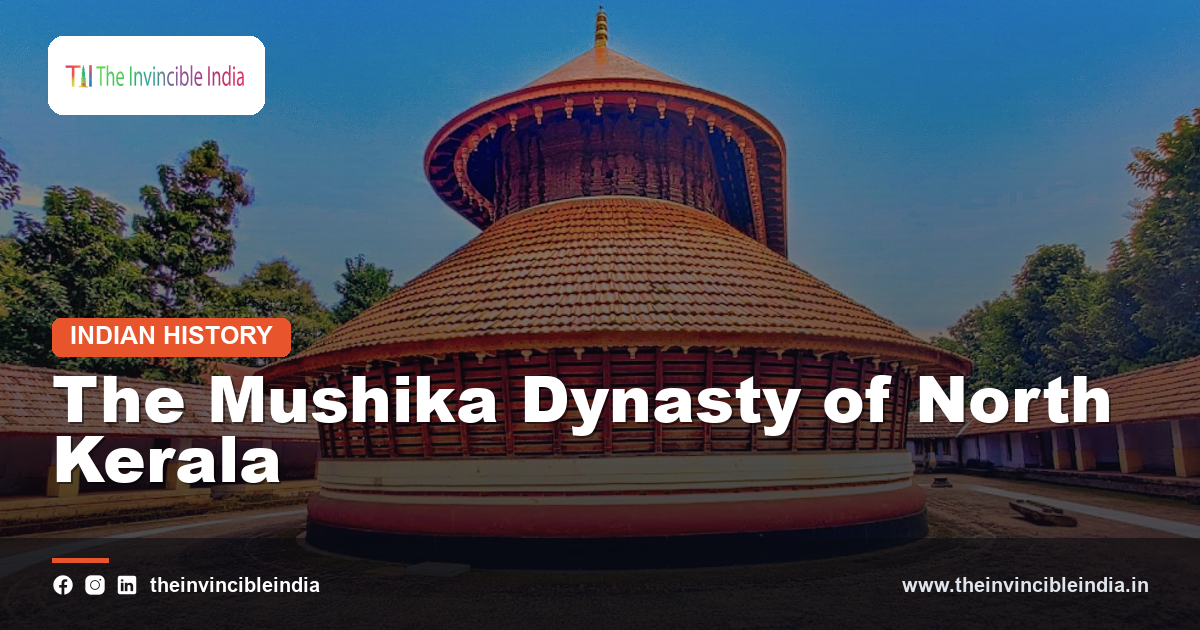
The Mushika dynasty, also spelled Mushaka and sometimes called the Ezhimala rulers, was an ancient and early-medieval ruling house of north Kerala whose heartland lay in the Ezhimala region near present-day Kannur, along the northern Malabar coast. Remembered chiefly through the Sanskrit court poem known as the Mushikavamsha, the dynasty is counted among the oldest ruling lines of the Kerala coast and is regarded by tradition as a forerunner of the later Kolathiri, or Chirakkal, house. Their territory of forest, hill and sea connected them to the wider world of south Indian kingdoms, including neighbours such as the Chola dynasty of the Tamil country. Because the surviving evidence is limited and partly literary, this guide keeps to broad terms where dates and details are uncertain and flags legends clearly as tradition.
Quick answer: The Mushika dynasty, also spelled Mushaka, was an ancient to early-medieval ruling house of north Kerala centred on the Ezhimala region near present-day Kannur. It is known chiefly from the Sanskrit chronicle-poem the Mushikavamsha, which recounts the line, and it is remembered as one of the oldest dynasties of the Kerala coast. Tradition regards the Mushikas as a precursor of the later Kolathiri, or Chirakkal, royal house of northern Malabar. Much of its story survives only in literary tradition and is treated cautiously by historians.
Key Takeaways
- The Mushika dynasty, also spelled Mushaka, ruled in north Kerala, with its heartland in the Ezhimala region near present-day Kannur.
- It is one of the oldest known ruling lines of the Kerala coast, spanning the ancient and early-medieval periods.
- The dynasty is chronicled in the Sanskrit court poem the Mushikavamsha, which recounts its kings in a mix of history and tradition.
- The Ezhimala hill and the northern Malabar coast formed the geographic core of Mushika power.
- Tradition regards the Mushikas as a precursor of the later Kolathiri, or Chirakkal, royal house.
- Much of the dynasty’s history is reconstructed from literary tradition, so its chronology is treated in broad terms.
Read on for the history, culture, and legacy in detail.
Quick Facts
| Detail | Information |
|---|---|
| Dynasty | Mushika dynasty (Mushaka / Ezhimala rulers) |
| Period | Ancient to early medieval, dates debated |
| Region | North Kerala (Ezhimala, near Kannur) |
| Core Area | Ezhimala hill and the northern Malabar coast |
| Chronicle | Mushikavamsha, a Sanskrit court poem |
| Patronage | Hindu worship, with Jain and Buddhist presence in the region |
| Legacy | Regarded by tradition as a precursor of the Kolathiri (Chirakkal) house |
| Known From | Literary tradition and scattered references |
Who Were the Mushikas?
The Mushikas were an ancient ruling family of north Kerala, counted among the earliest dynasties of the Malabar coast and remembered as a line of kings who held the Ezhimala country over many generations. Their name appears in the forms Mushika and Mushaka, and in later tradition they are closely linked with the hill of Ezhimala and the northern reaches of the Kerala coast. They belonged to the world of early south Indian kingship, in which ruling houses governed small but culturally rich territories between the Western Ghats and the sea. The dynasty is known chiefly through a Sanskrit chronicle-poem and through scattered references rather than an abundant contemporary record. What tradition agrees upon is their long association with the Ezhimala region and their standing as an old and respected royal line. The Mushikas therefore represent an early and foundational layer in the dynastic history of Kerala.
Where Was the Mushika Kingdom Located?
The Mushika kingdom was located in north Kerala, in the region of the northern Malabar coast around the hill of Ezhimala, near the modern city of Kannur. This was a land of forested hills descending to a palm-fringed coastline, well watered by rivers flowing from the Western Ghats to the Arabian Sea. The position gave the kingdom both the resources of the hinterland and access to the sea trade that had long enriched the Kerala coast. Ezhimala, a prominent headland and hill rising near the shore, formed a natural landmark and a focus of the dynasty’s identity. The territory lay in the northern part of what is today Kerala, a region of distinct culture within the broader Malayalam-speaking country. The geography of hill, river and coast therefore shaped the character and fortunes of the Mushika kingdom throughout its long history.
What Does the Name Mushika Mean?
The name Mushika, also written Mushaka, is associated in tradition with the hill of Ezhimala and the land around it, and the dynasty is sometimes explained through the imagery of a mountain in the literary sources. In Sanskrit the word has associations that tradition connected to the royal line and its mountain homeland, though such explanations belong to the poetic conventions of the age rather than to firm history. The alternate spellings reflect the way the name was rendered in different sources and languages over time. Scholars treat the traditional etymologies and origin stories as part of the dynasty’s literary memory rather than as established fact. What is clear is that the name became firmly linked with the Ezhimala region and its rulers. The naming of the Mushikas therefore illustrates how early dynasties were remembered through a blend of place, poetry and tradition rather than precise record.
When Did the Mushika Dynasty Flourish?
The Mushika dynasty flourished across a long span reaching from ancient times into the early-medieval period, making it one of the most enduring of the old Kerala ruling lines. Because the dynasty is known mainly through a later literary chronicle and scattered references, its chronology is expressed by historians in broad terms rather than with firm dates. Tradition presents a long succession of kings holding the Ezhimala country over many generations, suggesting continuity over several centuries. The dynasty belongs to the era before the rise of the better-documented medieval powers of Kerala, and it overlapped with the wider age of south Indian kingdoms along the coast and in the Tamil country. The precise beginning and end of its rule remain uncertain and debated. What is widely accepted is that the Mushikas represent a very old layer of Kerala’s dynastic past, rooted in the ancient history of the Malabar coast.
What Is the Mushikavamsha?
The Mushikavamsha is a Sanskrit court poem that chronicles the Mushika dynasty, and it is the single most important source for the memory of the line. Composed in the ornate tradition of classical Sanskrit historical poetry, it recounts a long succession of Mushika kings, weaving together genealogy, legend and praise in the manner characteristic of such works. The poem is traditionally attributed to a court poet named Atula and is generally placed in the eleventh century, a dating that scholars treat as approximate. As with other works of its kind, it blends historical memory with literary embellishment, so historians read it carefully, distinguishing its broad outline from its poetic elaborations. The Mushikavamsha is nonetheless invaluable, for it preserves the dynasty’s own account of its origins and rulers. Without this chronicle, far less would be known of the Mushikas, which makes the poem central to any study of the dynasty.
Who Was the Poet Atula?
Atula is the name traditionally given to the court poet credited with composing the Mushikavamsha, the Sanskrit chronicle of the Mushika dynasty. He is remembered as a learned poet attached to the Mushika court, writing in the classical tradition that celebrated royal lineages through elaborate verse. His work places him among the Sanskrit authors of Kerala who contributed to the region’s rich literary heritage, and his chronicle reflects the patronage that the Mushika rulers extended to learning and letters. Because information about him comes almost entirely from the poem itself and later tradition, the details of his life are known only in the most general terms. His dating, generally placed around the eleventh century, is treated by scholars as approximate. Atula is nonetheless significant as the voice through whom the Mushika dynasty is remembered. His chronicle secured the dynasty a lasting place in the literary and historical memory of Kerala.
How Was Ezhimala Important to the Mushikas?
Ezhimala was important to the Mushikas as the hill and headland that formed the geographic and symbolic heart of their kingdom on the north Kerala coast. Rising near the shore, Ezhimala is a prominent natural landmark that has long been associated with the history and legend of the region, and it gave the dynasty a lasting identity. The surrounding country, with its hills, rivers and coastline, provided the resources and the strategic position on which the kingdom rested. In tradition and literature the hill is closely bound up with the memory of the Mushika rulers and the origins of their line. Its position near the sea also linked the dynasty to the coastal trade of Malabar. Ezhimala therefore stands at the centre of the Mushika story, both as the physical core of the kingdom and as the enduring emblem of the dynasty in the historical memory of Kerala.
What Was the Mushika Link to Ancient Kerala?
The Mushika link to ancient Kerala places the dynasty within the earliest layers of the region’s recorded past, among the ruling lines that governed the Malabar coast in the age of the old south Indian kingdoms. North Kerala in ancient times was part of a world described in early Tamil and Sanskrit literature, in which chieftains and kings held territories of hill and coast and took part in the trade and culture of the peninsula. The Mushikas belong to this early setting, remembered as one of the established royal houses of the northern coast. Their traditions connect them to the deep history of the region before the rise of the medieval powers of Kerala. Because the evidence is sparse and partly literary, this connection is understood in general terms. The Mushikas therefore serve as a link between the ancient and the early-medieval history of the Kerala coast.
How Did the Mushikas Govern Their Kingdom?
The Mushikas governed their kingdom in the manner of the early ruling houses of the Kerala coast, with a king at the head of the state supported by kinsmen, chiefs and local notables who managed the land and its people. The economy rested on agriculture in the fertile coastal and riverine lands, supplemented by the trade that flowed along the Malabar shore. Local lords and communities held considerable importance in the governance of the territory, a feature that would become pronounced in the later history of Kerala. Royal patronage of temples, Brahmin settlements and learned men was an expected part of kingship and helped bind the ruler to the religious and cultural life of the region. Because detailed records are lacking, this picture is drawn in general terms from what is known of the age. The Mushika state nonetheless represents the pattern of settled coastal kingship in early Kerala.
What Religion Did the Mushikas Patronise?
The Mushikas, like other rulers of early Kerala, were patrons of religion, supporting the Hindu worship that formed the mainstream of the region’s devotional life while a broader religious landscape existed around them. Royal endowments to temples, gifts to Brahmins and the support of religious institutions were expected duties of kingship, tying the rulers to the spiritual life of their people. The north Kerala coast also knew the presence of Jain and Buddhist traditions in its earlier history, part of the wider religious diversity of the ancient peninsula, before Hindu temple culture became dominant. The Mushika court, as reflected in its literary chronicle, belonged to the Sanskritic religious and cultural world of the age. Because specific endowments are not well recorded, the picture is drawn in general terms. The Mushikas nonetheless belong to the tradition of religious patronage that shaped the temple-centred culture of Kerala.
How Did the Mushikas Relate to the Cheras and Cholas?
The Mushikas related to the great powers of the south, including the Cheras of Kerala and the Cholas of the Tamil country, through the shifting diplomacy and conflict typical of the early-medieval peninsula. As a kingdom of the northern Kerala coast, the Mushikas existed alongside and at times under the shadow of larger neighbours who contested influence across the south. The expansion of the Chola power from the Tamil country in the medieval centuries affected the whole of the Kerala coast, and the northern kingdoms were drawn into the wider struggles of the age. The Mushikas, like other coastal rulers, navigated these pressures through a mixture of resistance, submission and accommodation as circumstances required. The details of specific conflicts are known only in outline. These relationships nonetheless placed the Mushikas within the broader political world of medieval south India, connecting their coastal kingdom to the great events of the peninsula.
What Was the Maritime Role of the North Kerala Coast?
The north Kerala coast, the homeland of the Mushikas, had a significant maritime role, for the Malabar shore was one of the great centres of seaborne trade in the ancient and medieval world. The ports of the Kerala coast exported the spices, especially pepper, for which the region was famed, drawing merchants from across the Indian Ocean and beyond. This trade brought wealth, foreign contact and cultural exchange to the coastal kingdoms, including the lands of the Mushikas in the north. The sea thus connected north Kerala to a wider world of commerce stretching to Arabia, the Mediterranean and the East. Control of coastal trade was a source of prosperity and importance for the region’s rulers. While the specific commercial role of the Mushika kingdom is not recorded in detail, the maritime character of the Malabar coast formed an essential part of the setting in which the dynasty flourished.
How Did the Mushikas Evolve into the Kolathiri House?
The Mushikas are regarded by tradition as a precursor of the Kolathiri, or Chirakkal, royal house that dominated northern Malabar in the later medieval and early modern periods. According to this understanding, the ancient line of Ezhimala rulers gave way over time to the Kolathiri dynasty, which inherited the political and cultural traditions of the northern Kerala coast. The Kolathiris, also known as the rajas of Kolathunad or Chirakkal, became one of the principal powers of Malabar, and tradition links their origins and legitimacy to the older Mushika past. This continuity is understood in broad terms rather than through a precise record of succession. The evolution reflects the way early dynasties were remembered as the roots of later ruling houses. The link between the Mushikas and the Kolathiris therefore connects the ancient history of north Kerala to its better-documented medieval and early modern political life.
What Is the Legacy of the Mushika Dynasty?
The legacy of the Mushika dynasty lies above all in its place as one of the oldest ruling lines of the Kerala coast and in the Sanskrit chronicle that preserves its memory. Through the Mushikavamsha, the dynasty secured a lasting presence in the literary and historical heritage of Kerala, offering a rare window into the early dynastic past of the Malabar coast. The association of the line with Ezhimala kept its memory alive in the landscape and tradition of the region. As a forerunner of the Kolathiri house, the Mushikas form a bridge between the ancient and the medieval history of northern Kerala. Their story illustrates the antiquity and continuity of kingship on the Kerala coast. The Mushika legacy therefore endures less in monuments than in the literary memory and the historical consciousness of the region, as a foundational chapter in Kerala’s long past.
Why Is the Mushika Dynasty Significant in Indian History?
The Mushika dynasty is significant in Indian history as one of the earliest documented ruling houses of the Kerala coast and as a dynasty whose memory survives through a notable work of Sanskrit historical poetry. Their long association with the Ezhimala region of north Kerala illustrates the antiquity of settled kingship in the Malabar country, rooted in the deep history of the south Indian peninsula. The Mushikavamsha, which chronicles the line, is itself a valuable example of the regional Sanskrit literary tradition and of how early dynasties recorded their own past. As a traditional precursor of the Kolathiri house, the Mushikas link the ancient and medieval political history of northern Kerala. For students of Indian history, the dynasty offers insight into the early kingdoms of the Kerala coast. Its significance lies in this antiquity, continuity and literary memory rather than in conquest or empire.
The Mushika Dynasty Today
The Mushika dynasty is remembered today chiefly through the landscape of north Kerala and the literary heritage of the Mushikavamsha, which keep alive the memory of this ancient ruling line. The hill and headland of Ezhimala remain a notable landmark of the Kannur region, linked in tradition and local memory to the old Mushika kings. The Sanskrit chronicle continues to interest scholars of Kerala’s history and literature as a rare record of an early dynasty. The connection of the Mushikas to the later Kolathiri house ties their memory to the broader historical consciousness of northern Malabar. Historians continue to study the chronicle and the scattered evidence to understand this early kingdom and its place in the region’s past. For readers of Indian history, the Mushikas offer a glimpse of the ancient roots of Kerala’s dynastic tradition. Their legacy endures quietly in the heritage and memory of the north Kerala coast.
Sources & Further Reading
- Archaeological Survey of India (asi.nic.in).
- Ministry of Culture, Government of India (indiaculture.gov.in).
- Kerala Tourism, Government of Kerala (keralatourism.org).
Frequently Asked Questions
Who were the Mushikas?
The Mushikas, also spelled Mushakas, were an ancient to early-medieval ruling dynasty of north Kerala centred on the Ezhimala region near present-day Kannur. They are counted among the oldest ruling lines of the Kerala coast and are known chiefly from a Sanskrit chronicle-poem.
Where was the Mushika kingdom located?
The Mushika kingdom was located in north Kerala, around the hill and headland of Ezhimala on the northern Malabar coast, near the modern city of Kannur. Its territory combined forested hills, rivers and a stretch of the Arabian Sea coast.
What is the Mushikavamsha?
The Mushikavamsha is a Sanskrit court poem that chronicles the Mushika dynasty and is the main source for its memory. It is traditionally attributed to a poet named Atula and generally placed around the eleventh century, though scholars treat its details with care.
Was the Mushika dynasty connected to the Kolathiris?
Tradition regards the Mushikas as a precursor of the later Kolathiri, or Chirakkal, royal house of northern Malabar. This connection links the ancient Ezhimala rulers to the better-documented medieval dynasty, though it is understood in broad terms rather than through a precise record.
Why is so little known about the Mushikas?
Little is known in precise detail because the dynasty left few contemporary records, and its history survives mainly through the later literary chronicle and scattered references. Historians therefore reconstruct the Mushikas in broad outline and treat many traditional details with caution.
Why are the Mushikas important in Indian history?
The Mushikas are important as one of the earliest documented ruling houses of the Kerala coast, remembered through a notable work of Sanskrit historical poetry. They illustrate the antiquity of kingship in north Kerala and form a bridge to the later Kolathiri dynasty.


