

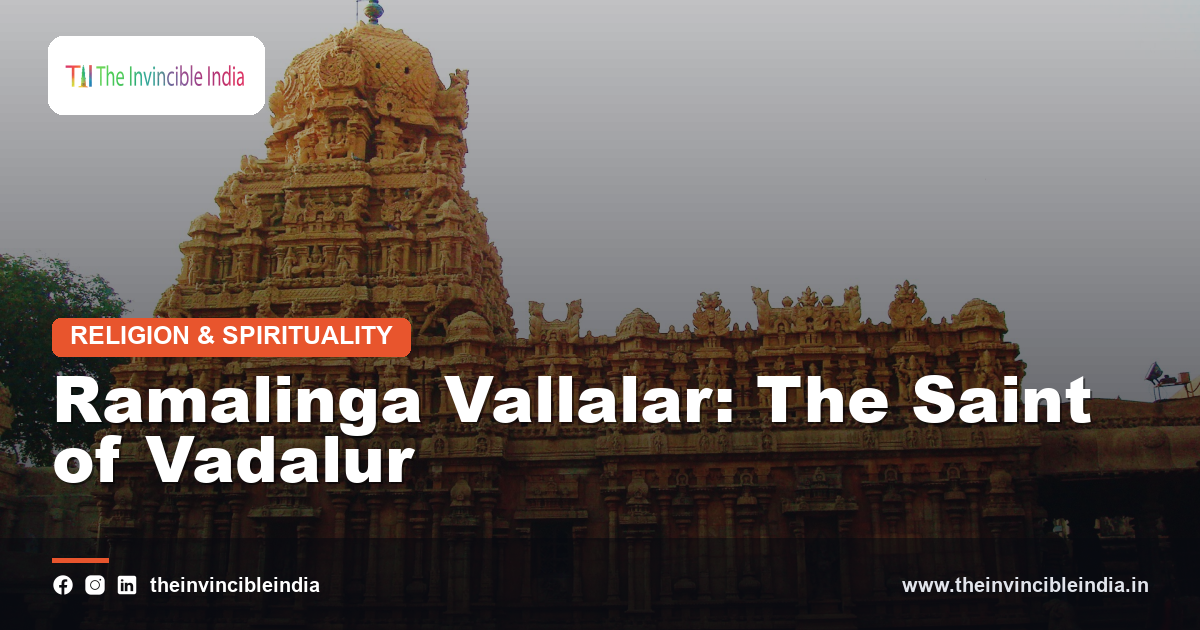
Ramalinga Vallalar, also known as Ramalinga Adigal and Ramalinga Swamigal, was a Tamil saint of the nineteenth century, commonly dated from 1823 to 1874, who taught a path of compassion, light and devotion. He is associated above all with Vadalur in Tamil Nadu, where he founded the Satya Gnana Sabha, a house of true wisdom, and a free alms-house known as the Sathya Dharma Salai. He taught jeeva karunya, compassion toward all living beings, and the ideal of a radiant body of light, and his Tamil hymns are gathered in the Thiru Arutpa. His teaching belongs to the broad tradition of Shaivism and Tamil devotion, and his vision of universal compassion continues to inspire devotees today.
Quick answer: Ramalinga Vallalar, also called Ramalinga Adigal and Ramalinga Swamigal, was a Tamil saint commonly dated from 1823 to 1874. Associated with Vadalur in Tamil Nadu, he founded the Satya Gnana Sabha and a free alms-house, the Sathya Dharma Salai. He taught jeeva karunya, compassion to all living beings, and the ideal of a body of light, and his hymns are collected in the Thiru Arutpa.
Key Takeaways
- Ramalinga Vallalar, also known as Ramalinga Adigal and Ramalinga Swamigal, was a Tamil saint commonly dated 1823 to 1874.
- He is associated above all with Vadalur in Tamil Nadu.
- He founded the Satya Gnana Sabha, a house of true wisdom, at Vadalur.
- He established a free alms-house known as the Sathya Dharma Salai.
- He taught jeeva karunya, compassion toward all living beings.
- His Tamil devotional hymns are gathered in the Thiru Arutpa.
The sections below explain his life, his hymns the Thiru Arutpa, the Satya Gnana Sabha, his teaching of compassion and the ideal of the body of light, and his continuing place in Tamil devotion.
Quick Facts
| Detail | Information |
|---|---|
| Also known as | Ramalinga Adigal, Ramalinga Swamigal |
| Tradition | Tamil devotion, Shaiva and universalist |
| Era | 19th century, commonly dated 1823-1874 |
| Region | Vadalur, Tamil Nadu |
| Language of works | Tamil |
| Principal works | Thiru Arutpa (collected hymns) |
| Founded | Satya Gnana Sabha; Sathya Dharma Salai (alms-house) |
| Key teaching | Jeeva karunya (compassion for all living beings) |
Who Was Ramalinga Vallalar?
Ramalinga Vallalar was a Tamil saint of the nineteenth century, commonly dated from 1823 to 1874, who taught a path of compassion, devotion and inner light. He is honoured as a poet, a spiritual teacher and a tireless servant of the poor and suffering.
Also known as Ramalinga Adigal and Ramalinga Swamigal, and often called simply Vallalar, meaning the generous one, he is remembered for his loving concern for all living beings. He founded a place of worship and a free alms-house at Vadalur in Tamil Nadu, and he composed a great body of Tamil hymns. His teaching stressed compassion, service and the pursuit of a life transformed by divine grace and light. Ramalinga Vallalar stands among the most beloved of the modern Tamil saints, honoured both for his hymns and for the example of his boundless compassion.
What Are His Names and Titles?
Ramalinga Vallalar is known by several names and titles that reflect the reverence in which he is held. He is called Ramalinga Adigal, using the Tamil honorific Adigal given to revered holy figures, and Ramalinga Swamigal, another respectful title for a saint.
The name Vallalar, by which he is widely known, means the generous or bountiful one, honouring his boundless compassion and his care for the hungry and the suffering. Devotees use these names and titles interchangeably to refer to the same saint of Vadalur. Keeping them in mind helps a reader recognise him across different accounts and traditions. The variety of honorifics reflects both the breadth of his following and the deep affection and respect felt for a teacher whose life was devoted to compassion, service and the love of the divine.
When and Where Did Ramalinga Vallalar Live?
Ramalinga Vallalar lived in the nineteenth century, commonly dated from 1823 to 1874, in the Tamil country of southern India. Because he belongs to the modern period and is well documented, these widely accepted dates may be stated, unlike the more uncertain chronology of ancient saints.
His life is associated above all with Vadalur in Tamil Nadu, where he established his centre of worship and service, as well as with other places in the Tamil region linked to his early life and spiritual growth. The nineteenth century was a time of change and renewal in Tamil religious life, and the saint’s teaching responded to this age with a vision of compassion and universal spirituality. His firm association with Vadalur gives his memory a clear setting, and the town remains a living centre of his following and the heart of his legacy.
What Is the Thiru Arutpa?
The Thiru Arutpa is the great collection of Tamil devotional hymns composed by Ramalinga Vallalar, honoured as the central body of his spiritual poetry. The title is understood to mean the sacred songs of grace, reflecting their theme of divine grace and compassion.
The hymns pour out the saint’s love for the divine, his longing for grace and light, and his compassion for all living beings. They range across praise, prayer, longing and spiritual teaching, expressed in language of great tenderness and beauty. The Thiru Arutpa is cherished by devotees as both a treasury of devotion and a guide to the spiritual life the saint taught. Recited and studied widely, it stands as the literary heart of his legacy and one of the most beloved works of modern Tamil religious poetry, carrying his message of grace and compassion to each new generation.
What Did Ramalinga Vallalar Teach About Compassion?
Ramalinga Vallalar taught jeeva karunya, compassion toward all living beings, as the heart of the spiritual life, holding that true devotion must express itself in kindness and service. He regarded compassion for every creature as inseparable from the love of the divine.
He taught that the sight of hunger and suffering should move the heart to mercy, and he urged his followers to feed the hungry and care for the needy. This conviction led him to establish a free alms-house so that no one who came would be turned away hungry. His emphasis on compassion extended to all life, reflecting a reverence for every living being. This teaching lies at the centre of his legacy and has made him a beloved symbol of mercy and generosity, honoured for showing that the love of God and the love of all creatures are one.
What Is the Satya Gnana Sabha at Vadalur?
The Satya Gnana Sabha is the hall of true wisdom founded by Ramalinga Vallalar at Vadalur, a place of worship that expresses his universal spiritual vision. Its name is understood to mean the assembly or hall of true knowledge.
Rather than enshrining an image in the usual way, the Satya Gnana Sabha is associated with the worship of light, reflecting the saint’s teaching that the divine is best approached as pure radiance and grace. The hall was conceived as a place open to sincere seekers, in keeping with the saint’s inclusive vision. It remains a focus of pilgrimage and devotion for his followers and a lasting emblem of his teaching. The Satya Gnana Sabha stands at Vadalur as the enduring centre of the saint’s legacy and a symbol of his message of light, wisdom and compassion.
What Was the Sathya Dharma Salai?
The Sathya Dharma Salai is the free alms-house founded by Ramalinga Vallalar at Vadalur, established so that the hungry might be fed without distinction. It is one of the most cherished expressions of his teaching of compassion in action.
Moved by the sight of hunger and suffering, the saint founded this house of charity to provide food to all who came, embodying his conviction that service to living beings is a form of worship. Tradition holds that the alms-house was intended to keep its fire of hospitality always burning. The Sathya Dharma Salai turned the saint’s teaching of jeeva karunya into a living institution of mercy. It remains a powerful symbol of his legacy, showing that his vision of compassion was not only taught in verse but practised in the daily feeding of the poor.
What Is the Ideal of the Body of Light?
Ramalinga Vallalar taught the ideal of a transformed body of light, a vision in which the human frame is refined and illumined by divine grace into a radiant, pure form. This teaching is among the most distinctive and cherished aspects of his spiritual message.
He spoke of grace descending to transform the devotee, overcoming the limitations of ordinary existence and filling the being with divine light. For his followers this ideal represents the goal of the spiritual path he taught, a life wholly transformed by grace and compassion. The teaching is expressed in his hymns and remembered in the traditions of his following. It is understood within his devotional vision and is cherished as a profound spiritual ideal, pointing to a state of being filled with light, free from suffering and united with the divine.
What Was the Significance of His Worship of Light?
The worship of light held a central place in the devotion taught by Ramalinga Vallalar, who saw in radiance a fitting symbol of the divine grace and wisdom he sought. At the Satya Gnana Sabha the lighting of a flame is associated with his vision of worshipping the formless divine as light.
This emphasis on light reflects his teaching that the divine transcends particular forms and is best approached as pure, universal radiance. The flame became for his followers a symbol of grace, truth and the illumined life. The worship of light also expresses the inclusive spirit of his message, open to all sincere seekers regardless of background. Through this devotion the saint gave his followers a simple yet profound focus for worship, uniting his teachings of compassion, grace and the transformed life in the single image of the sacred, ever-burning flame.
How Did He Serve the Poor and Suffering?
Ramalinga Vallalar served the poor and suffering through acts of charity, above all the founding of a free alms-house where the hungry could be fed. His life was marked by a practical compassion that sought to relieve want and ease distress wherever he found it.
He urged his followers to see the service of living beings as a sacred duty and to respond to hunger and suffering with immediate mercy. His own example of generosity earned him the name Vallalar, the generous one. This service was not separate from his spiritual teaching but its very heart, for he held that compassion in action is the truest form of devotion. Through his charity and his call to serve, the saint left a model of religion expressed in kindness. His legacy of service continues to inspire works of compassion among his followers to this day.
What Is Known of His Disappearance in 1874?
Tradition records that in 1874 Ramalinga Vallalar withdrew into a locked room at Mettukuppam, near Vadalur, and was not seen again, an event his followers understand as his final union with the divine. This disappearance is one of the most remembered episodes of his life.
According to the tradition, the saint instructed that the room be kept closed, and when it was later opened he was no longer found within. His followers interpret this as the fulfilment of his teaching of the body of light, a passing beyond ordinary existence rather than an ordinary death. The account is cherished as part of his spiritual legacy and is described here as recorded tradition and devotional belief. It has deepened the reverence in which he is held and is remembered each year by those who follow his path of compassion and light.
How Does His Teaching Relate to Tamil Devotion?
The teaching of Ramalinga Vallalar stands within the long tradition of Tamil devotion while giving it a distinctive universal and compassionate character. He drew on the heritage of Tamil Shaiva poetry and devotion yet shaped a vision open to all, centred on grace, light and mercy.
His hymns continue the tradition of Tamil religious verse that reaches back to the earlier saints, expressing love and longing for the divine in the Tamil tongue. At the same time his stress on universal compassion and the worship of light gave his message a breadth that reached beyond older boundaries. In this way he renewed the Tamil devotional tradition for the modern age. His place within this heritage links him to the wider world of Tamil and Shaiva devotion, while his universal vision has given him a following that extends widely.
How Is Ramalinga Vallalar Remembered Today?
Ramalinga Vallalar is remembered today as one of the most beloved of the modern Tamil saints, honoured for his hymns, his teaching of compassion and his founding of the centre at Vadalur. His following continues to cherish his message of grace, service and light.
His memory is kept alive through the recitation of the Thiru Arutpa, the worship at the Satya Gnana Sabha and the continued charity inspired by his example. Festivals and observances recall his life and teaching, and the alms-house tradition he began endures as a symbol of his compassion. Devotees treasure both his hymns and the ideals he embodied. The reverence in which he is held reflects the lasting power of his vision, and his legacy remains a living presence in the religious life of Tamil Nadu and among his followers more widely.
Why Does Ramalinga Vallalar Still Matter Today?
Ramalinga Vallalar still matters today because his teaching of compassion for all living beings and his message of grace and light speak to enduring human concerns. His hymns remain treasured, and his call to serve the hungry and suffering continues to inspire works of charity.
For devotees he is a saint whose life united devotion with practical mercy, showing that love of the divine and love of all creatures are one. His founding of a free alms-house and his teaching of jeeva karunya offer a model of religion expressed in kindness. Scholars value his hymns as landmarks of modern Tamil devotional poetry, while worshippers cherish his vision of a transformed, illumined life. His example of compassion, generosity and universal spirituality gives his legacy a lasting relevance that reaches well beyond his own time and region.
Ramalinga Vallalar Today
Ramalinga Vallalar today is remembered as the compassionate saint of Vadalur, honoured for the Thiru Arutpa, the Satya Gnana Sabha and his tireless service of the poor. His message of universal compassion, grace and light continues to draw devotees and admirers.
Through his hymns he gave the Tamil devotional tradition a renewed and universal voice, and through his alms-house and teaching he turned devotion into mercy in action. His recorded disappearance in 1874 is cherished by his followers as the crown of his spiritual path. His widely accepted dates and well-attested works give a clear portrait of a saint of the modern age. His legacy endures as a reminder that true devotion shows itself in compassion, that the divine may be worshipped as light, and that love of God embraces every living being.
Sources & Further Reading
- Ministry of Culture, Government of India (indiaculture.gov.in).
- Sahitya Akademi general references on Tamil devotional literature.
Frequently Asked Questions
Who was Ramalinga Vallalar?
Ramalinga Vallalar, also called Ramalinga Adigal and Ramalinga Swamigal, was a Tamil saint commonly dated from 1823 to 1874. Associated with Vadalur in Tamil Nadu, he taught compassion for all living beings and founded the Satya Gnana Sabha and a free alms-house.
What is the Thiru Arutpa?
The Thiru Arutpa is the collection of Tamil devotional hymns composed by Ramalinga Vallalar, whose title means the sacred songs of grace. The hymns express his love for the divine, his longing for grace and light, and his compassion for all living beings.
What did Ramalinga Vallalar teach?
Ramalinga Vallalar taught jeeva karunya, compassion toward all living beings, as the heart of the spiritual life. He also taught the worship of the divine as light and the ideal of a transformed body of light attained through divine grace.
What is the Satya Gnana Sabha?
The Satya Gnana Sabha is the hall of true wisdom founded by Ramalinga Vallalar at Vadalur. Associated with the worship of light rather than an image, it expresses his universal spiritual vision and remains a centre of pilgrimage for his followers.
What happened to Ramalinga Vallalar in 1874?
Tradition records that in 1874 Ramalinga Vallalar withdrew into a locked room near Vadalur and was not seen again. His followers understand this as his final union with the divine, and it is cherished as recorded tradition and devotional belief.
Why is he called Vallalar?
He is called Vallalar, meaning the generous or bountiful one, in honour of his boundless compassion and his care for the hungry and suffering. The name reflects his founding of a free alms-house and his teaching that service to living beings is a form of worship.


