

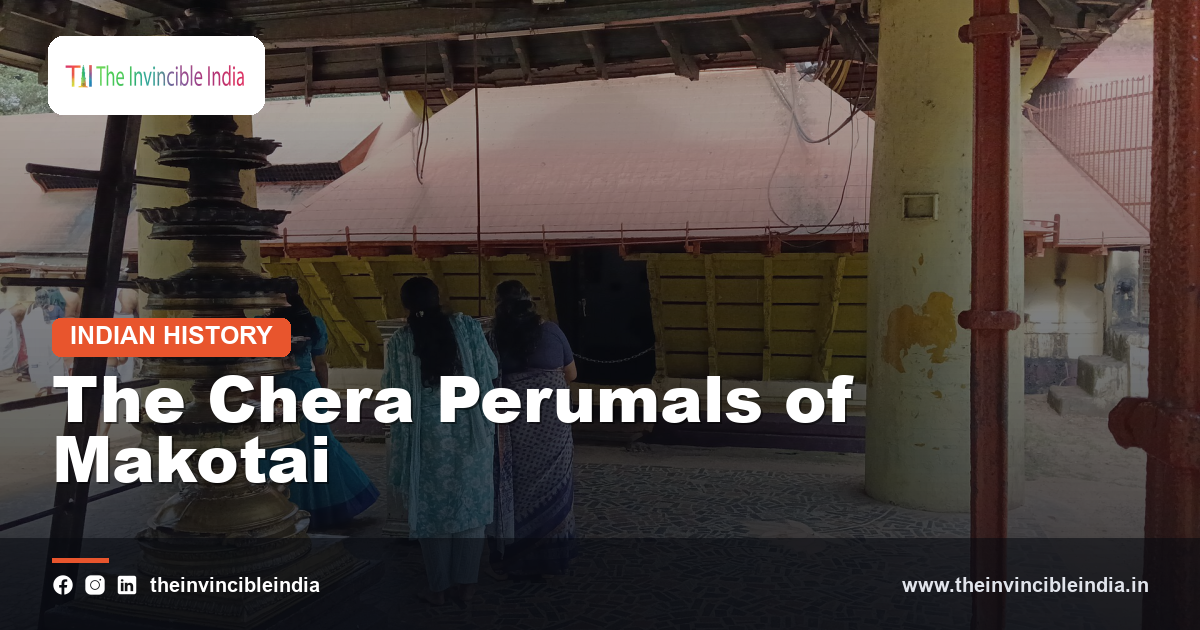
The Chera Perumals of Makotai, also known as the Kulasekhara dynasty of Mahodayapuram and often called the second Cheras of Kerala, were the ruling house that governed much of the Kerala coast from roughly the ninth to the twelfth centuries, with their capital at Mahodayapuram near present-day Kodungallur. Distinct from the earlier Sangam-age Cheras, this medieval dynasty presided over a period of temple building, Sanskrit and Malayalam learning, and flourishing maritime trade, before the kingdom dissolved into the local chiefdoms, or swarupams, that shaped later Kerala. Tradition links the line to the Vaishnava saint Kulasekhara Alvar and to the famous Cheraman Perumal stories, which are flagged here as tradition. The Chera Perumals ruled a coast long connected to the wider south, including the realm of the Chola dynasty. Where dates and details are uncertain, this guide keeps to general terms.
Quick answer: The Chera Perumals of Makotai, also called the Kulasekhara dynasty of Mahodayapuram, were the medieval ruling house of Kerala, generally dated from about the ninth to the twelfth centuries, with their capital at Mahodayapuram near present-day Kodungallur. Known as the second Cheras, they presided over a flourishing of temple culture, learning and maritime trade on the Kerala coast. Tradition links them to the saint Kulasekhara Alvar and to the Cheraman Perumal stories, which are treated as tradition. The kingdom later dissolved into local chiefdoms, or swarupams, such as Venad and Kozhikode.
Key Takeaways
- The Chera Perumals of Makotai, also called the Kulasekhara dynasty of Mahodayapuram, were the medieval ruling house of the Kerala coast.
- They are generally dated from about the ninth to the twelfth centuries and are known as the second Cheras.
- Their capital was Mahodayapuram, or Makotai, near present-day Kodungallur in central Kerala.
- Their age saw a flourishing of temple culture, learning and the great spice trade of the Malabar coast.
- Tradition links the dynasty to the Vaishnava saint Kulasekhara Alvar and to the Cheraman Perumal stories, flagged as tradition.
- The kingdom later dissolved into local chiefdoms, or swarupams, including Venad and Kozhikode.
Read on for the history, culture, and legacy in detail.
Quick Facts
| Detail | Information |
|---|---|
| Dynasty | Chera Perumals of Makotai (Kulasekhara dynasty) |
| Period | Roughly ninth to twelfth centuries, generally dated |
| Region | Kerala (central Kerala coast) |
| Capital | Mahodayapuram (Makotai), near Kodungallur |
| Also Called | The second Cheras of Kerala |
| Patronage | Hindu temple culture, Sanskrit and Malayalam learning |
| Dissolution | Into local swarupams such as Venad and Kozhikode |
| Legacy | Foundational to medieval Kerala’s polity and culture |
Who Were the Chera Perumals?
The Chera Perumals were the medieval ruling house of the Kerala coast, a dynasty that governed much of present-day Kerala from its capital at Mahodayapuram and bore the title of Perumal, meaning a great or paramount ruler. Also known as the Kulasekhara dynasty of Mahodayapuram, they are commonly called the second Cheras to distinguish them from the ancient Sangam-age Chera dynasty that had ruled the region in a much earlier period. The Chera Perumals revived the illustrious Chera name and presided over a notable era of political unity, cultural achievement and prosperity on the Kerala coast. Their rule marks a defining period in the shaping of medieval Kerala. They governed in close partnership with powerful Brahmin settlements and local lords, a feature that would shape the later political order of the region. The Chera Perumals therefore stand as the central dynasty of medieval Kerala, remembered for both their authority and their cultural legacy.
Where Was Mahodayapuram Located?
Mahodayapuram, also known as Makotai, was the capital of the Chera Perumals and was located in central Kerala near present-day Kodungallur, close to the coast where the backwaters meet the Arabian Sea. This region had long been a centre of trade, religion and settlement on the Malabar coast, with ancient associations reaching back to the early history of Kerala. The capital’s position near the sea and the river mouths placed it at the heart of the maritime commerce that enriched the kingdom. Kodungallur and its surroundings were home to temples, Brahmin settlements and trading communities, making the area a focus of the religious and economic life of the coast. From this centre the Chera Perumals exercised their authority over much of Kerala. The location of Mahodayapuram near Kodungallur therefore gave the dynasty a capital at the crossroads of trade, faith and culture on the central Kerala coast.
What Were the Second Cheras?
The term second Cheras refers to the Chera Perumals of Mahodayapuram, the medieval dynasty that revived the ancient and celebrated Chera name on the Kerala coast. The original, or first, Cheras were the Sangam-age rulers of the far south, famous in early Tamil literature, whose power had long since passed. Centuries later the Kulasekhara dynasty of Mahodayapuram took up the Chera title and heritage, and historians therefore distinguish them as the second Cheras of Kerala. This dynasty governed a unified Kerala coast during the medieval centuries and gave the region a distinct political and cultural identity. The use of the venerable Chera name linked the medieval rulers to the deep antiquity of the region’s history. The distinction between the first and second Cheras is important for understanding Kerala’s past. The second Cheras therefore represent the medieval flowering of the Chera tradition on the Malabar coast.
When Did the Chera Perumals Rule?
The Chera Perumals ruled from roughly the ninth to the twelfth centuries, a period generally accepted by historians though expressed in broad terms because the precise chronology is debated. Their rise followed earlier centuries in which the Kerala coast had been divided among smaller powers, and their dynasty brought a measure of political unity to the region for the first time in the medieval age. Their rule spanned several generations of Perumals governing from Mahodayapuram. The age of the Chera Perumals coincided with the great period of south Indian temple culture and maritime trade, and with the rise of powerful neighbours such as the Cholas in the Tamil country. The end of their rule is generally placed around the twelfth century, when the kingdom broke apart. The period of the Chera Perumals therefore marks the central medieval chapter in the history of Kerala, bridging the ancient and the later medieval periods.
Who Founded the Chera Perumal Line?
The founding of the Chera Perumal line is attributed in tradition to the establishment of the Kulasekhara dynasty at Mahodayapuram, generally placed around the ninth century, though the details are known only in broad outline. The dynasty took the title of Perumal and the heritage of the ancient Cheras, presenting itself as the paramount ruling house of the Kerala coast. Tradition surrounds the origins of the line with accounts that blend history and legend, in the manner common to medieval dynasties, so historians treat the specific founding stories with caution. What is accepted is that a line of Perumals came to rule a unified Kerala from Mahodayapuram during this period. The early rulers established the capital and the institutions on which the dynasty’s authority rested. The founding of the Chera Perumal line therefore marks the beginning of the central medieval kingdom of Kerala, even where its precise origins remain uncertain.
What Is the Tradition of Kulasekhara Alvar?
Kulasekhara Alvar is a revered Vaishnava saint-poet of the Tamil bhakti tradition, counted among the Alvars whose devotional hymns to Vishnu are treasured in south Indian religion, and tradition links him with the Chera royal house. According to this tradition, Kulasekhara was a king of the Chera line who became a great devotee and poet of Vishnu, and his hymns form part of the sacred canon of Tamil Vaishnavism. The connection between the saint and the Chera Perumal dynasty is a matter of tradition, and historians are cautious about the precise historical relationship and dating. What is clear is the lasting association in religious memory between the Chera name and this celebrated devotee. The tradition reflects the deep roots of bhakti devotion in the region. The tradition of Kulasekhara Alvar therefore ties the Chera Perumals, through religious memory, to one of the honoured saints of south Indian Vaishnavism, though the link is flagged as tradition.
What Are the Cheraman Perumal Stories?
The Cheraman Perumal stories are a cluster of traditions surrounding the figure of the last Chera Perumal ruler, remembered in legend as a king who divided his kingdom and departed from the throne, bringing the unified Chera realm to an end. Various traditions attach different accounts to this last Perumal, including stories of his renunciation and journeys, and these narratives are preserved in later tradition rather than in contemporary record. One well-known tradition connects a Cheraman Perumal with early contacts between Kerala and other faiths on the trading coast, a story honoured in local memory and flagged here as tradition. Historians treat these varied and legendary accounts with caution, distinguishing the broad memory of the kingdom’s end from the embellishments of later storytelling. The stories nonetheless express how later generations remembered the close of the Chera Perumal age. The Cheraman Perumal legends therefore form an important, if traditional, part of Kerala’s historical memory.
How Did the Chera Perumals Govern Kerala?
The Chera Perumals governed Kerala through a distinctive system in which the paramount ruler at Mahodayapuram shared authority with powerful Brahmin settlements and local chiefs, giving the medieval Kerala polity its particular character. The Perumal stood at the head of the kingdom, but real power on the ground was exercised in partnership with the Brahmin corporations and the naduvazhis, the lords of the various districts, who held considerable local authority. This arrangement reflected the strong role of temple-centred Brahmin communities and landed lords in the society of medieval Kerala. The system provided both the unity symbolised by the Perumal and the decentralised local power that would later come to the fore. Revenue, justice and the ordering of society rested heavily on temple institutions and local lords. The governance of the Chera Perumals therefore combined central kingship with powerful local and religious institutions, a pattern that deeply shaped the later history of Kerala.
What Religion Did the Chera Perumals Patronise?
The Chera Perumals patronised the Hindu temple culture that dominated the religious life of medieval Kerala, while their realm, as a great trading coast, was also home to communities of other faiths. Royal and Brahmin patronage supported the building and endowment of temples, which stood at the centre of the religious, social and economic life of the kingdom. The devotional traditions of both Shaivism and Vaishnavism flourished, nourished by the bhakti movement that swept the south, and the region produced celebrated saints and hymns. At the same time the ports of the coast hosted long-established communities of Jewish, Christian and Muslim traders, reflecting the openness of the trading shore, a feature honoured in local tradition. The Perumals’ support for temples bound the dynasty to the spiritual life of its people. The religious patronage of the Chera Perumals therefore shaped the temple-centred and pluralistic culture for which medieval Kerala is remembered.
What Was the Role of Temples in the Kingdom?
Temples played a central role in the kingdom of the Chera Perumals, serving not only as places of worship but as the focal institutions of the social, economic and cultural life of medieval Kerala. The great temples were landholders, employers and centres of learning and the arts, around which much of the life of the region was organised. Brahmin corporations attached to the temples held great authority and worked in partnership with the rulers and local lords in the governance of the land. Temple festivals, rituals and patronage shaped the rhythms of community life and the identity of localities across the coast. The wealth and influence of the temples made them pillars of the medieval order. Their prominence reflected the deeply temple-centred character of Kerala society in this age. The role of temples in the Chera Perumal kingdom therefore illustrates how religious institutions stood at the very heart of medieval Kerala’s polity and culture.
How Did Trade Shape the Chera Perumal Realm?
Trade profoundly shaped the realm of the Chera Perumals, for the Kerala coast was one of the world’s great centres of the spice trade, drawing merchants from across the Indian Ocean and beyond. The ports of the Malabar coast, including the region around the capital at Mahodayapuram, exported pepper and other spices for which Kerala was renowned, bringing wealth and wide international contact. This commerce connected the kingdom to Arabia, the Mediterranean, Persia and the East, and it supported communities of foreign and local traders in the port towns. The prosperity of trade underpinned the wealth of the rulers, the temples and the merchant communities alike. The openness of the trading coast gave medieval Kerala its cosmopolitan character, with diverse religious and cultural communities settled along the shore. Trade therefore stood at the economic heart of the Chera Perumal realm, linking the Kerala coast to a vast world of maritime commerce and exchange.
How Did the Kingdom Dissolve into Swarupams?
The kingdom of the Chera Perumals dissolved around the twelfth century into a number of local chiefdoms, known in Kerala as swarupams, which became the ruling houses of the region in the later medieval period. As the central authority of the Perumals weakened, the powerful naduvazhis and local lords asserted their independence, and the unified kingdom broke apart into these smaller principalities. Among the swarupams that emerged were Venad in the south, which grew into Travancore, and the realm of the Zamorins of Kozhikode, or Calicut, on the central coast, along with others such as Kolathunad in the north. These successor states shaped the political landscape of Kerala for centuries. The dissolution reflected the strong local and decentralised tendencies within the Chera Perumal system itself. The breaking of the kingdom into swarupams therefore marked the transition from the unified medieval Chera realm to the fragmented but enduring political order of later Kerala.
What Cultural Legacy Did the Chera Perumals Leave?
The Chera Perumals left a rich cultural legacy that shaped the identity of Kerala, including the flourishing of temple art and architecture, the growth of Sanskrit and the Malayalam language, and the devotional traditions of the region. Their age saw the consolidation of the temple-centred society and the distinctive institutions that would characterise Kerala for centuries. The period contributed to the development of Malayalam as a literary language distinct within the broader south Indian family, alongside the continued cultivation of Sanskrit learning. The devotional poetry and temple culture of the age enriched the religious life of the coast. The political and social patterns established under the Perumals, including the role of temples and local lords, endured into later Kerala. The cultural legacy of the Chera Perumals therefore lies at the foundation of medieval and later Kerala, in its language, religion, art and the enduring institutions of its distinctive society.
Why Are the Chera Perumals Significant in Indian History?
The Chera Perumals are significant in Indian history as the dynasty that gave medieval Kerala a period of political unity and cultural flowering, shaping the distinctive identity of the region. As the second Cheras, they revived an ancient and illustrious name and presided over a notable era of temple building, learning and prosperous maritime trade. Their system of governance, combining central kingship with powerful Brahmin settlements and local lords, laid the foundations of the later political order of Kerala. The dissolution of their kingdom into the swarupams determined the shape of Kerala politics for centuries afterward. Their age also reflects the cosmopolitan character of the Malabar trading coast. For students of Indian history, the Chera Perumals illuminate the formation of medieval Kerala and its place in the wider world of south Indian and Indian Ocean history. Their significance lies in this foundational role in the making of Kerala.
The Chera Perumals Today
The Chera Perumals are remembered today through the heritage of central Kerala, the temples and traditions of the Kodungallur region, and the historical memory of the medieval Chera kingdom. The area around the old capital of Mahodayapuram preserves ancient temples and associations that recall the age of the Perumals and the long history of the coast. The Cheraman Perumal stories and the memory of the saint Kulasekhara live on in religious and popular tradition, flagged by historians as tradition. The swarupams that succeeded the kingdom, such as Travancore and the realm of the Zamorins, carried forward its legacy into later Kerala. Historians study the inscriptions, literature and traditions of the period to understand the dynasty and its distinctive polity. For readers of Indian history, the Chera Perumals offer a key to the making of medieval Kerala. Their legacy endures in the language, temples and culture of the region.
Sources & Further Reading
- Archaeological Survey of India (asi.nic.in).
- Ministry of Culture, Government of India (indiaculture.gov.in).
- Kerala Tourism, Government of Kerala (keralatourism.org).
Frequently Asked Questions
Who were the Chera Perumals?
The Chera Perumals of Makotai, also called the Kulasekhara dynasty of Mahodayapuram, were the medieval ruling house of the Kerala coast. Known as the second Cheras, they governed much of present-day Kerala from their capital at Mahodayapuram, generally from about the ninth to the twelfth centuries.
Where was the capital of the Chera Perumals?
The capital of the Chera Perumals was Mahodayapuram, also known as Makotai, located in central Kerala near present-day Kodungallur. Its position near the coast and the river mouths placed it at the heart of the maritime trade that enriched the kingdom.
Why are they called the second Cheras?
They are called the second Cheras because they revived the ancient and celebrated Chera name centuries after the original Sangam-age Cheras of the far south. Historians use the term to distinguish the medieval Kulasekhara dynasty of Mahodayapuram from the much earlier Chera rulers.
What are the Cheraman Perumal stories?
The Cheraman Perumal stories are traditions surrounding the last Chera Perumal ruler, remembered in legend as a king who divided his kingdom and left the throne. These accounts are preserved in later tradition rather than contemporary record and are treated by historians as tradition.
How did the Chera Perumal kingdom end?
The kingdom of the Chera Perumals dissolved around the twelfth century into local chiefdoms known as swarupams, as central authority weakened and local lords asserted independence. Among the successor states were Venad, which became Travancore, and the realm of the Zamorins of Kozhikode.
Why are the Chera Perumals important in Indian history?
The Chera Perumals are important as the dynasty that gave medieval Kerala political unity and a cultural flowering in temple art, learning and trade. Their system of governance and the swarupams that succeeded them shaped the distinctive identity and later history of Kerala.


