

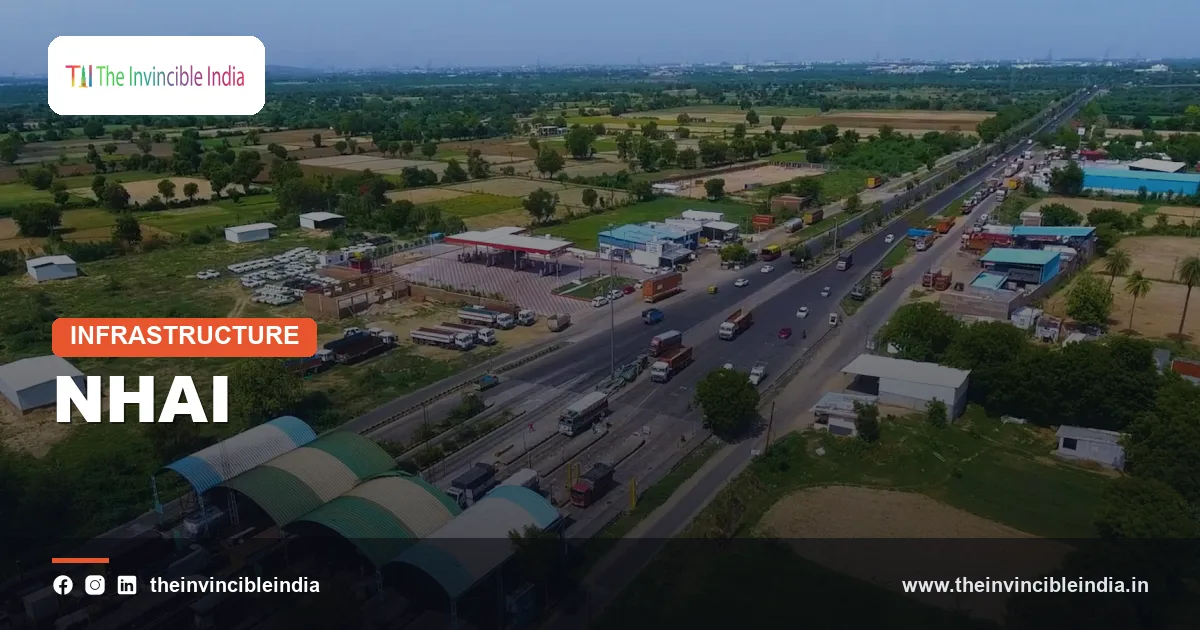
The National Highways Authority of India (NHAI) is the autonomous statutory body, set up under the National Highways Authority of India Act, 1988 and made operational in 1995, that develops, maintains and manages a large part of India’s national highway network. The National Highways Authority of India works under the Ministry of Road Transport and Highways (MoRTH), Government of India, and is headquartered in New Delhi.
The National Highways Authority of India (NHAI) is best known for delivering the Golden Quadrilateral and the wider National Highways Development Project (NHDP), and later for executing much of the Bharatmala Pariyojana. This explainer covers how NHAI was created, what it does, the contract models it uses, how tolling and FASTag work, how it raises money through monetisation and InvITs, and how it approaches road safety.
| Attribute | Detail |
|---|---|
| Full name | National Highways Authority of India (NHAI) |
| Legal basis | National Highways Authority of India Act, 1988 |
| Operational since | 1995 (the Authority was constituted in 1988 and began functioning in 1995) |
| Parent ministry | Ministry of Road Transport and Highways (MoRTH) |
| Type | Autonomous statutory authority |
| Headquarters | New Delhi |
| Landmark programmes | National Highways Development Project (NHDP), Golden Quadrilateral, Bharatmala Pariyojana |
| Main delivery models | EPC, BOT (Toll), Hybrid Annuity Model (HAM), Toll-Operate-Transfer (TOT) |
| Tolling system | FASTag (RFID-based electronic toll collection) |
Key Takeaways
- The National Highways Authority of India (NHAI) is an autonomous statutory body created by the National Highways Authority of India Act, 1988 and operational from 1995.
- NHAI reports to the Ministry of Road Transport and Highways (MoRTH) and is responsible for developing, maintaining and managing a large share of India’s national highways.
- The Golden Quadrilateral, linking Delhi, Mumbai, Chennai and Kolkata, was the flagship of the National Highways Development Project (NHDP) executed by NHAI.
- NHAI builds highways through several contract models, including Engineering, Procurement and Construction (EPC), Build-Operate-Transfer (BOT) and the Hybrid Annuity Model (HAM).
- FASTag, a radio-frequency identification (RFID) system, is the electronic toll collection method on national highway toll plazas and became mandatory for four-wheeled vehicles from February 2021.
- NHAI raises funds not only from budgetary support and tolls but also by monetising operational highways through Toll-Operate-Transfer (TOT) bundles and an Infrastructure Investment Trust (InvIT).
What is the National Highways Authority of India?
The National Highways Authority of India is a statutory authority that plans, builds, operates and maintains national highways entrusted to it by the Government of India. The National Highways Authority of India is not a department of a ministry; it is a body corporate with its own Chairman and Members, and it functions under the policy direction of the Ministry of Road Transport and Highways.
The legal foundation is the National Highways Authority of India Act, 1988, passed by Parliament to create a dedicated agency that could focus on highway development, raise resources and recruit specialist staff. The Authority was constituted in 1988 but remained largely dormant until 1995, when it was made operational and began taking up projects.
The National Highways Authority of India is one of several agencies that deal with national highways. Not every national highway is built or managed by NHAI, which is why the division of roles is explained in a later section.
Why was NHAI created and how did it develop?
The National Highways Authority of India was created because national highways were earlier handled mainly by state public works departments and the Central Public Works Department, with limited funding and inconsistent quality. A dedicated authority was meant to bring professional management, a single point of accountability and the ability to raise money for large projects.
In its early years NHAI was a small organisation. It grew rapidly after the late 1990s, when the Government of India decided to push a nationwide programme of highway upgrading. The Authority was given the task of executing that programme, and its staffing, project management systems and financing tools were expanded accordingly.
Key phases in NHAI’s history
- 1988: The National Highways Authority of India Act is passed and the Authority is constituted.
- 1995: NHAI becomes operational and begins project work.
- Late 1990s: The National Highways Development Project (NHDP) is conceived, with the Golden Quadrilateral as its first major component.
- 2000s: Four-laning and six-laning of key corridors, and wider use of private-sector concessions.
- 2010s: The Hybrid Annuity Model is introduced, and the Bharatmala Pariyojana is announced and later approved.
- 2020s: FASTag becomes mandatory, monetisation through TOT and InvIT scales up, and satellite-based and barrier-free tolling are explored.
What is the National Highways Development Project and the Golden Quadrilateral?
The National Highways Development Project (NHDP) was a phased national programme, launched in the late 1990s and executed largely by NHAI, to widen and upgrade India’s trunk highways to four or six lanes. The NHDP is widely regarded as the biggest road-building effort in independent India up to that point.
The Golden Quadrilateral was the first and best-known component of the NHDP. The Golden Quadrilateral links the four metropolitan cities of Delhi, Mumbai, Chennai and Kolkata through a ring of four- and six-lane highways of roughly 5,800 km in total length. Work began around the turn of the millennium and the corridor was substantially completed in the following decade.
The NHDP also covered the North-South and East-West Corridors. The North-South Corridor connects Srinagar in the north to Kanyakumari in the south, while the East-West Corridor connects Silchar in the east to Porbandar in the west. Together with the Golden Quadrilateral, these corridors form the backbone of long-distance road freight and passenger movement in India.
NHDP phases at a glance
| Phase | Main focus |
|---|---|
| Phase I and II | Golden Quadrilateral and the North-South and East-West Corridors |
| Phase III | Upgrading high-density national highways to four lanes, largely on a BOT basis |
| Phase IV | Upgrading single-lane and two-lane highways to two lanes with paved shoulders |
| Phase V | Six-laning of selected four-lane stretches |
| Phase VI and VII | Expressways and ring roads, bypasses and grade separators |
The phase descriptions above are summary descriptions; the scope, lengths and numbering of individual phases were revised several times, and later programmes such as Bharatmala absorbed much of the remaining NHDP work.
What does NHAI do, and how is it different from other highway agencies?
NHAI is responsible for the development, maintenance and management of national highways assigned to it, including project planning, land acquisition support, awarding contracts, supervising construction, collecting toll and maintaining operational stretches. The National Highways Authority of India is the largest of the agencies handling national highways, but it is not the only one.
India’s national highway network, which runs to well over one lakh kilometres, is managed by a mix of agencies:
- NHAI: Builds and manages a large share of the trunk network, particularly high-traffic corridors and tolled stretches.
- Ministry of Road Transport and Highways (MoRTH): Sets policy and also executes works directly through its regional offices.
- National Highways and Infrastructure Development Corporation Limited (NHIDCL): Created in 2014, it focuses on strategically important and difficult areas such as the North-East, border regions and hill states.
- State public works departments (PWDs) and Border Roads Organisation (BRO): Build and maintain national highways entrusted to them, including many remote and strategic roads.
The division of work means the same national highway number can pass through stretches handled by different agencies, which is why road users may see different contact details and helplines on different sections.
How is a national highway numbered and classified?
National highways in India are numbered under a system in which the number and its parity indicate direction and location. Broadly, north-south highways carry even numbers that increase from east to west, east-west highways carry odd numbers that increase from south to north, and three-digit numbers are used for branches of a primary route. The numbering was reorganised around 2010 to make it more logical.
National highways are declared under the National Highways Act, 1956. The Central Government has the authority to declare a road as a national highway, after which it becomes the Centre’s responsibility. This declaration is distinct from a state highway, which falls under a state government.
- Primary highways carry one- or two-digit numbers and form the main trunk routes.
- Three-digit numbers generally denote spur or branch routes connected to a primary highway.
- Expressways are a separate class of access-controlled roads, usually with limited entry and exit points, and are built as new alignments or by upgrading existing highways.
How does NHAI build highways? BOT, EPC and HAM explained
NHAI builds highways using several contract models, which differ mainly in who invests the money, who takes the traffic and toll risk, and how the contractor is paid. The three most commonly discussed models are Build-Operate-Transfer (BOT), Engineering, Procurement and Construction (EPC) and the Hybrid Annuity Model (HAM).
Comparison of the main models
| Model | Who funds construction | Who bears traffic and toll risk | How the builder is paid |
|---|---|---|---|
| EPC | NHAI (government) | NHAI | Fixed contract payments during construction |
| BOT (Toll) | Private concessionaire | Concessionaire | Collects toll for the concession period |
| BOT (Annuity) | Private concessionaire | NHAI | Fixed annuity payments from NHAI |
| HAM | Part government, part private | NHAI | A share during construction and annuities afterwards |
| TOT | Investor pays upfront for an existing road | Investor | Collects toll for the concession period |
Why the models changed
The early NHDP phases relied heavily on BOT (Toll), in which private concessionaires built roads and recovered costs from toll. Many concessionaires later faced financial stress when traffic or financing assumptions did not hold, and bank lending to the sector became cautious.
The Hybrid Annuity Model was introduced around 2016 to share risk more evenly. Under HAM, NHAI typically pays a portion of the project cost during construction, and the concessionaire raises the rest and is repaid through fixed semi-annual annuities, while NHAI takes the toll revenue. EPC, in which the government funds the work fully and the contractor only builds, became widely used again as public funding rose.
What is the Bharatmala Pariyojana?
The Bharatmala Pariyojana is a Government of India umbrella programme for highway development, announced in 2015 and given approval in 2017, which aims to optimise the efficiency of freight and passenger movement through economic corridors, feeder routes, border and coastal roads, and expressways. NHAI is one of the main executing agencies of Bharatmala, alongside NHIDCL and state agencies.
Bharatmala was designed around identified economic corridors and inter-corridor and feeder routes rather than simply widening existing roads. Its first phase covered tens of thousands of kilometres, and it subsumed earlier unfinished NHDP work. The programme introduced a corridor-based planning approach, which also drove the construction of new greenfield expressways.
The programme’s overall targets and costs were revised over time, and individual project completion varies, so readers should check current official dashboards for up-to-date numbers.
How do tolling and FASTag work on national highways?
Tolling on national highways works by charging vehicles a fee at toll plazas, collected under the National Highways Fee (Determination of Rates and Collection) Rules, 2008, and today most collection happens electronically through FASTag. FASTag is a prepaid, radio-frequency identification (RFID) tag fixed to a vehicle’s windscreen, which lets the toll plaza deduct the fee automatically without the vehicle stopping.
FASTag operates under the National Electronic Toll Collection (NETC) programme run by the National Payments Corporation of India (NPCI). A user obtains a tag from a participating bank or issuer, links it to a prepaid account or wallet, and the amount is debited as the vehicle crosses a toll lane.
Key points about tolling
- FASTag use was made mandatory for all four-wheeled vehicles on national highway toll plazas from mid-February 2021.
- Toll rates vary by vehicle class, by stretch and by journey type, and are revised periodically, usually annually.
- Local and frequent users may be eligible for monthly passes or concessions at certain plazas.
- A pass option for private non-commercial vehicles was announced in 2025 to simplify toll payment, and users should confirm the current terms on official channels.
- Barrier-free or multi-lane free-flow tolling, including satellite-based systems, has been tested and discussed as the next step to reduce plaza delays.
The aim of FASTag is to cut waiting time at plazas, reduce fuel waste and improve transparency in toll collection.
How does NHAI monetise highways and raise funds?
NHAI raises money through government budgetary support, borrowing, toll revenue and the monetisation of operational highways, meaning it transfers the right to collect toll on completed roads to investors in return for upfront payments. Monetisation lets NHAI recycle capital into new projects without relying wholly on the budget.
Main monetisation tools
- Toll-Operate-Transfer (TOT): NHAI bundles operational toll roads and awards the right to collect toll and maintain them for a fixed concession period, such as around 15 to 30 years, in exchange for an upfront payment.
- Infrastructure Investment Trust (InvIT): NHAI sponsored a public InvIT, which pools completed, revenue-generating roads and offers units to institutional and, in some cases, retail investors. InvITs are regulated by the Securities and Exchange Board of India (SEBI).
- Asset Monetisation Plan: The National Monetisation Pipeline announced in 2021 included a large road-asset component to be monetised over several years.
- Bonds and borrowing: NHAI has also raised funds through bonds and loans backed by toll receivables.
Monetisation proceeds are intended to fund new highway work, while operations of the monetised roads move to the concessionaire. Critics sometimes question the long-term impact on road users, while supporters point to efficiency and capital recycling. Both views are part of public debate, and outcomes depend on contract terms.
How does NHAI approach road safety on national highways?
NHAI approaches road safety through engineering fixes, enforcement support and user information, because national highways carry a disproportionate share of road accident fatalities relative to their length. India has one of the highest absolute road fatality counts in the world, and the Government of India has repeatedly set targets to reduce deaths.
Common safety measures
- Black spot rectification: Identifying stretches with repeated fatal accidents and correcting their design, signage, lighting and junctions.
- Road safety audits: Independent audits at design, construction and operation stages.
- Fencing and grade separation: Fenced access-controlled stretches, underpasses and overpasses for crossing traffic and animals.
- Emergency response: A national highway helpline, ambulances and patrol vehicles on selected stretches.
- Technology: Advanced traffic management systems, speed enforcement cameras and incident detection on expressways.
- Wayside amenities: Rest areas and trauma care facilities to reduce fatigue and speed up medical help.
Legal changes such as the Motor Vehicles (Amendment) Act, 2019 increased penalties for several violations. Road safety also depends on driver behaviour, vehicle standards and enforcement by state police, which fall outside NHAI’s direct control.
What are the main criticisms and challenges facing NHAI?
The main challenges facing NHAI include land acquisition delays, project cost overruns, quality and maintenance concerns, debt levels and environmental trade-offs. These challenges are widely discussed in official audits, parliamentary committee reports and the press.
- Land acquisition and clearances: Delays in acquiring land and obtaining forest and environmental clearances have often held up projects.
- Debt and financing: NHAI’s borrowings grew significantly during periods of heavy construction, drawing attention to long-term repayment capacity.
- Quality and maintenance: Surface damage, drainage failures and poorly maintained stretches draw complaints, and contractors can face penalties.
- Environment and wildlife: Highways through forests and wildlife corridors require mitigation such as underpasses and overpasses.
- Toll disputes: Disagreements over toll rates, plaza spacing and the duration of toll collection recur at local level.
Addressing these challenges is an ongoing process involving policy changes, contract reforms and use of technology for monitoring.
Bottom Line
The National Highways Authority of India (NHAI) is the central agency that turned national highway development in India into a large, professionally managed programme, from the Golden Quadrilateral to Bharatmala. Its future depends on financing through monetisation, smoother tolling through FASTag and newer technologies, and measurable improvements in road safety. Readers should consult NHAI’s official website for current figures, since lengths, dates and policies are updated regularly (last updated 17 October 2026).
Frequently Asked Questions
What does NHAI stand for and what does it do?
NHAI stands for the National Highways Authority of India, an autonomous statutory body under the Ministry of Road Transport and Highways. NHAI develops, maintains and manages national highways, awards construction contracts and collects toll on its stretches. It was set up under the National Highways Authority of India Act, 1988 and became operational in 1995.
When was NHAI established?
NHAI was established under the National Highways Authority of India Act, 1988, and became operational in 1995. The gap exists because the Authority existed in law from 1988 but only began actively executing projects in the mid-1990s. Its role expanded sharply after the National Highways Development Project began in the late 1990s.
What is the Golden Quadrilateral?
The Golden Quadrilateral is a network of four- and six-lane highways of roughly 5,800 km that connects Delhi, Mumbai, Chennai and Kolkata. It was the first major component of the National Highways Development Project, executed by NHAI. The corridor was substantially completed in the decade after work began around 2000.
What is the difference between BOT, EPC and HAM?
BOT, EPC and HAM are different contract models for building highways that vary in who funds the work and who bears the traffic risk. In BOT a private concessionaire funds the road and recovers costs through toll, in EPC the government funds everything and the contractor only builds, and in HAM the cost and risk are shared. Under HAM, NHAI pays a portion during construction and the rest as annuities, while NHAI keeps the toll revenue.
How does FASTag work?
FASTag is a prepaid RFID tag fixed to a vehicle’s windscreen that lets toll plazas deduct the fee automatically as the vehicle passes. The tag is linked to a prepaid account issued by a bank or authorised issuer under the NPCI-run National Electronic Toll Collection programme. FASTag was made mandatory for four-wheeled vehicles on national highway toll plazas from February 2021.
How does NHAI raise money apart from the government budget?
NHAI raises money through toll revenue, borrowing and bonds, and by monetising completed highways. Its monetisation tools include Toll-Operate-Transfer bundles and a SEBI-regulated Infrastructure Investment Trust (InvIT), in which investors pay upfront for the right to toll revenue. The proceeds are intended to be reinvested in new highway projects.
{“@context”:”https://schema.org”,”@graph”:[{“@type”:”FAQPage”,”mainEntity”:[{“@type”:”Question”,”name”:”What does NHAI stand for and what does it do?”,”acceptedAnswer”:{“@type”:”Answer”,”text”:”NHAI stands for the National Highways Authority of India, an autonomous statutory body under the Ministry of Road Transport and Highways. NHAI develops, maintains and manages national highways, awards construction contracts and collects toll on its stretches. It was set up under the National Highways Authority of India Act, 1988 and became operational in 1995.”}},{“@type”:”Question”,”name”:”When was NHAI established?”,”acceptedAnswer”:{“@type”:”Answer”,”text”:”NHAI was established under the National Highways Authority of India Act, 1988, and became operational in 1995. The gap exists because the Authority existed in law from 1988 but only began actively executing projects in the mid-1990s. Its role expanded sharply after the National Highways Development Project began in the late 1990s.”}},{“@type”:”Question”,”name”:”What is the Golden Quadrilateral?”,”acceptedAnswer”:{“@type”:”Answer”,”text”:”The Golden Quadrilateral is a network of four- and six-lane highways of roughly 5,800 km that connects Delhi, Mumbai, Chennai and Kolkata. It was the first major component of the National Highways Development Project, executed by NHAI. The corridor was substantially completed in the decade after work began around 2000.”}},{“@type”:”Question”,”name”:”What is the difference between BOT, EPC and HAM?”,”acceptedAnswer”:{“@type”:”Answer”,”text”:”BOT, EPC and HAM are different contract models for building highways that vary in who funds the work and who bears the traffic risk. In BOT a private concessionaire funds the road and recovers costs through toll, in EPC the government funds everything and the contractor only builds, and in HAM the cost and risk are shared. Under HAM, NHAI pays a portion during construction and the rest as annuities, while NHAI keeps the toll revenue.”}},{“@type”:”Question”,”name”:”How does FASTag work?”,”acceptedAnswer”:{“@type”:”Answer”,”text”:”FASTag is a prepaid RFID tag fixed to a vehicle’s windscreen that lets toll plazas deduct the fee automatically as the vehicle passes. The tag is linked to a prepaid account issued by a bank or authorised issuer under the NPCI-run National Electronic Toll Collection programme. FASTag was made mandatory for four-wheeled vehicles on national highway toll plazas from February 2021.”}},{“@type”:”Question”,”name”:”How does NHAI raise money apart from the government budget?”,”acceptedAnswer”:{“@type”:”Answer”,”text”:”NHAI raises money through toll revenue, borrowing and bonds, and by monetising completed highways. Its monetisation tools include Toll-Operate-Transfer bundles and a SEBI-regulated Infrastructure Investment Trust (InvIT), in which investors pay upfront for the right to toll revenue. The proceeds are intended to be reinvested in new highway projects.”}}]}]}


