

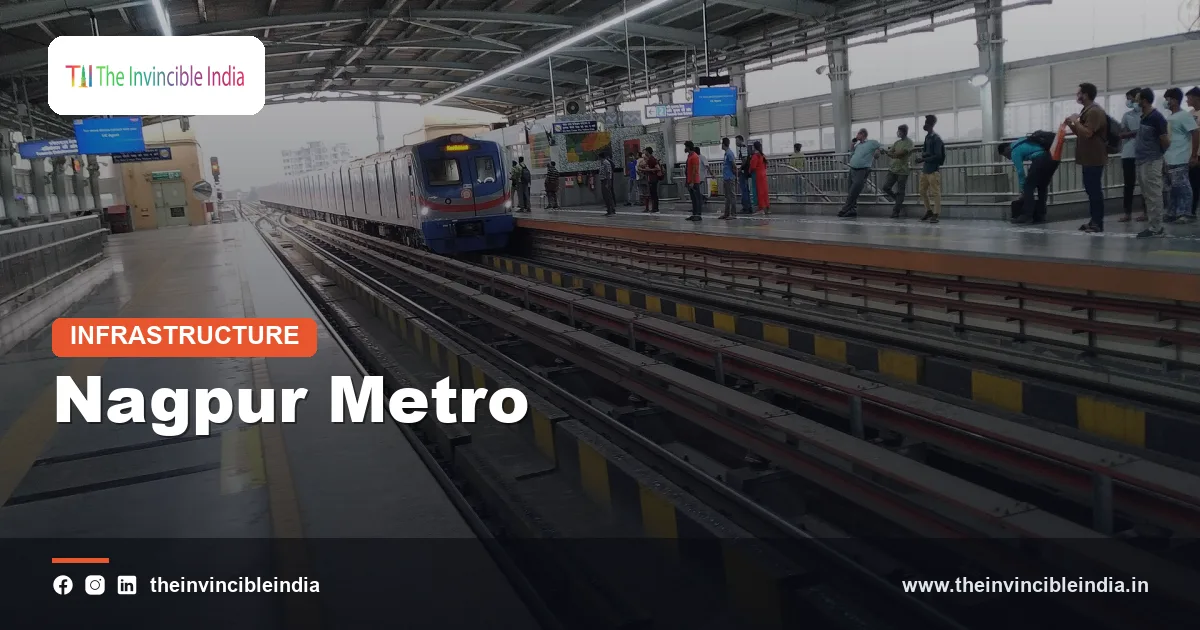
The Nagpur Metro is the rapid-transit system of Nagpur, Maharashtra, built and operated by Maharashtra Metro Rail Corporation Limited (Maha Metro), with two lines, the Orange Line and the Aqua Line, covering roughly 38 km in Phase I. The Nagpur Metro is known for a Guinness-recognised double-decker viaduct that carries a metro track above a flyover, for heavy use of solar power and green building design, and for proposals to extend metro-style services into the wider Nagpur region.
The Nagpur Metro opened in stages from 2019 and was among the first of the newer generation of Tier-II city metros in India. This explainer covers the two lines and their stations, the engineering behind the double-decker viaduct, the green and solar features, the Phase II expansion and the proposed Broad Gauge Metro and NeoMetro regional extensions.
| Attribute | Detail |
|---|---|
| Official name | Nagpur Metro (Nagpur Metro Rail Project) |
| Builder and operator | Maharashtra Metro Rail Corporation Limited (Maha Metro) |
| Ownership | Joint venture of the Government of India and the Government of Maharashtra |
| City and state | Nagpur, Maharashtra |
| Lines in Phase I | Orange Line (north-south) and Aqua Line (east-west) |
| Phase I length | Roughly 38 km, largely elevated |
| Opening | First stretch opened in 2019; Phase I completed in stages, with full operation reported around late 2022 |
| Gauge and power | Standard gauge (1,435 mm), 25 kV AC overhead electrification |
| Notable record | Double-decker viaduct of about 3.1 km recognised by Guinness World Records |
Key Takeaways
- The Nagpur Metro is the metro rail system of Nagpur in Maharashtra, built and run by Maharashtra Metro Rail Corporation Limited (Maha Metro).
- The Nagpur Metro Phase I has two corridors, the Orange Line running north-south and the Aqua Line running east-west, with a combined length of roughly 38 km.
- The Nagpur Metro has a double-decker viaduct of about 3.1 km on Wardha Road, where the metro runs above a flyover, which earned a Guinness World Record.
- Maha Metro has emphasised solar power and green building features on the Nagpur Metro, including rooftop solar panels at stations and depots.
- The two Nagpur Metro lines interchange at Sitabuldi, the central station near the city’s railway station and commercial heart.
- Maha Metro has proposed a Broad Gauge Metro and NeoMetro style services to link Nagpur with surrounding towns, subject to approvals and funding.
What is the Nagpur Metro?
The Nagpur Metro is an elevated metro rail network serving Nagpur, the winter capital of Maharashtra and a major city of central India. The Nagpur Metro was conceived to improve public transport in a city that had relied largely on buses, autos and private vehicles, and to reduce traffic congestion on arterial roads.
The project was sanctioned by the Government of India in the mid-2010s and was implemented by Maha Metro, a special-purpose company jointly owned by the Union Government and the Government of Maharashtra. Phase I covers about 38 km, and a larger second phase has been planned and approved for extending the network.
Nagpur is often called the geographical centre of India, because the Zero Mile Stone, a British-era survey marker, stands in the city. A metro station near this location carries the name Zero Mile, which links the transit network to the city’s identity.
Who built and runs the Nagpur Metro?
The Nagpur Metro was built and is operated by Maharashtra Metro Rail Corporation Limited, commonly called Maha Metro. Maha Metro is a joint venture company of the Government of India and the Government of Maharashtra, with equal shareholding, and it was formed to implement metro projects in the state outside the Mumbai Metropolitan Region.
The project was financed through a mix of equity from the two governments, funding from multilateral and bilateral lenders, and other borrowings. Maha Metro has also been appointed to handle metro work in other cities, including Pune, where it built the Pune Metro, and has been associated with proposals for Nashik.
The Nagpur Metro uses standard gauge track of 1,435 mm and 25 kV AC overhead electrification, which is the standard adopted for most modern Indian metro systems. Trains are formed of three-car sets with air-conditioned coaches, and they carry features such as automatic doors, passenger information displays and space for wheelchairs.
What are the lines and stations of the Nagpur Metro?
The Nagpur Metro Phase I has two lines, the Orange Line and the Aqua Line, which cross at Sitabuldi interchange. The Orange Line runs roughly north to south, while the Aqua Line runs roughly east to west across the city, so that together they form a cross-shaped network.
The two lines at a glance
| Line | Direction | Termini | Approximate length |
|---|---|---|---|
| Orange Line | North-south | Automotive Square to Khapri | About 18 km |
| Aqua Line | East-west | Prajapati Nagar to Lokmanya Nagar | About 18-19 km |
Orange Line
The Orange Line serves the north-south spine of Nagpur, running from Automotive Square in the north through the heart of the city to Khapri in the south. The Orange Line passes stations such as Kasturchand Park, Zero Mile, Sitabuldi, Congress Nagar and Ajni Square, and it reaches the airport zone in the south of the city.
The southern end near Khapri connects towards the MIHAN area, which is a planned multi-modal international cargo hub and special economic zone linked to the Dr. Babasaheb Ambedkar International Airport.
Aqua Line
The Aqua Line serves the east-west direction, running from Prajapati Nagar in the east to Lokmanya Nagar in the west. The Aqua Line passes the Nagpur Railway Station area, Sitabuldi, Institution of Engineers, Dharampeth College, Subhash Nagar and Rachna Ring Road before reaching Lokmanya Nagar near Hingna.
The Aqua Line gives direct access to the city’s main railway station and bus stands, which makes it useful for travellers arriving from other cities. The Aqua Line is also well placed to serve the educational and commercial districts of western Nagpur.
Interchange at Sitabuldi
Sitabuldi is the interchange station where the Orange Line and the Aqua Line meet, and it sits close to the older commercial centre of Nagpur. Passengers change between lines at this station, so it is the most important node of the network.
Why is the Nagpur Metro known for its double-decker viaduct?
The Nagpur Metro is known for its double-decker viaduct because Maha Metro built a metro track directly above a road flyover on Wardha Road, which is a rare engineering arrangement. The structure is about 3.1 km long and carries the metro on top of a highway flyover, sharing the same piers.
The double-decker design was chosen because the road corridor on Wardha Road was narrow and heavily used. By stacking the metro viaduct on the same piers as the flyover, Maha Metro avoided acquiring extra land and avoided building two separate structures. This saved space, time and cost, and it limited disruption to traffic and property.
The structure was recognised by Guinness World Records as the longest double-decker viaduct in the world, with the record associated with the Wardha Road stretch. The double-decker concept has since been discussed for other Indian cities where road width is limited, including in Maha Metro’s own later projects.
Why the stacked design matters
- It reduces land acquisition in congested corridors.
- It shares foundations and piers between the road and the metro.
- It shortens construction time compared with two separate structures.
- It reduces the visual clutter of multiple elevated structures along the same road.
How green is the Nagpur Metro? Solar power and green buildings
The Nagpur Metro is promoted as one of the greener metro systems in India because Maha Metro has installed solar power at stations and depots and designed stations to green building standards. The aim is to reduce the grid electricity the system consumes and to lower its carbon footprint.
Green features
- Rooftop solar: Solar panels have been installed on station roofs and depot buildings, and the generated power feeds the system’s own needs. Maha Metro has reported that a significant share of the network’s energy use is met through solar arrangements, though the exact proportion changes over time.
- Green-rated stations: Several stations and buildings have been certified by green building rating agencies such as the Indian Green Building Council (IGBC), with designs that use natural light and ventilation.
- Regenerative braking: Trains return a part of braking energy to the supply, which improves efficiency.
- Water conservation: Rainwater harvesting and treated-water reuse at stations and depots.
- Tree planting: Compensatory plantation and landscaping along the viaduct, to offset trees removed during construction.
How was the Nagpur Metro built and opened?
The Nagpur Metro was built in phases between the mid-2010s and the early 2020s, with the first section opened to the public in 2019 and the full Phase I completed in stages afterwards. Construction began after the project was approved by the Union Government in 2014, and it was financed through equity and loans.
Milestones
| Period | Milestone |
|---|---|
| Early 2010s | Planning and detailed project report for Nagpur Metro |
| 2014 | Union Government approval for Phase I |
| 2015-2018 | Construction, including the double-decker viaduct on Wardha Road |
| 2019 | First section of the Orange Line inaugurated and opened to commuters |
| 2020-2022 | Remaining sections of both lines opened in stages |
| Late 2022 | Phase I completion marked and Phase II foundation laid |
The dates above are approximate and are shown only to give a general sequence; the exact opening days of each section are available from Maha Metro and official announcements.
What is the Nagpur Metro Phase II?
The Nagpur Metro Phase II is the planned extension of the Nagpur Metro network that adds several new stretches to the Orange and Aqua Lines and builds further elevated corridors, with a combined length of roughly 40 km or more. Phase II was approved for implementation after Phase I, and construction has proceeded in stages.
Phase II is designed to extend the existing lines to the outskirts and to connect additional residential and industrial areas to the network. It is intended to improve coverage so that more of the city lies within walking distance of a station. The scope, length and cost have been revised at different stages of approval, so readers should treat the figures given in news reports as approximate.
What are the Broad Gauge Metro and NeoMetro proposals for Nagpur?
The Broad Gauge Metro and NeoMetro are proposals to extend metro-style or lighter urban transit from Nagpur to nearby towns and suburbs, rather than adding more heavy metro lines inside the city. The ideas arose because standard metro construction is expensive, and smaller towns around Nagpur have lower passenger volumes.
Broad Gauge Metro
The Broad Gauge Metro is a concept in which metro-style trains run on Indian Railways’ broad gauge track of 1,676 mm, often sharing or parallelling existing railway corridors, to link Nagpur with regional towns such as Wardha, Katol, Narkhed and Ramtek. Maha Metro put forward the idea as a lower-cost way to provide frequent, local services across a wider region, and it remains at planning and approval stages rather than an operating system.
NeoMetro
NeoMetro is a lighter, lower-cost form of urban transit, often involving rubber-tyred electric vehicles on elevated or dedicated guideways, which is meant for cities and corridors with lower demand than a traditional metro. Maha Metro developed the NeoMetro concept for Nagpur’s surrounding area and for other cities such as Nashik, and approvals and sanctions have come at different times.
The status of these proposals changes with government decisions, so the safest reading is that Broad Gauge Metro and NeoMetro are planned or proposed regional extensions rather than services that are in everyday operation.
How many people ride the Nagpur Metro and what is its impact?
The Nagpur Metro carries a modest number of passengers compared with the big metro systems of Delhi, Mumbai or Bengaluru, with daily ridership generally in the tens of thousands rather than lakhs. Ridership varies with events, fares, holidays and new section openings, and Maha Metro publishes updated figures from time to time.
The lower ridership reflects the size of the city, which has a population of around 2.4 million in the 2011 census city area and more in the wider urban region. Maha Metro has tried to raise ridership through feeder buses, cycle rental, parking at stations, event-based services and mobile ticketing.
Ways Maha Metro has tried to increase use
- Feeder bus and e-rickshaw links to stations.
- Non-fare revenue from advertising, property development and commercial use of station space.
- Special services for events, exhibitions and sports matches.
- Digital payments, QR tickets and smart cards, including the National Common Mobility Card (NCMC).
The long-term benefits of the Nagpur Metro are expected to include reduced road congestion, lower vehicular emissions, improved access to the airport zone and more orderly urban growth along the corridors.
Bottom Line
The Nagpur Metro is a compact, mostly elevated two-line system that stands out for its double-decker viaduct and its focus on solar power and green building. Its challenge is building ridership in a mid-sized city, and its next steps are Phase II and the proposed Broad Gauge Metro and NeoMetro links. Check Maha Metro’s official channels for current timings, fares and figures (last updated 17 October 2026).
Frequently Asked Questions
Who runs the Nagpur Metro?
The Nagpur Metro is run by Maharashtra Metro Rail Corporation Limited, known as Maha Metro. Maha Metro is a joint venture of the Government of India and the Government of Maharashtra. It built the project and operates the trains.
How many lines does the Nagpur Metro have?
The Nagpur Metro has two lines in Phase I, the Orange Line and the Aqua Line. The Orange Line runs north-south from Automotive Square to Khapri, and the Aqua Line runs east-west from Prajapati Nagar to Lokmanya Nagar. The two lines together cover roughly 38 km and meet at the Sitabuldi interchange.
Why is the Nagpur Metro in the Guinness World Records?
The Nagpur Metro is in the Guinness World Records for its double-decker viaduct on Wardha Road. The viaduct is about 3.1 km long and carries the metro track on top of a road flyover using shared piers. It was recognised as the longest double-decker viaduct in the world.
Is the Nagpur Metro powered by solar energy?
The Nagpur Metro uses solar energy for a significant part of its needs, but it is not powered by solar alone. Maha Metro has installed rooftop solar panels at stations and depots, and these meet part of the system’s electricity demand, while the rest is drawn from the grid. The exact share varies from year to year.
What is the Broad Gauge Metro in Nagpur?
The Broad Gauge Metro is a proposed metro-style rail service that would run on Indian Railways’ broad gauge track to link Nagpur with nearby towns. It was proposed by Maha Metro as a lower-cost regional extension, with towns such as Wardha, Katol, Narkhed and Ramtek discussed as possible destinations. It is a planned concept rather than an operating service.
Does the Nagpur Metro connect to the airport?
The Nagpur Metro connects to the airport area through the Orange Line, which has stations in the airport zone in the south of the city. The Orange Line runs towards Khapri, close to the Dr. Babasaheb Ambedkar International Airport and the MIHAN development. Passengers should check the current station names and last-mile options before travelling.
{“@context”:”https://schema.org”,”@graph”:[{“@type”:”FAQPage”,”mainEntity”:[{“@type”:”Question”,”name”:”Who runs the Nagpur Metro?”,”acceptedAnswer”:{“@type”:”Answer”,”text”:”The Nagpur Metro is run by Maharashtra Metro Rail Corporation Limited, known as Maha Metro. Maha Metro is a joint venture of the Government of India and the Government of Maharashtra. It built the project and operates the trains.”}},{“@type”:”Question”,”name”:”How many lines does the Nagpur Metro have?”,”acceptedAnswer”:{“@type”:”Answer”,”text”:”The Nagpur Metro has two lines in Phase I, the Orange Line and the Aqua Line. The Orange Line runs north-south from Automotive Square to Khapri, and the Aqua Line runs east-west from Prajapati Nagar to Lokmanya Nagar. The two lines together cover roughly 38 km and meet at the Sitabuldi interchange.”}},{“@type”:”Question”,”name”:”Why is the Nagpur Metro in the Guinness World Records?”,”acceptedAnswer”:{“@type”:”Answer”,”text”:”The Nagpur Metro is in the Guinness World Records for its double-decker viaduct on Wardha Road. The viaduct is about 3.1 km long and carries the metro track on top of a road flyover using shared piers. It was recognised as the longest double-decker viaduct in the world.”}},{“@type”:”Question”,”name”:”Is the Nagpur Metro powered by solar energy?”,”acceptedAnswer”:{“@type”:”Answer”,”text”:”The Nagpur Metro uses solar energy for a significant part of its needs, but it is not powered by solar alone. Maha Metro has installed rooftop solar panels at stations and depots, and these meet part of the system’s electricity demand, while the rest is drawn from the grid. The exact share varies from year to year.”}},{“@type”:”Question”,”name”:”What is the Broad Gauge Metro in Nagpur?”,”acceptedAnswer”:{“@type”:”Answer”,”text”:”The Broad Gauge Metro is a proposed metro-style rail service that would run on Indian Railways’ broad gauge track to link Nagpur with nearby towns. It was proposed by Maha Metro as a lower-cost regional extension, with towns such as Wardha, Katol, Narkhed and Ramtek discussed as possible destinations. It is a planned concept rather than an operating service.”}},{“@type”:”Question”,”name”:”Does the Nagpur Metro connect to the airport?”,”acceptedAnswer”:{“@type”:”Answer”,”text”:”The Nagpur Metro connects to the airport area through the Orange Line, which has stations in the airport zone in the south of the city. The Orange Line runs towards Khapri, close to the Dr. Babasaheb Ambedkar International Airport and the MIHAN development. Passengers should check the current station names and last-mile options before travelling.”}}]}]}


