

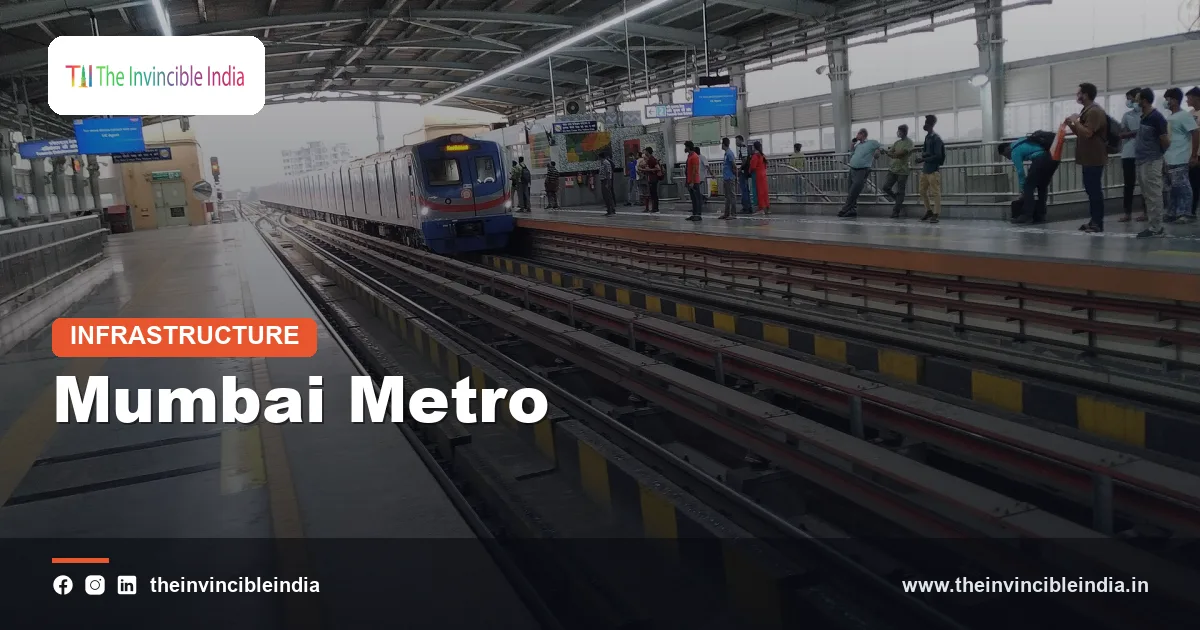
The Mumbai Metro is the growing metro rail network of the Mumbai Metropolitan Region, which began with Line 1 between Versova, Andheri and Ghatkopar in June 2014 and now includes elevated lines such as Lines 2A and 7 and the fully underground Aqua Line (Line 3) between Colaba, Bandra and SEEPZ. The Mumbai Metro is being built mainly by the Mumbai Metropolitan Region Development Authority (MMRDA) and the Mumbai Metro Rail Corporation (MMRCL) to relieve Mumbai’s overloaded suburban railway and road network.
The Mumbai Metro adds an east-west and north-south layer of rapid transit to a city whose main rail corridors run north-south. This explainer covers why the metro was needed, Line 1, the Yellow and Red Lines, the underground Aqua Line 3, the MMRDA build-out plan, ticketing and ridership, and the controversies and challenges involved.
| Attribute | Detail |
|---|---|
| Official name | Mumbai Metro (metro rail network of the Mumbai Metropolitan Region) |
| Main agencies | MMRDA (planning and construction of most lines) and Mumbai Metro Rail Corporation Limited (MMRCL, Line 3) |
| First line | Line 1 (Versova-Andheri-Ghatkopar), about 11.4 km, opened June 2014 |
| Underground line | Aqua Line (Line 3), Colaba-Bandra-SEEPZ, about 33.5 km, fully underground |
| Other operating lines | Line 2A (Yellow) and Line 7 (Red), elevated, opened in phases from 2022 |
| Operators | Mumbai Metro One Pvt. Ltd. (Line 1), Maha Mumbai Metro Operation Corporation (Lines 2A and 7), MMRCL (Line 3) |
| State | Maharashtra |
| Gauge and power | Standard gauge (1,435 mm), 25 kV AC overhead electrification |
| Long-term plan | A metro master plan of well over 300 km across the Mumbai Metropolitan Region |
Key Takeaways
- The Mumbai Metro is the metro rail network of the Mumbai Metropolitan Region in Maharashtra, with Line 1 between Versova, Andheri and Ghatkopar opening in June 2014 as its first line.
- The Mumbai Metro Aqua Line (Line 3) runs about 33.5 km from Colaba to SEEPZ via Bandra and is fully underground.
- The Mumbai Metro Lines 2A (Yellow) and 7 (Red) are elevated lines in the western suburbs built by the Mumbai Metropolitan Region Development Authority (MMRDA) and opened in phases from 2022.
- The Mumbai Metro was planned to relieve the Mumbai Suburban Railway, which carries millions of passengers a day and is among the most crowded urban rail systems in the world.
- The MMRDA has a master plan for a metro network of well over 300 km across the Mumbai Metropolitan Region, to be built in phases through the late 2020s and beyond.
- The Mumbai Metro uses standard gauge track of 1,435 mm, which differs from the broad gauge of the Mumbai suburban railway, so the two systems do not share trains.
What is the Mumbai Metro?
The Mumbai Metro is a network of electrically powered rapid-transit lines serving Mumbai and its neighbouring towns in the Mumbai Metropolitan Region (MMR). The Mumbai Metro runs on separate tracks, either elevated on viaducts or in underground tunnels, and it is designed to carry commuters faster and in more comfort than buses or cars on the city’s crowded roads.
Mumbai’s older mass transit system is the Mumbai Suburban Railway, run by Western Railway and Central Railway, which runs mainly along north-south corridors. The Mumbai Metro adds lines in east-west and cross-city directions that the suburban railway does not cover, and it gives new areas, such as Andheri East and the Bandra Kurla Complex, direct rail access.
The Mumbai Metro should not be confused with the Navi Mumbai Metro, which is built by CIDCO in Navi Mumbai and has its own lines, or with the Mumbai Monorail, which is a separate rail technology on the Chembur-Jacob Circle corridor.
Why does Mumbai need a metro?
Mumbai needs a metro because its suburban rail and roads carry far more people than they were designed for, and there is limited space to add new surface infrastructure. The Mumbai Suburban Railway has historically carried several million passengers daily, and trains at peak hours run with extreme crowding.
The city is a long, narrow peninsula with a limited number of north-south corridors, and the western and eastern express highways are congested for much of the day. Land is scarce and costly, and so the Mumbai Metro has been built mostly on viaducts over existing roads and, in the dense southern part, underground.
Problems the metro is meant to address
- Overcrowding on the suburban railway, where passenger loads at peak hours greatly exceed design capacity.
- Slow road traffic on the western and eastern express highways and link roads.
- Poor east-west connectivity between the western line and the central and harbour lines.
- Long travel times between business districts such as Bandra Kurla Complex, Nariman Point, SEEPZ and Andheri.
Which was the first Mumbai Metro line? Line 1 explained
The first Mumbai Metro line was Line 1, also called the Blue Line, which runs about 11.4 km between Versova in the west and Ghatkopar in the east via Andheri and opened to the public on 8 June 2014. Line 1 is elevated and has 12 stations, and it crosses the western and central suburban rail lines to give an east-west link that previously needed a long bus or road journey.
Line 1 was built as a public-private partnership, with a company called Mumbai Metro One Private Limited holding the concession. The company was led by Reliance Infrastructure, with the MMRDA as a minority stakeholder, and it ran the line under a build-operate-transfer arrangement. Later, the MMRDA moved to take over the private stake, and arrangements for the transfer have been reported across several years.
Line 1 cut the travel time between Versova and Ghatkopar from well over an hour by road at peak times to roughly 20 minutes or so on the train, and it quickly became one of the busiest metro lines in India per kilometre. It also interchanges with Western Railway at Andheri and with Central Railway at Ghatkopar.
What are the Yellow Line and Red Line of the Mumbai Metro?
The Yellow Line (Line 2A) and the Red Line (Line 7) are elevated Mumbai Metro lines in the western suburbs, built by the MMRDA and opened in phases from 2022. The Yellow Line (Line 2A) runs from Dahisar East to Andheri West and the Red Line (Line 7) runs from Dahisar East to Andheri East, so that both lines share the northern terminus area at Dahisar.
Lines at a glance
| Line | Colour | Route (approximate) | Approximate length | Type |
|---|---|---|---|---|
| Line 1 | Blue | Versova to Ghatkopar via Andheri | About 11.4 km | Elevated |
| Line 2A | Yellow | Dahisar East to DN Nagar (Andheri West) | About 18-19 km | Elevated |
| Line 7 | Red | Dahisar East to Gundavali (Andheri East) | About 16-17 km | Elevated |
| Line 3 | Aqua | Colaba to Bandra to SEEPZ (Aarey) | About 33.5 km | Fully underground |
Lines 2A and 7 run mostly along the Western Express Highway and the Link Road, which are among the busiest arterial roads in Mumbai. The two lines are operated by Maha Mumbai Metro Operation Corporation Limited (MMMOCL), an MMRDA company. Line 2A connects with Line 1 at DN Nagar, Line 7 connects with Line 1 at Gundavali, and both lines meet the suburban railway at several stations, and they are linked to the Mumbai One smart card and other digital payment systems.
The lengths and opening dates for each stretch are approximate, as the phases opened over 2022 and 2023, and the MMRDA publishes updated information on these lines.
What is the Mumbai Metro Aqua Line (Line 3)?
The Mumbai Metro Aqua Line, officially Line 3, is a fully underground metro corridor of about 33.5 km that runs from Colaba in south Mumbai through Bandra Kurla Complex and the airport to SEEPZ and Aarey in the north. The Aqua Line is built and operated by the Mumbai Metro Rail Corporation Limited (MMRCL), a joint venture company of the Government of Maharashtra and the Government of India.
The Aqua Line has around 27 stations, all underground, and it connects major destinations including the Cuffe Parade business district, Churchgate and Chhatrapati Shivaji Maharaj Terminus areas, Mumbai Central, Siddhivinayak, Dadar, Bandra Kurla Complex, both terminals of the Chhatrapati Shivaji Maharaj International Airport and the SEEPZ industrial zone. The route passes under some of the densest parts of the city, which is why the line was built underground with tunnel boring machines.
Why Line 3 was a major project
- It is Mumbai’s first fully underground metro and one of the largest underground metro projects in India.
- It was financed with a large loan from the Japan International Cooperation Agency (JICA), alongside government equity.
- It uses eight-car trains and modern signalling designed for high frequency and driverless-capable operation.
- It links the central business district of south Mumbai directly with the airport and Bandra Kurla Complex.
Line 3 opened in phases beginning in October 2024, starting with the northern section, and further sections to Worli and then to south Mumbai followed. The project drew public attention over the location of its car depot at Aarey Colony, a green area in Goregaon, and the issue involved court cases, public protests and changes of government decisions over the years. Environmental groups raised concerns about tree felling, while the authorities argued that the depot was essential for operating the line.
Who builds the Mumbai Metro and what is the MMRDA master plan?
The Mumbai Metro is built mainly by the Mumbai Metropolitan Region Development Authority (MMRDA), a state government body responsible for planning and coordinating development across the Mumbai Metropolitan Region. The MMRDA is the nodal agency for most lines, while Line 3 was entrusted to MMRCL, and Navi Mumbai’s lines are handled by CIDCO.
The MMRDA’s metro master plan envisages a network of well over 300 km across Mumbai, Thane, Navi Mumbai, Kalyan, Mira-Bhayandar and other parts of the region. The plan is implemented in phases and has been revised several times, so completion dates and lengths shift.
Examples of lines planned or under construction
| Line | Broad description |
|---|---|
| Line 2B | Extension from the Yellow Line towards Mandale in Chembur, serving the eastern suburbs |
| Line 4 and 4A | Wadala to Thane and Kasarvadavali, linking central Mumbai to Thane |
| Line 5 | Thane to Bhiwandi and Kalyan |
| Line 6 | Swami Samarth Nagar in Andheri West to Vikhroli |
| Line 9 | Extension of the Red Line from Dahisar towards Mira-Bhayandar |
| Other lines | Further corridors towards Navi Mumbai, Virar and other parts of the region |
The statuses of these projects vary between under construction, tendered and proposed, and each line has its own timeline. Delays have occurred because of land acquisition, utility shifting, tree felling permissions, funding arrangements and contractual disputes.
How do you pay for the Mumbai Metro and how many people use it?
You can pay for the Mumbai Metro using single-journey tokens or QR tickets, smart cards, the National Common Mobility Card (NCMC) and mobile apps, and the Mumbai Metro carries hundreds of thousands of passengers on a busy day across its operating lines. Line 1 alone has historically carried several lakh passengers on busy days, and the network’s overall ridership has grown with each new line and extension.
Common ticketing options
- Smart cards: Stored-value cards such as the Mumbai One card, which offer discounts on fares.
- NCMC: The interoperable National Common Mobility Card used across multiple transport systems.
- QR tickets: Tickets bought on mobile apps and scanned at gates.
- Tokens: Single-journey tickets from counters or vending machines.
Fares are determined by a fare-fixation committee and vary by distance and line, and they have been revised from time to time. Ridership depends on connectivity with the suburban railway, the availability of feeder buses, the coverage of the network and how many lines connect with each other. Official figures are published by the operators and are revised frequently.
What are the challenges and controversies around the Mumbai Metro?
The main challenges around the Mumbai Metro are land and right-of-way constraints, project delays and cost increases, environmental objections, and the difficulty of integrating separate lines run by different operators. These issues are common to big city metro projects, and Mumbai’s density makes them especially acute.
- Cost and delays: Several lines were completed later and at higher cost than the original estimates.
- Aarey and tree felling: The location of the Line 3 car depot at Aarey Colony and the felling of trees led to prolonged public debate and legal proceedings.
- Fares: Early Line 1 fare increases and disputes between the concessionaire and the MMRDA drew attention.
- Integration: Passengers need smooth transfers between metro lines, suburban railway stations, buses and autos, and the quality of walkways and feeder links varies.
- Construction disruption: Traffic diversions, noise and dust during construction affect residents and businesses along the routes.
Authorities respond with measures such as the common mobility card, skywalks and feeder bus routes, though improvement depends on coordination among multiple agencies.
Bottom Line
The Mumbai Metro has moved from a single 11-km line in 2014 to a multi-line network that includes the underground Aqua Line, and it is set to grow under the MMRDA master plan. Its success will depend on completing the remaining corridors, integrating lines and fares, and connecting stations well with the suburban railway. For current routes, timings and fares, refer to the operators’ official channels (last updated 17 October 2026).
Frequently Asked Questions
Which was the first metro line in Mumbai?
The first metro line in Mumbai was Line 1, which runs between Versova, Andheri and Ghatkopar. Line 1 opened on 8 June 2014 and is about 11.4 km long with 12 elevated stations. It was built as a public-private partnership.
What is the Mumbai Metro Aqua Line?
The Mumbai Metro Aqua Line is Line 3, a fully underground metro corridor of about 33.5 km between Colaba and SEEPZ. It passes Mumbai Central, Dadar, Bandra Kurla Complex and the airport, and it was built by Mumbai Metro Rail Corporation Limited (MMRCL). It opened in phases starting in October 2024.
Who runs the Mumbai Metro?
The Mumbai Metro is run by several operators depending on the line. Mumbai Metro One Pvt. Ltd. runs Line 1, Maha Mumbai Metro Operation Corporation (an MMRDA company) runs Lines 2A and 7, and MMRCL runs the Aqua Line (Line 3). The MMRDA plans and builds most of the network.
Does the Mumbai Metro go to the airport?
The Mumbai Metro reaches the airport area through the Aqua Line (Line 3), which has stations serving both terminals of the Chhatrapati Shivaji Maharaj International Airport. The Aqua Line connects the airport to Bandra Kurla Complex and south Mumbai. Lines 1, 2A and 7 serve the surrounding suburbs and Andheri, from where connections to the airport area are possible.
Why is the Mumbai Metro needed when there is a suburban railway?
The Mumbai Metro is needed because the Mumbai Suburban Railway is overcrowded and does not cover many east-west and cross-city routes. The suburban railway carries millions of passengers daily on largely north-south lines, and the metro adds capacity and new links such as Andheri to Ghatkopar. The two systems are complementary and interchange at several stations.
How long will the Mumbai Metro network eventually be?
The MMRDA’s master plan envisages a Mumbai Metro network of well over 300 km across the Mumbai Metropolitan Region. The network is being built in phases, and lengths and completion dates are revised from time to time. Not all of the planned lines are operational, and some are still under construction or in the planning stage.
{“@context”:”https://schema.org”,”@graph”:[{“@type”:”FAQPage”,”mainEntity”:[{“@type”:”Question”,”name”:”Which was the first metro line in Mumbai?”,”acceptedAnswer”:{“@type”:”Answer”,”text”:”The first metro line in Mumbai was Line 1, which runs between Versova, Andheri and Ghatkopar. Line 1 opened on 8 June 2014 and is about 11.4 km long with 12 elevated stations. It was built as a public-private partnership.”}},{“@type”:”Question”,”name”:”What is the Mumbai Metro Aqua Line?”,”acceptedAnswer”:{“@type”:”Answer”,”text”:”The Mumbai Metro Aqua Line is Line 3, a fully underground metro corridor of about 33.5 km between Colaba and SEEPZ. It passes Mumbai Central, Dadar, Bandra Kurla Complex and the airport, and it was built by Mumbai Metro Rail Corporation Limited (MMRCL). It opened in phases starting in October 2024.”}},{“@type”:”Question”,”name”:”Who runs the Mumbai Metro?”,”acceptedAnswer”:{“@type”:”Answer”,”text”:”The Mumbai Metro is run by several operators depending on the line. Mumbai Metro One Pvt. Ltd. runs Line 1, Maha Mumbai Metro Operation Corporation (an MMRDA company) runs Lines 2A and 7, and MMRCL runs the Aqua Line (Line 3). The MMRDA plans and builds most of the network.”}},{“@type”:”Question”,”name”:”Does the Mumbai Metro go to the airport?”,”acceptedAnswer”:{“@type”:”Answer”,”text”:”The Mumbai Metro reaches the airport area through the Aqua Line (Line 3), which has stations serving both terminals of the Chhatrapati Shivaji Maharaj International Airport. The Aqua Line connects the airport to Bandra Kurla Complex and south Mumbai. Lines 1, 2A and 7 serve the surrounding suburbs and Andheri, from where connections to the airport area are possible.”}},{“@type”:”Question”,”name”:”Why is the Mumbai Metro needed when there is a suburban railway?”,”acceptedAnswer”:{“@type”:”Answer”,”text”:”The Mumbai Metro is needed because the Mumbai Suburban Railway is overcrowded and does not cover many east-west and cross-city routes. The suburban railway carries millions of passengers daily on largely north-south lines, and the metro adds capacity and new links such as Andheri to Ghatkopar. The two systems are complementary and interchange at several stations.”}},{“@type”:”Question”,”name”:”How long will the Mumbai Metro network eventually be?”,”acceptedAnswer”:{“@type”:”Answer”,”text”:”The MMRDA’s master plan envisages a Mumbai Metro network of well over 300 km across the Mumbai Metropolitan Region. The network is being built in phases, and lengths and completion dates are revised from time to time. Not all of the planned lines are operational, and some are still under construction or in the planning stage.”}}]}]}


