

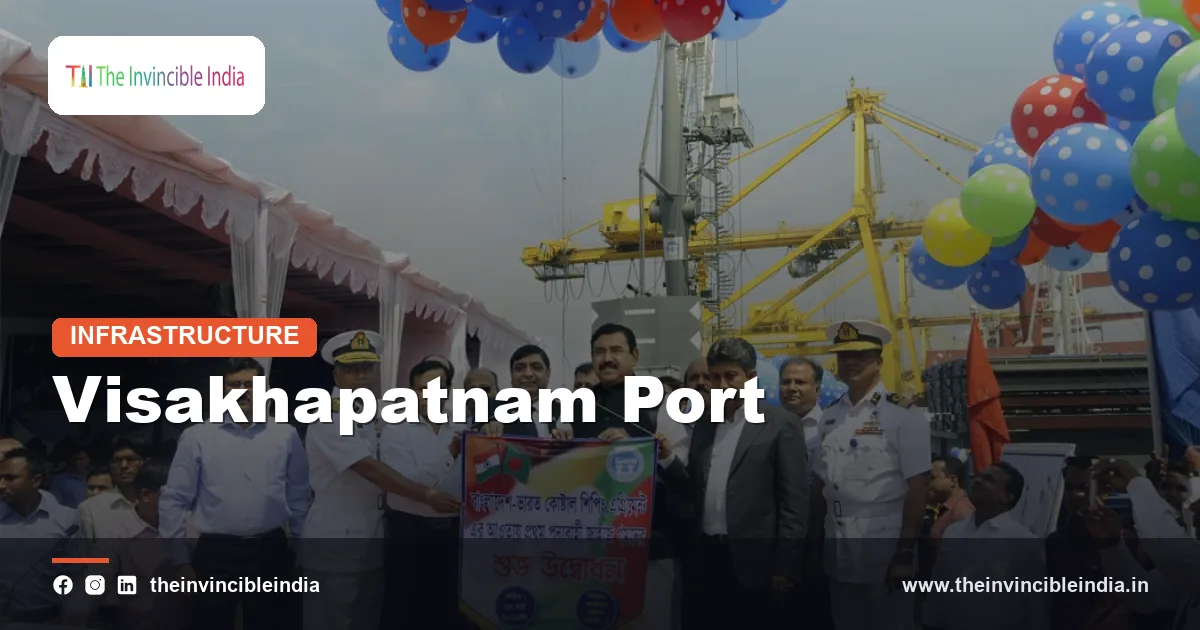
Visakhapatnam Port is one of India’s dozen or so major ports, a deepwater natural harbour on the Bay of Bengal coast of Andhra Pradesh that is run by the Visakhapatnam Port Authority under the Ministry of Ports, Shipping and Waterways. Visakhapatnam Port, often called Vizag Port, handles iron ore, coal, crude oil, fertilisers, petroleum products and containers, and it sits next to the Eastern Naval Command of the Indian Navy.
Visakhapatnam Port is important because it is the main outlet on the east coast for the steel, mineral and refining industries of Andhra Pradesh, Odisha, Chhattisgarh and neighbouring regions. This explainer describes how Visakhapatnam Port is organised, what it handles, who runs it, how its inner and outer harbours differ, and why its location beside a naval base and an industrial city makes it unusual among Indian ports.
| Attribute | Detail |
|---|---|
| Name | Visakhapatnam Port (Vizag Port), run by the Visakhapatnam Port Authority |
| Location | Visakhapatnam, Andhra Pradesh, on the Bay of Bengal coast |
| Status | One of India’s major ports, owned by the Government of India |
| Opened | October 1933 |
| Governing law | Major Port Authorities Act, 2021 (earlier the Major Port Trusts Act, 1963) |
| Parent ministry | Ministry of Ports, Shipping and Waterways |
| Harbour layout | Inner harbour, outer harbour and a long entrance channel |
| Main cargoes | Iron ore, coal, crude oil and petroleum products, fertilisers, containers, general cargo |
| Neighbours | Eastern Naval Command, Hindustan Shipyard, Visakhapatnam Steel Plant |
Key Takeaways
- Visakhapatnam Port is a major port of India on the east coast, located in Visakhapatnam, Andhra Pradesh, and managed by the Visakhapatnam Port Authority.
- Visakhapatnam Port began operations in 1933 and has grown into a deepwater harbour with an inner harbour and a later outer harbour built to handle large bulk carriers.
- Visakhapatnam Port handles a mix of bulk cargoes such as iron ore, coal and crude oil along with a growing volume of containers handled through private terminal operators.
- Visakhapatnam Port lies close to the Eastern Naval Command of the Indian Navy, which makes the harbour both a commercial and a strategic asset.
- Visakhapatnam Port serves the industrial hinterland of Andhra Pradesh, Odisha, Chhattisgarh and Telangana through rail and road links, including the Kirandul iron ore line.
- Visakhapatnam Port, together with nearby shipbuilding, steel and refining industries, forms the economic core of the city of Visakhapatnam.
What Is Visakhapatnam Port?
Visakhapatnam Port is a government-owned major seaport that serves as the principal gateway for cargo on the Andhra Pradesh coast and a large part of eastern and central India. It is a natural harbour, protected on one side by a rocky headland, and it can take vessels that many other east-coast ports cannot.
The port is generally called Vizag Port in everyday speech, after the common short name of the city. It is administered as a major port, which means it falls under the central government and not under the state maritime board, unlike the many smaller non-major ports on the same coast.
The port’s role is to receive and ship bulk commodities, support the oil refinery and steel plant in the city, and connect Indian exporters to Asian, European and Middle Eastern markets.
Where Is Visakhapatnam Port Located?
Visakhapatnam Port is located on the Bay of Bengal in the city of Visakhapatnam in Andhra Pradesh, roughly midway along India’s east coast between Chennai and Kolkata. The harbour sits in a natural bay that is sheltered by a prominent rocky outcrop known as Dolphin’s Nose, a landmark familiar to sailors and local residents.
The location offers several advantages:
- Natural depth: the sheltered bay has deep water close to the shore, which reduces the amount of dredging needed.
- Rail and road access: the port is connected by rail to the mineral belt of Odisha and Chhattisgarh and by road to the national highway along the east coast.
- Industrial neighbours: a steel plant, a refinery, a shipyard and the naval base are located within or close to the city.
- Distance from major sea lanes: the port is well placed for trade with East and Southeast Asia, including Japan, China and Southeast Asian countries.
When Was Visakhapatnam Port Established?
Visakhapatnam Port was formally opened in October 1933 after years of survey and construction, and it later became a major port under the central government. The harbour was developed in the early decades of the twentieth century to give the Bengal-Nagpur Railway system and the interior a direct outlet to the sea.
Early work focused on cutting a navigation channel through the sandy bar at the harbour mouth and building quays inside the sheltered inner harbour. After Independence, the harbour was expanded, and it was brought under the Major Port Trusts framework as traffic from iron ore and other bulk commodities grew.
A major expansion came in the 1970s with the construction of the outer harbour, which allowed much larger bulk ships to call at Visakhapatnam without having to enter the narrow inner harbour. The exact opening years of individual berths vary by source, so readers who need a specific date should check the port’s own records.
What Are the Inner Harbour and Outer Harbour at Visakhapatnam Port?
The inner harbour at Visakhapatnam Port is the original, sheltered basin of older berths, while the outer harbour is a later deepwater extension built to handle larger vessels carrying bulk cargo. The two harbours work together as a single port but serve different kinds of ships and cargoes.
The inner harbour
The inner harbour is the older part of the port. It has a number of berths for general cargo, fertilisers, containers and other mixed cargoes, and it is reached through a dredged entrance channel. Because of the limited width and depth, it is better suited to small and medium vessels.
The outer harbour
The outer harbour was built to take vessels of a much larger size. It has deeper berths, including terminals for iron ore, coal and crude oil, and it can handle ships of the capesize and large tanker class, subject to the declared draft at any given time.
| Feature | Inner harbour | Outer harbour |
|---|---|---|
| Era | Original port from the 1930s | Later extension from the 1970s onward |
| Vessel size | Small to medium ships | Large bulk carriers and tankers |
| Typical cargo | General cargo, fertilisers, containers, petroleum products | Iron ore, coal, crude oil, large bulk cargo |
| Depth | Shallower, dredged channel | Deeper, suitable for much larger ships |
What Does Visakhapatnam Port Handle?
Visakhapatnam Port handles mainly dry bulk and liquid bulk cargoes, led by iron ore, coal and crude oil, with petroleum products, fertilisers and containers making up the rest. The cargo mix reflects the industries of the hinterland more than consumer trade.
- Iron ore and pellets: exported largely from the Bailadila region of Chhattisgarh and from Odisha, often to steel makers in East Asia.
- Coal: imported coking coal for steel plants and thermal coal for power stations.
- Crude oil and petroleum products: crude for the refinery in the city and products moved out by coastal tankers.
- Fertilisers and chemicals: imported or moved coastally for agriculture and industry.
- Containers: handled through terminals run by private operators under concession from the port authority.
Annual traffic at Visakhapatnam Port has been in the range of several tens of millions of tonnes in recent years, but figures change from year to year, so the latest official statistics from the port authority should be used when precise numbers are needed.
Who Runs Visakhapatnam Port?
Visakhapatnam Port is run by the Visakhapatnam Port Authority, a central government body headed by a chairperson and governed by a board under the Major Port Authorities Act, 2021. The port authority owns the land, channels and many of the berths, and it works as a landlord port in much of its business.
In the landlord model, the port authority leases terminals to private companies, which build and operate cargo-handling equipment and pay the authority a share of revenue or a fee. This is the model followed across India’s major ports since the reforms of the 1990s and 2000s.
The Ministry of Ports, Shipping and Waterways oversees policy, and the port authority is responsible for dredging, navigation aids, pilotage, tug services and land management within its limits. Customs, immigration and port health authorities operate in parallel, as they do at any international port.
How Is Visakhapatnam Port Connected to Its Hinterland?
Visakhapatnam Port is connected to its hinterland mainly by railway and by national highway, with a dedicated railway line that carries iron ore from Chhattisgarh to the coast. The rail connection is especially important because bulk cargoes such as iron ore and coal are moved in large rakes over long distances.
The Kirandul line, commonly called the Kottavalasa-Kirandul railway, runs from the coast through the Eastern Ghats to the Bailadila mines in Chhattisgarh. It passes through steep terrain and numerous tunnels and bridges, and it was built largely to carry iron ore to Visakhapatnam for export. The east-coast railway trunk route links the port to Kolkata and Chennai, and the national highway along the coast provides road access.
The port is also part of broader corridor plans, including the Visakhapatnam-Chennai Industrial Corridor, which is intended to improve road, rail and industrial links along the east coast. The pace and exact scope of such corridor projects change over time.
What Is the Link Between Visakhapatnam Port and the Indian Navy?
Visakhapatnam Port shares its harbour area with the Eastern Naval Command of the Indian Navy, which has its headquarters in the city and is responsible for naval operations in the Bay of Bengal. Naval and commercial facilities are kept separate, but they share the same coastline, approach waters and city infrastructure.
The Eastern Naval Command was set up in the late 1960s, and Visakhapatnam has since become one of the Indian Navy’s most important bases. The naval presence includes dockyard facilities, a naval base and a significant shipbuilding presence. The city is also associated with the Indian Navy’s submarine programme, with submarine construction activity located at a dedicated facility.
This co-location has two consequences. It adds security requirements and navigation rules in the harbour approaches, and it makes Visakhapatnam strategically important for India’s maritime strategy in the Bay of Bengal and the wider Indian Ocean.
How Does Visakhapatnam Port Support the City’s Economy?
Visakhapatnam Port supports the city’s economy by anchoring a cluster of heavy industry, providing jobs in cargo handling and logistics, and giving industries a direct route to foreign markets. The port-industrial economy of Visakhapatnam is one of the largest on India’s east coast.
The main economic partners of the port within the city are:
- Visakhapatnam Steel Plant: an integrated steel plant that imports coal and ore via the port and exports steel products.
- Refinery and petrochemicals: an oil refinery in the city that receives crude oil and ships out petroleum products.
- Shipbuilding and repair: a shipyard dating to the 1940s, associated with the launch of an early Indian-built merchant ship, and naval shipbuilding facilities.
- Fisheries and tourism: a fishing harbour and a growing coastal tourism and cruise sector.
- Logistics and warehousing: trucking, rail yards, container depots and storage firms around the port.
The city is also becoming an information technology and pharmaceutical hub, but heavy industry linked to the port remains the traditional economic backbone.
How Does Visakhapatnam Port Compare With Other East Coast Ports?
Visakhapatnam Port is the largest major port on the Andhra Pradesh coast and is usually grouped with Paradip, Kolkata and Chennai as a key east-coast port, with nearby private ports such as Gangavaram and Krishnapatnam providing competition. The comparison below uses broad, qualitative descriptions instead of exact tonnage figures.
| Port | State | Ownership | Known for |
|---|---|---|---|
| Visakhapatnam | Andhra Pradesh | Major port (central government) | Iron ore, coal, crude oil, naval co-location |
| Paradip | Odisha | Major port (central government) | Coal, iron ore, large bulk volumes |
| Chennai | Tamil Nadu | Major port (central government) | Containers, automobiles |
| Kolkata (Syama Prasad Mookerjee) | West Bengal | Major port (central government) | River port with a dock complex and Haldia |
| Gangavaram | Andhra Pradesh | Private non-major port | Deep draft bulk and coal terminal near Visakhapatnam |
The presence of private ports on the same coast means Visakhapatnam Port competes for cargo and has pursued modernisation, mechanisation and terminal upgrades to retain traffic.
What Is the Future Outlook for Visakhapatnam Port?
The outlook for Visakhapatnam Port depends on deeper berths, better rail and road links and the success of coastal industrial corridors, with the port authority planning upgrades under India’s national maritime programmes. Projects under the Sagarmala programme aim to improve port connectivity, modernise terminals and develop industrial clusters around ports.
Several themes are likely to shape the port’s future:
- Capacity expansion: deepening and widening berths so that larger vessels can be handled.
- Mechanisation: adding modern bulk and container handling equipment to cut ship turnaround times.
- Last-mile connectivity: improving rail sidings and road links to the port.
- Environmental management: controlling dust from coal and ore handling and protecting the coastline.
- Diversification: growth in containers, coastal shipping and cruise tourism alongside bulk cargo.
Plans and project timelines of this kind change with funding and policy, so they should be read as directions rather than fixed commitments.
Bottom Line
Visakhapatnam Port is a major deepwater port on the Bay of Bengal coast of Andhra Pradesh, run by the Visakhapatnam Port Authority, handling iron ore, coal, crude oil and containers through an inner and an outer harbour. Its location beside the Eastern Naval Command and a cluster of steel, refining and shipbuilding industries makes it both an economic and a strategic gateway for eastern India.
Frequently Asked Questions
Where is Visakhapatnam Port located?
Visakhapatnam Port is located in the city of Visakhapatnam on the Bay of Bengal coast of Andhra Pradesh. It sits in a natural bay sheltered by the Dolphin’s Nose headland. The port lies roughly midway along the east coast, between Chennai and Kolkata.
Is Visakhapatnam Port a major port?
Yes, Visakhapatnam Port is one of India’s dozen or so major ports and is owned by the Government of India. It is managed by the Visakhapatnam Port Authority under the Ministry of Ports, Shipping and Waterways. Major ports are distinct from non-major ports, which come under state maritime boards.
What cargo does Visakhapatnam Port handle?
Visakhapatnam Port handles mainly bulk cargoes such as iron ore, coal and crude oil, along with petroleum products, fertilisers and containers. Iron ore from Chhattisgarh and Odisha is a traditional export. Container and general cargo are handled through private terminal operators working under the port authority.
What is the difference between the inner and outer harbour at Visakhapatnam Port?
The inner harbour is the original, sheltered part of Visakhapatnam Port suitable for smaller and medium ships, while the outer harbour is a later deepwater extension for large bulk carriers and tankers. The outer harbour was built from the 1970s onward. Both are managed as a single port by the Visakhapatnam Port Authority.
Is Visakhapatnam Port connected to the Indian Navy base?
Yes, Visakhapatnam Port shares its coastline with the Eastern Naval Command of the Indian Navy, which has its headquarters in the city. Naval and commercial facilities are kept separate, but they share the approach waters. This co-location makes Visakhapatnam strategically important in the Bay of Bengal.
How is iron ore brought to Visakhapatnam Port?
Iron ore reaches Visakhapatnam Port mainly by rail, using the Kottavalasa-Kirandul line from the Bailadila mines in Chhattisgarh. The line crosses the Eastern Ghats through many tunnels and bridges. The ore is loaded into ships at the port for export, largely to steel makers in East Asia.
{“@context”:”https://schema.org”,”@graph”:[{“@type”:”FAQPage”,”mainEntity”:[{“@type”:”Question”,”name”:”Where is Visakhapatnam Port located?”,”acceptedAnswer”:{“@type”:”Answer”,”text”:”Visakhapatnam Port is located in the city of Visakhapatnam on the Bay of Bengal coast of Andhra Pradesh. It sits in a natural bay sheltered by the Dolphin’s Nose headland. The port lies roughly midway along the east coast, between Chennai and Kolkata.”}},{“@type”:”Question”,”name”:”Is Visakhapatnam Port a major port?”,”acceptedAnswer”:{“@type”:”Answer”,”text”:”Yes, Visakhapatnam Port is one of India’s dozen or so major ports and is owned by the Government of India. It is managed by the Visakhapatnam Port Authority under the Ministry of Ports, Shipping and Waterways. Major ports are distinct from non-major ports, which come under state maritime boards.”}},{“@type”:”Question”,”name”:”What cargo does Visakhapatnam Port handle?”,”acceptedAnswer”:{“@type”:”Answer”,”text”:”Visakhapatnam Port handles mainly bulk cargoes such as iron ore, coal and crude oil, along with petroleum products, fertilisers and containers. Iron ore from Chhattisgarh and Odisha is a traditional export. Container and general cargo are handled through private terminal operators working under the port authority.”}},{“@type”:”Question”,”name”:”What is the difference between the inner and outer harbour at Visakhapatnam Port?”,”acceptedAnswer”:{“@type”:”Answer”,”text”:”The inner harbour is the original, sheltered part of Visakhapatnam Port suitable for smaller and medium ships, while the outer harbour is a later deepwater extension for large bulk carriers and tankers. The outer harbour was built from the 1970s onward. Both are managed as a single port by the Visakhapatnam Port Authority.”}},{“@type”:”Question”,”name”:”Is Visakhapatnam Port connected to the Indian Navy base?”,”acceptedAnswer”:{“@type”:”Answer”,”text”:”Yes, Visakhapatnam Port shares its coastline with the Eastern Naval Command of the Indian Navy, which has its headquarters in the city. Naval and commercial facilities are kept separate, but they share the approach waters. This co-location makes Visakhapatnam strategically important in the Bay of Bengal.”}},{“@type”:”Question”,”name”:”How is iron ore brought to Visakhapatnam Port?”,”acceptedAnswer”:{“@type”:”Answer”,”text”:”Iron ore reaches Visakhapatnam Port mainly by rail, using the Kottavalasa-Kirandul line from the Bailadila mines in Chhattisgarh. The line crosses the Eastern Ghats through many tunnels and bridges. The ore is loaded into ships at the port for export, largely to steel makers in East Asia.”}}]}]}


