

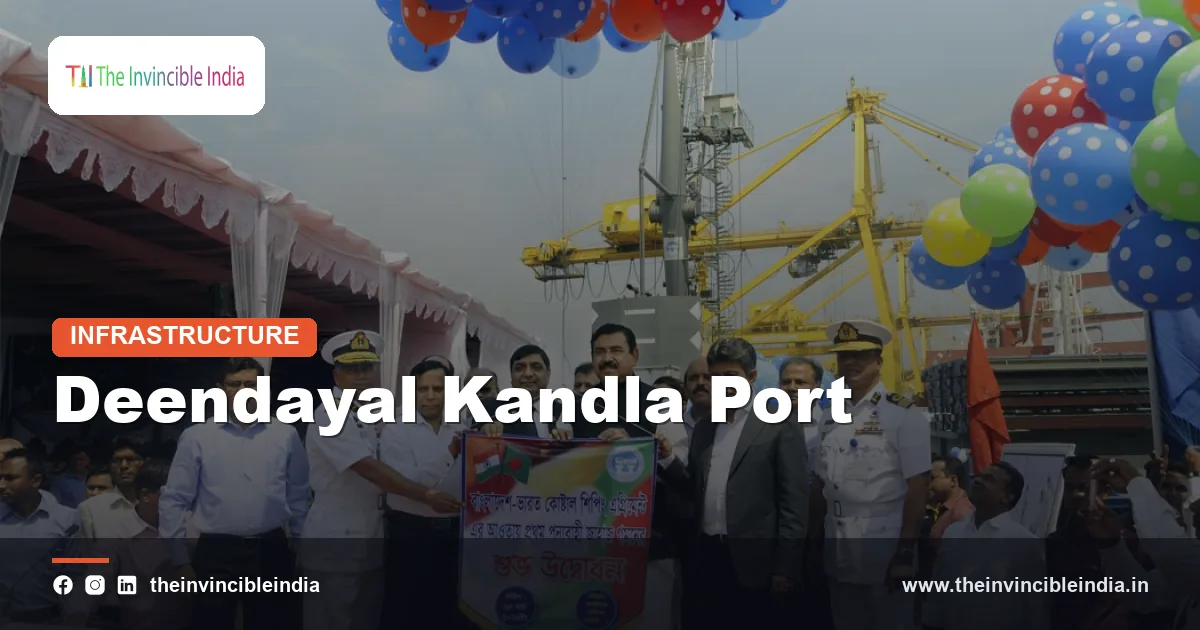
Deendayal Port, formerly known as Kandla Port, is a major port of India located on Kandla Creek in the Gulf of Kutch in Gujarat, run by the Deendayal Port Authority and widely known as one of the country’s highest-tonnage ports. Deendayal Port handles crude oil, petroleum products, edible oil, fertilisers, grain, coal, salt and other bulk cargo, and it sits beside the Kandla Special Economic Zone and the Gandhidham township.
Deendayal Port was developed in the years after Partition to replace the loss of Karachi as the main outlet for northwest India, and it was renamed in 2017 after the political thinker Pandit Deendayal Upadhyaya. This explainer sets out what Deendayal Port is, why its tidal creek location matters, what it handles, who runs it, and how it connects to the Kandla Special Economic Zone and the wider northern hinterland.
| Attribute | Detail |
|---|---|
| Current name | Deendayal Port (also called Kandla Port) |
| Earlier name | Kandla Port, renamed Deendayal Port in 2017 |
| Location | Kandla Creek, Gulf of Kutch, Kachchh district, Gujarat |
| Status | One of India’s major ports, owned by the Government of India |
| Developed | 1950s, after Partition, as a replacement for Karachi |
| Administered by | Deendayal Port Authority, under the Ministry of Ports, Shipping and Waterways |
| Type of port | Tidal port on a creek, handling bulk, liquid and container cargo |
| Main cargoes | Crude oil, petroleum, oil and chemicals, edible oils, fertilisers, grain, coal, salt |
| Associated zone | Kandla Special Economic Zone (KASEZ), established in the 1960s as an export processing zone |
Key Takeaways
- Deendayal Port is the name since 2017 of Kandla Port, a major port of India on Kandla Creek in the Gulf of Kutch, Gujarat.
- Deendayal Port was developed in the 1950s to give northwestern India a major outlet to the sea after the loss of Karachi following Partition.
- Deendayal Port has been among the highest-tonnage ports in India for many years, helped by large volumes of crude oil, petroleum products and other bulk cargo.
- Deendayal Port is a tidal port, which means ship movements depend on the rise and fall of the tide in the Gulf of Kutch and in Kandla Creek.
- Deendayal Port is next to the Kandla Special Economic Zone, which began as an export processing zone in the 1960s and is often cited as the first of its kind in Asia.
- Deendayal Port also administers oil handling facilities at Vadinar on the Gulf of Kutch, which serve refineries in Gujarat.
What Is Deendayal Port?
Deendayal Port is a major seaport of India on the Gulf of Kutch coast of Gujarat that handles bulk, liquid and container cargo for northern and western India. It was known as Kandla Port until 2017, and many official documents, shipping lines and people in the trade still use the older name alongside the new one.
The port is owned by the Government of India and managed by the Deendayal Port Authority, which is a statutory body under the Ministry of Ports, Shipping and Waterways. It is a “major port” in the legal sense, which puts it under the central government and distinguishes it from the many small and medium ports run by the Gujarat Maritime Board.
Deendayal Port is one of several large ports on the Gujarat coast, and it works in close proximity to the privately developed Mundra port, which lies on the same gulf.
Where Is Deendayal Port Located?
Deendayal Port is located on Kandla Creek, an inlet of the Gulf of Kutch in Kachchh district, western Gujarat, close to the twin town of Gandhidham. The port sits at the head of the gulf, some distance inland from the open Arabian Sea, and ships reach it through a long approach channel.
The creek location has shaped how the port works:
- Sheltered water: the gulf and the creek protect vessels from open-sea swell, particularly during the monsoon.
- Strong tides: the Gulf of Kutch has a large tidal range, so water depth at berths changes substantially during the day.
- Silt: the creek tends to accumulate silt, so regular dredging is needed to keep channels and berths at the required depth.
- Gateway to the north: from Kandla, rail and road routes lead north to Rajasthan, Punjab, Haryana, Delhi and beyond.
The neighbouring township of Gandhidham was planned in the late 1940s and 1950s to house people displaced by Partition, particularly Sindhi families, and it grew alongside the port.
Why Was Kandla Port Built?
Kandla Port was built because Partition in 1947 left Karachi, the main port for northwest India, in Pakistan, and the Indian government needed a new large port on the western coast to serve Gujarat, Rajasthan, Punjab and the northern plains. The Kachchh coast offered a sheltered creek relatively close to those regions.
The decision, taken in the late 1940s, led to construction work in the early 1950s on berths, a jetty and an approach channel. The port was declared a major port in the 1950s and placed under a port trust. Over the following decades it was expanded as oil imports, fertiliser imports and agricultural exports increased.
Kandla was in effect an answer to a geographical problem. After 1947, Mumbai handled much of the western coast trade, but its distance from the northwestern hinterland and its congestion made another large port necessary.
Why Was Kandla Port Renamed Deendayal Port?
Kandla Port was renamed Deendayal Port in 2017 in honour of Pandit Deendayal Upadhyaya, a political thinker and leader associated with the Bharatiya Jana Sangh, during the period marking the centenary of his birth. The Government of India announced the change in 2017, and the port authority adopted the new name in its official work.
The renaming did not change the port’s legal status or location. The institution continued as a major port, and the earlier body, formerly called the Kandla Port Trust, became the Deendayal Port Trust and, after the Major Port Authorities Act of 2021, the Deendayal Port Authority.
In practice, many documents still carry the name Kandla, and the phrase “Kandla Port” remains widely used in trade and shipping circles. Both names refer to the same port.
What Does Deendayal Port Handle?
Deendayal Port handles a wide mix of bulk and liquid cargo, with crude oil and other petroleum products, edible oils and chemicals, fertilisers, grains, coal and salt among the leading items. It also handles a share of containers and general cargo, although much of India’s container trade on this coast goes through nearby ports.
- Crude oil and petroleum products: crude imported for refineries in Gujarat and further inland, plus refined products moved on to consumers.
- Edible oils: India’s imports of palm and other vegetable oils form a significant share of the liquid cargo.
- Fertilisers: imported fertilisers and raw materials destined for farms in northern India.
- Grain and agricultural cargo: food grains moved in bulk for government and commercial buyers.
- Coal and other dry bulk: thermal coal, limestone, and other minerals.
- Salt: Kutch is one of India’s main salt-producing regions, and salt is a traditional outbound cargo.
Traffic at Deendayal Port has been well over one hundred million tonnes in some recent years, placing it at or near the top of India’s major port rankings by tonnage. Exact annual figures differ by year and should be checked in the port authority’s current statistics.
How Does Deendayal Port Compare With Other Major Ports?
Deendayal Port is often described as the highest-tonnage major port in India, although the ranking can vary from year to year depending on crude oil and coal volumes. The table below gives a qualitative comparison with other leading Indian ports rather than exact tonnage numbers.
| Port | Coast | Status | Known for |
|---|---|---|---|
| Deendayal (Kandla) | West (Gujarat) | Major port | Crude, petroleum, edible oil, fertiliser, salt |
| Jawaharlal Nehru Port (Nhava Sheva) | West (Maharashtra) | Major port | India’s leading container port |
| Paradip | East (Odisha) | Major port | Coal and iron ore |
| Mundra | West (Gujarat) | Private non-major port | Containers, coal, large multi-cargo operations |
| Visakhapatnam | East (Andhra Pradesh) | Major port | Iron ore, coal, crude, naval co-location |
A key reason Deendayal Port records such high tonnage is that crude oil and petroleum products are very heavy cargoes by weight. A port with large oil volumes will report high tonnage even if its container count is modest.
What Is the Role of Vadinar in Deendayal Port?
The oil terminals at Vadinar, on the southern shore of the Gulf of Kutch near Jamnagar, are administered as part of the Deendayal Port complex and handle large volumes of crude oil. Vadinar has offshore single point mooring facilities that allow very large crude carriers to unload without entering a shallow creek.
The Vadinar facilities supply crude oil to refineries and pipelines in Gujarat, and this is a major reason why Deendayal Port records such large liquid cargo totals. The crude pumped inland from Vadinar and Kandla flows through pipeline systems to refineries in Gujarat and in northern India.
The arrangement shows that “Deendayal Port” refers to a broader port complex and not only to the berths at Kandla Creek, a distinction that matters when reading headline traffic statistics.
What Is the Kandla Special Economic Zone?
The Kandla Special Economic Zone (KASEZ) is an export-oriented industrial zone next to Deendayal Port that began in the mid-1960s as the Kandla Free Trade Zone and is often described as the first export processing zone in Asia. It was later converted into a special economic zone in the early 2000s under India’s SEZ policy.
The zone offers tax and duty benefits to units that manufacture or trade for export. Its tenants have included firms in engineering goods, chemicals, textiles, food processing and warehousing. The zone’s location next to the port reduces logistics costs for exporters and importers of raw materials.
KASEZ is administered by the Ministry of Commerce and Industry, while the port authority belongs to the Ministry of Ports, Shipping and Waterways, so the two bodies are separate even though they are neighbours. The success of the zone depends on the port’s connectivity and customs processes.
Who Runs Deendayal Port and How Is It Governed?
Deendayal Port is run by the Deendayal Port Authority, a statutory body headed by a chairperson and governed by a board under the Major Port Authorities Act, 2021. The authority owns the port land, channels and a large share of the berths, and it follows a landlord model in which private companies operate many terminals.
The key governance points are:
- Parent ministry: the Ministry of Ports, Shipping and Waterways of the Government of India.
- Legal basis: the Major Port Authorities Act, 2021, which replaced the older Major Port Trusts Act, 1963.
- Landlord model: berths and terminals are leased to private operators on long-term concessions.
- Public services: dredging, pilotage, navigational aids, tug services and land management.
- Related agencies: customs, immigration, port health and marine safety authorities operate at the port.
The shift from a port trust to a port authority in 2021 was intended to give major ports more autonomy in decisions on tariffs, land use and projects.
How Is Deendayal Port Connected to the Rest of India?
Deendayal Port is connected to the rest of India by broad-gauge railway, national highway and pipeline links that carry cargo to the northern and western states. The rail network gives access to the dry ports and industrial belts of Rajasthan, Punjab, Haryana and Delhi, and the highway system links the Kachchh region to the main Gujarat corridors.
Crude oil and petroleum pipelines add another channel. Pipelines run from the Gulf of Kutch coast to refineries and consumption centres in Gujarat and northern India. The port also lies within the broader Delhi-Mumbai freight corridor catchment, with plans for improved rail connectivity.
The port’s strategic position, with access to northern markets but a location far from the Indian interior’s southern and eastern regions, explains why it focuses on cargo for the north and west.
What Is the Future Outlook for Deendayal Port?
The outlook for Deendayal Port depends on capacity expansion, better container handling and the development of new terminals, including large container projects planned at Tuna Tekra within the port complex. The port authority has pursued concessions with private and international operators to increase container capacity and modernise cargo handling.
Several themes are likely to matter:
- Container growth: new deepwater container capacity to compete with other ports on the Gujarat coast.
- Green energy: proposals for green hydrogen and ammonia facilities linked to the Kutch region’s renewable energy potential.
- Dredging and depth: keeping channels at sufficient depth in a silt-prone creek.
- Competition: managing competition from nearby private ports with strong container and bulk operations.
- Resilience: the Kachchh region is seismically active, and the 2001 Bhuj earthquake caused significant damage to port infrastructure, which has shaped rebuilding and design standards.
Project details and dates of this kind change over time, so they should be treated as plans and not as guarantees.
Bottom Line
Deendayal Port, formerly Kandla Port, is a major tidal port on Kandla Creek in the Gulf of Kutch, Gujarat, built after Partition to serve northwestern India and long counted among India’s highest-tonnage ports because of its large oil and bulk cargo volumes. It works together with the Kandla Special Economic Zone and the Vadinar oil terminals, and it was renamed in 2017 after Pandit Deendayal Upadhyaya.
Frequently Asked Questions
Is Deendayal Port the same as Kandla Port?
Yes, Deendayal Port and Kandla Port are the same port. The name Kandla Port was changed to Deendayal Port in 2017 in honour of Pandit Deendayal Upadhyaya. Many shipping documents and traders still use the older name.
Where is Deendayal Port located?
Deendayal Port is located on Kandla Creek in the Gulf of Kutch, in Kachchh district of Gujarat. It lies close to the town of Gandhidham. Ships reach the port through a long approach channel from the open Arabian Sea.
Why is Deendayal Port important to India?
Deendayal Port is important because it is one of India’s highest-tonnage ports and the main major port serving northwestern India. It handles large volumes of crude oil, petroleum products, edible oil, fertilisers and grain. It was developed after Partition to replace the access that Karachi once provided.
What does Deendayal Port mainly handle?
Deendayal Port mainly handles bulk and liquid cargo such as crude oil, petroleum products, edible oils, fertilisers, grain, coal and salt. It also handles some containers and general cargo. Its large oil volumes help explain its high annual tonnage.
What is the Kandla Special Economic Zone?
The Kandla Special Economic Zone is an export-oriented industrial zone beside Deendayal Port that began in the 1960s as an export processing zone. It is often described as the first export processing zone in Asia. It offers tax and duty benefits to units that produce or trade for export.
What does the tidal creek location mean for Deendayal Port?
The tidal creek location means ship movements and water depth at Deendayal Port depend on the tide in the Gulf of Kutch. The creek is sheltered from the open sea but accumulates silt, so regular dredging is needed. Large crude carriers are served at the offshore Vadinar terminals instead of entering the creek.
{“@context”:”https://schema.org”,”@graph”:[{“@type”:”FAQPage”,”mainEntity”:[{“@type”:”Question”,”name”:”Is Deendayal Port the same as Kandla Port?”,”acceptedAnswer”:{“@type”:”Answer”,”text”:”Yes, Deendayal Port and Kandla Port are the same port. The name Kandla Port was changed to Deendayal Port in 2017 in honour of Pandit Deendayal Upadhyaya. Many shipping documents and traders still use the older name.”}},{“@type”:”Question”,”name”:”Where is Deendayal Port located?”,”acceptedAnswer”:{“@type”:”Answer”,”text”:”Deendayal Port is located on Kandla Creek in the Gulf of Kutch, in Kachchh district of Gujarat. It lies close to the town of Gandhidham. Ships reach the port through a long approach channel from the open Arabian Sea.”}},{“@type”:”Question”,”name”:”Why is Deendayal Port important to India?”,”acceptedAnswer”:{“@type”:”Answer”,”text”:”Deendayal Port is important because it is one of India’s highest-tonnage ports and the main major port serving northwestern India. It handles large volumes of crude oil, petroleum products, edible oil, fertilisers and grain. It was developed after Partition to replace the access that Karachi once provided.”}},{“@type”:”Question”,”name”:”What does Deendayal Port mainly handle?”,”acceptedAnswer”:{“@type”:”Answer”,”text”:”Deendayal Port mainly handles bulk and liquid cargo such as crude oil, petroleum products, edible oils, fertilisers, grain, coal and salt. It also handles some containers and general cargo. Its large oil volumes help explain its high annual tonnage.”}},{“@type”:”Question”,”name”:”What is the Kandla Special Economic Zone?”,”acceptedAnswer”:{“@type”:”Answer”,”text”:”The Kandla Special Economic Zone is an export-oriented industrial zone beside Deendayal Port that began in the 1960s as an export processing zone. It is often described as the first export processing zone in Asia. It offers tax and duty benefits to units that produce or trade for export.”}},{“@type”:”Question”,”name”:”What does the tidal creek location mean for Deendayal Port?”,”acceptedAnswer”:{“@type”:”Answer”,”text”:”The tidal creek location means ship movements and water depth at Deendayal Port depend on the tide in the Gulf of Kutch. The creek is sheltered from the open sea but accumulates silt, so regular dredging is needed. Large crude carriers are served at the offshore Vadinar terminals instead of entering the creek.”}}]}]}


