

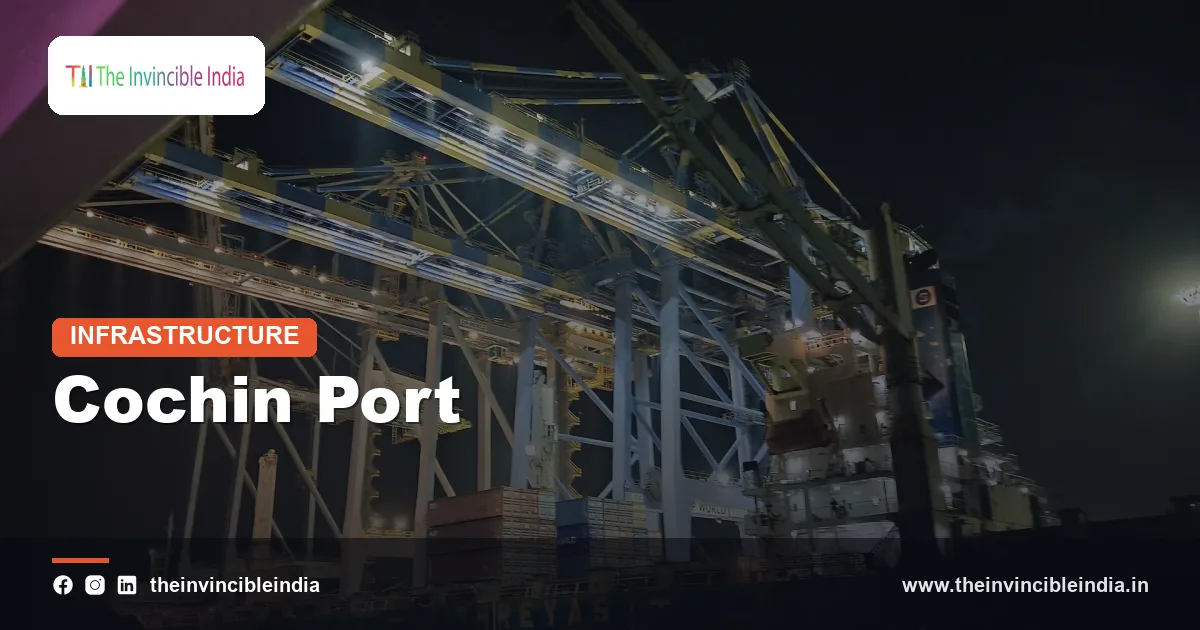
Cochin Port is a major natural-harbour port of India at Kochi in Kerala, run by the Cochin Port Authority and centred on the man-made Willingdon Island, with the Vallarpadam International Container Transshipment Terminal (ICTT) as its flagship container facility. Cochin Port also hosts the Sagarika international cruise terminal, bunkering services, a liquefied natural gas (LNG) terminal and the Cochin Shipyard, and it sits close to the main east-west shipping route across the Indian Ocean.
Cochin Port is the principal seaport of Kerala and one of the best-sheltered harbours on India’s west coast, formed where the Vembanad backwaters meet the Arabian Sea. This explainer describes how Cochin Port developed, what Willingdon Island is, how the Vallarpadam terminal works, what the port handles, and why its strategic position makes it important for India’s maritime trade.
| Attribute | Detail |
|---|---|
| Name | Cochin Port (also called Kochi Port), run by the Cochin Port Authority |
| Location | Kochi, Ernakulam district, Kerala, on the Arabian Sea coast |
| Status | One of India’s major ports, owned by the Government of India |
| Harbour type | Natural harbour at the mouth of the Vembanad backwaters |
| Key island | Willingdon Island, built from dredged material in the early twentieth century |
| Container terminal | International Container Transshipment Terminal (ICTT), Vallarpadam, opened in 2011 |
| Cruise terminal | Sagarika international cruise terminal |
| Parent ministry | Ministry of Ports, Shipping and Waterways |
| Main activities | Containers, petroleum, LNG, bulk cargo, bunkering, cruise and ship repair |
Key Takeaways
- Cochin Port is a major port of India at Kochi, Kerala, built around a natural harbour where the Vembanad backwaters reach the Arabian Sea.
- Cochin Port developed in the early twentieth century under the engineer Sir Robert Bristow, whose dredging created the man-made Willingdon Island.
- Cochin Port operates the Vallarpadam International Container Transshipment Terminal, India’s first dedicated international container transshipment terminal, which opened in 2011.
- Cochin Port is located only a short distance from the main east-west shipping lane across the Indian Ocean, which gives it a strategic position for transshipment and bunkering.
- Cochin Port has a dedicated international cruise terminal named Sagarika and is the main cruise port on India’s southwest coast.
- Cochin Port sits beside Cochin Shipyard, which built India’s first indigenous aircraft carrier, INS Vikrant, commissioned in 2022.
What Is Cochin Port?
Cochin Port is a government-owned major seaport at Kochi, Kerala, that serves as the principal gateway for trade, shipping and cruise tourism on India’s southwest coast. It is managed by the Cochin Port Authority and handles containers, crude oil and petroleum products, LNG, fertilisers, bulk cargo and passengers.
The port is one of the best natural harbours in the country. It is formed by a wide estuary where the backwaters, rivers and the sea meet, and its channel is sheltered from the monsoon swell that affects many open coastal ports. The result is that vessels can enter and berth throughout the year with relatively few weather interruptions.
Cochin Port is also known as Kochi Port, as the city of Cochin was officially renamed Kochi in 1996. Both names refer to the same port.
Where Is Cochin Port Located?
Cochin Port is located in Kochi, in Ernakulam district of Kerala, on the Arabian Sea coast of southern India. The port area stretches across several islands and shores of a large harbour, including Willingdon Island, Vallarpadam, Bolgatty and the mainland at Ernakulam and Mattancherry.
Key location advantages are:
- Natural shelter: a deep, protected harbour that stays navigable through the monsoon.
- Proximity to the main sea lane: the port lies only a short sailing distance from the main east-west shipping route linking Europe, the Middle East and East Asia.
- Waterway links: the backwaters allow cargo to move inland by barge in some areas.
- Industrial neighbours: a refinery, an LNG terminal, a shipyard and petrochemical units are located nearby.
The port’s location on the southwest coast makes it one of the Indian major ports closest to the busy international shipping lane, which is the main reason for its transshipment role.
How Did Cochin Port Develop?
Cochin Port developed from an old trading harbour into a modern deepwater port in the 1920s and 1930s, when the British engineer Sir Robert Bristow led a large dredging project that deepened the channel and created Willingdon Island. Kochi had been a trade centre for spices for many centuries, visited by Arab, Chinese, Portuguese, Dutch and British traders, but a sandbar at the harbour mouth had long prevented large ships from entering.
Bristow arrived in Cochin in 1920 and spent years on the project, which removed the bar and used the dredged material to reclaim land. The new island was named Willingdon Island after Lord Willingdon, the Governor of Madras and later Viceroy of India. The port was declared a major port in the 1930s, and the harbour was opened to modern shipping.
After Independence the port expanded with new berths, oil terminals and cargo facilities. A major landmark came in the early 2010s with the opening of the Vallarpadam container terminal, which moved the port into international transshipment.
What Is Willingdon Island?
Willingdon Island is an artificial island in Kochi harbour, created from dredged material in the early twentieth century, which houses much of the older port infrastructure along with railway, customs and hotel facilities. It is among the largest man-made islands in India.
The island contains:
- The main wharves and berths used for general cargo and passengers.
- The Cochin Port Authority administrative offices.
- A railway terminus and goods yard linked to the mainland network.
- The Sagarika cruise terminal and the older passenger terminal facilities.
- Offices and installations of customs, the Navy’s Southern Naval Command nearby and other agencies.
The Southern Naval Command of the Indian Navy is headquartered in Kochi and operates from facilities near Willingdon Island, which makes the harbour a place where commercial, naval and shipbuilding activity coexist.
What Is the Vallarpadam ICTT?
The Vallarpadam International Container Transshipment Terminal (ICTT) is Cochin Port’s deepwater container terminal on Vallarpadam island, which opened in February 2011 and is operated by DP World under a long-term concession. It was designed as India’s first dedicated international container transshipment terminal.
Transshipment means that containers arrive on one ship, are unloaded, and then move on to another ship bound for a different destination. A port that serves as a transshipment hub allows large ocean-going vessels to call at one hub and have cargo spread to smaller feeder ships for onward delivery.
Why the ICTT matters
- Depth: the terminal was dredged to accommodate large container ships that many Indian ports could not handle at the time.
- Transshipment goal: it aimed to capture Indian containers that were being transshipped at foreign hubs such as Colombo, Singapore and Salalah.
- Location: it is close to the main east-west shipping lane, so ships divert little from their route to call.
- Connectivity: it is linked to the mainland by a road and a rail link, including a dedicated rail line and a series of bridges along National Highway 966A.
The terminal has grown in volume over the years, but it has faced challenges in competing with established foreign transshipment hubs. India’s long-term plan is to develop more domestic transshipment capacity so that fewer Indian containers have to be transshipped abroad.
What Does Cochin Port Handle?
Cochin Port handles containers, crude oil, petroleum products, LNG, fertilisers, bulk goods and passengers. The mix reflects Kerala’s industries, the refinery at Kochi and the port’s role as a transshipment and cruise centre.
- Containers: through the Vallarpadam ICTT and older container facilities, for imports, exports and transshipment.
- Crude oil and petroleum: crude for the Kochi refinery and refined products shipped coastwise.
- LNG: an LNG import terminal at Puthuvypeen, near the port, which began operations in the early 2010s.
- Fertilisers and chemicals: for Kerala’s agriculture and industry.
- Traditional exports: spices, tea, coffee, coir, cashew, marine products and rubber from Kerala and neighbouring states.
- Bunkering: fuel supply services to ships calling at the port or passing the nearby shipping lane.
Traffic figures for Cochin Port change from year to year, so the latest official statistics from the Cochin Port Authority should be consulted for precise tonnage and container counts.
What Is the Sagarika Cruise Terminal?
Sagarika is the international cruise terminal at Cochin Port, built to handle passenger ships and to promote cruise tourism on India’s southwest coast. It is located on Willingdon Island and is among India’s main cruise facilities, with its own passenger-processing area, immigration and customs counters.
Cochin is a popular stop on cruise itineraries because of its heritage sites, backwaters and spice-trading history. Visitors can reach Fort Kochi, Mattancherry and the backwaters easily from the terminal, which explains the city’s appeal to cruise operators. The cruise season generally runs through the cooler months, and passenger numbers vary with global travel conditions.
Cruise tourism contributes to the local economy through port charges, shore excursions and hospitality demand, although it is a small share of total port revenue compared with cargo.
How Does Bunkering Work at Cochin Port?
Bunkering at Cochin Port means supplying marine fuel and related services to ships, and the port has pursued it as a growth activity because of its location close to the main international shipping route. Bunker fuel can be supplied alongside or at anchorage by barges and tankers licensed to operate in port waters.
The idea is simple. A ship on the east-west route needs fuel, and if it can refuel with a small diversion near Kochi at competitive prices, the port earns revenue from fuel sales, pilotage, agency fees and related services. Bunkering also supports ship repair and chandler businesses in the city.
India’s major ports are keen to increase their share in bunkering, which has long been dominated by hubs such as Singapore, Fujairah and Colombo. The success of Cochin Port in this field depends on fuel quality, price, speed of service and regulation.
What Is the Role of Cochin Shipyard and Other Maritime Industries?
Cochin Shipyard Limited is a public sector shipbuilding and ship repair company in Kochi that works alongside Cochin Port and built INS Vikrant, India’s first indigenous aircraft carrier, which was commissioned into the Indian Navy in 2022. The shipyard has also built merchant ships, tankers and offshore vessels, and it operates a large ship repair facility.
Together, the port, shipyard, refinery and naval command create a maritime cluster in Kochi:
| Institution | Role |
|---|---|
| Cochin Port Authority | Runs the major port and its land, channels and berths |
| Cochin Shipyard Limited | Builds and repairs large ships, including naval vessels |
| Southern Naval Command | Indian Navy command headquartered in Kochi, responsible for training and operations |
| Kochi refinery (BPCL) | Processes imported crude oil and supplies petroleum products |
| Puthuvypeen LNG terminal | Receives and regasifies imported liquefied natural gas |
| Vallarpadam ICTT (DP World) | Container transshipment and cargo handling |
This cluster makes Kochi one of India’s most important maritime cities, and it helps explain why port, shipbuilding and naval jobs form a large share of local skilled employment.
Who Runs Cochin Port?
Cochin Port is run by the Cochin Port Authority, a statutory central government body governed by a board under the Major Port Authorities Act, 2021. The authority owns the port land, channels and many of the berths, and it grants concessions to private operators for terminals such as the Vallarpadam ICTT.
The port authority reports to the Ministry of Ports, Shipping and Waterways. Its main responsibilities include dredging and channel maintenance, pilotage, tug services, navigation aids, land leasing and safety. Customs, immigration and marine safety agencies operate within the port as at other international ports.
Until 2021, the body was known as the Cochin Port Trust. The change to an authority was meant to give major ports more flexibility in decision-making.
Why Does Cochin Port Matter Strategically?
Cochin Port matters strategically because it lies close to the main east-west shipping route in the Arabian Sea and the wider Indian Ocean, and because Kochi is home to a naval command, a shipyard and key energy infrastructure. The port gives India a southern gateway that supports trade, transshipment and maritime security.
Three strategic strengths are often highlighted:
- Location: a short diversion from the sea lane that carries a large share of global container and energy shipping.
- Natural harbour: deep, sheltered water that is open through the monsoon.
- Industrial depth: shipbuilding, refining, LNG and naval facilities within the same city.
India’s future plans include more domestic transshipment capacity, and Cochin Port is a candidate to play a major role alongside other developing hubs on the coast.
Bottom Line
Cochin Port is a major natural-harbour port at Kochi, Kerala, run by the Cochin Port Authority, with Willingdon Island as its historic core, the Vallarpadam ICTT as India’s first international container transshipment terminal, and the Sagarika cruise terminal for passenger ships. Its sheltered harbour, closeness to the main Indian Ocean shipping lane and neighbouring shipyard and naval command make it a strategic maritime hub for southern India.
Frequently Asked Questions
Where is Cochin Port located?
Cochin Port is located at Kochi in Ernakulam district of Kerala, on the Arabian Sea coast of southern India. The port covers several islands and shores of a natural harbour, including Willingdon Island and Vallarpadam. It lies close to the main east-west shipping route across the Indian Ocean.
What is Willingdon Island in Kochi?
Willingdon Island is an artificial island in Kochi harbour, created from dredged material in the early twentieth century during the port’s development under Sir Robert Bristow. It houses much of the port’s older infrastructure, including wharves, offices and a railway terminus. It was named after Lord Willingdon, a Governor of Madras and later Viceroy of India.
What is the Vallarpadam ICTT?
The Vallarpadam ICTT is Cochin Port’s International Container Transshipment Terminal, which opened in 2011 and is operated by DP World. It was designed as India’s first dedicated international container transshipment terminal. Its aim is to handle large container ships and reduce the number of Indian containers transshipped at foreign hubs.
Is Cochin Port a major port?
Yes, Cochin Port is one of India’s major ports and is owned by the Government of India. It is managed by the Cochin Port Authority under the Ministry of Ports, Shipping and Waterways. Major ports are governed by central law, unlike smaller non-major ports, which come under state maritime boards.
Why is Cochin Port strategically important?
Cochin Port is strategically important because of its location near the main east-west sea lane, its sheltered natural harbour and the presence of a naval command, shipyard and energy terminals in Kochi. These features support transshipment, bunkering and naval operations. Cochin Shipyard built INS Vikrant, India’s first indigenous aircraft carrier.
Does Cochin Port have a cruise terminal?
Yes, Cochin Port has an international cruise terminal named Sagarika on Willingdon Island. It is one of India’s main facilities for cruise ships and provides passenger processing with immigration and customs. Cochin is a popular cruise stop because of its heritage sites, spice-trading history and backwaters.
{“@context”:”https://schema.org”,”@graph”:[{“@type”:”FAQPage”,”mainEntity”:[{“@type”:”Question”,”name”:”Where is Cochin Port located?”,”acceptedAnswer”:{“@type”:”Answer”,”text”:”Cochin Port is located at Kochi in Ernakulam district of Kerala, on the Arabian Sea coast of southern India. The port covers several islands and shores of a natural harbour, including Willingdon Island and Vallarpadam. It lies close to the main east-west shipping route across the Indian Ocean.”}},{“@type”:”Question”,”name”:”What is Willingdon Island in Kochi?”,”acceptedAnswer”:{“@type”:”Answer”,”text”:”Willingdon Island is an artificial island in Kochi harbour, created from dredged material in the early twentieth century during the port’s development under Sir Robert Bristow. It houses much of the port’s older infrastructure, including wharves, offices and a railway terminus. It was named after Lord Willingdon, a Governor of Madras and later Viceroy of India.”}},{“@type”:”Question”,”name”:”What is the Vallarpadam ICTT?”,”acceptedAnswer”:{“@type”:”Answer”,”text”:”The Vallarpadam ICTT is Cochin Port’s International Container Transshipment Terminal, which opened in 2011 and is operated by DP World. It was designed as India’s first dedicated international container transshipment terminal. Its aim is to handle large container ships and reduce the number of Indian containers transshipped at foreign hubs.”}},{“@type”:”Question”,”name”:”Is Cochin Port a major port?”,”acceptedAnswer”:{“@type”:”Answer”,”text”:”Yes, Cochin Port is one of India’s major ports and is owned by the Government of India. It is managed by the Cochin Port Authority under the Ministry of Ports, Shipping and Waterways. Major ports are governed by central law, unlike smaller non-major ports, which come under state maritime boards.”}},{“@type”:”Question”,”name”:”Why is Cochin Port strategically important?”,”acceptedAnswer”:{“@type”:”Answer”,”text”:”Cochin Port is strategically important because of its location near the main east-west sea lane, its sheltered natural harbour and the presence of a naval command, shipyard and energy terminals in Kochi. These features support transshipment, bunkering and naval operations. Cochin Shipyard built INS Vikrant, India’s first indigenous aircraft carrier.”}},{“@type”:”Question”,”name”:”Does Cochin Port have a cruise terminal?”,”acceptedAnswer”:{“@type”:”Answer”,”text”:”Yes, Cochin Port has an international cruise terminal named Sagarika on Willingdon Island. It is one of India’s main facilities for cruise ships and provides passenger processing with immigration and customs. Cochin is a popular cruise stop because of its heritage sites, spice-trading history and backwaters.”}}]}]}


