

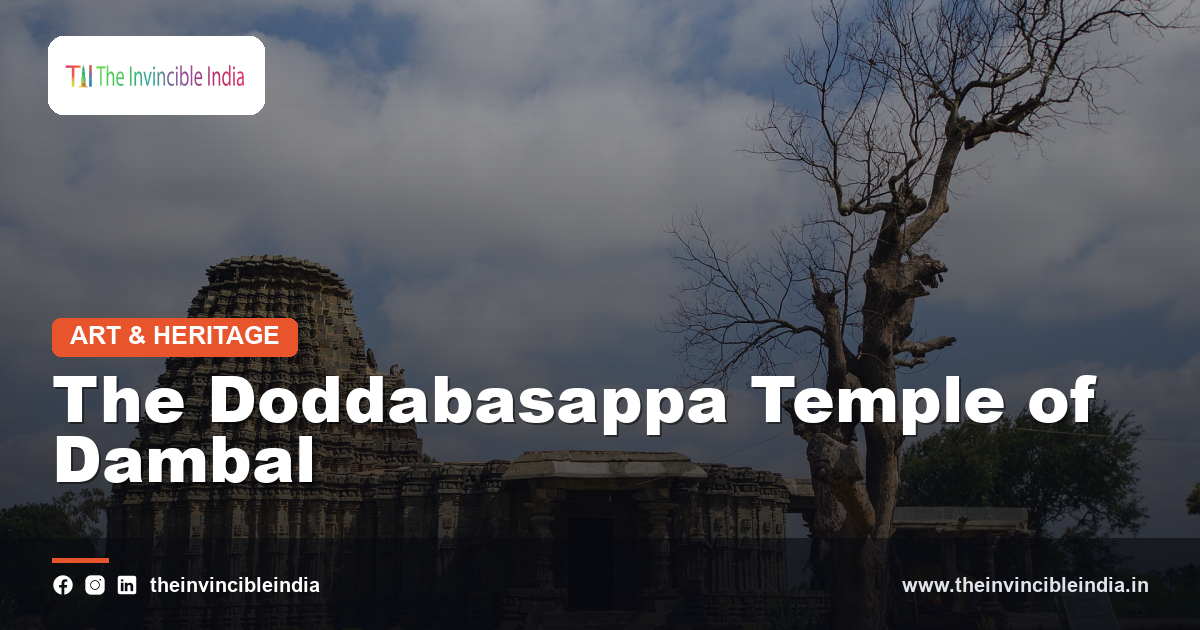
The Doddabasappa temple, also spelled Dodda Basappa and sometimes called the Doddabasappa Shiva temple, stands in the village of Dambal, also written Dambala, in Gadag district of northern Karnataka. It is a Hindu temple of the Western Chalukya period, the dynasty often called the Kalyani Chalukyas, who ruled much of the Deccan from their capital at Kalyani and were great patrons of temple building. Dedicated to Shiva, the temple is celebrated above all for its remarkable ground plan, which is laid out as an unusual many-pointed star, often described as a 24-pointed stellate design. This striking geometry makes it one of the most distinctive examples of the style discussed in the guide to Indian temple architecture. This article explains its location, builders, design and significance.
Quick answer: The Doddabasappa temple is a Western Chalukya (Kalyani Chalukya) Hindu temple at Dambal in Gadag district, Karnataka, India, dedicated to Shiva. It is best known for its unusual ground plan, laid out as a many-pointed star and often described as a 24-pointed stellate design, which makes it a distinctive example of Western Chalukya architecture. The temple is generally dated to the period of Chalukya temple building in the late medieval centuries and is a protected monument.
Key Takeaways
- The Doddabasappa temple is a Western Chalukya Shiva temple at Dambal in Gadag district, Karnataka.
- It is famous for an unusual multi-pointed star-shaped, or stellate, ground plan, often described as having 24 points.
- It was built by the Western Chalukyas of Kalyani, also called the Kalyani or Later Chalukyas.
- The temple is dedicated to Shiva and built in the ornate Deccan style of Chalukya shrines.
- It is generally dated to the era of Western Chalukya temple building, stated in general terms rather than an exact year.
- The temple is recognised as a monument of heritage importance and is cared for as a protected site.
The sections below explain where the Doddabasappa temple stands, who built it and what makes its design so remarkable.
Quick Facts
| Detail | Information |
|---|---|
| Location | Dambal, Gadag district, Karnataka |
| Type | Hindu (Shiva) temple |
| Period and builders | Western Chalukya (Kalyani Chalukya) period |
| Associated dynasties | Western Chalukyas of Kalyani |
| Material | Dressed chloritic schist (soapstone) and dark stone |
| Key feature | Many-pointed star-shaped (stellate) plan, often described as 24-pointed |
| Protected status | Monument of recognised heritage importance |
| Nearest city | Gadag, northern Karnataka |
What Is the Doddabasappa Temple?
The Doddabasappa temple is a Hindu temple dedicated to Shiva, standing in the village of Dambal in Gadag district of Karnataka and built in the tradition of the Western Chalukyas. It is a compact but richly conceived shrine, famous not for great size but for the extraordinary geometry of its plan, which is laid out as a many-pointed star rather than the usual square or simple stepped outline. This stellate design, often described as having twenty-four points, gives the building a complex, faceted profile that catches light and shadow across its many projecting angles. The temple belongs to the ornate Deccan style of stone temple architecture that flourished under the Chalukya rulers. Though modest in scale, it is counted among the most inventive surviving shrines of its school. The Doddabasappa temple is therefore best understood as a small masterpiece of Western Chalukya design, prized for the mathematical beauty of its star-shaped ground plan.
Where Is the Doddabasappa Temple Located?
The Doddabasappa temple is located in the village of Dambal, in Gadag district, in the northern part of Karnataka within the Deccan plateau of southern India. Gadag district lies in a region rich in temples of the Chalukya and later periods, so the Doddabasappa temple forms part of a wider landscape of medieval stone architecture. The nearest major town is Gadag, which serves as the usual base for travellers exploring the monuments of the area. Dambal is a historic settlement that was a place of some importance in medieval times, associated with religious and cultural life. The surrounding country of the northern Karnataka plains and low hills is dotted with shrines that reward the student of temple art. The location of the Doddabasappa temple at Dambal therefore places it within one of the great heartlands of Deccan temple building, close to many other monuments of the same broad tradition.
Who Built the Doddabasappa Temple?
The Doddabasappa temple was built by the Western Chalukyas, the dynasty also known as the Kalyani Chalukyas or the Later Chalukyas, who ruled much of the Deccan from their capital at Kalyani during the late medieval centuries. These rulers and the communities under them were prolific patrons of temple architecture, and their reign saw the construction of numerous ornate stone shrines across what is now northern Karnataka and neighbouring regions. The Western Chalukya style developed a distinctive and highly decorative manner of building, and the Doddabasappa temple is one of its more unusual products. As with many temples of the period, the precise patron and the exact circumstances of construction are not recorded in detail, and attribution rests on architectural style and the broad historical setting. The building of the Doddabasappa temple therefore reflects the wider achievement of the Western Chalukyas, whose patronage produced a remarkable flowering of temple art in the Deccan.
What Is the Star-Shaped Plan of the Temple?
The star-shaped plan is the defining feature of the Doddabasappa temple, setting it apart from most other shrines of its region and period. Instead of a simple square or rectangular outline, the base of the temple is laid out as a many-pointed star, formed by rotating and overlapping squares or by projecting a series of angled points around the sanctum. This produces a stellate, or star-like, ground plan that is often described as having twenty-four points, giving the walls a deeply indented, faceted surface. The design is a sophisticated exercise in geometry, turning the plan of the building into an intricate figure. Such stellate plans appear in Deccan temple architecture and were developed further in later schools, but the Doddabasappa temple is an especially striking early example. The star-shaped plan of the temple therefore represents a high point of architectural invention, in which mathematics and devotion combine to shape the very footprint of the shrine.
Why Is the Temple Dedicated to Shiva?
The Doddabasappa temple is dedicated to Shiva, one of the principal deities of Hinduism, worshipped widely across the Deccan during the Chalukya age and after. Shiva was a favoured deity of many rulers and communities of the region, and a great number of the temples built under the Western Chalukyas were raised in his honour, often enshrining a linga, the aniconic symbol of the god, in the sanctum. The dedication of the Doddabasappa temple to Shiva therefore reflects the broad devotional climate of the period, in which Shaiva worship flourished alongside other traditions. The name of the temple itself, associated with a form of reverence for the deity, points to its Shaiva character. Like other such shrines, it would have served as a focus of worship, ritual and community life. The dedication of the Doddabasappa temple to Shiva thus places it firmly within the rich Shaiva heritage that shaped much of the temple building of the medieval Deccan.
What Does the Stellate Design Look Like?
The stellate design of the Doddabasappa temple gives the shrine a striking appearance, with walls that zigzag in and out around the sanctum in a series of sharp angles and projecting points. Seen from above, the plan resembles a complex star, and seen from the ground the effect is of a building whose surface is broken into many vertical facets, each catching the light differently through the day. These facets are carried up the walls and often reflected in the tiered tower, so that the star shape is expressed not only in the base but in the rising mass of the temple. The deep indentations create strong contrasts of light and shadow that animate the stone. This faceted treatment is characteristic of the more adventurous Deccan temple designs. The look of the stellate design therefore turns the Doddabasappa temple into a play of geometry and light, in which the star-shaped plan shapes the whole visual character of the shrine.
How Old Is the Doddabasappa Temple?
The Doddabasappa temple is old, belonging to the era of Western Chalukya temple building that flourished in the late medieval centuries, though a precise year of construction cannot be given with confidence. The Western Chalukyas of Kalyani were active patrons of architecture across their long period of rule, and the temple is dated by scholars to this broad phase on the basis of its style, its decorative treatment and its relationship to other monuments of the school. As with many temples of the Deccan, exact dates rest on inscriptions and architectural analysis, and should be treated with appropriate caution. The temple may also have seen later repair or modification, as was common for shrines in continuous use. The general framework places it within the great age of Chalukya temple art. The age of the Doddabasappa temple is therefore best expressed in general terms, as a product of the Western Chalukya period rather than of a single documented year.
What Is Western Chalukya Architecture?
Western Chalukya architecture is the distinctive style of temple building that developed under the Western, or Kalyani, Chalukyas across the Deccan during the late medieval centuries. Growing out of earlier traditions and drawing on influences from both northern and southern Indian temple styles, it produced ornate stone shrines marked by intricate carving, elaborate towers and inventive ground plans. Builders in this tradition favoured fine-grained stone that allowed delicate detail, and they experimented with the geometry of plans, including stepped and star-shaped outlines. Pillared halls, carved doorways, decorated ceilings and richly ornamented wall surfaces are typical features. The style forms an important bridge between earlier and later phases of Deccan temple art, and it influenced the schools that followed. The Doddabasappa temple is a notable example of its more experimental side. Western Chalukya architecture therefore represents a creative and highly decorative chapter in the long story of Indian temple building, centred on the Deccan plateau.
What Carvings and Sculpture Does the Temple Have?
The Doddabasappa temple carries the kind of carving and sculptural ornament characteristic of Western Chalukya shrines, though its fame rests more on its plan than on figural sculpture alone. The faceted walls created by the star-shaped plan provide many surfaces for decoration, including mouldings, bands of ornament and carved detail that enrich the stone. Doorways, pillars and ceilings in temples of this school are often finely worked, with intricate patterns and decorative motifs typical of the Deccan tradition. The tower above the sanctum is treated with tiers and ornament that echo the geometry of the base. As with many old temples, the condition and extent of the carving reflect the passage of time and the history of the building. The carvings and sculpture of the Doddabasappa temple therefore complement its remarkable design, adding the decorative richness that marks Western Chalukya architecture and rewarding close attention to the surfaces of the stone.
How Does It Compare to Other Chalukya Temples?
The Doddabasappa temple compares with other Western Chalukya temples as an unusually inventive example within a prolific and varied school. The Chalukya period produced many temples across northern Karnataka and neighbouring regions, ranging from relatively simple shrines to elaborate complexes, and the district of Gadag and its surroundings is especially rich in such monuments. Most of these temples follow stepped or more conventional plans, so the pronounced star-shaped design of the Doddabasappa temple stands out as a bold departure. In its carving, materials and tower, however, it shares the common features of the school, linking it clearly to its tradition. Comparing it with neighbouring temples highlights both the shared vocabulary of Chalukya architecture and the willingness of its builders to experiment. The place of the Doddabasappa temple among other Chalukya temples is therefore that of a distinctive variant, familiar in style yet exceptional in the geometry of its plan.
What Is the Significance of Dambal?
Dambal, the village in which the Doddabasappa temple stands, was a settlement of some historical and religious importance in medieval times within the Deccan. Like many towns of the region, it was associated with temples, monasteries and the cultural life that flourished under the Chalukyas and later powers. The presence of a temple as distinctive as the Doddabasappa shrine points to the standing of the place as a centre of patronage and devotion. Dambal is also associated more broadly with the religious currents of the medieval Deccan, including traditions of learning and worship. Today the village is chiefly known to visitors for its historic temples, which draw those interested in Chalukya architecture. The significance of Dambal therefore lies in its role as a historic settlement that preserved important monuments, and its name is closely linked with the remarkable star-shaped temple that is its most celebrated building.
Why Is the Temple Architecturally Important?
The Doddabasappa temple is architecturally important because its star-shaped plan represents a striking and sophisticated experiment within the Western Chalukya tradition and within Indian temple design more broadly. Stellate plans, in which the base of a temple is laid out as a many-pointed star, are among the most mathematically elegant solutions in temple architecture, and the Doddabasappa temple is a notable early expression of the idea in the Deccan. Such designs influenced later schools that carried the stellate principle further, making the temple significant for the history of architectural ideas. Its faceted walls, rising tower and decorative treatment demonstrate how geometry could be turned into devotional art. For students of temple building, it offers a clear and memorable case of inventive planning. The architectural importance of the Doddabasappa temple therefore extends beyond its village, marking it as a key example of creative design in the evolution of Deccan temple architecture.
What Materials Were Used to Build It?
The Doddabasappa temple, like many Western Chalukya shrines, was built of fine-grained dark stone, commonly a chloritic schist or soapstone that could be dressed and carved with precision. This choice of material was well suited to the intricate work favoured by Chalukya builders, allowing sharp mouldings, crisp angles and delicate ornament to be cut into the stone. The faceted surfaces of the star-shaped plan depend on the ability to dress the stone accurately, so the material and the design are closely linked. The use of durable stone has also helped the temple survive the centuries, though weathering has naturally affected its surfaces. The deep tone of the stone adds to the play of light and shadow across the many angles of the walls. The materials of the Doddabasappa temple therefore served both the structural and the artistic needs of the building, enabling the precise geometry and fine carving that define this remarkable Chalukya shrine.
How Is the Doddabasappa Temple Protected and Preserved?
The Doddabasappa temple is recognised as a monument of heritage importance and is cared for as a protected site, with its conservation falling under the responsibility of archaeological authorities. Preserving a medieval stone temple involves guarding it against weathering, the growth of vegetation, structural strain and the wear caused by time and visitors. Conservation work aims to stabilise the building and protect its carved surfaces while retaining its historic character and its distinctive design. Because the formal status and arrangements of such sites can change, visitors interested in conservation should consult current official information. Respectful behaviour at the temple supports its preservation, as does awareness of its fragility as an ancient monument. As one of the more unusual temples of the Chalukya school, it holds particular value for heritage. The protection of the Doddabasappa temple therefore depends on the care of heritage authorities together with the respect of the communities and visitors who value its exceptional architecture.
How Can Visitors Plan a Trip to the Doddabasappa Temple?
Visitors can plan a trip to the Doddabasappa temple by travelling to the village of Dambal in Gadag district, most conveniently from the town of Gadag, which is connected by road and rail to other parts of Karnataka. The cooler months from about October to February are generally the most comfortable for exploring the temples of northern Karnataka, since the summer can be very hot. The temple can be visited as part of a wider tour of the many Chalukya monuments of the Gadag region, which rewards those interested in temple architecture. Modest, respectful behaviour is appropriate at the shrine, and footwear is removed before entering the temple interior. Allowing time to study the star-shaped plan and the carving enriches the visit. Checking current access and local conditions in advance is wise. A well planned trip allows the Doddabasappa temple to be appreciated as a jewel of Western Chalukya design within a landscape rich in medieval temples.
The Doddabasappa Temple Today
The Doddabasappa temple today stands as one of the most distinctive surviving shrines of the Western Chalukya tradition, quietly remarkable for the star-shaped plan that sets it apart from its neighbours. Though modest in scale and set in a village rather than a famous city, it draws those with an interest in temple architecture to admire the inventive geometry of its design and the fine stonework of its school. As a protected monument, it is cared for as part of the rich heritage of Gadag district and the wider Deccan. Its faceted walls and tiered tower continue to express the creativity of the Chalukya builders who shaped it. Continued conservation and respectful visitation help ensure that it endures for future study and devotion. The Doddabasappa temple thus remains a small masterpiece of Deccan temple art, a lasting testament to the imagination of the Western Chalukyas and their love of geometry in stone.
Sources & Further Reading
- Archaeological Survey of India (asi.nic.in).
- Department of Tourism, Government of Karnataka (karnatakatourism.org).
Frequently Asked Questions
Where is the Doddabasappa temple located?
The Doddabasappa temple is located in the village of Dambal, in Gadag district, in the northern part of Karnataka. The town of Gadag is the usual base for travellers, and the temple forms part of a region rich in Chalukya-era monuments.
What is the Doddabasappa temple famous for?
The Doddabasappa temple is famous for its unusual ground plan, laid out as a many-pointed star, or stellate, design that is often described as having twenty-four points. This striking geometry makes it one of the most distinctive temples of the Western Chalukya tradition.
Who built the Doddabasappa temple?
The Doddabasappa temple was built by the Western Chalukyas, also called the Kalyani or Later Chalukyas, who ruled much of the Deccan from their capital at Kalyani. The precise patron is not recorded in detail, and the attribution rests on architectural style and historical setting.
Which deity is the Doddabasappa temple dedicated to?
The Doddabasappa temple is dedicated to Shiva, a principal deity of Hinduism widely worshipped across the Deccan during the Chalukya age. Many temples built under the Western Chalukyas were raised in honour of Shiva.
How old is the Doddabasappa temple?
The Doddabasappa temple belongs to the era of Western Chalukya temple building in the late medieval centuries, though a precise year cannot be given with confidence. It is dated by scholars on the basis of its style and its relationship to other monuments of the school.
What is a stellate or star-shaped temple plan?
A stellate, or star-shaped, temple plan is one in which the base of the shrine is laid out as a many-pointed star rather than a simple square. It is created by rotating or overlapping squares, producing faceted walls, and the Doddabasappa temple is a notable Deccan example.


