

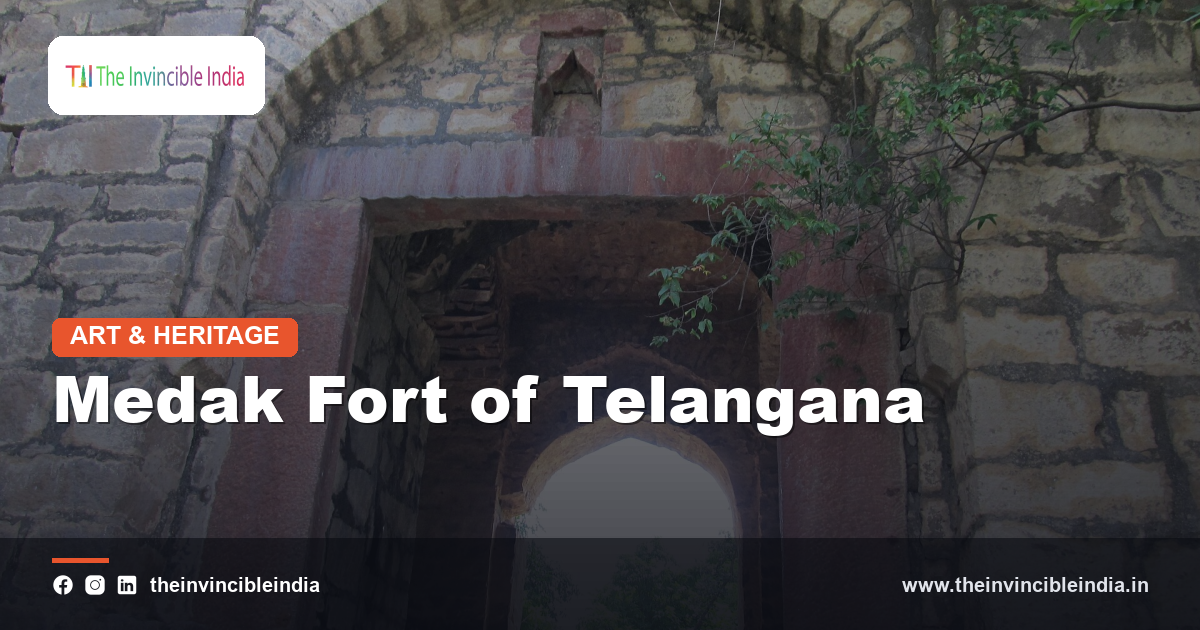
Medak fort, the hilltop stronghold that rises above the town of Medak in Telangana, is one of the historic forts of the Deccan interior. Built on a hill that commands the surrounding plains, it is associated in tradition with the Kakatiya period and was later held and reshaped by successive Deccan powers. Its walls, gateways and bastions follow the contours of the hill, and from its heights the fort looks out over a wide landscape of farmland and villages. The town of Medak is also known for the separate and much later Medak Cathedral, a famous modern church that stands apart from the old fort and should not be confused with it. Medak fort belongs to the wider story told in the guide to the great forts of India. This article explains its location, history, architecture and significance.
Quick answer: Medak fort is a hilltop Deccan fort above the town of Medak in Telangana, India, built on a hill that commands the surrounding plains. It is associated in tradition with the Kakatiya period and was later held and strengthened by successive Deccan powers. The fort preserves walls, gateways and bastions, and it stands apart from the separate, much later Medak Cathedral in the same town.
Key Takeaways
- Medak fort is a hilltop Deccan fort above the town of Medak in Telangana.
- It is associated in tradition with the Kakatiya period and later Deccan powers.
- The fort commands the surrounding plains from its hill and preserves walls, gateways and bastions.
- Its construction and rebuilding span several periods, stated in general terms rather than exact dates.
- The fort is a distinct monument from the separate, much later Medak Cathedral in the same town.
- Medak fort is a protected heritage site and a landmark of the Medak area.
The sections below explain where Medak fort stands, who held it and what visitors can see today.
Quick Facts
| Detail | Information |
|---|---|
| Location | Medak, Telangana |
| Type | Hilltop Deccan fort |
| Period and builders | Associated with the Kakatiya period, rebuilt by later powers |
| Associated dynasties | Kakatiyas and later Deccan rulers |
| Material | Stone ramparts, gateways and bastions |
| Key structures | Hilltop walls, gateways, bastions and cannon positions |
| Protected status | Monument of recognised heritage importance |
| Nearest city | Medak, with Hyderabad the main regional city |
What Is Medak Fort?
Medak fort is a historic hilltop stronghold that crowns a hill above the town of Medak in Telangana, within the interior of the Deccan plateau. It is a classic hill fort, with stone walls, gateways and bastions that follow the natural shape of the hill and command the plains spread out below. The fort is associated in tradition with the Kakatiya period and was held and strengthened by later Deccan powers, so its defences reflect more than one phase of building. From its heights it offered its holders a commanding view over the surrounding country and the routes that crossed it. Today the fort survives as a landmark of the Medak area and a destination for those interested in the region’s history. Medak fort is therefore best understood as a layered hill fortress whose walls and gateways preserve the memory of the dynasties that raised, held and reshaped it over the centuries.
Where Is Medak Fort Located?
Medak fort is located above the town of Medak, the headquarters of the Medak area in the state of Telangana, within the dry interior of the Deccan. The town lies north of Hyderabad, the major regional city, which serves as the main gateway for travellers to the area. The fort crowns a hill that rises above the town and the surrounding plains, giving it a commanding position over the landscape. Roads connect Medak with Hyderabad and other towns of Telangana, making the fort accessible to visitors exploring the region. The surrounding country of farmland, villages and low hills is characteristic of the interior Deccan. The town is also well known for its separate cathedral, which draws visitors in its own right. The location of Medak fort on its hill above the town therefore places it at a strategic and scenic point in the Telangana countryside, overlooking the plains it was built to watch.
Who Built Medak Fort?
Medak fort is associated in tradition with the Kakatiyas, a dynasty that ruled much of the Deccan region and were noted builders of forts, though the full sequence of its construction spans more than one period. The Kakatiyas fortified many hills across their territories, and Medak fits the pattern of their fort building, so tradition links the stronghold with their age. Over the following centuries, the fort was held and strengthened by later powers who dominated the Deccan, each adapting the defences to their needs. As a result, the surviving walls, gateways and bastions reflect several phases of work rather than a single original design. As with many forts, the precise early history rests on tradition and such records as survive, and should be stated with caution. The building of Medak fort therefore began, by tradition, in the Kakatiya age, but the stronghold as it survives is the work of successive Deccan powers who reshaped it over time.
How Old Is Medak Fort?
Medak fort is old, with its origins associated in tradition with the Kakatiya period, placing its early history in the medieval centuries of Deccan history. Because the fort was held and rebuilt by successive powers after that time, its surviving structures belong to a range of periods rather than to a single founding date. Scholars date the various walls, gateways and bastions by their style and by such records as exist, while treating the earliest traditional dates with caution. The broad framework places the fort’s beginnings in the medieval Deccan and its later development across the following centuries, as the region passed between different rulers. The long span of its occupation gives the fort a layered history typical of Deccan strongholds. The age of Medak fort is therefore best expressed in general terms, as a monument whose origins reach back to the medieval period and whose present form reflects centuries of building and rebuilding.
What Dynasties Held the Fort?
Medak fort was held over the centuries by a succession of Deccan powers, reflecting the shifting politics of the region. Tradition associates its early history with the Kakatiyas, and after their age the fort came under the control of the later powers that dominated the Deccan, including the sultanates and the authorities who succeeded them. In time the region fell within the domains associated with Hyderabad and its rulers. Each of these powers used, repaired or strengthened the fort according to its needs, so the stronghold served many masters across its long life. As with many Deccan forts, the detailed sequence of control rests on historical records and tradition, and some particulars are uncertain. The changing hands of the fort mirror the broader story of the plateau, where power passed between dynasties over the centuries. The succession of dynasties at Medak fort therefore illustrates how a single hill fortress could outlast many rulers in the turbulent history of the Deccan.
What Are the Fortifications Like?
The fortifications of Medak fort are built to make the most of the hill on which the stronghold stands, with stone walls, gateways and bastions arranged along the contours of the height. The defences include lines of rampart that climb and encircle the hill, punctuated by bastions from which defenders could command the approaches. Gateways, often set to force attackers along exposed and twisting paths, controlled entry into the fort. Positions for guns and other defences were added by the powers who held the fort in later centuries, reflecting changes in warfare. The combination of the natural height and the built masonry made the fort a formidable obstacle to any attacker. Within the walls lay the structures needed to sustain a garrison. The fortifications of Medak fort therefore show the standard logic of the Deccan hill fort, in which nature and masonry were combined to create a stronghold that could watch and dominate the surrounding plains.
What Can Be Seen Inside the Fort?
Inside Medak fort, visitors can see the remains of the structures that once supported life and defence within the walls, set against the backdrop of the surrounding plains. Gateways, ramparts and bastions survive along the circuit of the hill, while within the enclosure lie the ruins or remains of buildings used by the garrison and the fort’s occupants. Positions for guns and other defensive works recall the fort’s military role in later centuries. Water storage, essential for any hill fort facing the possibility of siege, would have been provided within the walls. From the higher points, the fort offers wide views over the town and the country beyond. The overall impression is of a historic stronghold whose features can still be traced across the hilltop. What can be seen inside Medak fort therefore allows visitors to picture the workings of a Deccan hill fortress, combining defensive strength with the practical needs of those who held it.
Why Was Medak Fort Strategically Important?
Medak fort was strategically important because its hilltop position commanded the surrounding plains and the routes that crossed this part of the Deccan, giving its holders control over the local countryside. A fort set on a height could watch the approaches, dominate the town below and serve as a refuge and base in times of conflict. For the powers that ruled the region, holding such a stronghold meant securing the area and its resources. The natural strength of the hill, combined with the walls, gateways and bastions, made the fort difficult to attack and valuable to possess. Its command of the plains allowed it to play a part in the defence and administration of the region. The strategic importance of Medak fort therefore lay in the union of a commanding hill and solid fortification, which together turned the height above the town into a key military and administrative asset in the history of the Deccan.
What Views Does the Fort Command?
Medak fort commands wide views over the surrounding landscape, since its hilltop position raises it well above the town and the plains that stretch away on all sides. From the ramparts and higher points, visitors can look out over the town of Medak, the patchwork of farmland and villages, and the low hills of the interior Deccan. These sweeping vistas were of practical value to the fort’s defenders, who could watch the approaches and the routes crossing the country. For visitors today, the views are among the chief rewards of the climb, offering a sense of the fort’s strategic reach and the beauty of the Telangana countryside. The outlook changes with the light and the seasons, and is especially pleasant in the cooler hours. The views commanded by Medak fort therefore combine strategic significance with scenic appeal, revealing why the hill was chosen as the site of a stronghold that could survey the surrounding land.
How Does Medak Fort Relate to the Kakatiyas?
Medak fort relates to the Kakatiyas through the tradition that associates its early history with their period, when the dynasty was a major power in the Deccan and an active builder of forts. The Kakatiyas fortified many hills across their territories and were known for their contributions to the architecture and defence of the region. The association of Medak with their age places the fort within this wider tradition of Kakatiya fortification, even where the detailed evidence is limited. After the Kakatiya period, the fort passed to later powers who continued to use and develop it, so the Kakatiya connection marks its beginnings rather than its whole history. As with many such attributions, the link rests on tradition and should be treated with appropriate caution. The relationship of Medak fort to the Kakatiyas therefore roots the stronghold in one of the formative dynasties of the Deccan, connecting it to the broader achievement of Kakatiya fort building.
What Is the Difference Between Medak Fort and Medak Cathedral?
Medak fort and Medak Cathedral are two entirely separate monuments in the same town, and they should not be confused with one another. Medak fort is the ancient hilltop stronghold described in this article, a Deccan hill fort with origins reaching back to the medieval period and associated in tradition with the Kakatiyas. Medak Cathedral, by contrast, is a famous and much later Christian church, a large and architecturally notable building from the modern era that draws visitors in its own right. The two stand apart, one a military fortress on a hill and the other a place of Christian worship in the town. They belong to different periods, purposes and traditions, and are mentioned together only because they share the name of the town. The distinction between Medak fort and Medak Cathedral is therefore important for clarity, since the historic hill fort and the modern cathedral are quite different monuments that happen to lie in the same place.
How Does Medak Fort Reflect Deccan History?
Medak fort reflects the broader history of the Deccan, a region shaped over centuries by the rise and fall of successive dynasties and the contest for its hills and plains. The fort’s association with the Kakatiyas and its later holding by other powers mirror the way control of the Deccan passed between rulers through the medieval and later periods. Hill forts like Medak were the keys to holding the countryside, and their changing hands trace the political story of the plateau. The adaptations made to the fort over time, including positions for later weapons, record changes in warfare and rule. Studying the fort thus offers a window onto the wider history of the region. The way Medak fort reflects Deccan history therefore gives it meaning beyond its local setting, since its walls and gateways carry the memory of the dynasties and conflicts that shaped the interior of southern India.
What Legends and Traditions Surround the Fort?
Several legends and traditions surround Medak fort, as is common for old strongholds that have stood above their towns for centuries. The association of the fort with the Kakatiya period is itself part of the tradition that gives the site its sense of antiquity and importance. Stories attach to the building of the fort, to its defenders and to the events it witnessed, blending history with the imagination of later generations. Such traditions, preserved in local memory, are valued for the cultural meaning they carry rather than as precise historical records, and they should be treated as tradition. They help explain the place the fort holds in the identity of the Medak area. Like the legends of many Deccan forts, they keep alive a sense of the stronghold’s long past. The legends and traditions surrounding Medak fort therefore add a human and imaginative dimension to the monument, enriching its history with the memories and stories of the people around it.
How Is Medak Fort Protected and Preserved?
Medak fort is recognised as a heritage monument and is cared for as a protected site, with its conservation falling under the responsibility of the relevant authorities. Preserving a hill fort involves guarding its walls, gateways and bastions against weathering, the growth of vegetation, structural strain and the wear caused by time and visitors. Conservation work aims to stabilise and document the structures while retaining the historic character of the fort and its setting. The hilltop location adds challenges for both preservation and visitor management. Because the formal status and arrangements of such a site can change, visitors should consult current official information. Responsible behaviour, including care on the climb and respect for the monument, supports its preservation. As a landmark of the Medak area, the fort holds value for local heritage and tourism. The protection of Medak fort therefore depends on cooperation between heritage authorities, the local community and the visitors who come to admire its history and its views.
How Can Visitors Plan a Trip to Medak Fort?
Visitors can plan a trip to Medak fort by travelling to the town of Medak, most conveniently from Hyderabad, which is the main regional city and is connected to Medak by road. The cooler months from about October to February are generally the most comfortable, since the summer in the interior Deccan can be very hot. The climb to the hilltop fort rewards an unhurried pace, ideally in the cooler morning or evening, and visitors should wear sturdy footwear and carry water. From the heights the fort offers wide views over the town and the plains. A visit can be combined with the separate and famous Medak Cathedral in the same town. Checking current access and local conditions in advance is wise, as facilities may be limited. A well planned trip allows Medak fort to be enjoyed as both a historic Deccan stronghold and a fine viewpoint over the Telangana countryside.
Medak Fort Today
Medak fort today stands as a historic hilltop landmark above the town of Medak, its walls, gateways and bastions recalling the dynasties and conflicts of the Deccan past. Associated in tradition with the Kakatiyas and held by successive powers, the fort preserves the layered memory of a region that passed between many rulers over the centuries. From its heights it continues to command wide views over the plains it was built to watch, offering visitors both a sense of history and the beauty of the surrounding country. Though quieter than some of the grander forts of India, it remains a rewarding destination for those interested in the heritage of Telangana, distinct from the famous modern cathedral that shares the name of the town. Continued conservation and responsible tourism will help ensure its survival. Medak fort thus endures as a lasting witness to the long and contested history of the interior Deccan.
Sources & Further Reading
- Archaeological Survey of India (asi.nic.in).
- Department of Tourism, Government of Telangana (telanganatourism.gov.in).
Frequently Asked Questions
Where is Medak fort located?
Medak fort is located above the town of Medak in the state of Telangana, within the interior of the Deccan plateau. The town lies north of Hyderabad, the major regional city, which serves as the main gateway for travellers.
Who built Medak fort?
Medak fort is associated in tradition with the Kakatiyas, a dynasty noted for fort building in the Deccan, though its construction spans more than one period. It was later held and strengthened by successive Deccan powers, so the early history should be stated with caution.
How old is Medak fort?
Medak fort has origins associated in tradition with the Kakatiya period, placing its early history in the medieval centuries of the Deccan. Because it was rebuilt by later powers, its surviving structures belong to a range of periods rather than a single founding date.
Is Medak fort the same as Medak Cathedral?
No. Medak fort is the ancient hilltop stronghold, while Medak Cathedral is a famous and much later Christian church in the same town. They are entirely separate monuments of different periods and purposes, linked only by the name of the town.
What can you see at Medak fort?
Visitors can see stone walls, gateways and bastions along the circuit of the hill, along with the remains of structures within the enclosure and positions for later weapons. From the heights the fort offers wide views over the town and the surrounding plains.
What is the best time to visit Medak fort?
The best time to visit is the cooler season from about October to February, since the summer in the interior Deccan can be very hot. The climb to the hilltop fort is most comfortable in the cooler morning or evening hours.


