

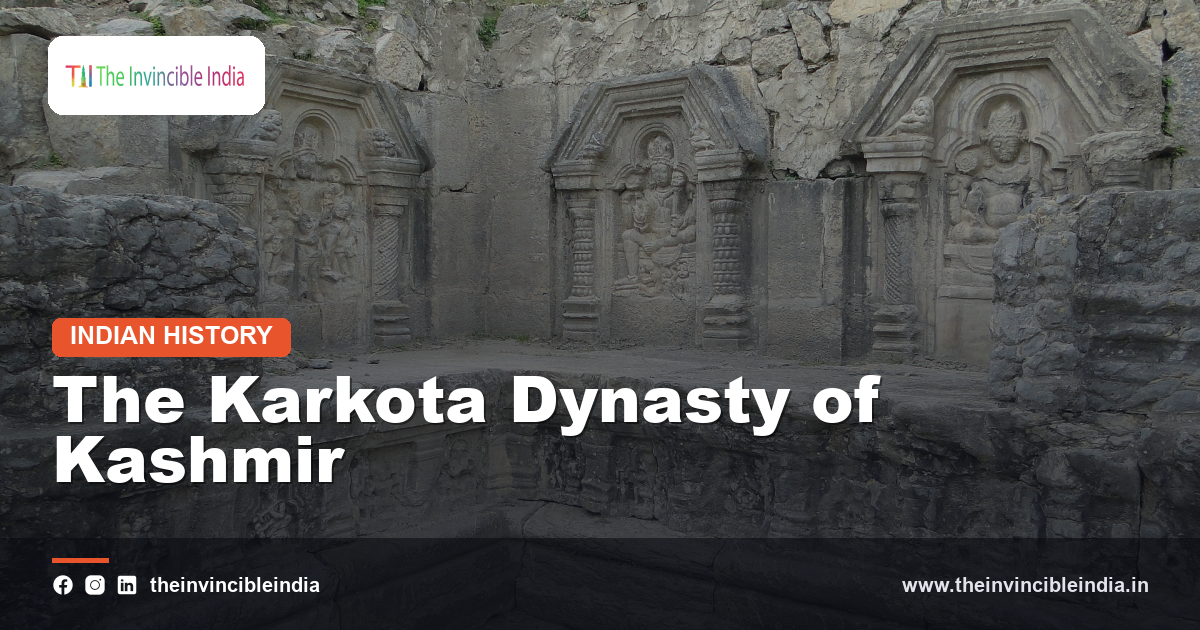
The Karkota dynasty, also written as the Karkotas or the Naga dynasty of Kashmir in some accounts, was a line of rulers who dominated the Kashmir Valley and surrounding regions during the early medieval period, generally dated to roughly the seventh to ninth centuries. Founded by Durlabhavardhana, the dynasty is best remembered for its greatest ruler, Lalitaditya Muktapida, a famed conqueror of the eighth century who is traditionally credited with far-reaching campaigns and with building the celebrated Martand Sun Temple. Much of what is known of the Karkotas comes from Kalhana’s twelfth-century Sanskrit chronicle, the Rajatarangini, a rare narrative history of Kashmir. Their rule marks an important chapter in the history of the northern subcontinent, in the same broad era as the Rajput kingdoms described in our guide to the Rajputs. Because several dates and details rest on later tradition, this account keeps to general terms where the record is uncertain.
Quick answer: The Karkota dynasty was a line of rulers who dominated the Kashmir Valley and adjoining regions during the early medieval period, generally dated to roughly the seventh to ninth centuries. Founded by Durlabhavardhana, it is best remembered for Lalitaditya Muktapida, a famed eighth-century conqueror traditionally credited with wide campaigns and with building the Martand Sun Temple near present-day Anantnag. Much of what is known of the dynasty comes from Kalhana’s Sanskrit chronicle, the Rajatarangini, and several details rest on later tradition.
Key Takeaways
- The Karkotas were an early-medieval dynasty of Kashmir, generally dated to roughly the seventh to ninth centuries.
- The dynasty was founded by Durlabhavardhana, who established Karkota rule in the Kashmir Valley.
- Lalitaditya Muktapida, an eighth-century ruler, is the dynasty’s most celebrated figure and a famed conqueror.
- Lalitaditya is traditionally credited with building the Martand Sun Temple, whose ruins stand near Anantnag.
- Most of what is known of the Karkotas comes from Kalhana’s twelfth-century chronicle, the Rajatarangini.
- The Karkotas were patrons of temple building and of both Hindu and Buddhist traditions in Kashmir.
Read on for the history, culture, and legacy in detail.
Quick Facts
| Detail | Information |
|---|---|
| Dynasty | Karkota dynasty (Karkotas of Kashmir) |
| Period | Roughly seventh to ninth centuries, dates debated |
| Region | Kashmir Valley and adjoining regions of the north |
| Capital | Associated with Parihasapura and early Kashmiri centres |
| Founder | Durlabhavardhana |
| Notable Ruler | Lalitaditya Muktapida, a famed conqueror |
| Patronage | Temple building; Hindu and Buddhist traditions |
| Chief Source | Kalhana’s Rajatarangini (twelfth century) |
| Succeeded By | The Utpala dynasty of Kashmir |
Who Were the Karkotas?
The Karkotas were an early-medieval dynasty that rose to dominate the Kashmir Valley and surrounding regions, generally dated to roughly the seventh to ninth centuries. They established one of the most powerful kingdoms in the early history of Kashmir, remembered for its military strength, its ambitious rulers and its patronage of temple building. The dynasty is sometimes linked in tradition with the Nagas, serpent deities important in Kashmiri lore, though such associations belong to legend rather than firm history. The Karkotas presided over a period in which Kashmir was a wealthy and culturally vibrant land, connected by trade and pilgrimage to the wider subcontinent and to regions beyond the mountains. Their kings bore proud titles and pursued expansive ambitions, above all under their greatest ruler. As the dynasty that gave Kashmir one of its most celebrated conquerors, the Karkotas occupy a prominent place in the early history of the northern subcontinent.
Where Did the Karkota Dynasty Rule?
The Karkota dynasty ruled from the Kashmir Valley, a fertile and secluded land of mountains, lakes and rivers in the far north of the subcontinent, and extended its influence over surrounding regions. The valley, watered by the river known as the Vitasta, or Jhelum, was a prosperous and well-defined realm, protected by its encircling mountains and rich in agriculture and culture. From this heartland the Karkotas, especially under Lalitaditya Muktapida, are said in tradition to have campaigned widely across the plains and hills beyond Kashmir. The valley’s position on routes linking the subcontinent with Central Asia gave it strategic and commercial importance. Its natural defences and wealth made it a strong base for an ambitious dynasty. The Karkotas built their capitals and monuments within this valley, which remained the core of their power. The Kashmir Valley was thus both the homeland and the stronghold of Karkota rule.
Who Founded the Karkota Dynasty?
The Karkota dynasty was founded by Durlabhavardhana, remembered as the ruler who established the line in the Kashmir Valley and inaugurated the dynasty’s rise. According to the traditions preserved in the Rajatarangini, he came to power and secured the throne of Kashmir, laying the foundation for the strong kingdom that his successors would expand. The precise circumstances of his accession are drawn from Kalhana’s chronicle and later tradition and are treated cautiously by historians. What is clear in the account is that Durlabhavardhana marks the beginning of Karkota rule and the start of a powerful new era in Kashmir’s history. From his foundation the dynasty grew into one of the most formidable powers of the early-medieval north. Durlabhavardhana therefore holds the honoured place of founder in the memory of the Karkotas. The kingdom he established would reach its height under his celebrated descendant Lalitaditya Muktapida.
Who Was Lalitaditya Muktapida?
Lalitaditya Muktapida was the greatest ruler of the Karkota dynasty and one of the most celebrated kings in the history of Kashmir, remembered as a famed conqueror of the eighth century. According to the Rajatarangini, he led wide-ranging campaigns and extended the fame and influence of Kashmir far beyond its mountain valley, becoming a figure of legendary military prowess. He is also remembered as a great builder and patron, traditionally credited with founding the city of Parihasapura and with raising the celebrated Martand Sun Temple. His reign is regarded as the high point of Karkota power and of early-medieval Kashmir. Because much of his story comes from a chronicle written centuries later, historians treat the more extraordinary claims about his conquests as a blend of history and tradition. Lalitaditya nonetheless stands as the towering figure of the dynasty, embodying the ambition and achievement of the Karkota age.
What Were Lalitaditya's Conquests?
Lalitaditya’s conquests, as related in the Rajatarangini, are portrayed as sweeping campaigns that carried the arms of Kashmir across much of the northern subcontinent and into regions beyond. Tradition credits him with victories over many rulers and with extending his influence over wide territories, making him one of the most renowned warrior-kings in the memory of Kashmir. These accounts, preserved in Kalhana’s chronicle written long after the events, mingle historical achievement with legendary elaboration, and historians therefore describe the scale of his conquests in cautious and general terms. What the tradition conveys clearly is the reputation of Lalitaditya as a conqueror of extraordinary ambition and energy. His campaigns are said to have brought wealth and prestige to Kashmir, supporting his great building projects. Whatever their precise extent, these conquests secured his legendary status. The memory of Lalitaditya as a far-ranging conqueror remains central to the fame of the Karkota dynasty.
What Is the Martand Sun Temple?
The Martand Sun Temple, whose ruins stand on a plateau near present-day Anantnag in Kashmir, is the most famous monument associated with the Karkota dynasty and is traditionally credited to Lalitaditya Muktapida. Dedicated to the sun god, Surya, known here as Martand, the temple was a grand stone structure set in a commanding position with sweeping views over the valley. Even in ruin it is admired for its impressive scale, its distinctive Kashmiri architectural style, and its colonnaded courtyard, which reflect the wealth and artistic ambition of the Karkota age. The temple stands as a powerful symbol of the devotional and architectural achievements of the dynasty. Its weathered remains remain among the most evocative ancient monuments of Kashmir. The attribution to Lalitaditya rests on tradition and the Rajatarangini, and the precise history of the site is studied with scholarly care. The Martand temple endures as the enduring emblem of Karkota grandeur.
What Was Parihasapura?
Parihasapura was a city traditionally associated with Lalitaditya Muktapida, remembered as a capital or royal centre founded or adorned by the great Karkota ruler. According to tradition and the surviving remains, the site was embellished with temples, shrines and monuments reflecting the wealth and devotion of the dynasty at its height. The ruins associated with Parihasapura include the remains of substantial structures that attest to the scale of royal building in the Karkota age. The city is remembered as a symbol of Lalitaditya’s ambition and of the flourishing of Kashmir under his rule. As with other sites of the period, the precise history of Parihasapura is reconstructed from tradition and archaeological evidence and is treated with caution. The founding of such a centre reflects the practice of early-medieval rulers who expressed their power through grand new cities and monuments. Parihasapura thus stands alongside the Martand temple as a monument to Karkota achievement.
How Did the Karkotas Patronise Religion?
The Karkotas were active patrons of religion, supporting both Hindu and Buddhist traditions that flourished together in early-medieval Kashmir. The dynasty is associated with the building of temples and shrines, above all the great Sun Temple at Martand, reflecting devotion to Hindu deities such as Surya and Vishnu. At the same time, Kashmir in this period was an important centre of Buddhist learning and art, and the rulers are remembered for supporting Buddhist establishments as well. This dual patronage reflects the religious vitality and tolerance of Kashmir in the Karkota age, when different traditions coexisted and received royal support. The temples and monuments of the period express this devotional energy in stone. Religious patronage reinforced the legitimacy and prestige of the dynasty and tied its rule to the sacred landscape of the valley. Through such support the Karkotas left a lasting mark on the religious and artistic heritage of Kashmir.
What Was Karkota Art and Architecture Like?
Karkota art and architecture belonged to the distinctive tradition of early-medieval Kashmir, renowned for its massive stone temples, finely carved images and a style shaped by the region’s own character and its contacts with wider worlds. The great temples of the age, above all the Sun Temple at Martand, display a monumental stone architecture with colonnaded courtyards, trefoil arches and bold forms that mark a distinctive Kashmiri style. The sculpture of the period, including images of deities in stone and metal, is admired for its refinement and its blend of influences. This art reflects the prosperity of Kashmir and the patronage of its rulers, as well as the valley’s position at a crossroads of cultural exchange. Much of this heritage survives in ruins and in images preserved in collections. The architectural achievements of the Karkota age form one of the glories of Kashmiri art. They stand as enduring evidence of the dynasty’s wealth and devotion.
What Is the Rajatarangini?
The Rajatarangini, meaning the River of Kings, is a celebrated Sanskrit chronicle of the kings of Kashmir composed by the poet and historian Kalhana in the twelfth century, and it is the principal source for the history of the Karkota dynasty. Remarkable among Indian texts for its sustained narrative of political history, the work traces the rulers of Kashmir across many reigns, preserving traditions, genealogies and stories that would otherwise have been lost. For the Karkotas, and especially for Lalitaditya Muktapida, the Rajatarangini is the main window onto their deeds and character. Because Kalhana wrote long after the Karkota age, drawing on earlier sources and traditions, historians read his account with care, distinguishing firm history from legend and poetic elaboration. The chronicle nonetheless remains an invaluable and rare record. The Rajatarangini is thus inseparable from the study of the Karkotas, shaping almost everything that is known of the dynasty.
How Was the Karkota Kingdom Governed?
The Karkota kingdom was governed from the Kashmir Valley through the authority of the king, supported by ministers, officials and commanders who administered the realm and its armies. At the head stood the Karkota ruler, whose power rested on the wealth of the fertile valley, the strength of its armies and the prestige of the dynasty. The administration oversaw revenue drawn chiefly from the rich agriculture of the valley, as well as the organisation of the military campaigns for which the dynasty, under Lalitaditya, became famous. The valley’s natural defences and prosperity gave the kingdom a strong and stable base. As in other early-medieval states, local chiefs and officers held responsibilities within the structure of government. The resources of the realm supported the dynasty’s extensive building and religious patronage. This system of governance underpinned the achievements of the Karkota age and enabled the ambitious projects for which the dynasty is remembered.
How Did the Karkota Dynasty Decline?
The Karkota dynasty declined in the period after its height under Lalitaditya Muktapida, as later rulers proved unable to sustain the power and unity that the dynasty had achieved. According to the traditions preserved in the Rajatarangini, the dynasty experienced internal troubles, weaker rulers and the familiar strains that beset ruling houses over time. As the central authority of the Karkotas weakened, the way was opened for new powers to rise within Kashmir. The dynasty was eventually succeeded by the Utpala dynasty, which took up the rule of the valley. The precise course of this decline is drawn from Kalhana’s chronicle and is described cautiously by historians. Rather than a single dramatic fall, the decline of the Karkotas appears as a gradual weakening following their age of greatness. Their passing marked the end of one powerful chapter and the beginning of another in the long history of Kashmir.
Who Succeeded the Karkotas?
The Karkotas were succeeded by the Utpala dynasty, which rose to rule the Kashmir Valley after the decline of Karkota power. The transition from one dynasty to the other is related in the Rajatarangini, which traces the continuous succession of Kashmir’s rulers across the changing fortunes of its royal houses. The Utpalas, founded by Avantivarman, inaugurated a new era remembered for notable achievements of their own, including major works of irrigation and the building of temples. The passage from the Karkotas to the Utpalas reflects the ongoing story of Kashmir as recorded in Kalhana’s chronicle. The precise circumstances of the change are drawn from tradition and are treated with scholarly caution. The succession of the Utpalas shows the continuity of Kashmir’s distinctive historical record, in which one dynasty gave way to another. The Karkotas thus form the first of the great early-medieval dynasties chronicled in the Rajatarangini.
Why Are the Karkotas Significant?
The Karkotas are significant as one of the most powerful early-medieval dynasties of Kashmir and as the house that produced Lalitaditya Muktapida, among the most celebrated warrior-kings in the region’s history. Their age is remembered for military ambition, for the building of great temples such as the Sun Temple at Martand, and for the flourishing of art and culture in the valley. The dynasty’s deeds, preserved in the Rajatarangini, give Kashmir one of the richest narrative records of any region in early India. The Karkotas illustrate the wealth, strength and cultural vitality of early-medieval Kashmir and its connections with the wider subcontinent. Their monuments, even in ruin, remain among the most striking ancient heritage of the valley. For students of Indian history, the Karkotas offer a vivid picture of a northern mountain kingdom at its height. Their significance rests on this blend of conquest, architecture and cultural achievement.
The Karkota Dynasty Today
The Karkota dynasty is remembered today chiefly through the ruins of its great monuments, above all the Sun Temple at Martand near Anantnag, and through the vivid narrative of the Rajatarangini. The weathered remains of Martand and the sites associated with Parihasapura draw visitors, historians and admirers of ancient architecture, standing as enduring symbols of the dynasty’s grandeur. The memory of Lalitaditya Muktapida as a legendary conqueror remains a cherished part of the historical imagination of Kashmir. Scholars continue to study the Rajatarangini and the archaeological remains to refine the understanding of the Karkota age. For readers of Indian history, the Karkotas offer a striking example of a powerful early-medieval kingdom of the far north and its celebrated rulers. Their legacy endures in the stone temples of the valley, in the pages of Kalhana’s chronicle, and in the proud historical memory of Kashmir.
Sources & Further Reading
- Archaeological Survey of India (asi.nic.in).
- Ministry of Culture, Government of India (indiaculture.gov.in).
- Department of Tourism, Government of Jammu and Kashmir (jktourism.jk.gov.in).
Frequently Asked Questions
Who were the Karkotas of Kashmir?
The Karkotas were an early-medieval dynasty that dominated the Kashmir Valley and adjoining regions, generally dated to roughly the seventh to ninth centuries. They are best remembered for the conqueror Lalitaditya Muktapida and for their patronage of great temples such as the Sun Temple at Martand.
Who founded the Karkota dynasty?
The Karkota dynasty was founded by Durlabhavardhana, who established the line in the Kashmir Valley according to the Rajatarangini. From this foundation the dynasty grew into one of the most powerful kingdoms of the early-medieval north.
Who was Lalitaditya Muktapida?
Lalitaditya Muktapida was the greatest Karkota ruler, a famed eighth-century conqueror celebrated in the Rajatarangini for wide-ranging campaigns. He is also traditionally credited with building the Martand Sun Temple and founding the city of Parihasapura.
What is the Martand Sun Temple?
The Martand Sun Temple is a ruined early-medieval stone temple near Anantnag in Kashmir, dedicated to the sun god and traditionally credited to Lalitaditya Muktapida. Even in ruin it is admired for its scale and its distinctive Kashmiri architectural style.
How do we know about the Karkotas?
Most of what is known of the Karkotas comes from Kalhana’s twelfth-century Sanskrit chronicle, the Rajatarangini, which narrates the kings of Kashmir. Because it was written long after the Karkota age, historians read its more legendary claims with caution.
Who succeeded the Karkota dynasty?
The Karkotas were succeeded by the Utpala dynasty, founded by Avantivarman, which rose to rule the Kashmir Valley after the decline of Karkota power. The transition is recorded in the continuous narrative of the Rajatarangini.


